Animal field guide
Melipona Stingless Bee
Melipona
Stout, honeybee-sized social bees of tropical forest and savanna, with a sting reduced to a useless vestige. Workers carry sticky plant resin home on their hind legs and blend it with wax to build brood comb and storage pots, and with mud to make the hard plates that wall off the nest cavity inside a hollow trunk.
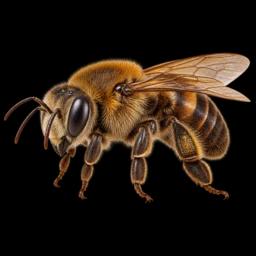
Melipona Stingless Bee at a glance
Invertebrate · North America · Tropical and subtropical forest and · Relatively common
Known for: Stout, Mud-and-resin nest entrance, A single guard bee filling the entrance hole, Pollen carried in baskets on the hind legs
Its Power
Resin Gate
Guard one narrow resin-and-mud entrance.
A single well-built, well-watched entrance defends a whole community better than many weak walls.
“One gate, well guarded.”
Capture a Melipona Stingless Bee, and it's yours when you finish one step it gives you.
Biological basis
Melipona colonies nest in tree cavities, sealing the space with batumen plates of mud and resin and building a narrow entrance often guarded by a single worker. Lacking a functional sting, workers defend by blocking the entrance and biting.
Put it into practice
A building committee closes the side doors and staffs the front entrance with one receptionist, and unwelcome visitors stop wandering in.
What does the melipona stingless bee symbolize?
The melipona stingless bee symbolizes resin gate: guard one narrow resin-and-mud entrance. It represents boundaries, protective strength and discernment. Its AnimalDex motto: "One gate, well guarded."
The melipona stingless bee as a spirit animal
If the melipona stingless bee is your spirit animal, the AnimalDex reading is Resin Gate: a single well-built, well-watched entrance defends a whole community better than many weak walls. It suggests a strength in boundaries and protective strength, and a reminder to use it on purpose.
What can the melipona stingless bee help you with in life?
The melipona stingless bee is a guide for boundaries, protective strength and discernment. Its lesson applies wherever boundaries matters: a single well-built, well-watched entrance defends a whole community better than many weak walls.
- Boundaries
- Protective Strength
- Discernment
In practice: A building committee closes the side doors and staffs the front entrance with one receptionist, and unwelcome visitors stop wandering in.
What can we learn from the Melipona Stingless Bee?What does it mean to dream about or encounter a wild melipona stingless bee?
Meeting a wild melipona stingless bee, asleep or awake, is often a nudge toward boundaries, the quality the melipona stingless bee is built around. In AnimalDex, the melipona stingless bee's principle is Resin Gate: guard one narrow resin-and-mud entrance. Read the moment through its core lesson: A single well-built, well-watched entrance defends a whole community better than many weak walls.
Neither good nor bad on its own. How the melipona stingless bee acts matters: at ease, it reflects boundaries; hostile, it flags boundaries out of balance.
Spotting a melipona stingless bee in the wild
If a melipona stingless bee crosses your path, take it as a cue to look at where boundaries fits your day. Its AnimalDex motto: "One gate, well guarded."
A melipona stingless bee that keeps appearing
Repeated sightings of a melipona stingless bee usually mean the Resin Gate lesson is still open: a single well-built, well-watched entrance defends a whole community better than many weak walls.
Dreaming of being chased by a melipona stingless bee
Being chased suggests you are avoiding the Resin Gate the melipona stingless bee stands for: a single well-built, well-watched entrance defends a whole community better than many weak walls. Ask what you keep postponing that needs boundaries.
Dreaming that a melipona stingless bee attacks you
An attack points to boundaries turned against you: someone using it on you, or your own boundaries overused until it costs you.
A calm or friendly melipona stingless bee
A calm melipona stingless bee suggests you have made peace with boundaries and can use it without force.
A dead or injured melipona stingless bee
Seeing the melipona stingless bee hurt may point to protective strength that has been neglected. Ask what it would take to restore it.
These readings are reflective prompts drawn from how the melipona stingless bee really lives, not predictions. If you meet one in the wild, watch from a distance and leave it undisturbed.
Capture your own Melipona Stingless Bee
Photograph or film one in the wild, at a zoo or at home with the app. It becomes yours: it remembers you, gives you steps, and can debate your problems with your other animals.
Animal field guide
Melipona Stingless Bee
Sign in to hear this read by a natural AI voice instead of your browser's.
Stout, honeybee-sized social bees of tropical forest and savanna, with a sting reduced to a useless vestige. Workers carry sticky plant resin home on their hind legs and blend it with wax to build brood comb and storage pots, and with mud to make the hard plates that wall off the nest cavity inside a hollow trunk.
Native range
Natural range, not this capture location
Tropical and subtropical forest and savanna, including the Amazonian rainforest, Atlantic Forest, cerrado and dry caatinga of South America. Colonies nest mainly in hollow trunks and large branches of living trees, so they depend on big, old timber; a few species nest underground.
Search near meAnimalDex stats
Dominance
30
Speed
30
Size
25
Intelligence
30
Rarity
20%
Total
135
Size scale
Understand the animal
Understand the Melipona Stingless Bee
Factual biology first: what this animal is like, where it lives, how it survives, and why those traits exist.
01
Introduction to Melipona Stingless Bee
Stout, honeybee-sized social bees of tropical forest and savanna, with a sting reduced to a useless vestige. Workers carry sticky plant resin home on their hind legs and blend it with wax to build brood comb and storage pots, and with mud to make the hard plates that wall off the nest cavity inside a hollow trunk.
How to identify a Melipona Stingless Bee
- Stout, honeybee-sized body, about 8 to 15 mm long
- Mud-and-resin nest entrance, often with radiating ridges
- A single guard bee filling the entrance hole
- Pollen carried in baskets on the hind legs
- Does not sting; defends the nest by biting
Why Melipona Stingless Bee are interesting
- The genus holds roughly 70 described species and includes some of the largest of all stingless bees.
- Honey is stored in clusters of egg-shaped pots made of wax mixed with resin, and is thinner and more acidic than honeybee honey.
- Whether a female larva becomes a queen is thought to depend partly on her genes, and up to a quarter of females may emerge as queens.
- A new colony is founded gradually: workers prepare and stock the new cavity over days or weeks before a young queen moves in.
- Brazilian beekeepers keep species such as the mandaçaia, Melipona quadrifasciata, and the uruçu, Melipona scutellaris, in box hives for honey and crop pollination.
02
Adaptations and biological abilities
03
Why does Melipona Stingless Bee behave this way?
- Stout, honeybee-sized body, about 8 to 15 mm long
- Mud-and-resin nest entrance, often with radiating ridges
- A single guard bee filling the entrance hole
- Pollen carried in baskets on the hind legs
- Does not sting; defends the nest by biting
Foragers fly by day, starting at or soon after dawn and often busiest in the cooler, more humid morning hours. The whole colony stays inside the nest at night, and flights fall away during heavy rain and cold spells.
04
Why Tropical and subtropical forest and savanna?
Habitat: Tropical and subtropical forest and savanna, including the Amazonian rainforest, Atlantic Forest, cerrado and dry caatinga of South America. Colonies nest mainly in hollow trunks and large branches of living trees, so they depend on big, old timber; a few species nest underground.
Native range: North America, South America
Native range
Natural range, not this specific capture location.
Tropical and subtropical forest and savanna, including the Amazonian rainforest, Atlantic Forest, cerrado and dry caatinga of South America. Colonies nest mainly in hollow trunks and large branches of living trees, so they depend on big, old timber; a few species nest underground.
05
Why this diet?
Workers collect nectar and pollen from forest trees, shrubs and crops, and can shake pollen out of flowers such as tomato and aubergine by vibrating their flight muscles. Larvae are fed once: each brood cell is filled with a pollen and nectar mix, given an egg and sealed.
06
Activity, rest, and lifespan
Foragers fly by day, starting at or soon after dawn and often busiest in the cooler, more humid morning hours. The whole colony stays inside the nest at night, and flights fall away during heavy rain and cold spells.
Workers live roughly one to two months as adults. Queens live far longer, commonly one to three years and sometimes more, and a colony can persist for many years as queens are replaced.
07
Melipona Stingless Bee reproduction
The queen lays a single egg on the liquid food in each cell of a horizontal brood comb, and workers seal the cell at once. Growth to adult takes about five to seven weeks. Queens are reared in cells the same size as workers', and surplus young queens are killed.
Workers are females with pollen baskets on the hind legs. Males are similar in size but lack the baskets, have one more antennal segment and often a paler face. The laying queen has an abdomen so swollen with eggs that she cannot fly.
08
Predators, threats, and defense
09
Conservation and rarity
Rarity: Relatively common · 20/100. AnimalDex canonical rarity score: 20/100, maintained by the live indexed species profile.
- Observe from a respectful distance and avoid changing the animal's behavior.
- Do not block feeding, shelter, nesting, or travel routes.
- Use a live camera capture without handling or staging wildlife.
Talk to it
Talk to the Melipona Stingless Bee
It answers as itself: ask about how it lives, or bring it something of yours and hear what it would do, from its own Power.
Anonymous: 3/day. Signed-in: 10/day. Pro: 100/day.
Side by side
The Melipona Stingless Bee, side by side
Nothing written side by side for the Melipona Stingless Bee yet. Pick any animal to compare it with. Compare with any animal →
Where to find them
Where to find Melipona Stingless Bee
To find Melipona Stingless Bee in the wild, focus on the exact habitat patches that match its body design and daily behavior, not just the broad country where it exists. You usually do better by working one good piece of habitat inside north America, South America than by covering too much ground.
- Forest edge, canopy gaps, fruiting trees, or shaded trails where cover and food meet
- Burrow systems, sandy banks, fallen logs, or ground with clear den entrances
- Sunlit logs, exposed branches, warm rocks, or regular perch sites used for scanning
Where explorers saw it
- Malheiros, Rio Grande do Sul, BrasilSep · 1 sighting
Scientific name
Melipona
Category
Invertebrate
Habitat
Tropical and subtropical forest and savanna, including the Amazonian rainforest, Atlantic Forest, cerrado and dry caatinga of South America. Colonies nest mainly in hollow trunks and large branches of living trees, so they depend on big, old timber; a few species nest underground.
Rarity
Relatively common · 20/100
Native range
North America, South America
Take the encyclopedia outside
AnimalDex helps you scan real animals, identify species, collect cards, and learn from nature wherever you are.