
Animal field guide
Mexican Paper Wasp
Polistes instabilis
A slender paper wasp of Mexico and Central America. Nests can be founded by several females together, and one of them becomes the main egg-layer while the others forage, build and guard.
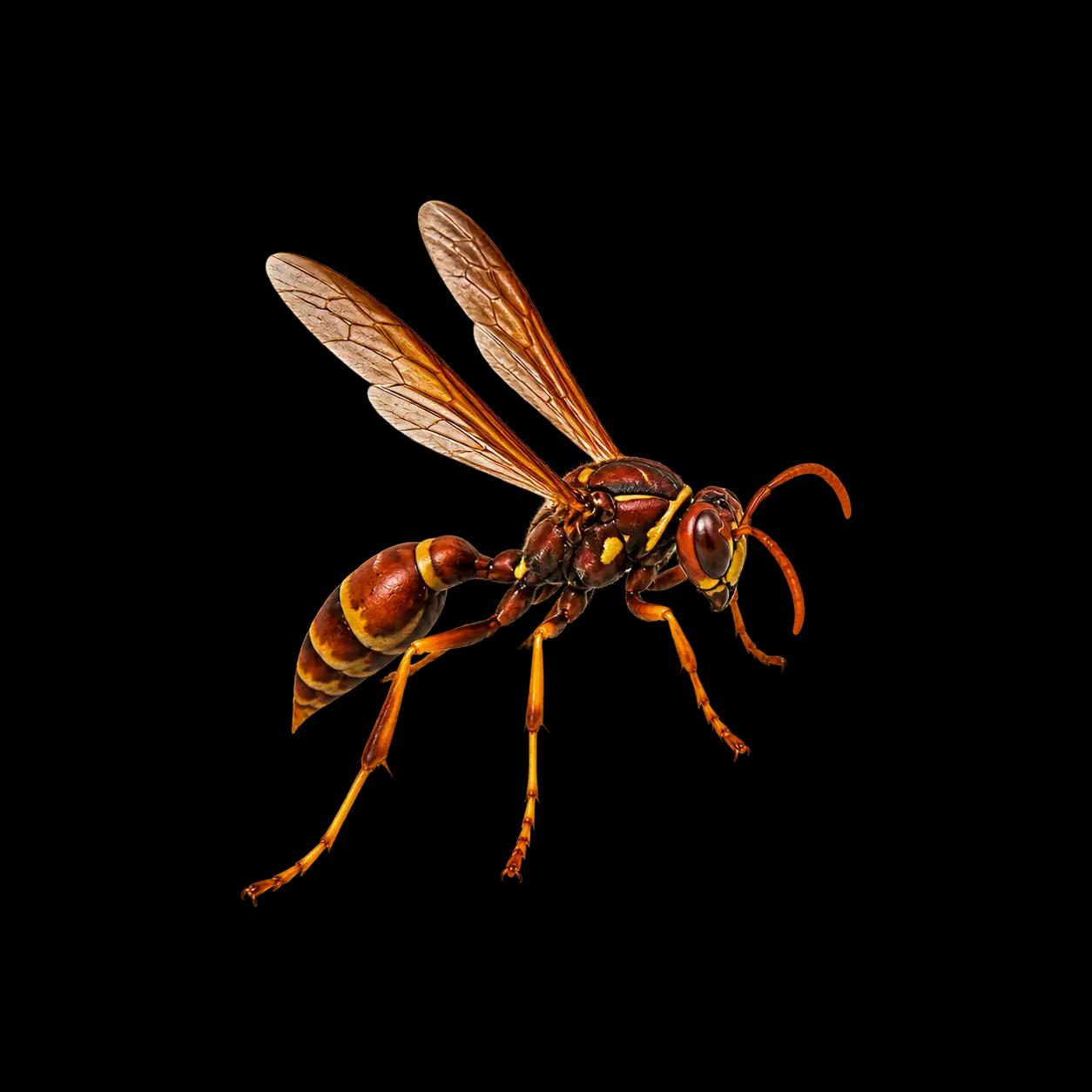
Mexican Paper Wasp at a glance
Invertebrate · North America · Tropical dry forest and scrub · Relatively common
Known for: Slender waist and long hind legs trailing in flight, Wings folded lengthwise along the body at rest, Spindle-shaped abdomen tapering at both ends, Single uncovered paper comb with visible hexagonal
Its Power
Colony Teamwork
Collaborate efficiently to achieve common goals.
Mexican Paper Wasps exemplify the power of collective effort, as they work together to build nests and protect their colony, demonstrating how teamwork can lead to success.
“Cluster through the dry season.”
Capture a Mexican Paper Wasp, and it's yours when you finish one step it gives you.
Biological basis
Mexican Paper Wasps are social insects that live in colonies, where they collaborate to construct nests and care for their young.
Put it into practice
Neighbours raise a community shed in one weekend because each brings a tool and takes a task.
What does the Mexican paper wasp symbolize?
The Mexican paper wasp symbolizes colony teamwork: collaborate efficiently to achieve common goals. It represents teamwork, community and protective strength. Its AnimalDex motto: "Cluster through the dry season."
The Mexican paper wasp as a spirit animal
If the Mexican paper wasp is your spirit animal, the AnimalDex reading is Colony Teamwork: mexican Paper Wasps exemplify the power of collective effort, as they work together to build nests and protect their colony, demonstrating how teamwork can lead to success. It suggests a strength in teamwork and community, and a reminder to use it on purpose.
What can the Mexican paper wasp help you with in life?
The Mexican paper wasp is a guide for teamwork, community and protective strength. Its lesson applies wherever teamwork matters: mexican Paper Wasps exemplify the power of collective effort, as they work together to build nests and protect their colony, demonstrating how teamwork can lead to success.
- Teamwork
- Community
- Protective Strength
In practice: Neighbours raise a community shed in one weekend because each brings a tool and takes a task.
What can we learn from the Mexican Paper Wasp?What does it mean to dream about or encounter a wild Mexican paper wasp?
A wild Mexican paper wasp, whether in a dream or in front of you, tends to show up when teamwork or community is on your mind. In AnimalDex, the Mexican paper wasp's principle is Colony Teamwork: collaborate efficiently to achieve common goals. Read the moment through its core lesson: Mexican Paper Wasps exemplify the power of collective effort, as they work together to build nests and protect their colony, demonstrating how teamwork can lead to success.
Neither good nor bad on its own. How the Mexican paper wasp acts matters: at ease, it reflects teamwork; hostile, it flags teamwork out of balance.
Spotting a Mexican paper wasp in the wild
If a Mexican paper wasp crosses your path, take it as a cue to look at where teamwork fits your day. Its AnimalDex motto: "Cluster through the dry season."
A Mexican paper wasp that keeps appearing
A Mexican paper wasp that keeps turning up points to community you keep circling back to. The repetition is the message.
Dreaming of being chased by a Mexican paper wasp
A chase often means a demand for teamwork is catching up with you. The Mexican paper wasp's lesson, "Mexican Paper Wasps exemplify the power of collective effort, as they work together to build nests and protect their colony, demonstrating how teamwork can lead to success", is the part you may be running from.
Dreaming that a Mexican paper wasp attacks you
An aggressive Mexican paper wasp can mirror a conflict where teamwork has become a weapon rather than a strength.
A calm or friendly Mexican paper wasp
A relaxed Mexican paper wasp near you, in a dream or in person, reads as readiness: Colony Teamwork is available to you now, as its motto puts it, "Cluster through the dry season.".
A dead or injured Mexican paper wasp
Seeing the Mexican paper wasp hurt may point to community that has been neglected. Ask what it would take to restore it.
These readings are reflective prompts drawn from how the Mexican paper wasp really lives, not predictions. If you meet one in the wild, watch from a distance and leave it undisturbed.
Capture your own Mexican Paper Wasp
Photograph or film one in the wild, at a zoo or at home with the app. It becomes yours: it remembers you, gives you steps, and can debate your problems with your other animals.
Animal field guide
Mexican Paper Wasp
Sign in to hear this read by a natural AI voice instead of your browser's.
A slender paper wasp of Mexico and Central America. Nests can be founded by several females together, and one of them becomes the main egg-layer while the others forage, build and guard.
Native range
Natural range, not this capture location
Tropical dry forest and scrub, forest edges, pastures and gardens, mostly in lowlands and foothills. Nests hang beneath leaves, branches, rock overhangs and the eaves of buildings.
Search near meAnimalDex stats
Size scale
Understand the animal
Understand the Mexican Paper Wasp
Factual biology first: what this animal is like, where it lives, how it survives, and why those traits exist.
01
Introduction to Mexican Paper Wasp
A slender paper wasp of Mexico and Central America. Nests can be founded by several females together, and one of them becomes the main egg-layer while the others forage, build and guard.
How to identify a Mexican Paper Wasp
- Slender waist and long hind legs trailing in flight
- Wings folded lengthwise along the body at rest
- Spindle-shaped abdomen tapering at both ends
- Single uncovered paper comb with visible hexagonal cells
Why Mexican Paper Wasp are interesting
- In Costa Rica, wasps of this species have been recorded leaving lowland dry forest in the dry season to cluster at cooler upland sites.
- Like other Polistes, it makes nest paper from fibres scraped off weathered wood and plant stems and mixed with saliva.
- As in other Polistes, the comb hangs from a single narrow stalk, which the wasps are thought to coat with a secretion that deters ants.
- The species name instabilis is Latin for unsteady or changeable.
02
Adaptations and biological abilities
03
Why does Mexican Paper Wasp behave this way?
- Slender waist and long hind legs trailing in flight
- Wings folded lengthwise along the body at rest
- Spindle-shaped abdomen tapering at both ends
- Single uncovered paper comb with visible hexagonal cells
Active in warm daylight hours. At night and in cool weather adults rest motionless on the face of the comb or close beside it.
04
Why Tropical dry forest and scrub?
Habitat: Tropical dry forest and scrub, forest edges, pastures and gardens, mostly in lowlands and foothills. Nests hang beneath leaves, branches, rock overhangs and the eaves of buildings.
Native range: North America
Native range
Natural range, not this specific capture location.
Tropical dry forest and scrub, forest edges, pastures and gardens, mostly in lowlands and foothills. Nests hang beneath leaves, branches, rock overhangs and the eaves of buildings.
05
Why this diet?
Adults drink nectar and other sugary liquids and hunt soft-bodied insects, mainly caterpillars, which they chew into a paste to feed the larvae.
06
Activity, rest, and lifespan
Active in warm daylight hours. At night and in cool weather adults rest motionless on the face of the comb or close beside it.
Lifespan has not been measured for individual wasps of this tropical species.
07
Mexican Paper Wasp reproduction
08
Predators, threats, and defense
Birds and raiding ants take brood from the comb, and parasitoid insects attack developing young. Guards turn to face an intruder with wings raised and will sting when the nest is disturbed.
09
Conservation and rarity
Rarity: Relatively common · 24/100. AnimalDex canonical rarity score: 24/100, maintained by the live indexed species profile.
- Observe from a respectful distance and avoid changing the animal's behavior.
- Do not block feeding, shelter, nesting, or travel routes.
- Use a live camera capture without handling or staging wildlife.
Talk to it
Talk to the Mexican Paper Wasp
It answers as itself: ask about how it lives, or bring it something of yours and hear what it would do, from its own Power.
Anonymous: 6/day. Signed-in: 10/day. Pro: 100/day.
Side by side
The Mexican Paper Wasp, side by side
Nothing written side by side for the Mexican Paper Wasp yet. Pick any animal to compare it with. Compare with any animal →
Where to find them
Where to find Mexican Paper Wasp
To find Mexican Paper Wasp in the wild, focus on the exact habitat patches that match its body design and daily behavior, not just the broad country where it exists. You usually do better by working one good piece of habitat inside north America than by covering too much ground.
- Forest edge, canopy gaps, fruiting trees, or shaded trails where cover and food meet
- Protected habitat blocks within north America
In the Ark
1 Mexican Paper Wasp is aboard right now.
Since November 5: 1 came aboard.
The Ark is a live, shared animal world. Animals come aboard when people capture them, and live there by rules based on their field guides.
Scientific name
Polistes instabilis
Category
Invertebrate
Habitat
Tropical dry forest and scrub, forest edges, pastures and gardens, mostly in lowlands and foothills. Nests hang beneath leaves, branches, rock overhangs and the eaves of buildings.
Rarity
Relatively common · 24/100
Native range
North America
Take the encyclopedia outside
AnimalDex helps you scan real animals, identify species, collect cards, and learn from nature wherever you are.