
Animal field guide
Red-veined Darter
Sympetrum fonscolombii
It travels more like a migrant bird than most dragonflies do. Breeding in warm temporary pools across Africa, the Mediterranean and the Middle East, this red darter moves north in spring and summer and reaches northern Europe in some years.
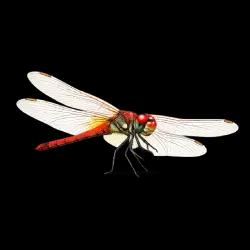
Red-veined Darter at a glance
Animal · Europe · Warm · Relatively common
Known for: Lower half of the eyes blue-grey, Red veins on the forewing leading edge in males, Yellow patch at the base of the hindwings, Pale yellow wing spot edged with black
Its Power
Agile Flight
Adapt quickly to changing circumstances.
The Red-veined Darter can swiftly change direction mid-flight, allowing it to adapt to dynamic environments and evade predators.
“Pivot with precision.”
Capture a Red-veined Darter, and it's yours when you finish one step it gives you.
Biological basis
This dragonfly is known for its agile flight patterns, enabling it to navigate complex airspaces and hunt effectively.
Put it into practice
A wedding planner moves the whole ceremony indoors within ten minutes of the first thunderclap.
What does the red-veined darter symbolize?
The red-veined darter symbolizes agile flight: adapt quickly to changing circumstances. It represents agility, adaptability and speed. Its AnimalDex motto: "Pivot with precision."
The red-veined darter as a spirit animal
If the red-veined darter is your spirit animal, the AnimalDex reading is Agile Flight: the Red-veined Darter can swiftly change direction mid-flight, allowing it to adapt to dynamic environments and evade predators. It suggests a strength in agility and adaptability, and a reminder to use it on purpose.
What can the red-veined darter help you with in life?
The red-veined darter is a guide for agility, adaptability and speed. Its lesson applies wherever agility matters: the Red-veined Darter can swiftly change direction mid-flight, allowing it to adapt to dynamic environments and evade predators.
- Agility
- Adaptability
- Speed
In practice: A wedding planner moves the whole ceremony indoors within ten minutes of the first thunderclap.
What can we learn from the Red-veined Darter?What does it mean to dream about or encounter a wild red-veined darter?
Dreaming about a wild red-veined darter, or coming across one, usually points to agility and adaptability: the qualities the red-veined darter lives by. In AnimalDex, the red-veined darter's principle is Agile Flight: adapt quickly to changing circumstances. Read the moment through its core lesson: The Red-veined Darter can swiftly change direction mid-flight, allowing it to adapt to dynamic environments and evade predators.
Mostly a prompt rather than a warning. A calm red-veined darter suggests agility you already have; a threatening one suggests agility is being tested or pushed too far.
Spotting a red-veined darter in the wild
Coming across a red-veined darter in person asks for attention more than interpretation. Watch it for a minute; the red-veined darter's way of working is Agile Flight, and the lesson is: the Red-veined Darter can swiftly change direction mid-flight, allowing it to adapt to dynamic environments and evade predators.
A red-veined darter that keeps appearing
Repeated sightings of a red-veined darter usually mean the Agile Flight lesson is still open: the Red-veined Darter can swiftly change direction mid-flight, allowing it to adapt to dynamic environments and evade predators.
Dreaming of being chased by a red-veined darter
Being chased suggests you are avoiding the Agile Flight the red-veined darter stands for: the Red-veined Darter can swiftly change direction mid-flight, allowing it to adapt to dynamic environments and evade predators. Ask what you keep postponing that needs agility.
Dreaming that a red-veined darter attacks you
When the red-veined darter attacks, the dream may be about pressure: adaptability or speed applied too hard, by you or by someone close to you.
A calm or friendly red-veined darter
A calm red-veined darter suggests you have made peace with agility and can use it without force.
A dead or injured red-veined darter
Seeing the red-veined darter hurt may point to adaptability that has been neglected. Ask what it would take to restore it.
These readings are reflective prompts drawn from how the red-veined darter really lives, not predictions. If you meet one in the wild, watch from a distance and leave it undisturbed.
Capture your own Red-veined Darter
Photograph or film one in the wild, at a zoo or at home with the app. It becomes yours: it remembers you, gives you steps, and can debate your problems with your other animals.
Animal field guide
Red-veined Darter
Sign in to hear this read by a natural AI voice instead of your browser's.
It travels more like a migrant bird than most dragonflies do. Breeding in warm temporary pools across Africa, the Mediterranean and the Middle East, this red darter moves north in spring and summer and reaches northern Europe in some years.
Native range
Natural range, not this capture location
Warm, shallow, open standing water with sparse vegetation: ponds, flooded pits, lagoons, reservoirs, rice fields and seasonal pools, including brackish sites and desert oases.
Search near meAnimalDex stats
Size scale
Understand the animal
Understand the Red-veined Darter
Factual biology first: what this animal is like, where it lives, how it survives, and why those traits exist.
01
Introduction to Red-veined Darter
It travels more like a migrant bird than most dragonflies do. Breeding in warm temporary pools across Africa, the Mediterranean and the Middle East, this red darter moves north in spring and summer and reaches northern Europe in some years.
How to identify a Red-veined Darter
- Lower half of the eyes blue-grey
- Red veins on the forewing leading edge in males
- Yellow patch at the base of the hindwings
- Pale yellow wing spot edged with black
Why Red-veined Darter are interesting
- Immature males are yellowish and only turn red as they mature.
- In Britain it has occasionally bred after large arrivals, though such colonies have rarely lasted.
- It is often among the first dragonflies to breed in newly dug ponds and flooded pits with little vegetation.
- Its species name honours the French entomologist Boyer de Fonscolombe.
02
Adaptations and biological abilities
03
Why does Red-veined Darter behave this way?
- Lower half of the eyes blue-grey
- Red veins on the forewing leading edge in males
- Yellow patch at the base of the hindwings
- Pale yellow wing spot edged with black
Flies only in sunshine and warmth. At night and in cloudy weather it roosts clinging to grass stems or shrubs, often away from the water.
04
Why Warm?
Habitat: Warm, shallow, open standing water with sparse vegetation: ponds, flooded pits, lagoons, reservoirs, rice fields and seasonal pools, including brackish sites and desert oases.
Native range: Europe, North Africa & Middle East, Sub-Saharan Africa
Native range
Natural range, not this specific capture location.
Warm, shallow, open standing water with sparse vegetation: ponds, flooded pits, lagoons, reservoirs, rice fields and seasonal pools, including brackish sites and desert oases.
05
Why this diet?
Adults catch midges, mosquitoes, small flies and other soft-bodied flying insects in flight. Larvae hunt small aquatic invertebrates on the pond bottom.
06
Activity, rest, and lifespan
Flies only in sunshine and warmth. At night and in cloudy weather it roosts clinging to grass stems or shrubs, often away from the water.
Adults usually live a few weeks; in warm water the whole cycle from egg to adult can take roughly three months.
07
Red-veined Darter reproduction
Pairs fly in tandem, the male holding the female, while she taps her abdomen on open water and releases eggs. Larvae grow quickly in warm pools, allowing more than one generation a year in the south.
Mature males have a bright red abdomen and red wing veins. Females are yellowish-olive to light brown with yellow veins.
08
Predators, threats, and defense
Birds such as hobbies, bee-eaters and wagtails catch adults, and spiders and frogs take them near water. Larvae are eaten by fish and larger insect larvae, and shelter in silt and debris on the bottom.
09
Conservation and rarity
Rarity: Relatively common · 24/100. AnimalDex canonical rarity score: 24/100, maintained by the live indexed species profile.
- Observe from a respectful distance and avoid changing the animal's behavior.
- Do not block feeding, shelter, nesting, or travel routes.
- Use a live camera capture without handling or staging wildlife.
Talk to it
Talk to the Red-veined Darter
It answers as itself: ask about how it lives, or bring it something of yours and hear what it would do, from its own Power.
Anonymous: 6/day. Signed-in: 10/day. Pro: 100/day.
Side by side
The Red-veined Darter, side by side
Nothing written side by side for the Red-veined Darter yet. Pick any animal to compare it with. Compare with any animal →
Where to find them
Where to find Red-veined Darter
To find Red-veined Darter in the wild, focus on the exact habitat patches that match its body design and daily behavior, not just the broad country where it exists. You usually do better by working one good piece of habitat inside europe, North Africa & Middle East, Sub-Saharan Africa than by covering too much ground.
- Quiet marsh edges, reedbeds, river bends, or shallow wetland margins
- Water sources, dune bases, rocky wadis, or shaded scrub at first and last light
- Headlands, reef edges, island colonies, tidal channels, or productive coastal water
Where explorers saw it
- Trappitello, Sicilia, ItalyAug · 1 sighting
In the Ark
1 Red-veined Darter is aboard right now.
Since November 17: 1 died of old age.
The Ark is a live, shared animal world. Animals come aboard when people capture them, and live there by rules based on their field guides.
Scientific name
Sympetrum fonscolombii
Category
Animal
Habitat
Warm, shallow, open standing water with sparse vegetation: ponds, flooded pits, lagoons, reservoirs, rice fields and seasonal pools, including brackish sites and desert oases.
Rarity
Relatively common · 24/100
Native range
Europe, North Africa & Middle East, Sub-Saharan Africa
Take the encyclopedia outside
AnimalDex helps you scan real animals, identify species, collect cards, and learn from nature wherever you are.