Animal field guide
Sunda Scops Owl
Otus lempiji
Town parks, gardens and plantations suit this small eared owl of the Sunda region as well as forest does. Few residents ever see one: it hunts in the dark, and its presence is usually known only from its quiet voice.
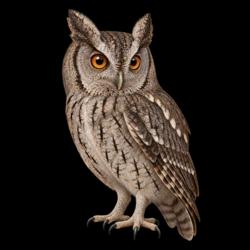
Sunda Scops Owl at a glance
Bird · Southeast Asia · Lowland and hill forest · Uncommon
Known for: Small owl, Pale buff collar across the back of the neck, Dark brown to orange-brown eyes, Brown upperparts finely streaked and vermiculated
Its Power
Nighttime Whisper
Communicate softly and effectively in low-light situations.
The Sunda Scops Owl uses its soft calls and acute hearing to communicate and hunt efficiently in the dark, demonstrating the power of subtlety and precision.
“Whisper in the dark.”
Capture a Sunda Scops Owl, and it's yours when you finish one step it gives you.
Biological basis
The Sunda Scops Owl is known for its soft, low-pitched calls, which it uses to communicate with others and locate prey during the night.
Put it into practice
During a late-night study session, Maria speaks quietly to avoid waking her roommate, yet still conveys her ideas clearly.
What does the sunda scops owl symbolize?
The sunda scops owl symbolizes nighttime whisper: communicate softly and effectively in low-light situations. It represents quiet confidence, clear communication and deep listening. Its AnimalDex motto: "Whisper in the dark."
The sunda scops owl as a spirit animal
If the sunda scops owl is your spirit animal, the AnimalDex reading is Nighttime Whisper: the Sunda Scops Owl uses its soft calls and acute hearing to communicate and hunt efficiently in the dark, demonstrating the power of subtlety and precision. It suggests a strength in quiet confidence and clear communication, and a reminder to use it on purpose.
What can the sunda scops owl help you with in life?
The sunda scops owl is a guide for quiet confidence, clear communication and deep listening. Its lesson applies wherever quiet confidence matters: the Sunda Scops Owl uses its soft calls and acute hearing to communicate and hunt efficiently in the dark, demonstrating the power of subtlety and precision.
- Quiet Confidence
- Clear Communication
- Deep Listening
In practice: During a late-night study session, Maria speaks quietly to avoid waking her roommate, yet still conveys her ideas clearly.
What can we learn from the Sunda Scops Owl?What does it mean to dream about or encounter a wild sunda scops owl?
Dreaming about a wild sunda scops owl, or coming across one, usually points to quiet confidence and clear communication: the qualities the sunda scops owl lives by. In AnimalDex, the sunda scops owl's principle is Nighttime Whisper: communicate softly and effectively in low-light situations. Read the moment through its core lesson: The Sunda Scops Owl uses its soft calls and acute hearing to communicate and hunt efficiently in the dark, demonstrating the power of subtlety and precision.
Mostly a prompt rather than a warning. A calm sunda scops owl suggests quiet confidence you already have; a threatening one suggests quiet confidence is being tested or pushed too far.
Spotting a sunda scops owl in the wild
A real encounter is the plainest version of the sign: notice what the sunda scops owl was doing. Communicate softly and effectively in low-light situations. That is the quiet confidence worth borrowing today.
A sunda scops owl that keeps appearing
A sunda scops owl that keeps turning up points to clear communication you keep circling back to. The repetition is the message.
Dreaming of being chased by a sunda scops owl
Being chased suggests you are avoiding the Nighttime Whisper the sunda scops owl stands for: the Sunda Scops Owl uses its soft calls and acute hearing to communicate and hunt efficiently in the dark, demonstrating the power of subtlety and precision. Ask what you keep postponing that needs quiet confidence.
Dreaming that a sunda scops owl attacks you
An attack points to quiet confidence turned against you: someone using it on you, or your own quiet confidence overused until it costs you.
A calm or friendly sunda scops owl
A relaxed sunda scops owl near you, in a dream or in person, reads as readiness: Nighttime Whisper is available to you now, as its motto puts it, "Whisper in the dark.".
A dead or injured sunda scops owl
A dead or injured sunda scops owl, dreamed or found, can mark quiet confidence you have let lapse, or a phase built on Nighttime Whisper coming to an end.
These readings are reflective prompts drawn from how the sunda scops owl really lives, not predictions. If you meet one in the wild, watch from a distance and leave it undisturbed.
Capture your own Sunda Scops Owl
Photograph or film one in the wild, at a zoo or at home with the app. It becomes yours: it remembers you, gives you steps, and can debate your problems with your other animals.
Animal field guide
Sunda Scops Owl
Sign in to hear this read by a natural AI voice instead of your browser's.
Town parks, gardens and plantations suit this small eared owl of the Sunda region as well as forest does. Few residents ever see one: it hunts in the dark, and its presence is usually known only from its quiet voice.
Native range
Natural range, not this capture location
Lowland and hill forest, forest edges, secondary growth, rubber and oil-palm plantations, orchards, gardens and wooded town parks across the Malay Peninsula, Sumatra, Borneo, Java and Bali, mostly at low to middle elevations.
Search near meAnimalDex stats
Dominance
30
Speed
40
Size
20
Intelligence
36
Rarity
65%
Total
191
Size scale
Understand the animal
Understand the Sunda Scops Owl
Factual biology first: what this animal is like, where it lives, how it survives, and why those traits exist.
01
Introduction to Sunda Scops Owl
Town parks, gardens and plantations suit this small eared owl of the Sunda region as well as forest does. Few residents ever see one: it hunts in the dark, and its presence is usually known only from its quiet voice.
How to identify a Sunda Scops Owl
- Small owl, about 20 cm, with short ear tufts
- Pale buff collar across the back of the neck
- Dark brown to orange-brown eyes, not yellow
- Brown upperparts finely streaked and vermiculated with buff
Why Sunda Scops Owl are interesting
- It was long treated as part of the Collared Scops Owl and is now usually recognised as a species of its own, partly on differences in voice.
- Individuals vary in tone, some looking greyer and others a warmer buff-brown.
- Several island subspecies have been named, although how distinct some of them are is debated.
- The female is reported to give a higher, more quavering call than the male's hoot, and paired birds sometimes answer one another.
02
Adaptations and biological abilities
03
Why does Sunda Scops Owl behave this way?
- Small owl, about 20 cm, with short ear tufts
- Pale buff collar across the back of the neck
- Dark brown to orange-brown eyes, not yellow
- Brown upperparts finely streaked and vermiculated with buff
Nocturnal, calling most at dusk and before dawn. It spends the day roosting alone or in pairs in dense foliage, a creeper-covered trunk or bamboo clump, usually close to the trunk.
04
Why Lowland and hill forest?
Habitat: Lowland and hill forest, forest edges, secondary growth, rubber and oil-palm plantations, orchards, gardens and wooded town parks across the Malay Peninsula, Sumatra, Borneo, Java and Bali, mostly at low to middle elevations.
Native range: Southeast Asia, Java, Sumatra, Borneo
Native range
Natural range, not this specific capture location.
Some regional overlays are unavailable in this web build.
Lowland and hill forest, forest edges, secondary growth, rubber and oil-palm plantations, orchards, gardens and wooded town parks across the Malay Peninsula, Sumatra, Borneo, Java and Bali, mostly at low to middle elevations.
05
Why this diet?
Mostly large insects such as beetles, grasshoppers, crickets and moths, with occasional small vertebrates like lizards and small rodents. It watches from a low perch and drops or sallies out to seize prey with its feet.
06
Activity, rest, and lifespan
Nocturnal, calling most at dusk and before dawn. It spends the day roosting alone or in pairs in dense foliage, a creeper-covered trunk or bamboo clump, usually close to the trunk.
Otus lempiji still lacks a published lifespan estimate; most encounters are by soft nocturnal voice rather than sight.
07
Sunda Scops Owl reproduction
Nests in a natural tree hole or hollow stump, laying a small clutch of white eggs, usually two or three. Incubation and fledging periods have not been well documented, and little is known of how long the young depend on the parents.
Males and females look alike, and the sexes cannot be told apart by plumage in the field.
08
Predators, threats, and defense
09
Conservation and rarity
Rarity: Uncommon · 65/100. AnimalDex canonical rarity score: 65/100, maintained by the live indexed species profile.
- Observe from a respectful distance and avoid changing the animal's behavior.
- Do not block feeding, shelter, nesting, or travel routes.
- Use a live camera capture without handling or staging wildlife.
Talk to it
Talk to the Sunda Scops Owl
It answers as itself: ask about how it lives, or bring it something of yours and hear what it would do, from its own Power.
Anonymous: 3/day. Signed-in: 10/day. Pro: 100/day.
Side by side
The Sunda Scops Owl, side by side
Nothing written side by side for the Sunda Scops Owl yet. Pick any animal to compare it with. Compare with any animal →
Where to find them
Where to find Sunda Scops Owl
To find Sunda Scops Owl in the wild, focus on the exact habitat patches that match its body design and daily behavior, not just the broad country where it exists. You usually do better by working one good piece of habitat inside southeast Asia, Java, Sumatra, Borneo than by covering too much ground.
- Forest edge, canopy gaps, fruiting trees, or shaded trails where cover and food meet
- Sunlit logs, exposed branches, warm rocks, or regular perch sites used for scanning
- Protected habitat blocks within southeast Asia, Java, Sumatra, Borneo
Scientific name
Otus lempiji
Category
Bird
Habitat
Lowland and hill forest, forest edges, secondary growth, rubber and oil-palm plantations, orchards, gardens and wooded town parks across the Malay Peninsula, Sumatra, Borneo, Java and Bali, mostly at low to middle elevations.
Rarity
Uncommon · 65/100
Native range
Southeast Asia, Java, Sumatra, Borneo
Take the encyclopedia outside
AnimalDex helps you scan real animals, identify species, collect cards, and learn from nature wherever you are.