
Animal field guide
Sundas Pit Viper
Trimeresurus insularis
A green pit viper of eastern Java and the Lesser Sunda islands, famous because its colour varies between islands. Most are leaf-green, but yellow animals occur, and on Komodo some individuals are a striking turquoise blue.
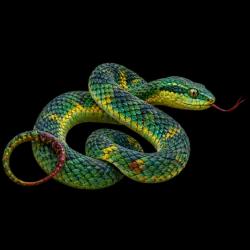
Sundas Pit Viper at a glance
Animal · Southeast Asia · Lowland and hill forest · Uncommon
Known for: Broad triangular head clearly wider than the neck, Vertical, Top of the head covered in many small scales, Plain body colour without bands or blotches
Its Power
Patient Precision
Exercise patience and precision in your actions.
The Sundas Pit Viper demonstrates that precise timing and careful movement are essential for effective hunting and survival in dense environments.
“Strike with precision.”
Capture a Sundas Pit Viper, and it's yours when you finish one step it gives you.
Biological basis
This viper uses its heat-sensing pits to detect prey with remarkable accuracy, striking with precision only when the moment is right.
Put it into practice
A photographer waits all morning with the frame set and presses the shutter once as the bride laughs.
What does the sundas pit viper symbolize?
The sundas pit viper symbolizes patient precision: exercise patience and precision in your actions. It represents precision, patient progress and sensitivity. Its AnimalDex motto: "Strike with precision."
The sundas pit viper as a spirit animal
If the sundas pit viper is your spirit animal, the AnimalDex reading is Patient Precision: the Sundas Pit Viper demonstrates that precise timing and careful movement are essential for effective hunting and survival in dense environments. It suggests a strength in precision and patient progress, and a reminder to use it on purpose.
What can the sundas pit viper help you with in life?
The sundas pit viper is a guide for precision, patient progress and sensitivity. Its lesson applies wherever precision matters: the Sundas Pit Viper demonstrates that precise timing and careful movement are essential for effective hunting and survival in dense environments.
- Precision
- Patient Progress
- Sensitivity
In practice: A photographer waits all morning with the frame set and presses the shutter once as the bride laughs.
What can we learn from the Sundas Pit Viper?What does it mean to dream about or encounter a wild sundas pit viper?
Dreaming about a wild sundas pit viper, or coming across one, usually points to precision and patient progress: the qualities the sundas pit viper lives by. In AnimalDex, the sundas pit viper's principle is Patient Precision: exercise patience and precision in your actions. Read the moment through its core lesson: The Sundas Pit Viper demonstrates that precise timing and careful movement are essential for effective hunting and survival in dense environments.
It depends on how the sundas pit viper behaved. Calm or close by, it reads as patient progress within reach; aggressive or fleeing, it points to precision you are resisting.
Spotting a sundas pit viper in the wild
Coming across a sundas pit viper in person asks for attention more than interpretation. Watch it for a minute; the sundas pit viper's way of working is Patient Precision, and the lesson is: the Sundas Pit Viper demonstrates that precise timing and careful movement are essential for effective hunting and survival in dense environments.
A sundas pit viper that keeps appearing
Repeated sightings of a sundas pit viper usually mean the Patient Precision lesson is still open: the Sundas Pit Viper demonstrates that precise timing and careful movement are essential for effective hunting and survival in dense environments.
Dreaming of being chased by a sundas pit viper
A chase often means a demand for precision is catching up with you. The sundas pit viper's lesson, "The Sundas Pit Viper demonstrates that precise timing and careful movement are essential for effective hunting and survival in dense environments", is the part you may be running from.
Dreaming that a sundas pit viper attacks you
An aggressive sundas pit viper can mirror a conflict where precision has become a weapon rather than a strength.
A calm or friendly sundas pit viper
A relaxed sundas pit viper near you, in a dream or in person, reads as readiness: Patient Precision is available to you now, as its motto puts it, "Strike with precision.".
A dead or injured sundas pit viper
A dead or injured sundas pit viper, dreamed or found, can mark precision you have let lapse, or a phase built on Patient Precision coming to an end.
These readings are reflective prompts drawn from how the sundas pit viper really lives, not predictions. If you meet one in the wild, watch from a distance and leave it undisturbed.
Capture your own Sundas Pit Viper
Photograph or film one in the wild, at a zoo or at home with the app. It becomes yours: it remembers you, gives you steps, and can debate your problems with your other animals.
Animal field guide
Sundas Pit Viper
Sign in to hear this read by a natural AI voice instead of your browser's.
A green pit viper of eastern Java and the Lesser Sunda islands, famous because its colour varies between islands. Most are leaf-green, but yellow animals occur, and on Komodo some individuals are a striking turquoise blue.
Native range
Natural range, not this capture location
Lowland and hill forest, dry monsoon woodland, bamboo thickets, scrub and gardens on the islands from eastern Java to Timor, usually in low vegetation and often near streams.
Search near meAnimalDex stats
Size scale
Understand the animal
Understand the Sundas Pit Viper
Factual biology first: what this animal is like, where it lives, how it survives, and why those traits exist.
01
Introduction to Sundas Pit Viper
A green pit viper of eastern Java and the Lesser Sunda islands, famous because its colour varies between islands. Most are leaf-green, but yellow animals occur, and on Komodo some individuals are a striking turquoise blue.
How to identify a Sundas Pit Viper
- Broad triangular head clearly wider than the neck
- Vertical, cat-like pupils
- Top of the head covered in many small scales
- Plain body colour without bands or blotches
Why Sundas Pit Viper are interesting
- It is also called the white-lipped island pit viper, after the pale scales along its upper jaw.
- Its venom mainly affects blood and tissue, and bites cause severe pain and swelling that need hospital care.
- The fangs fold back against the roof of the mouth when closed and swing forward as the mouth opens to strike.
- Its prehensile tail grips branches, anchoring the snake while the front of the body lunges.
02
Adaptations and biological abilities
03
Why does Sundas Pit Viper behave this way?
04
Why Lowland and hill forest?
Habitat: Lowland and hill forest, dry monsoon woodland, bamboo thickets, scrub and gardens on the islands from eastern Java to Timor, usually in low vegetation and often near streams.
Native range: Southeast Asia
Native range
Natural range, not this specific capture location.
Lowland and hill forest, dry monsoon woodland, bamboo thickets, scrub and gardens on the islands from eastern Java to Timor, usually in low vegetation and often near streams.
05
Why this diet?
06
Activity, rest, and lifespan
Mainly nocturnal. By day it rests coiled on a branch or among foliage, and may stay in the same spot for several days.
How long it lives in the wild is not known, and captive records for the species are sparse.
07
Sundas Pit Viper reproduction
Like its close relatives, it is believed to give birth to live young rather than laying eggs. Litter size and breeding season are poorly documented; the newborn snakes are independent and venomous from birth.
Females are thought to grow larger and heavier than males. In many populations males reportedly have a pale stripe along the lower flank that females lack or show only faintly.
08
Predators, threats, and defense
09
Conservation and rarity
Rarity: Uncommon · 63/100. AnimalDex canonical rarity score: 63/100, maintained by the live indexed species profile.
- Observe from a respectful distance and avoid changing the animal's behavior.
- Do not block feeding, shelter, nesting, or travel routes.
- Use a live camera capture without handling or staging wildlife.
Talk to it
Talk to the Sundas Pit Viper
It answers as itself: ask about how it lives, or bring it something of yours and hear what it would do, from its own Power.
Anonymous: 6/day. Signed-in: 10/day. Pro: 100/day.
Side by side
The Sundas Pit Viper, side by side
Nothing written side by side for the Sundas Pit Viper yet. Pick any animal to compare it with. Compare with any animal →
Where to find them
Where to find Sundas Pit Viper
To find Sundas Pit Viper in the wild, focus on the exact habitat patches that match its body design and daily behavior, not just the broad country where it exists. You usually do better by working one good piece of habitat inside southeast Asia than by covering too much ground.
- Forest edge, canopy gaps, fruiting trees, or shaded trails where cover and food meet
- Headlands, reef edges, island colonies, tidal channels, or productive coastal water
- Sunlit logs, exposed branches, warm rocks, or regular perch sites used for scanning
In the Ark
2 Sundas Pit Vipers are aboard right now.
None have come aboard or left since November 17.
The Ark is a live, shared animal world. Animals come aboard when people capture them, and live there by rules based on their field guides.
Scientific name
Trimeresurus insularis
Category
Animal
Habitat
Lowland and hill forest, dry monsoon woodland, bamboo thickets, scrub and gardens on the islands from eastern Java to Timor, usually in low vegetation and often near streams.
Rarity
Uncommon · 63/100
Native range
Southeast Asia
Take the encyclopedia outside
AnimalDex helps you scan real animals, identify species, collect cards, and learn from nature wherever you are.