
Animal field guide
Triangulate Combfoot
Steatoda triangulosa
A small cobweb spider that lives almost entirely alongside people, in basements, window frames and room corners. Its pale abdomen carries two rows of dark zigzag triangles, and it is an efficient hunter of ants, woodlice and even other spiders.
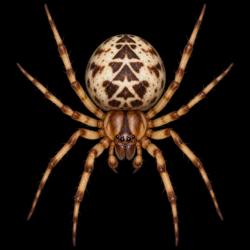
Triangulate Combfoot at a glance
Animal · Europe · Mostly inside buildings · Relatively common
Known for: Body only about 3 to 6 millimetres long, Glossy, Reddish-brown front body, Legs plain orange-brown
Its Power
Strategic Webbing
Design your environment to catch opportunities.
The Triangulate Combfoot spins its web in strategic locations to maximize its chances of catching prey, teaching us to position ourselves where opportunities are most likely to arise.
“Weave for success.”
Capture a Triangulate Combfoot, and it's yours when you finish one step it gives you.
Biological basis
The Triangulate Combfoot spider builds irregular webs in corners and crevices, optimizing its environment to catch unsuspecting insects.
Put it into practice
A portrait painter rents a stall beside the registry office and never runs short of commissions.
What does the triangulate combfoot symbolize?
The triangulate combfoot symbolizes strategic webbing: design your environment to catch opportunities. It represents seizing opportunity, planning and strategy. Its AnimalDex motto: "Weave for success."
The triangulate combfoot as a spirit animal
If the triangulate combfoot is your spirit animal, the AnimalDex reading is Strategic Webbing: the Triangulate Combfoot spins its web in strategic locations to maximize its chances of catching prey, teaching us to position ourselves where opportunities are most likely to arise. It suggests a strength in seizing opportunity and planning, and a reminder to use it on purpose.
What can the triangulate combfoot help you with in life?
The triangulate combfoot is a guide for seizing opportunity, planning and strategy. Its lesson applies wherever seizing opportunity matters: the Triangulate Combfoot spins its web in strategic locations to maximize its chances of catching prey, teaching us to position ourselves where opportunities are most likely to arise.
- Seizing Opportunity
- Planning
- Strategy
In practice: A portrait painter rents a stall beside the registry office and never runs short of commissions.
What can we learn from the Triangulate Combfoot?What does it mean to dream about or encounter a wild triangulate combfoot?
Dreaming about a wild triangulate combfoot, or coming across one, usually points to seizing opportunity and planning: the qualities the triangulate combfoot lives by. In AnimalDex, the triangulate combfoot's principle is Strategic Webbing: design your environment to catch opportunities. Read the moment through its core lesson: The Triangulate Combfoot spins its web in strategic locations to maximize its chances of catching prey, teaching us to position ourselves where opportunities are most likely to arise.
It depends on how the triangulate combfoot behaved. Calm or close by, it reads as planning within reach; aggressive or fleeing, it points to seizing opportunity you are resisting.
Spotting a triangulate combfoot in the wild
A real encounter is the plainest version of the sign: notice what the triangulate combfoot was doing. Design your environment to catch opportunities. That is the seizing opportunity worth borrowing today.
A triangulate combfoot that keeps appearing
A triangulate combfoot that keeps turning up points to planning you keep circling back to. The repetition is the message.
Dreaming of being chased by a triangulate combfoot
If the triangulate combfoot pursues you, look at where planning is being asked of you and you are stepping away instead of meeting it.
Dreaming that a triangulate combfoot attacks you
An attack points to seizing opportunity turned against you: someone using it on you, or your own seizing opportunity overused until it costs you.
A calm or friendly triangulate combfoot
A calm triangulate combfoot suggests you have made peace with seizing opportunity and can use it without force.
A dead or injured triangulate combfoot
An injured triangulate combfoot often reflects seizing opportunity under strain; rest and repair come before pushing again.
These readings are reflective prompts drawn from how the triangulate combfoot really lives, not predictions. If you meet one in the wild, watch from a distance and leave it undisturbed.
Capture your own Triangulate Combfoot
Photograph or film one in the wild, at a zoo or at home with the app. It becomes yours: it remembers you, gives you steps, and can debate your problems with your other animals.
Animal field guide
Triangulate Combfoot
Sign in to hear this read by a natural AI voice instead of your browser's.
A small cobweb spider that lives almost entirely alongside people, in basements, window frames and room corners. Its pale abdomen carries two rows of dark zigzag triangles, and it is an efficient hunter of ants, woodlice and even other spiders.
Native range
Natural range, not this capture location
Mostly inside buildings: cellars, garages, sheds, window frames and quiet corners. In warmer areas it also lives outdoors under stones and bark and in rock crevices.
Search near meAnimalDex stats
Size scale
Understand the animal
Understand the Triangulate Combfoot
Factual biology first: what this animal is like, where it lives, how it survives, and why those traits exist.
01
Introduction to Triangulate Combfoot
A small cobweb spider that lives almost entirely alongside people, in basements, window frames and room corners. Its pale abdomen carries two rows of dark zigzag triangles, and it is an efficient hunter of ants, woodlice and even other spiders.
How to identify a Triangulate Combfoot
- Body only about 3 to 6 millimetres long
- Glossy, rounded abdomen
- Reddish-brown front body
- Legs plain orange-brown
Why Triangulate Combfoot are interesting
- The name combfoot refers to a row of toothed bristles on the last segment of each hind leg, shared by the cobweb spider family.
- Its bite is not considered medically significant to people.
- Females hang several round, papery egg sacs in the web, each containing many eggs.
- Males are smaller and slimmer than females, with swollen tips on their palps.
02
Adaptations and biological abilities
03
Why does Triangulate Combfoot behave this way?
- Body only about 3 to 6 millimetres long
- Glossy, rounded abdomen
- Reddish-brown front body
- Legs plain orange-brown
Mostly active at night, hanging in its web; by day it rests in a corner of the tangle or in a nearby crack.
04
Why Mostly inside buildings?
Habitat: Mostly inside buildings: cellars, garages, sheds, window frames and quiet corners. In warmer areas it also lives outdoors under stones and bark and in rock crevices.
Native range: Europe, North America
Native range
Natural range, not this specific capture location.
Mostly inside buildings: cellars, garages, sheds, window frames and quiet corners. In warmer areas it also lives outdoors under stones and bark and in rock crevices.
05
Why this diet?
Small crawling arthropods caught in its irregular web, including ants, beetles, woodlice, ticks and other spiders. It throws sticky silk over prey with its hind legs before biting.
06
Activity, rest, and lifespan
Mostly active at night, hanging in its web; by day it rests in a corner of the tangle or in a nearby crack.
Often more than a year; females in sheltered buildings may live two years or longer, though lifespan is poorly documented.
07
Triangulate Combfoot reproduction
Females make several small, whitish, papery egg sacs and hang them in the web, guarding them. Spiderlings disperse after hatching.
The male's abdomen is noticeably smaller and narrower than the female's, and his palps end in dark, swollen bulbs. Females are the ones usually seen in webs; males wander in search of them.
08
Predators, threats, and defense
Other house spiders, including cellar spiders, and house centipedes are likely predators. It stays hidden in a retreat at the web's edge and drops away when disturbed.
09
Conservation and rarity
Rarity: Relatively common · 10/100. AnimalDex canonical rarity score: 10/100, maintained by the live indexed species profile.
- Observe from a respectful distance and avoid changing the animal's behavior.
- Do not block feeding, shelter, nesting, or travel routes.
- Use a live camera capture without handling or staging wildlife.
Talk to it
Talk to the Triangulate Combfoot
It answers as itself: ask about how it lives, or bring it something of yours and hear what it would do, from its own Power.
Anonymous: 6/day. Signed-in: 10/day. Pro: 100/day.
Side by side
The Triangulate Combfoot, side by side
Nothing written side by side for the Triangulate Combfoot yet. Pick any animal to compare it with. Compare with any animal →
Where to find them
Where to find Triangulate Combfoot
To find Triangulate Combfoot in the wild, focus on the exact habitat patches that match its body design and daily behavior, not just the broad country where it exists. You usually do better by working one good piece of habitat inside europe, North America than by covering too much ground.
- Mostly inside buildings: cellars, garages, sheds
- Protected habitat blocks within europe, North America
Where explorers saw it
- Niederneuching, Erding, DeutschlandAug · 1 sighting
- Riverside, Washington County, United StatesAug · 1 sighting
Guides to seeing Triangulate Combfoot
In the Ark
8 Triangulate Combfoots are aboard right now.
Since November 17: 1 born.
The Ark is a live, shared animal world. Animals come aboard when people capture them, and live there by rules based on their field guides.
Scientific name
Steatoda triangulosa
Category
Animal
Habitat
Mostly inside buildings: cellars, garages, sheds, window frames and quiet corners. In warmer areas it also lives outdoors under stones and bark and in rock crevices.
Rarity
Relatively common · 10/100
Native range
Europe, North America
Take the encyclopedia outside
AnimalDex helps you scan real animals, identify species, collect cards, and learn from nature wherever you are.