
Animal field guide
Umbrella Cockatoo
Cacatua alba
In alarm or display, the broad, rounded crest of this large white cockatoo lifts from lying flat into a full half-circle of white feathers around the head. About 46 centimetres long, it lives only in the northern Moluccas of Indonesia.
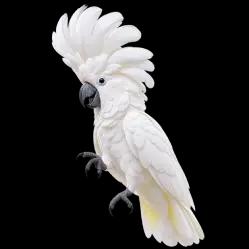
Umbrella Cockatoo at a glance
Animal · Southeast Asia · Lowland and hill rainforest · Relatively common
Known for: Entirely white plumage with a lemon-yellow wash, Heavy black bill and dark grey feet, Bare pale bluish-white ring of skin around each eye, Broad
Its Power
Survival Pattern
Foster strong connections through shared activities.
Umbrella Cockatoos form strong social bonds by engaging in shared activities like grooming and playing, highlighting the importance of active social engagement.
“Connect Through Action.”
Capture a Umbrella Cockatoo, and it's yours when you finish one step it gives you.
Biological basis
Umbrella Cockatoos are known for their strong social nature, often forming close bonds with their flock or human companions through interactive behaviors.
Put it into practice
Two brothers who rarely talk grow close again by rebuilding an old motorbike every Sunday.
What does the umbrella cockatoo symbolize?
The umbrella cockatoo symbolizes survival pattern: foster strong connections through shared activities. It represents social bonds, playfulness and community. Its AnimalDex motto: "Connect Through Action."
The umbrella cockatoo as a spirit animal
If the umbrella cockatoo is your spirit animal, the AnimalDex reading is Survival Pattern: umbrella Cockatoos form strong social bonds by engaging in shared activities like grooming and playing, highlighting the importance of active social engagement. It suggests a strength in social bonds and playfulness, and a reminder to use it on purpose.
What can the umbrella cockatoo help you with in life?
The umbrella cockatoo is a guide for social bonds, playfulness and community. Its lesson applies wherever social bonds matters: umbrella Cockatoos form strong social bonds by engaging in shared activities like grooming and playing, highlighting the importance of active social engagement.
- Social Bonds
- Playfulness
- Community
In practice: Two brothers who rarely talk grow close again by rebuilding an old motorbike every Sunday.
What can we learn from the Umbrella Cockatoo?What does it mean to dream about or encounter a wild umbrella cockatoo?
Meeting a wild umbrella cockatoo, asleep or awake, is often a nudge toward social bonds, the quality the umbrella cockatoo is built around. In AnimalDex, the umbrella cockatoo's principle is Survival Pattern: foster strong connections through shared activities. Read the moment through its core lesson: Umbrella Cockatoos form strong social bonds by engaging in shared activities like grooming and playing, highlighting the importance of active social engagement.
Neither good nor bad on its own. How the umbrella cockatoo acts matters: at ease, it reflects social bonds; hostile, it flags social bonds out of balance.
Spotting an umbrella cockatoo in the wild
Coming across an umbrella cockatoo in person asks for attention more than interpretation. Watch it for a minute; the umbrella cockatoo's way of working is Survival Pattern, and the lesson is: umbrella Cockatoos form strong social bonds by engaging in shared activities like grooming and playing, highlighting the importance of active social engagement.
An umbrella cockatoo that keeps appearing
An umbrella cockatoo that keeps turning up points to playfulness you keep circling back to. The repetition is the message.
Dreaming of being chased by an umbrella cockatoo
Being chased suggests you are avoiding the Survival Pattern the umbrella cockatoo stands for: umbrella Cockatoos form strong social bonds by engaging in shared activities like grooming and playing, highlighting the importance of active social engagement. Ask what you keep postponing that needs social bonds.
Dreaming that an umbrella cockatoo attacks you
An attack points to social bonds turned against you: someone using it on you, or your own social bonds overused until it costs you.
A calm or friendly umbrella cockatoo
A relaxed umbrella cockatoo near you, in a dream or in person, reads as readiness: Survival Pattern is available to you now, as its motto puts it, "Connect Through Action.".
A dead or injured umbrella cockatoo
A dead or injured umbrella cockatoo, dreamed or found, can mark social bonds you have let lapse, or a phase built on Survival Pattern coming to an end.
These readings are reflective prompts drawn from how the umbrella cockatoo really lives, not predictions. If you meet one in the wild, watch from a distance and leave it undisturbed.
Capture your own Umbrella Cockatoo
Photograph or film one in the wild, at a zoo or at home with the app. It becomes yours: it remembers you, gives you steps, and can debate your problems with your other animals.
Animal field guide
Umbrella Cockatoo
Sign in to hear this read by a natural AI voice instead of your browser's.
In alarm or display, the broad, rounded crest of this large white cockatoo lifts from lying flat into a full half-circle of white feathers around the head. About 46 centimetres long, it lives only in the northern Moluccas of Indonesia.
Native range
Natural range, not this capture location
Lowland and hill rainforest, swamp forest, mangroves and forest edges on Halmahera and neighbouring islands such as Bacan, Ternate and Tidore, from sea level to around 900 metres. It also feeds in gardens and plantations close to forest.
Search near meAnimalDex stats
Size scale
Understand the animal
Understand the Umbrella Cockatoo
Factual biology first: what this animal is like, where it lives, how it survives, and why those traits exist.
01
Introduction to Umbrella Cockatoo
In alarm or display, the broad, rounded crest of this large white cockatoo lifts from lying flat into a full half-circle of white feathers around the head. About 46 centimetres long, it lives only in the northern Moluccas of Indonesia.
How to identify a Umbrella Cockatoo
- Entirely white plumage with a lemon-yellow wash under the wings and tail
- Heavy black bill and dark grey feet
- Bare pale bluish-white ring of skin around each eye
- Broad, rounded wings beaten in shallow flaps between glides
- Short, square-ended white tail
Why Umbrella Cockatoo are interesting
- Special powder-down feathers break into a fine white dust that coats the plumage and can leave a chalky mark on the hand.
- Chicks hatch with closed eyes and only a sparse covering of yellowish down.
- It is also widely known by the name white cockatoo.
- Outside the breeding season it may gather in small loose groups at feeding trees.
02
Adaptations and biological abilities
03
Why does Umbrella Cockatoo behave this way?
- Entirely white plumage with a lemon-yellow wash under the wings and tail
- Heavy black bill and dark grey feet
- Bare pale bluish-white ring of skin around each eye
- Broad, rounded wings beaten in shallow flaps between glides
- Short, square-ended white tail
At dusk pairs and small groups fly to tall forest trees to roost, often using favoured trees again. By day they are active, and noisiest early and late.
04
Why Lowland and hill rainforest?
Habitat: Lowland and hill rainforest, swamp forest, mangroves and forest edges on Halmahera and neighbouring islands such as Bacan, Ternate and Tidore, from sea level to around 900 metres. It also feeds in gardens and plantations close to forest.
Native range: Southeast Asia
Native range
Natural range, not this specific capture location.
Lowland and hill rainforest, swamp forest, mangroves and forest edges on Halmahera and neighbouring islands such as Bacan, Ternate and Tidore, from sea level to around 900 metres. It also feeds in gardens and plantations close to forest.
05
Why this diet?
Seeds, nuts, fruits and berries are taken in the canopy, cracked or peeled with the heavy bill and held in one foot. Insects and their larvae are also eaten, and birds raid maize and fruit crops near forest.
06
Activity, rest, and lifespan
At dusk pairs and small groups fly to tall forest trees to roost, often using favoured trees again. By day they are active, and noisiest early and late.
Wild lifespan has not been documented. In captivity many live 40 to 60 years, and a few are reported to have lived longer.
07
Umbrella Cockatoo reproduction
Pairs nest in a hollow high in a large tree. The usual clutch is two white eggs, incubated by both parents for about four weeks, and the chicks stay in the nest for around three months while both adults feed them.
Plumage is identical. Adult males usually have a dark brown to black iris, while females have a reddish-brown one, and males tend to have a slightly larger head and bill.
08
Predators, threats, and defense
Natural predators have been little studied; large birds of prey probably take some adults and nests are exposed to climbing predators. Trapping for the cage-bird trade and forest loss are the serious threats, and the species is listed as Endangered.
09
Conservation and rarity
Rarity: Relatively common · 35/100. AnimalDex canonical rarity score: 35/100, maintained by the live indexed species profile.
- Observe from a respectful distance and avoid changing the animal's behavior.
- Do not block feeding, shelter, nesting, or travel routes.
- Use a live camera capture without handling or staging wildlife.
Talk to it
Talk to the Umbrella Cockatoo
It answers as itself: ask about how it lives, or bring it something of yours and hear what it would do, from its own Power.
Anonymous: 6/day. Signed-in: 10/day. Pro: 100/day.
Side by side
The Umbrella Cockatoo, side by side
Nothing written side by side for the Umbrella Cockatoo yet. Pick any animal to compare it with. Compare with any animal →
Where to find them
Where to find Umbrella Cockatoo
To find Umbrella Cockatoo in the wild, focus on the exact habitat patches that match its body design and daily behavior, not just the broad country where it exists. You usually do better by working one good piece of habitat inside southeast Asia than by covering too much ground.
- Quiet marsh edges, reedbeds, river bends, or shallow wetland margins
- Forest edge, canopy gaps, fruiting trees, or shaded trails where cover and food meet
- Headlands, reef edges, island colonies, tidal channels, or productive coastal water
In the Ark
7 Umbrella Cockatoos are aboard right now.
None have come aboard or left since November 17.
The Ark is a live, shared animal world. Animals come aboard when people capture them, and live there by rules based on their field guides.
Scientific name
Cacatua alba
Category
Animal
Habitat
Lowland and hill rainforest, swamp forest, mangroves and forest edges on Halmahera and neighbouring islands such as Bacan, Ternate and Tidore, from sea level to around 900 metres. It also feeds in gardens and plantations close to forest.
Rarity
Relatively common · 35/100
Native range
Southeast Asia
Take the encyclopedia outside
AnimalDex helps you scan real animals, identify species, collect cards, and learn from nature wherever you are.