
Animal field guide
Variable Hawk
Scientific classification under review
A buzzard-like hawk with one of the most variable plumages of any raptor: birds in the same valley may be white-bellied, slaty grey, finely barred or rufous-chested. Young birds are brown and streaked and take several years to reach adult dress.
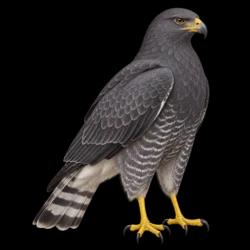
Variable Hawk at a glance
Bird · South America · Open country along the Andes and in · Uncommon
Known for: Plumage extremely variable, Short white tail with a broad black band near the, Adult females usually rufous on the back, Broad wings and a fairly short tail in flight
Its Power
Range Over Specialism
Fit many places rather than perfecting one.
Adapting to many habitats can make a predator resilient and successful.
“Fit anywhere.”
Capture a Variable Hawk, and it's yours when you finish one step it gives you.
Biological basis
The Variable Hawk hunts from Andean puna above four thousand metres down to coastal desert and Patagonian steppe, and its plumage is correspondingly variable — many described morphs, with no single correct appearance across the range.
Put it into practice
A handyman who can plumb, wire, and paint finds work in every town he moves to.
What does the variable hawk symbolize?
The variable hawk symbolizes range over specialism: fit many places rather than perfecting one. It represents versatility, adaptability and resourcefulness. Its AnimalDex motto: "Fit anywhere."
The variable hawk as a spirit animal
If the variable hawk is your spirit animal, the AnimalDex reading is Range Over Specialism: adapting to many habitats can make a predator resilient and successful. It suggests a strength in versatility and adaptability, and a reminder to use it on purpose.
What can the variable hawk help you with in life?
The variable hawk is a guide for versatility, adaptability and resourcefulness. Its lesson applies wherever versatility matters: adapting to many habitats can make a predator resilient and successful.
- Versatility
- Adaptability
- Resourcefulness
In practice: A handyman who can plumb, wire, and paint finds work in every town he moves to.
What can we learn from the Variable Hawk?What does it mean to dream about or encounter a wild variable hawk?
Meeting a wild variable hawk, asleep or awake, is often a nudge toward versatility, the quality the variable hawk is built around. In AnimalDex, the variable hawk's principle is Range Over Specialism: fit many places rather than perfecting one. Read the moment through its core lesson: Adapting to many habitats can make a predator resilient and successful.
Mostly a prompt rather than a warning. A calm variable hawk suggests versatility you already have; a threatening one suggests versatility is being tested or pushed too far.
Spotting a variable hawk in the wild
A real encounter is the plainest version of the sign: notice what the variable hawk was doing. Fit many places rather than perfecting one. That is the versatility worth borrowing today.
A variable hawk that keeps appearing
A variable hawk that keeps turning up points to adaptability you keep circling back to. The repetition is the message.
Dreaming of being chased by a variable hawk
If the variable hawk pursues you, look at where adaptability is being asked of you and you are stepping away instead of meeting it.
Dreaming that a variable hawk attacks you
An attack points to versatility turned against you: someone using it on you, or your own versatility overused until it costs you.
A calm or friendly variable hawk
A calm variable hawk suggests you have made peace with versatility and can use it without force.
A dead or injured variable hawk
An injured variable hawk often reflects versatility under strain; rest and repair come before pushing again.
These readings are reflective prompts drawn from how the variable hawk really lives, not predictions. If you meet one in the wild, watch from a distance and leave it undisturbed.
Capture your own Variable Hawk
Photograph or film one in the wild, at a zoo or at home with the app. It becomes yours: it remembers you, gives you steps, and can debate your problems with your other animals.
Animal field guide
Variable Hawk
Sign in to hear this read by a natural AI voice instead of your browser's.
A buzzard-like hawk with one of the most variable plumages of any raptor: birds in the same valley may be white-bellied, slaty grey, finely barred or rufous-chested. Young birds are brown and streaked and take several years to reach adult dress.
Native range
Natural range, not this capture location
Open country along the Andes and in the south of the continent, from Colombia to Tierra del Fuego and the Falkland Islands: puna and páramo grassland, arid scrub, coastal desert edges, Patagonian steppe and farmland, from sea level to above 4,000 metres.
Search near meAnimalDex stats
Size scale
Understand the animal
Understand the Variable Hawk
Factual biology first: what this animal is like, where it lives, how it survives, and why those traits exist.
01
Introduction to Variable Hawk
A buzzard-like hawk with one of the most variable plumages of any raptor: birds in the same valley may be white-bellied, slaty grey, finely barred or rufous-chested. Young birds are brown and streaked and take several years to reach adult dress.
How to identify a Variable Hawk
- Plumage extremely variable, with pale, dark and rufous forms
- Short white tail with a broad black band near the tip
- Adult females usually rufous on the back; males grey
- Broad wings and a fairly short tail in flight
- Yellow legs and yellow skin at the base of the bill
Why Variable Hawk are interesting
- It was long treated as two species, the Red-backed Hawk of lower ground and the Puna Hawk of the high Andes; many authorities now merge them.
- It builds a stick nest on a cliff ledge, in a tree or on a tall cactus, and usually lays two or three eggs.
- Small mammals, especially rodents, are its main prey, along with birds, lizards and large insects, often caught after hovering on the wind.
- Birds breeding in the far south of Patagonia partly move north in winter, while Andean birds are largely resident.
02
Adaptations and biological abilities
03
Why does Variable Hawk behave this way?
- Plumage extremely variable, with pale, dark and rufous forms
- Short white tail with a broad black band near the tip
- Adult females usually rufous on the back; males grey
- Broad wings and a fairly short tail in flight
- Yellow legs and yellow skin at the base of the bill
Active by day, hunting mostly once the morning air has warmed and the wind has risen. It roosts at night on cliff ledges, in trees or on rocky outcrops, often near the nest.
04
Why Open country along the Andes and in the south of the continent?
Habitat: Open country along the Andes and in the south of the continent, from Colombia to Tierra del Fuego and the Falkland Islands: puna and páramo grassland, arid scrub, coastal desert edges, Patagonian steppe and farmland, from sea level to above 4,000 metres.
Native range: South America
Native range
Natural range, not this specific capture location.
Open country along the Andes and in the south of the continent, from Colombia to Tierra del Fuego and the Falkland Islands: puna and páramo grassland, arid scrub, coastal desert edges, Patagonian steppe and farmland, from sea level to above 4,000 metres.
05
Why this diet?
Mostly rodents such as leaf-eared mice and tuco-tucos, and introduced rabbits in parts of Patagonia; it also takes small birds, lizards, snakes, beetles and grasshoppers, usually seized on the ground after a short stoop.
06
Activity, rest, and lifespan
Active by day, hunting mostly once the morning air has warmed and the wind has risen. It roosts at night on cliff ledges, in trees or on rocky outcrops, often near the nest.
No single lifespan fits this hawk complex; birds from coastal scrub to high Andean puna are often still treated as one variable form.
07
Variable Hawk reproduction
The female does most of the incubating while the male brings food. Nestlings grow up over several weeks and stay near the nest for a period after fledging; exact incubation and fledging times are poorly documented.
Females are larger and heavier than males, as in most hawks. Pale, dark and barred forms occur in both sexes, so size and back colour, not the underparts, separate them.
08
Predators, threats, and defense
Healthy adults have few natural enemies. People are the main threat: some birds are shot or poisoned near livestock farms, and pairs dive at intruding raptors and people near the nest.
09
Conservation and rarity
Rarity: Uncommon · 57/100. AnimalDex canonical rarity score: 57/100, maintained by the live indexed species profile.
- Observe from a respectful distance and avoid changing the animal's behavior.
- Do not block feeding, shelter, nesting, or travel routes.
- Use a live camera capture without handling or staging wildlife.
Talk to it
Talk to the Variable Hawk
It answers as itself: ask about how it lives, or bring it something of yours and hear what it would do, from its own Power.
Anonymous: 6/day. Signed-in: 10/day. Pro: 100/day.
Side by side
The Variable Hawk, side by side
Nothing written side by side for the Variable Hawk yet. Pick any animal to compare it with. Compare with any animal →
Where to find them
Where to find Variable Hawk
To find Variable Hawk in the wild, focus on the exact habitat patches that match its body design and daily behavior, not just the broad country where it exists. You usually do better by working one good piece of habitat inside south America than by covering too much ground.
- Open grassland edges, lightly wooded plains, or raised ground where you can scan long distances
- Water sources, dune bases, rocky wadis, or shaded scrub at first and last light
- Headlands, reef edges, island colonies, tidal channels, or productive coastal water
In the Ark
No Variable Hawk is aboard yet.
None have come aboard or left since November 6.
The Ark is a live, shared animal world. Animals come aboard when people capture them, and live there by rules based on their field guides.
Scientific name
Scientific classification under review
Category
Bird
Habitat
Open country along the Andes and in the south of the continent, from Colombia to Tierra del Fuego and the Falkland Islands: puna and páramo grassland, arid scrub, coastal desert edges, Patagonian steppe and farmland, from sea level to above 4,000 metres.
Rarity
Uncommon · 57/100
Native range
South America
Take the encyclopedia outside
AnimalDex helps you scan real animals, identify species, collect cards, and learn from nature wherever you are.