

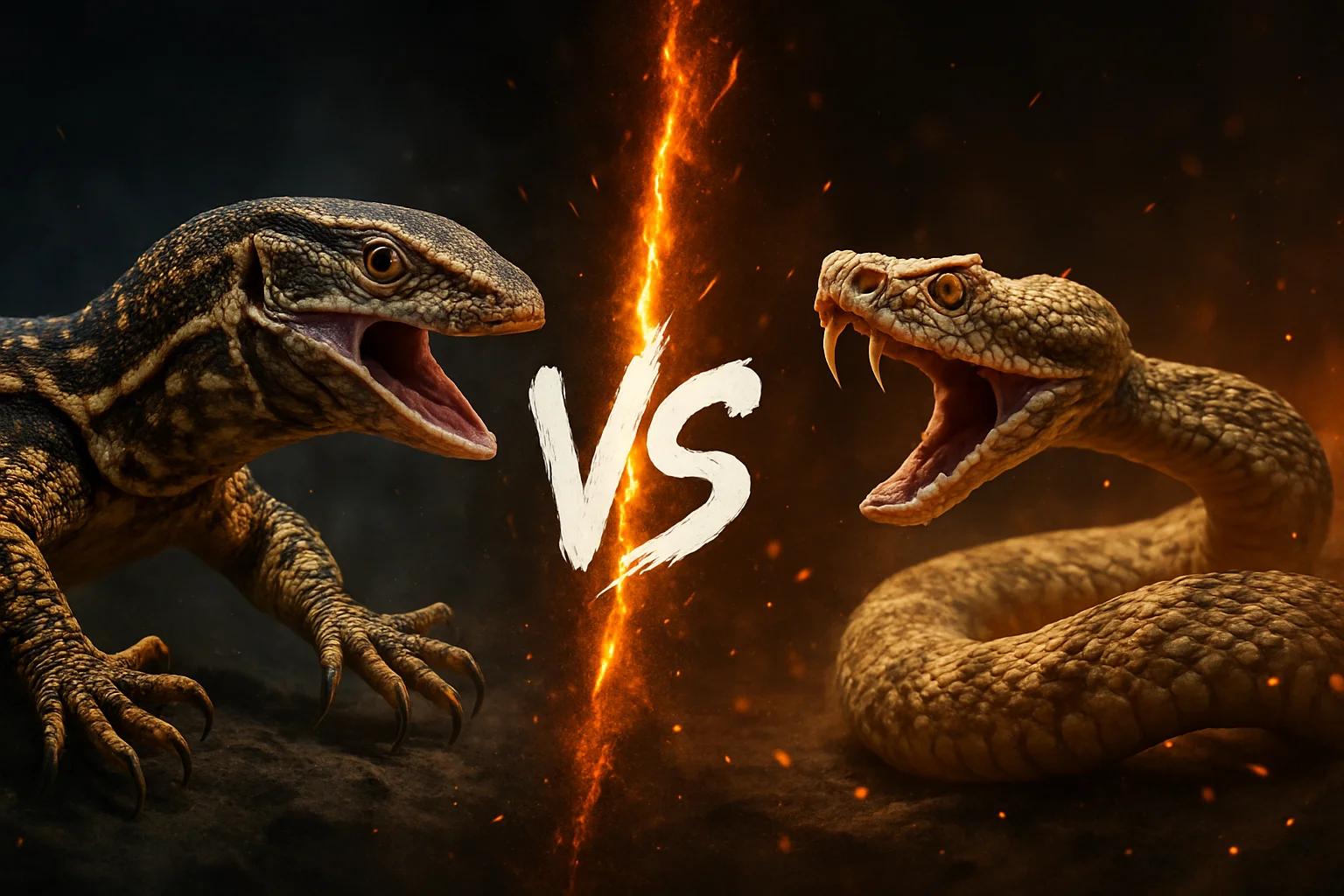
Ackie Monitor vs Sidewinder: Who Actually Wins?
Ackie monitor vs sidewinder rattlesnake: a biology-first look at size, venom, ambush tactics and armor, with a clear verdict on who wins in a fight.
Ackie Monitor vs Sidewinder
Matchup winner
Sidewinder
Quick verdict
Start with the direct answer, then use the structured comparison below to see what changes the outcome.
The sidewinder wins most realistic encounters. The ackie monitor is the heavier, smarter, more mobile reptile, with gripping jaws, hooked claws and a spiny defensive tail. The sidewinder, though, carries hemotoxic venom delivered by a strike faster than a small lizard can reliably react to. It also has heat-sensing pits that let it target warm prey in low light. An ackie is roughly lizard-prey size for a rattlesnake, and one well-placed bite can cause swelling, tissue damage and collapse long before the monitor's mechanical bites become fatal. The ackie's best outcomes come from refusing the fight: wedging into a rock crack behind its spiked tail, or spotting the snake first and leaving. In a forced, committed exchange, venom outweighs claws.
Read the full explanation
The sidewinder wins overall, because venom turns one successful strike into a fight-ender.
The ackie monitor is bigger, more agile on rocks and more behaviorally flexible, but it has no venom of its own and no known resistance to rattlesnake venom.
In rocky cover the ackie can stalemate or escape by plugging a crevice with its spiny tail.
They never meet in the wild: ackies live in arid Australia and sidewinders in North American deserts.
Reader vote
Who do you think wins?
Pick a side — no account needed. Results update live.
No votes yet — be the first to call it.
Editorial note
Why people disagree
Monitor lizards have a reputation as snake-killers, but that reputation belongs to large species. The ackie is a dwarf monitor that mostly eats insects.
Explosive power
The fight is decided in the first contact, and the snake's strike is built for exactly that moment.
Lethal payload
Venom lets the sidewinder win without winning the grapple. It can strike, release and wait.
Body mass and frame
The ackie can overpower and shake a snake it has seized, but only if it gets a grip without being bitten first.
Read the full explanation +
Size favors the ackie, which leads people to underrate how little size matters once hemotoxic venom is involved.
The sidewinder is small and low-yield by rattlesnake standards, so some assume its venom is weak. Against a lizard of a few hundred grams, it is more than enough.
Comparison FAQ
Short, direct answers to the next questions readers usually ask after the headline verdict.
Would an ackie monitor beat a sidewinder?+
Usually not. In a forced fight the sidewinder's venomous strike typically wins. The ackie does best by escaping into rocky cover.
Which is stronger, the ackie monitor or the sidewinder?+
The ackie monitor is physically stronger and heavier. The sidewinder is more lethal because of its venom.
Do monitor lizards eat snakes?+
Large monitors do. The ackie is a dwarf species that mainly eats insects and small reptiles, so a venomous rattlesnake is beyond its normal prey.
Why is the ackie still dangerous to the sidewinder?+
If it seizes the snake first, its clamping bite, claws and head-shaking can injure the snake's slender body badly. The snake can rarely afford to let a fight turn into a grapple.
Is sidewinder venom dangerous to people?+
Yes. Bites are rarely fatal with treatment, but they are painful and need emergency care.
Head-to-head species stats
These are the same core AnimalDex stat dimensions used on the dedicated animal pages, pulled side by side so the matchup is faster to scan.
Ackie Monitor
Tier DSidewinder
Tier CTrait-by-trait comparison
Only the categories that matter to this matchup are included. The goal is not filler stats, but the real design differences that change the result.
Quick lunges and a clamping bite
Explosive power
Sidewinder
Coiled strike lasting a fraction of a second
Explosive power
Sidewinder
Sharp teeth, no venom
Lethal payload
Sidewinder
Hemotoxic venom that damages tissue and disrupts clotting
Lethal payload
Sidewinder
Up to about 70 cm long, stocky and muscular
Body mass and frame
Ackie Monitor
Usually 45–75 cm long, slender and light
Body mass and frame
Ackie Monitor
Active daytime forager
Ambush control
Sidewinder
Buries itself in sand, guided by heat-sensing pits
Ambush control
Sidewinder
Spiny tail used as a crevice shield, tough scales
Close-range durability
Ackie Monitor
Thin-bodied, fragile once pinned
Close-range durability
Ackie Monitor
Curious, adaptable and quick to learn
Tactical flexibility
Ackie Monitor
Narrow, efficient strike-and-track routine
Tactical flexibility
Ackie Monitor
How the verdict forms
Verdict timeline
01 · Explosive power
Sidewinder
02 · Lethal payload
Sidewinder
03 · Body mass and frame
Ackie Monitor
04 · Ambush control
Sidewinder
05 · Close-range durability
Ackie Monitor
06 · Tactical flexibility
Ackie Monitor
Change the conditions
Scenario breakdown
This is where shallow battle content usually fails. Terrain, spacing, timing, and engagement style can change the answer.
Scenario lean
Ackie Monitor
Verdict confidence
82%
The ackie stalemates and survives.
Rocky outcrops are the ackie's home terrain. It retreats into a crack and blocks the entrance with its spiny tail, leaving the snake only an armored target. The sidewinder cannot dig it out and gains nothing by persisting. This counts as survival rather than a kill, but the ackie controls the outcome.
AnimalDex field profiles
Explore these animals
Ackie Monitor
Varanus acanthurus
rocky desert, spinifex plain, and arid scrub
Sidewinder
Crotalus cerastes
sand dune, desert wash, and hot arid plain
Systems Intelligence & Hidden Purpose
See the animals behind this comparison as engineered biological systems: what each one is built to do, where it gains leverage, and why the matchup changes by scenario.
Specialized Hardware
spiny defensive tail, compact muscular monitor body, and rock-crevice basking life give the Ackie Monitor a body plan tuned for its niche.
Systems Script
Ackie Monitors operate through rocky desert, spinifex plain, and arid scrub. Their design links movement, feeding, shelter, and timing into one workable survival system.
Strategic Insight
Harsh places reward efficiency, timing, and bodies that waste very little.
Specialized Hardware
sidewinding desert movement, heat-sensing pits, and horn-like scales above eyes give the Sidewinder a body plan tuned for its niche.
Systems Script
Sidewinders operate through sand dune, desert wash, and hot arid plain Their design links movement, shelter, and feeding into one workable survival system.
Strategic Insight
The right movement pattern can make a difficult platform usable.
Final take
The ackie monitor is the better all-round animal: smarter, sturdier and more versatile. But a fight is decided by a few critical seconds, and the sidewinder is built for those seconds.
Read the full explanation
The ackie's real strength is avoidance. In rocks and in daylight it can escape or simply never engage. When a fight is forced, the sidewinder's strike decides it.
Collect both animals in AnimalDex
Track the species behind this matchup, compare their real traits, and build the rivalry into your AnimalDex collection.
Related comparisons
Continue with nearby matchups to compare more real-world animal traits without dropping into junky who-wins filler.
Ackie Monitor vs Perentie: Who Actually Wins?
The perentie wins, and it is not close. Varanus giganteus is Australia's largest lizard. Adults commonly reach about 1.7–2 m and can weigh 15 kg or more. The ackie monitor (Varanus acanthurus) tops out around 60–70 cm and a few hundred grams. That is a mass gap of well over tenfold. Perentie diets include other lizards, and smaller monitors are realistic prey. Its serrated teeth, venom-associated oral glands, powerful neck and long whipping tail are built to subdue animals the ackie's size. The ackie's real edge is defensive. It wedges into rock crevices and inflates its body against the walls. Its spiny, armored tail blocks the entrance. In open contact, though, the perentie's reach, weight and bite end the encounter quickly. The ackie wins only by never being caught.
Read comparison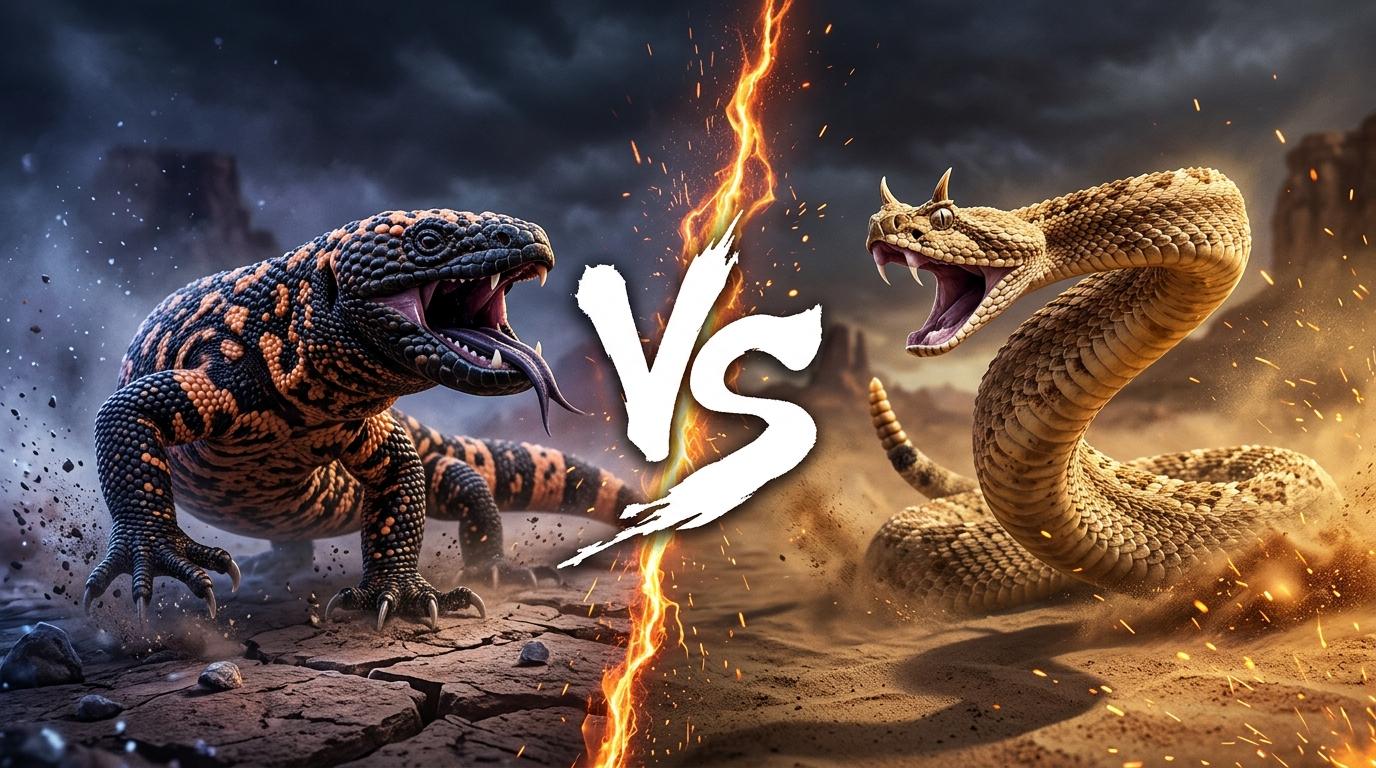
Gila Monster vs Sidewinder: Who Actually Wins?
The Gila monster wins this desert matchup. It is the heavier animal, often roughly two to four times a sidewinder's mass, and its skin is studded with bony osteoderms that act as partial armor. It also has a clamp-and-hold bite that the sidewinder cannot shake off once the lizard connects. The sidewinder is far quicker and carries hemotoxic venom, but it is one of the smaller rattlesnakes, and its venom is milder than that of its larger relatives. Its fangs have to find soft tissue on a slow but stubborn, thick-bodied opponent. In a forced close-quarters encounter, the lizard's mass, grip, and durability outlast the snake's speed. The sidewinder's real edge is that it rarely has to fight at all. On open sand it can simply leave.
Read comparison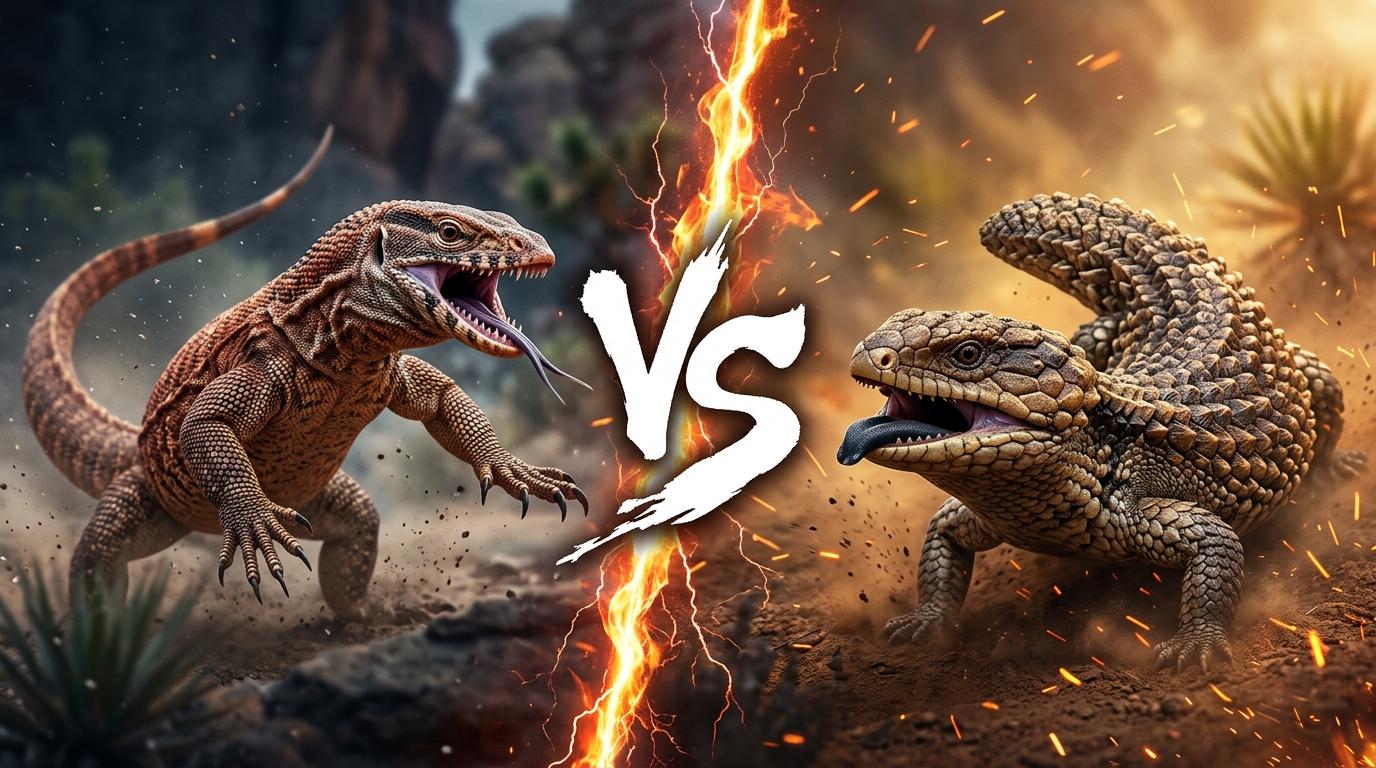
Ackie Monitor vs Shingleback Skink: Who Actually Wins?
The Ackie monitor wins. The ridge-tailed monitor (Varanus acanthurus) is a fast, alert, actively foraging predator with sharp recurved teeth, strong claws, and a spiny club of a tail. It reads situations quickly and can strike, retreat, and re-engage. The shingleback (Tiliqua rugosa) is the heavier-bodied tank. It has thick, pinecone-like osteoderm scales, a crushing blue-tongued bite, and a fat decoy tail that confuses attackers. But it is slow, built for defense rather than offense, and has no way to chase or pin a mobile opponent. The shingleback can make the monitor pay with a clamping bite. Over most realistic encounters, though, the monitor's speed, initiative, and tactical flexibility decide the outcome. The skink survives by being too annoying to finish, not by winning.
Read comparison
Discussion
What do you think?
Share your reasoning with other readers. Be civil and stick to the animals.
Sign in to join the discussion.
Sign inNo comments yet. Start the conversation.