

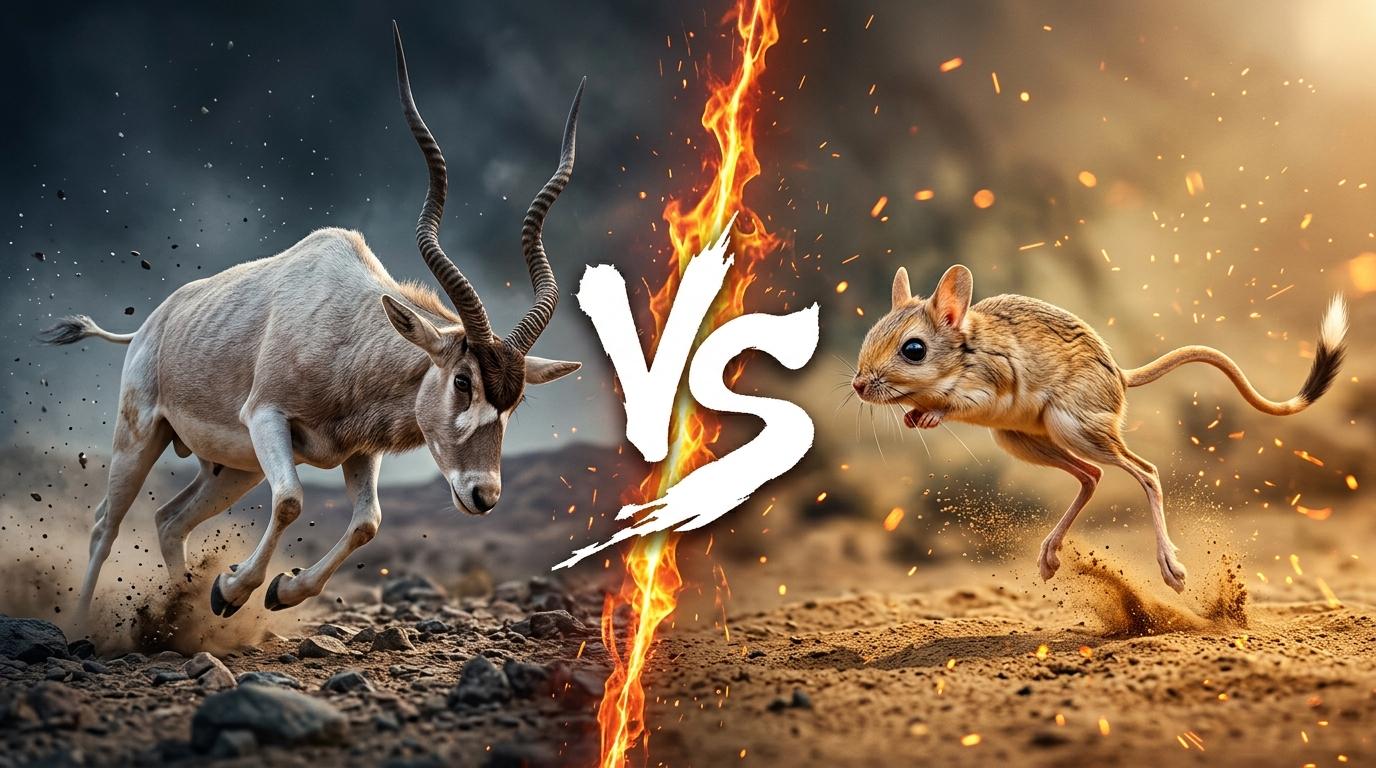
Addax vs Lesser Egyptian Jerboa: Who Actually Wins?
Addax vs Lesser Egyptian Jerboa: a biology-first breakdown of size, horns, speed, and desert survival to settle who would win a Sahara standoff.
Addax vs Jerboa
Matchup winner
Addax
Quick verdict
Start with the direct answer, then use the structured comparison below to see what changes the outcome.
The addax wins clearly. This is one of the most lopsided size matchups in the Sahara. An adult addax weighs roughly 60–125 kg and carries long spiraling horns. The lesser Egyptian jerboa weighs about 40–75 grams, which makes the antelope well over a thousand times heavier. Neither animal is a predator, and neither has any reason to fight the other. In any forced confrontation, though, the addax's mass, horns, and hooves decide it instantly. The jerboa's real strengths are its zigzag ricochet jumps, its burrow escapes, and its nighttime habits. Those skills keep it alive, but they cannot win a contest of force. The jerboa doesn't lose the desert. It loses the duel.
Read the full explanation
The addax wins any physical confrontation, mainly through size, horns, and trampling hooves.
The jerboa cannot meaningfully injure an adult addax. Its only winning move is escape.
In open sand, the jerboa's erratic bipedal hops make it very hard to pin down, so it usually 'wins' by disappearing.
Neither species hunts the other. This is a mismatch of hypotheticals, not a natural rivalry.
Reader vote
Who do you think wins?
Pick a side — no account needed. Results update live.
No votes yet — be the first to call it.
Editorial note
Why people disagree
Some readers count successful escape as a win. By that standard the jerboa often comes out ahead, because the addax has little reason or ability to chase it into a burrow.
Raw mass
A weight gap this large means any contact at all is decisive in the addax's favor.
Built-in weaponry
The addax carries tools made for sparring and defense. The jerboa's teeth are for seeds and plants, not combat.
Evasive agility
Agility is the jerboa's whole defense. It makes the animal hard to strike or follow.
Read the full explanation +
The jerboa's jumping speed and agility look impressive on video, which can make people overestimate its fighting relevance against a 100 kg antelope.
Both are elite desert survivors, so 'who wins' debates sometimes slide into 'who adapts better.' On that question the jerboa's abundance gives it a real argument.
Comparison FAQ
Short, direct answers to the next questions readers usually ask after the headline verdict.
Who would win, an addax or a jerboa?+
The addax wins decisively. It is well over a thousand times heavier and armed with horns and hooves. The jerboa has no way to injure it.
Which is stronger, the addax or the lesser Egyptian jerboa?+
The addax by an enormous margin. The jerboa's strength sits in its powerful hind legs, which are built for jumping rather than fighting.
Why is the jerboa still hard to beat even though it loses the fight?+
Its ricochet hops change direction unpredictably, and it can retreat into burrows within seconds. A larger animal often can't land contact at all. Its danger lies in being uncatchable, not in hurting anything.
Do addax and jerboas interact in the wild?+
Their ranges historically overlap in parts of the Sahara, but they don't compete directly or prey on each other. At most they share the same landscape. The addax is now critically endangered and survives in very few wild areas.
Could a jerboa outrun an addax?+
Over a short burst with sharp turns, the jerboa is far harder to follow. The addax is not built for sprinting. Its strength is slow, efficient endurance.
Head-to-head species stats
These are the same core AnimalDex stat dimensions used on the dedicated animal pages, pulled side by side so the matchup is faster to scan.
Addax
Tier BJerboa
Tier CTrait-by-trait comparison
Only the categories that matter to this matchup are included. The goal is not filler stats, but the real design differences that change the result.
Roughly 60–125 kg, built like a stocky antelope
Raw mass
Addax
About 40–75 g, palm-sized
Raw mass
Addax
Long spiral horns plus hard hooves
Built-in weaponry
Addax
Small incisors, no real defensive weapons
Built-in weaponry
Addax
Steady, plodding gait built for endurance
Evasive agility
Jerboa
Explosive bipedal ricochet hops with sudden direction changes
Evasive agility
Jerboa
Relies on open-ground vigilance and herd awareness
Escape infrastructure
Jerboa
Burrows with sealed entrances and emergency exits
Escape infrastructure
Jerboa
Thick hide and sturdy frame
Close-range durability
Addax
Fragile body, minimal protection
Close-range durability
Addax
Can go long periods without drinking, getting moisture from plants
Desert endurance
Addax
Nocturnal, gets water from its food, shelters in cool burrows
Desert endurance
Addax
How the verdict forms
Verdict timeline
01 · Raw mass
Addax
02 · Built-in weaponry
Addax
03 · Evasive agility
Jerboa
04 · Escape infrastructure
Jerboa
05 · Close-range durability
Addax
06 · Desert endurance
Addax
Change the conditions
Scenario breakdown
This is where shallow battle content usually fails. Terrain, spacing, timing, and engagement style can change the answer.
Scenario lean
Jerboa
Verdict confidence
82%
The jerboa vanishes before contact.
Broken ground with shrubs and burrow entrances favors the small animal. The jerboa can duck into cover or a tunnel within seconds. The addax gains nothing from pursuit and cannot reach the jerboa underground. No fight happens, and the jerboa survives untouched. This is a survival win, not a combat win.
AnimalDex field profiles
Explore these animals
Addax
Addax nasomaculatus
deep desert, arid dune system, and sparse Sahel fringe
Jerboa
Jaculus jaculus
sand desert, semi-arid steppe, and rocky plain
Systems Intelligence & Hidden Purpose
See the animals behind this comparison as engineered biological systems: what each one is built to do, where it gains leverage, and why the matchup changes by scenario.
Specialized Hardware
pale desert coat, wide spreading hooves, and slow-energy dryland survival give the Addax a body plan tuned for its niche.
Systems Script
Addaxs operate through deep desert, arid dune system, and sparse Sahel fringe Their design links movement, shelter, and feeding into one workable survival system.
Strategic Insight
The harsher the environment, the more valuable efficiency becomes.
Specialized Hardware
very long springing hind legs, long tufted balancing tail, and night desert hopping give the Jerboa a body plan tuned for its niche.
Systems Script
Jerboas operate through sand desert, semi-arid steppe, and rocky plain. Their design links movement, feeding, shelter, and timing into one workable survival system.
Strategic Insight
Harsh places reward efficiency, timing, and bodies that waste very little.
Final take
The addax is the clear winner. In any scenario that requires actual physical contest, the antelope's enormous size advantage, horns, and hooves leave no room for an upset.
Read the full explanation
The jerboa deserves respect as a design philosophy. It avoids fights entirely through speed, unpredictability, and underground refuge. Ask 'who survives the encounter' and the jerboa usually walks, or bounces, away fine. Ask 'who wins the fight' and the answer is the addax, every time.
Collect both animals in AnimalDex
Track the species behind this matchup, compare their real traits, and build the rivalry into your AnimalDex collection.
Related comparisons
Continue with nearby matchups to compare more real-world animal traits without dropping into junky who-wins filler.
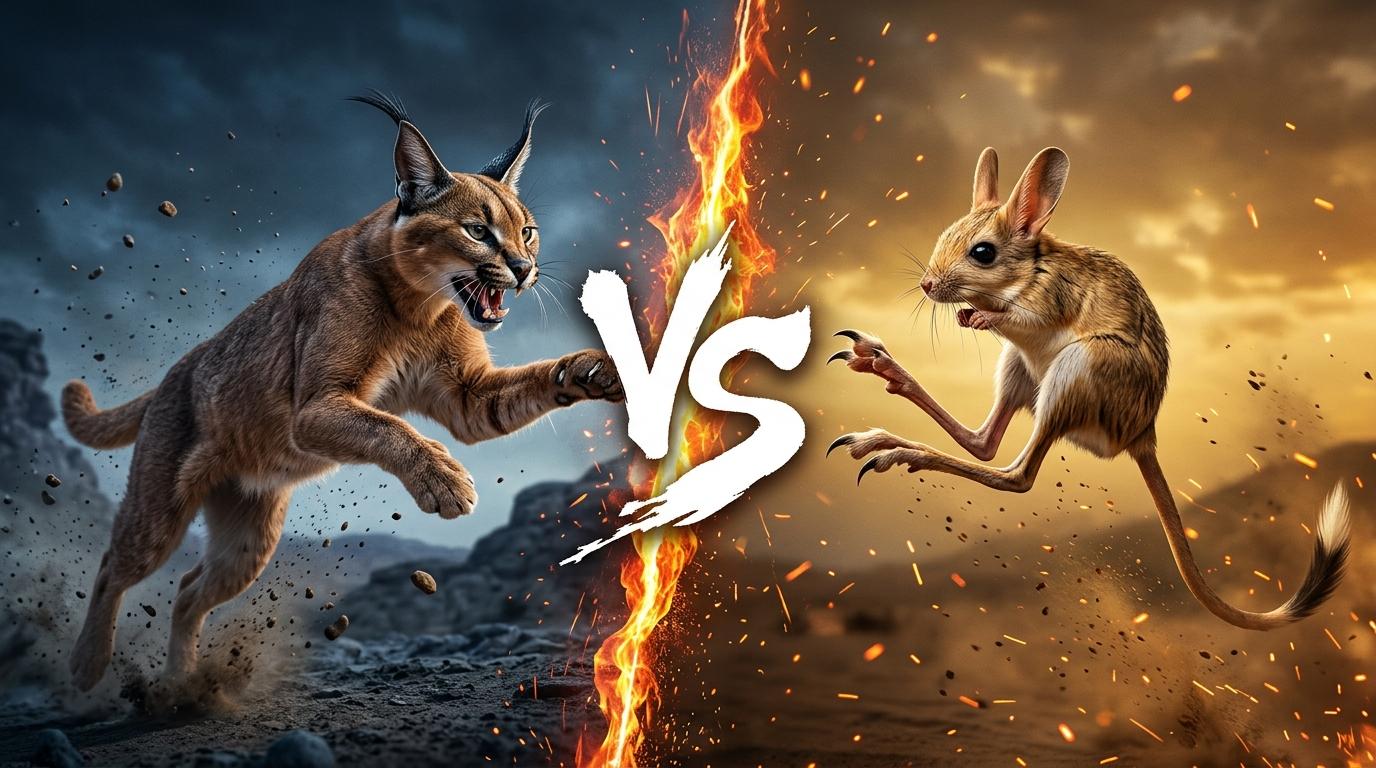
Caracal vs Lesser Egyptian Jerboa: Who Actually Wins?
The caracal wins, and it isn't close. An adult caracal weighs roughly 8–19 kg against a jerboa's 50–75 grams, so the cat is something like 150–300 times heavier. It is a specialist at catching small, fast desert animals. Caracals are famous for vertical leaps of up to about 3 meters, and they swat birds out of the air. They also have tufted ears tuned to rodent rustles and a killing bite built for quick dispatch. The lesser Egyptian jerboa is not built to fight anything. Its whole design is about not being caught: kangaroo-like hind legs, zigzag bounds, nocturnal burrow life, and plugged daytime tunnels. Once the caracal makes contact, the outcome is decided in seconds. The jerboa's only real wins come from never being reached, and the caracal does not always reach it.
Read comparison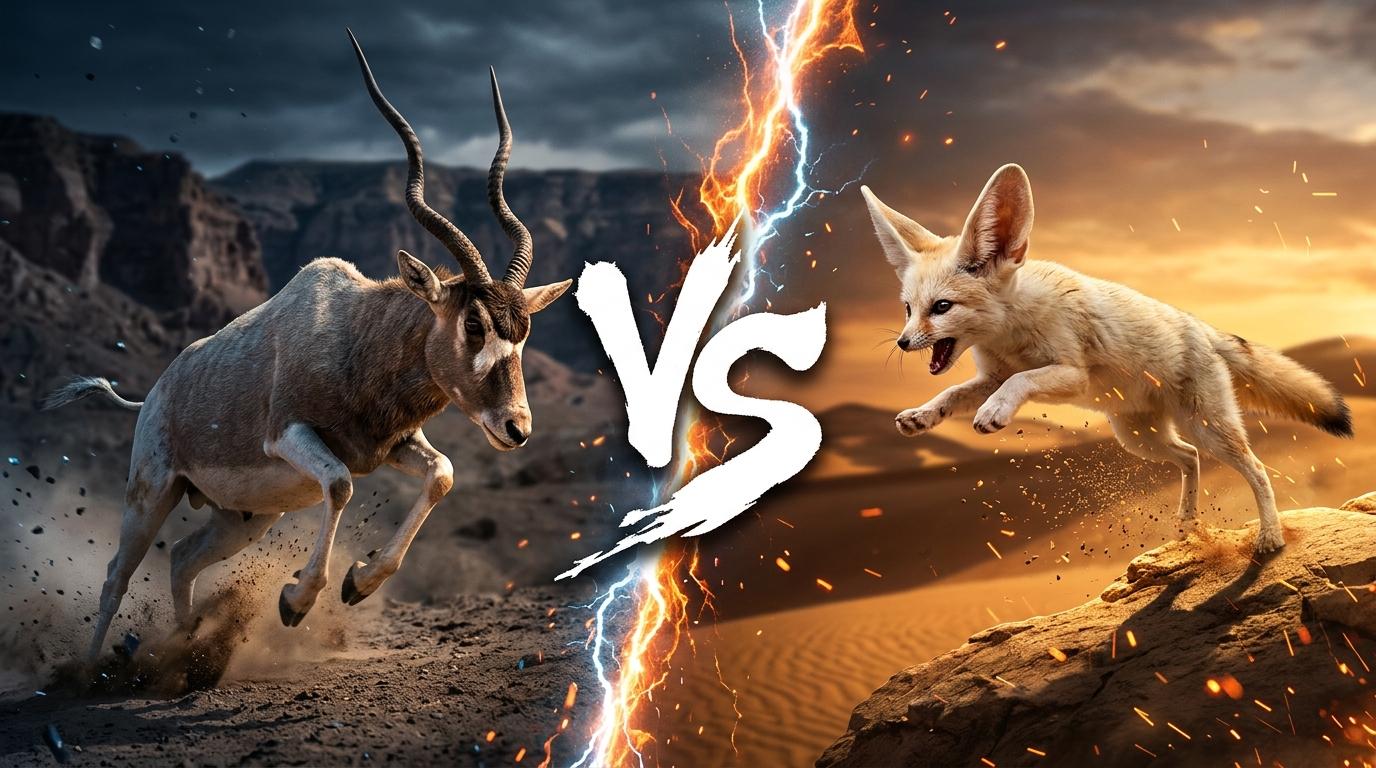
Addax vs Fennec Fox: Who Actually Wins?
The addax wins, and it is not close in a physical confrontation. This critically endangered Saharan antelope stands around a meter at the shoulder, typically weighs 60–125 kg, and carries long spiraled horns. The fennec fox weighs roughly 1–1.5 kg, about one-hundredth of the addax's mass. The fennec's real weapons are its 15 cm ears, its fast reflexes, and its ability to dig a burrow in minutes. Those tools are built for catching insects and rodents and for escaping predators, not for overpowering a large herbivore. An addax only needs to lower its horns, stamp, or simply walk forward, and the fox's best move is to leave. The fennec is quicker and harder to pin down. If it chooses not to engage, it 'survives' the encounter, but it never has a route to winning one.
Read comparison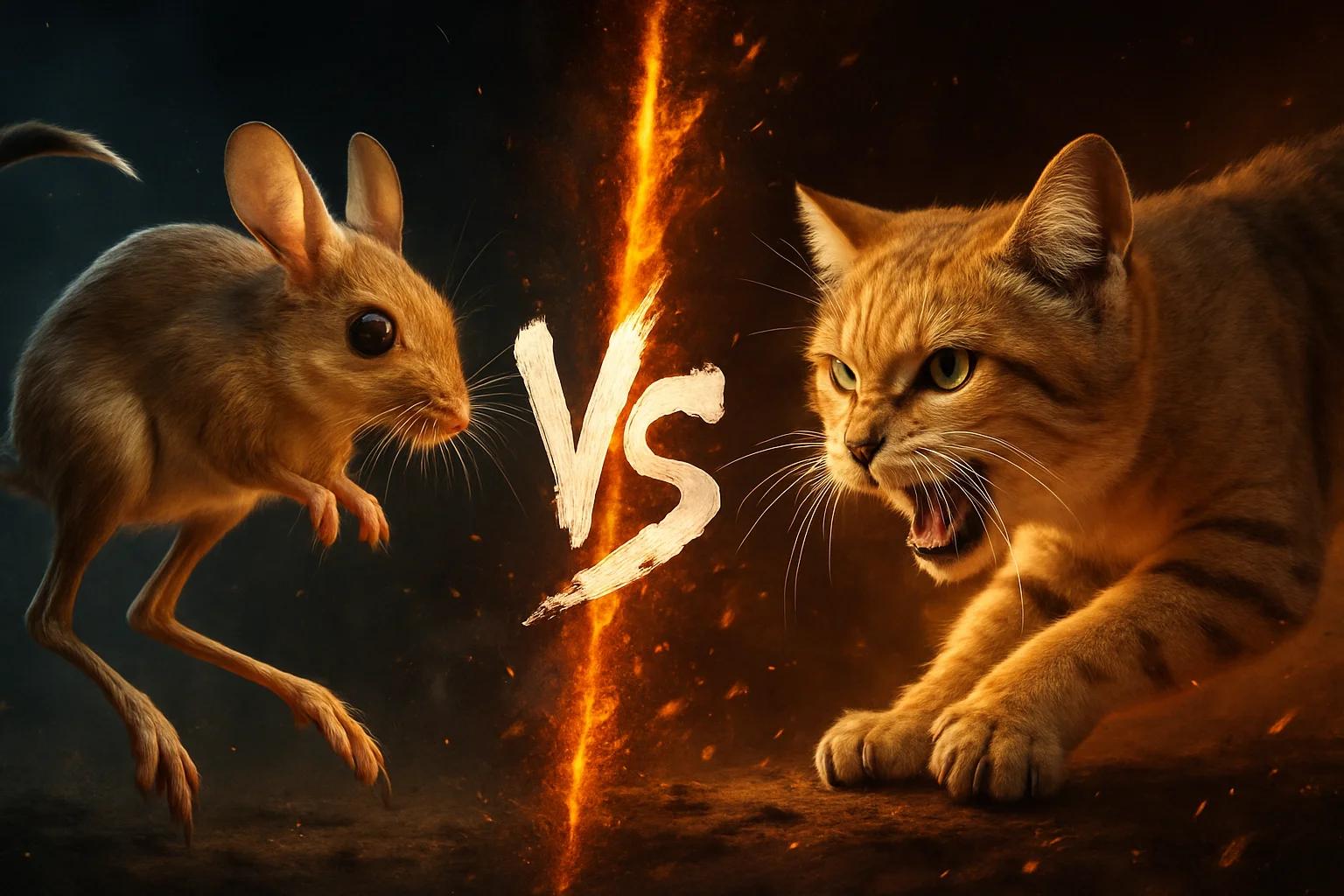
Lesser Egyptian Jerboa vs Sand Cat: Who Actually Wins?
The sand cat wins this matchup clearly. At roughly 2–3.5 kg it outweighs a 50–70 g lesser Egyptian jerboa by about fifty to one. It hunts at night, the same hours the jerboa forages, and its hearing is tuned to pick up the faint rustle of small rodents on and under the sand. Jerboas and gerbils are core items in its diet, so this is a predator meeting its prey, not a fight between rivals. The jerboa's real defense is not combat. It escapes. Long hind legs launch it into zigzag hops, and a deep burrow plugged with sand gives it shelter. In open ground, a jerboa that detects the cat early has a real chance to bounce away. Once the cat closes to striking range, though, the jerboa has no meaningful way to fight back.
Read comparison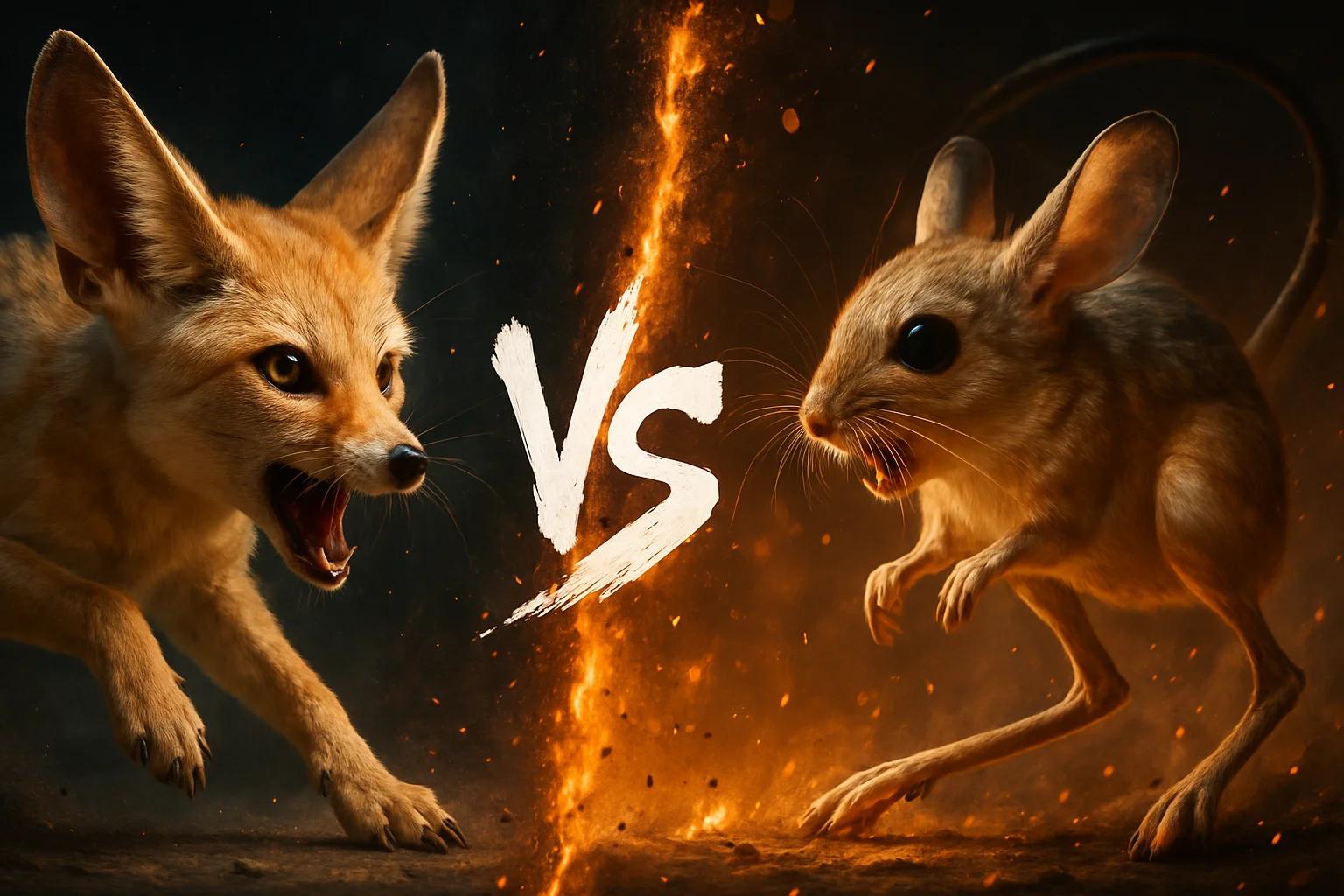
Fennec Fox vs Lesser Egyptian Jerboa: Who Actually Wins?
The fennec fox wins clearly. This isn't a matchup between equals. It's a desert predator against one of its natural prey species. A fennec weighs roughly 1–1.5 kg, about ten times the 50–70 g lesser Egyptian jerboa. It has sharp canines, a quick killing bite, and enormous ears that can hear small animals moving on or under the sand. Once the fox makes contact, the jerboa has no real way to fight back. The jerboa wins by not being caught. Its long hind legs launch erratic, zigzag bounds that can top 20 km/h in short bursts, it forages mostly in darkness, and it seals itself inside burrows during the day. So the fox wins the fight, and the jerboa wins plenty of chases.
Read comparison
Discussion
What do you think?
Share your reasoning with other readers. Be civil and stick to the animals.
Sign in to join the discussion.
Sign inNo comments yet. Start the conversation.