

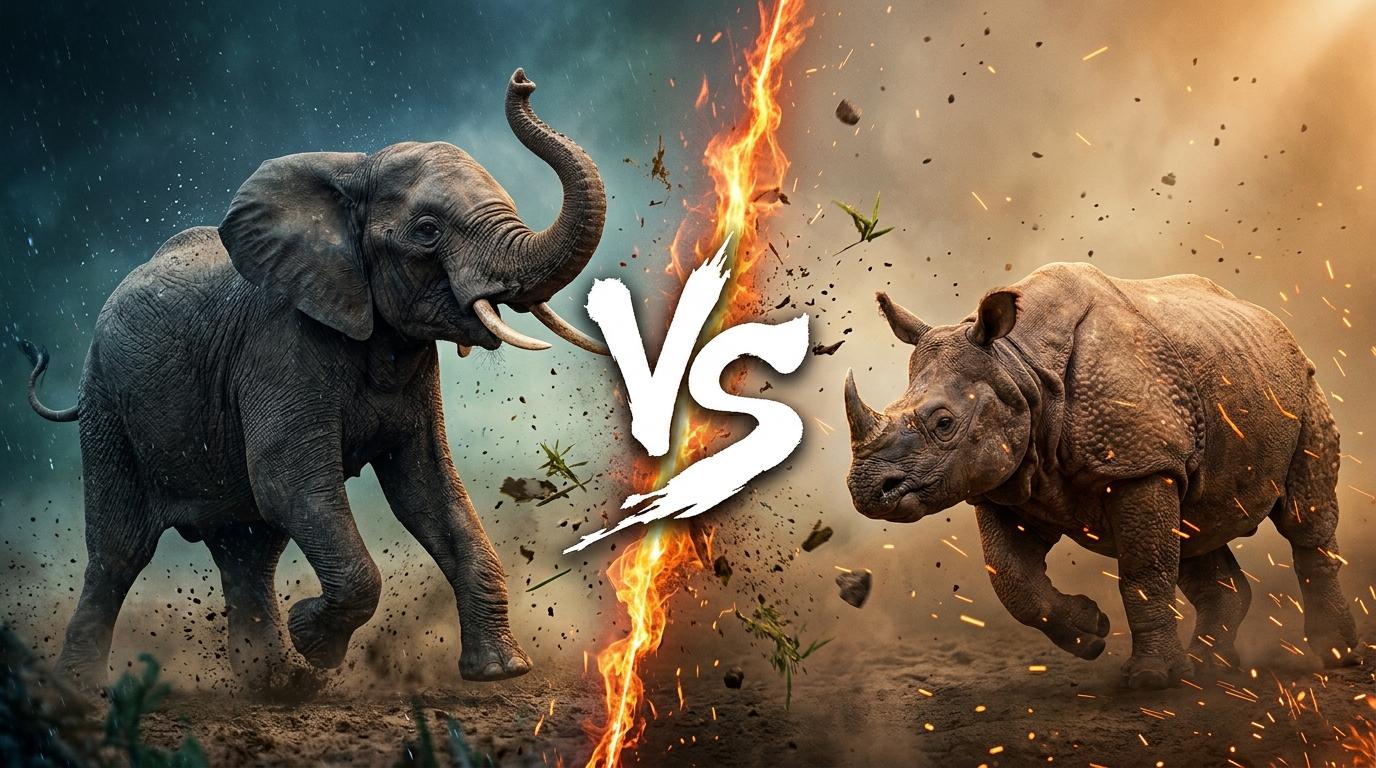
African Forest Elephant vs Javan Rhinoceros: Who Actually Wins?
African forest elephant vs Javan rhinoceros. A biology-first breakdown of size, tusks, horn, armor, and behavior to show who would win and why.
African Forest Elephant vs Javan Rhinoceros
Matchup winner
African Forest Elephant
Quick verdict
Start with the direct answer, then use the structured comparison below to see what changes the outcome.
The African forest elephant wins this matchup clearly. Bulls typically weigh about 2.5–6 tonnes and carry straight, dense, downward-pointing tusks. They also have a muscular trunk that can grab, shove, and pin. A Javan rhino usually weighs 1.4–2.3 tonnes and has a small horn, often under 25 cm, that is barely more than a knob on females. Its folded, armor-like skin and its sharp lower incisors are its real weapons, and it is a heavy, determined charger at short range. But it gives up mass, reach, and leverage. The elephant can strike from above and outside the rhino's effective range, and it can use tusks and trunk together. Its problem-solving brain also helps it read and avoid a bad angle. Neither species would normally seek this fight, and the two have never shared a range. In a forced confrontation, though, the elephant's size and reach advantage is decisive.
Read the full explanation
Winner: African forest elephant, mainly through mass, reach, and tusk leverage.
The Javan rhino's horn is small; its biting lower incisors and thick skin make it tough but not dominant.
The rhino's best chance is a sudden close-range charge in dense cover, and even that rarely overturns a weight gap of more than 1 tonne.
Both are rare forest giants, and in the real world they would almost always avoid each other.
Reader vote
Who do you think wins?
Pick a side — no account needed. Results update live.
No votes yet — be the first to call it.
Editorial note
Why people disagree
People picture the armored, horn-heavy Indian or white rhino. The Javan rhino is smaller, and its horn is often tiny.
Raw mass
In shoving contests between megaherbivores, extra tonnage decides who gets displaced or knocked over.
Weapon reach
The elephant can hit from outside the rhino's striking zone, while the rhino has to close all the way in to do damage.
Close-range durability
The rhino's low, compact body and plated look make it hard to wound with glancing blows.
Read the full explanation +
Forest elephants are much smaller than savanna elephants, so readers assume the size gap is closer than it actually is.
Rhinos charge hard and look like tanks, and readers often overrate armor against tusks driven by several tonnes of body weight.
Comparison FAQ
Short, direct answers to the next questions readers usually ask after the headline verdict.
Would an African forest elephant beat a Javan rhinoceros?+
Yes. Its greater weight, tusk reach, and trunk control would win most realistic encounters.
Which is stronger, a forest elephant or a Javan rhino?+
The forest elephant. It can weigh twice as much or more, and it can push, lift, and strike with greater force.
Is the Javan rhino's horn dangerous?+
Not much. The horn is small. The real danger comes from its sharp lower incisors and its compact charge.
Why is the Javan rhino still dangerous even if it loses?+
Its dense build, tough skin, and sudden close-range charge can wound a much larger animal, especially in thick cover.
Do elephants and Javan rhinos ever meet?+
No. Their ranges are on different continents. Asian elephants once shared Java with these rhinos, but African forest elephants never did.
Head-to-head species stats
These are the same core AnimalDex stat dimensions used on the dedicated animal pages, pulled side by side so the matchup is faster to scan.
African Forest Elephant
Tier CJavan Rhinoceros
Tier ATrait-by-trait comparison
Only the categories that matter to this matchup are included. The goal is not filler stats, but the real design differences that change the result.
~2.5–6 t bulls
Raw mass
African Forest Elephant
~1.4–2.3 t
Raw mass
African Forest Elephant
Long straight tusks plus trunk
Weapon reach
African Forest Elephant
Short horn, sharp lower incisors
Weapon reach
African Forest Elephant
Thick hide, huge frame
Close-range durability
Javan Rhinoceros
Folded armor-like skin, low and dense build
Close-range durability
Javan Rhinoceros
Powerful but taller, heavier start
Explosive charge
Javan Rhinoceros
Low, sudden burst
Explosive charge
Javan Rhinoceros
Memory, social learning, threat assessment
Tactical awareness
African Forest Elephant
Solitary, mostly reactive
Tactical awareness
African Forest Elephant
Trunk can grip, push, and pin
Grappling control
African Forest Elephant
No grappling limbs
Grappling control
African Forest Elephant
How the verdict forms
Verdict timeline
01 · Raw mass
African Forest Elephant
02 · Weapon reach
African Forest Elephant
03 · Close-range durability
Javan Rhinoceros
04 · Explosive charge
Javan Rhinoceros
05 · Tactical awareness
African Forest Elephant
06 · Grappling control
African Forest Elephant
Change the conditions
Scenario breakdown
This is where shallow battle content usually fails. Terrain, spacing, timing, and engagement style can change the answer.
Scenario lean
African Forest Elephant
Verdict confidence
82%
Elephant, though the rhino's surprise charge makes this the closest scenario.
Thick vegetation shortens sight lines, which favors the rhino's sudden, low charge and incisor slashes. Even so, forest elephants are built to push through undergrowth, and once contact happens the elephant's mass and tusks take over. The rhino can inflict wounds but cannot hold the clinch.
AnimalDex field profiles
Explore these animals
African Forest Elephant
Loxodonta cyclotis
dense rainforest, swamp forest, and forest clearings
Javan Rhinoceros
Rhinoceros sondaicus
lowland rainforest, swamp forest, and thick riverine thicket
Systems Intelligence & Hidden Purpose
See the animals behind this comparison as engineered biological systems: what each one is built to do, where it gains leverage, and why the matchup changes by scenario.
Specialized Hardware
rounded ears for tight forest travel, gentle path-making strength, and deep rumbling family calls give the African Forest Elephant a body plan tuned for its niche.
Systems Script
African Forest Elephants operate through dense rainforest, swamp forest, and forest clearings Their design links movement, shelter, feeding, and survival into one workable system.
Strategic Insight
Big strength becomes even more useful when it clears the way for others too.
Final take
The African forest elephant is the clear pick. Its advantages stack on each other: more mass, longer weapons, a grasping trunk, and better judgment. The Javan rhino is a rugged, armored survivor, but its toolkit suits short-range defense, not beating a bigger animal head-on.
Read the full explanation
The comparison is purely hypothetical. Forest elephants live in Central and West Africa, and the last Javan rhinos survive only in Ujung Kulon, Indonesia. That remaining population is roughly 50 animals or fewer, which makes the species one of the rarest large mammals on Earth.
Collect both animals in AnimalDex
Track the species behind this matchup, compare their real traits, and build the rivalry into your AnimalDex collection.
Related comparisons
Continue with nearby matchups to compare more real-world animal traits without dropping into junky who-wins filler.
African Forest Elephant vs Pygmy Hippopotamus: Who Actually Wins?
The African forest elephant wins, and it isn't close. A forest elephant bull can weigh around 2,500–4,000 kg and stands up to about 2.5 m at the shoulder. A pygmy hippo weighs roughly 180–275 kg and stands under a meter tall. That makes the elephant about ten to fifteen times heavier. The elephant also carries long, straight, downward-pointing tusks built for pushing through dense forest. It has a trunk that can shove, pin, and lift, and enough mass to knock over small trees. The pygmy hippo has sharp canines and a surprisingly dense, low-slung body. But it is a shy, mostly nocturnal browser built to slip away into swamps and streams, not to fight a megaherbivore. In nearly every realistic encounter the hippo retreats, and if it doesn't, the elephant's reach, weight, and tusks decide it fast.
Read comparison
Javan Rhinoceros vs Sumatran Tiger: Who Actually Wins?
The Javan rhinoceros wins, and it isn't close in a fair fight between healthy adults. An adult Javan rhino weighs roughly 900–2,300 kg, often ten times or more the mass of a male Sumatran tiger (about 100–140 kg, the smallest living tiger population). The rhino's thick, folded hide and sheer bulk shrug off the bite-and-hold technique tigers use to subdue deer and wild pigs. Its sharp lower incisors and battering charge can injure a cat badly. The Sumatran tiger is the better hunter by every measure of speed, stealth and tactical intelligence, and it would win only where biology lets it: against an unguarded calf. Against a grown rhino, the tiger's smartest move is the one real tigers make: walk away.
Read comparison
Discussion
What do you think?
Share your reasoning with other readers. Be civil and stick to the animals.
Sign in to join the discussion.
Sign inNo comments yet. Start the conversation.