

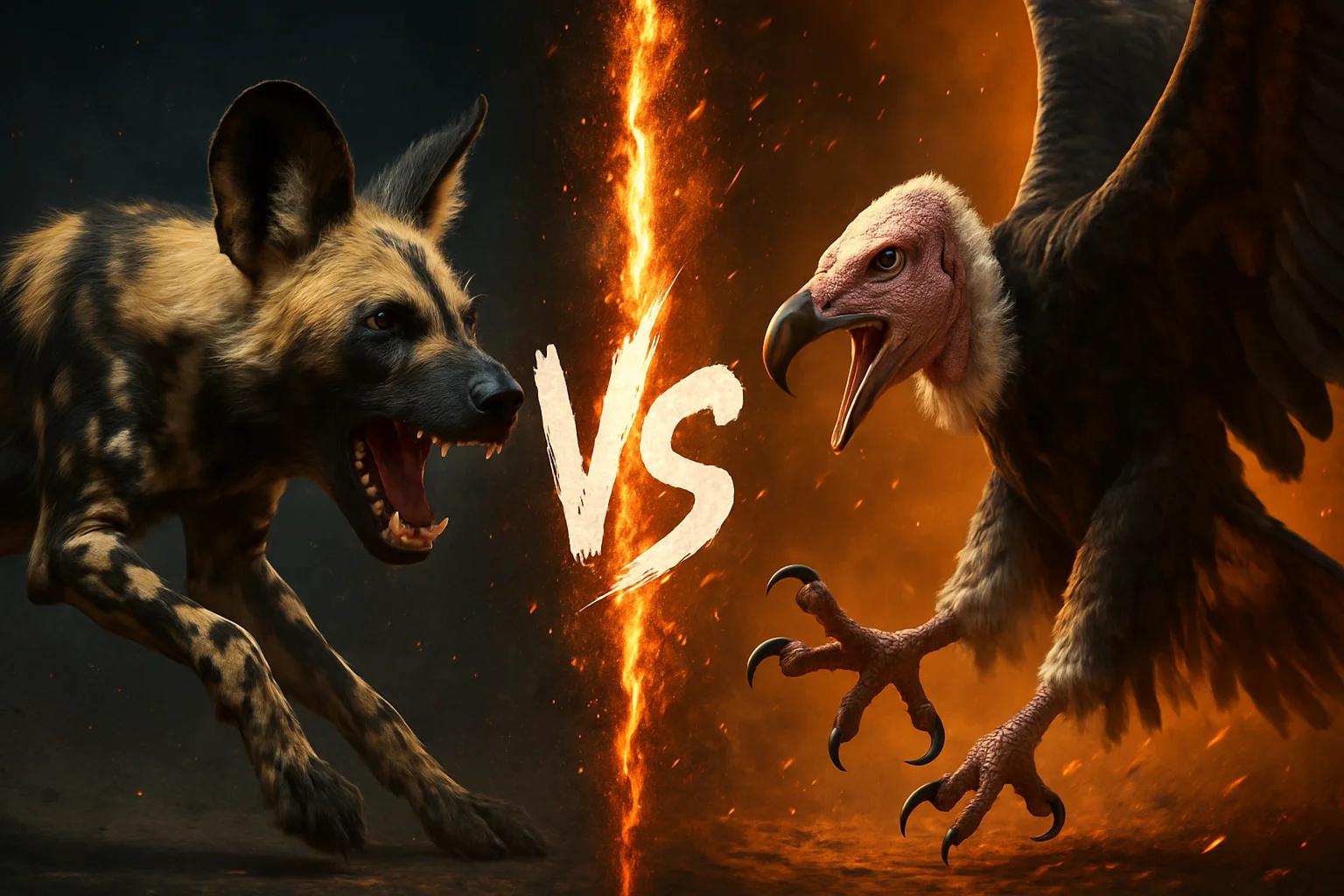
African Wild Dog vs White-headed Vulture: Who Actually Wins?
African wild dog vs white-headed vulture: who would win? A biology-first breakdown of jaws vs talons, ground vs air, and why the painted wolf takes it.
African Wild Dog vs White-headed Vulture
Matchup winner
African Wild Dog
Quick verdict
Start with the direct answer, then use the structured comparison below to see what changes the outcome.
The African wild dog wins clearly. At roughly 20–30 kg of sinew, stamina and shearing carnassial teeth, a wild dog outweighs a white-headed vulture (about 3.5–5.5 kg) several times over and is built to grab, hold and subdue live animals. The white-headed vulture is a scavenger with a strong hooked bill and weak, unspecialized feet. It cannot pin or kill a fit mammal of that size, and once grounded it is slow to take off. The vulture's real advantage is flight. It does not win fights. It simply leaves them. In any encounter where the bird must stand its ground, the dog's bite, agility and grip decide it in seconds.
Read the full explanation
African wild dog wins: about 5x heavier, with a killing bite and predator reflexes.
The white-headed vulture has no grappling talons, so its main weapon is its beak.
The vulture's best outcome is escape by air, not victory.
Near a carcass the dogs usually hold the ground, especially when the pack is present.
Reader vote
Who do you think wins?
Pick a side — no account needed. Results update live.
No votes yet — be the first to call it.
Editorial note
Why people disagree
Vultures look formidable with big wings and a hooked beak, but the beak is a tearing tool for carcasses, not a weapon for killing.
Explosive power
A dog's lunge closes distance before a grounded vulture can get airborne.
Kill-ready weaponry
Only one of these animals is equipped to disable a struggling opponent.
Mass and leverage
The weight gap means a single bite-and-shake can end the exchange.
Read the full explanation +
Some people count 'the bird flew away' as a draw. In a battle frame, though, holding the ground is winning.
White-headed vultures are bolder than many vultures and sometimes arrive first at carcasses, so people overrate how well they hold up against mammals.
Comparison FAQ
Short, direct answers to the next questions readers usually ask after the headline verdict.
Would an African wild dog beat a white-headed vulture?+
Yes. If they actually fight, the wild dog wins thanks to a major size advantage, a killing bite and predator reflexes.
Which is stronger, an African wild dog or a white-headed vulture?+
The wild dog, by a wide margin. It weighs about five times as much and has far stronger jaws and limbs.
Can a white-headed vulture hurt a wild dog?+
It can. A hooked beak strike can wound the face or eyes, which is why a dog avoids sloppy lunges. It is still not enough to win the fight.
Why does the vulture stay dangerous even though it loses?+
Its beak is built to rip tough hide, and its wings can buffet an attacker. Above all, flight lets it escape and outlast the dog around carcasses.
Do wild dogs and vultures meet in the wild?+
Yes, mainly at kills. Vultures circle and wait while the dogs feed, then move in.
Head-to-head species stats
These are the same core AnimalDex stat dimensions used on the dedicated animal pages, pulled side by side so the matchup is faster to scan.
African Wild Dog
Tier AWhite-headed Vulture
Tier BTrait-by-trait comparison
Only the categories that matter to this matchup are included. The goal is not filler stats, but the real design differences that change the result.
Sprint bursts near 60+ km/h, lunging bite
Explosive power
African Wild Dog
Heavy wingbeat takeoff, short hops
Explosive power
African Wild Dog
Carnassial shears, gripping jaws
Kill-ready weaponry
African Wild Dog
Hooked tearing beak, weak feet
Kill-ready weaponry
African Wild Dog
20–30 kg muscular frame
Mass and leverage
African Wild Dog
3.5–5.5 kg, mostly wing and feather
Mass and leverage
African Wild Dog
Ground-bound, relies on speed
Escape options
White-headed Vulture
Soaring flight, vertical escape
Escape options
White-headed Vulture
Dense muscle, tough hide
Close-range durability
African Wild Dog
Hollow bones, fragile wings
Close-range durability
African Wild Dog
Elite pack coordination
Tactical cooperation
African Wild Dog
Loose solitary or pair foraging
Tactical cooperation
African Wild Dog
How the verdict forms
Verdict timeline
01 · Explosive power
African Wild Dog
02 · Kill-ready weaponry
African Wild Dog
03 · Mass and leverage
African Wild Dog
04 · Escape options
White-headed Vulture
05 · Close-range durability
African Wild Dog
06 · Tactical cooperation
African Wild Dog
Change the conditions
Scenario breakdown
This is where shallow battle content usually fails. Terrain, spacing, timing, and engagement style can change the answer.
Scenario lean
African Wild Dog
Verdict confidence
82%
Dog wins decisively
In bush or thicket, the vulture's broad wings cannot generate a clean takeoff. The dog's agility and bite range dominate tight spaces, and a grounded raptor without grasping talons has no answer to being seized.
AnimalDex field profiles
Explore these animals
African Wild Dog
Lycaon pictus
Open woodland, savannah, and lightly wooded grassland with space for wide-range pack movement.
White-headed Vulture
Trigonoceps occipitalis
Savannah woodland, open dry forest edges, and mixed scrub zones near large mammal ranges.
Systems Intelligence & Hidden Purpose
See the animals behind this comparison as engineered biological systems: what each one is built to do, where it gains leverage, and why the matchup changes by scenario.
Specialized Hardware
Oversized ears, endurance-focused limbs, and a social communication stack built on posture, vocal cues, and pack coordination turn the African wild dog into elite pursuit hardware.
Systems Script
African wild dogs pressure prey populations through coordinated movement rather than isolated brute force. They help shape herbivore behavior, redistribute risk across landscapes, and reward connected ecosystems over fragmented ones.
Strategic Insight
High-performance teams do not need constant hierarchy chatter. Shared rules, clean signals, and role clarity create speed that solo talent cannot match.
Specialized Hardware
Exceptional eyesight, soaring efficiency, and scavenger-grade feeding hardware allow the white-headed vulture to locate carcasses quickly and convert death into cleanup before disease risk spreads.
Systems Script
This species is part of the ecosystem sanitation layer. By clearing carrion, vultures reduce pathogen buildup, accelerate nutrient cycling, and keep the wider environmental operating system cleaner and more stable.
Strategic Insight
Not every valuable system creates by adding more. Some create advantage by removing waste faster than everyone else.
Final take
This matchup pits a predator against a scavenger, and the biology shows it. The African wild dog is a compact killing system of jaws, endurance and coordination. The white-headed vulture is a soaring cleanup specialist whose anatomy is optimized for finding and tearing carrion, not for combat.
Read the full explanation
The vulture is not helpless. Its beak can draw blood, and flight gives it an exit no dog can follow. But in any contest decided by contact, the wild dog wins, and wins quickly.
Collect both animals in AnimalDex
Track the species behind this matchup, compare their real traits, and build the rivalry into your AnimalDex collection.
Related comparisons
Continue with nearby matchups to compare more real-world animal traits without dropping into junky who-wins filler.

Bald Eagle vs White-headed Vulture: Who Actually Wins?
The bald eagle wins this matchup clearly. The two birds are surprisingly close in size, since both weigh roughly 3 to 6 kg and have wingspans around 2 meters. But their weapons are built for different jobs. The eagle is a grasping predator. Its curved talons and strong feet are designed to seize, pin, and puncture living prey, and the species habitually bullies other raptors off food. The white-headed vulture is the most predatory-leaning of Africa's vultures and has a heavy, hooked beak for tearing hide. Its feet, however, are flatter walking-and-standing tools rather than killing grips. In any contact fight, the bird that can lock onto a body with its feet controls the outcome, and that bird is the eagle. The vulture's best moments come in carcass standoffs, where bluffing, posture, and patience matter more than lethal grip.
Read comparison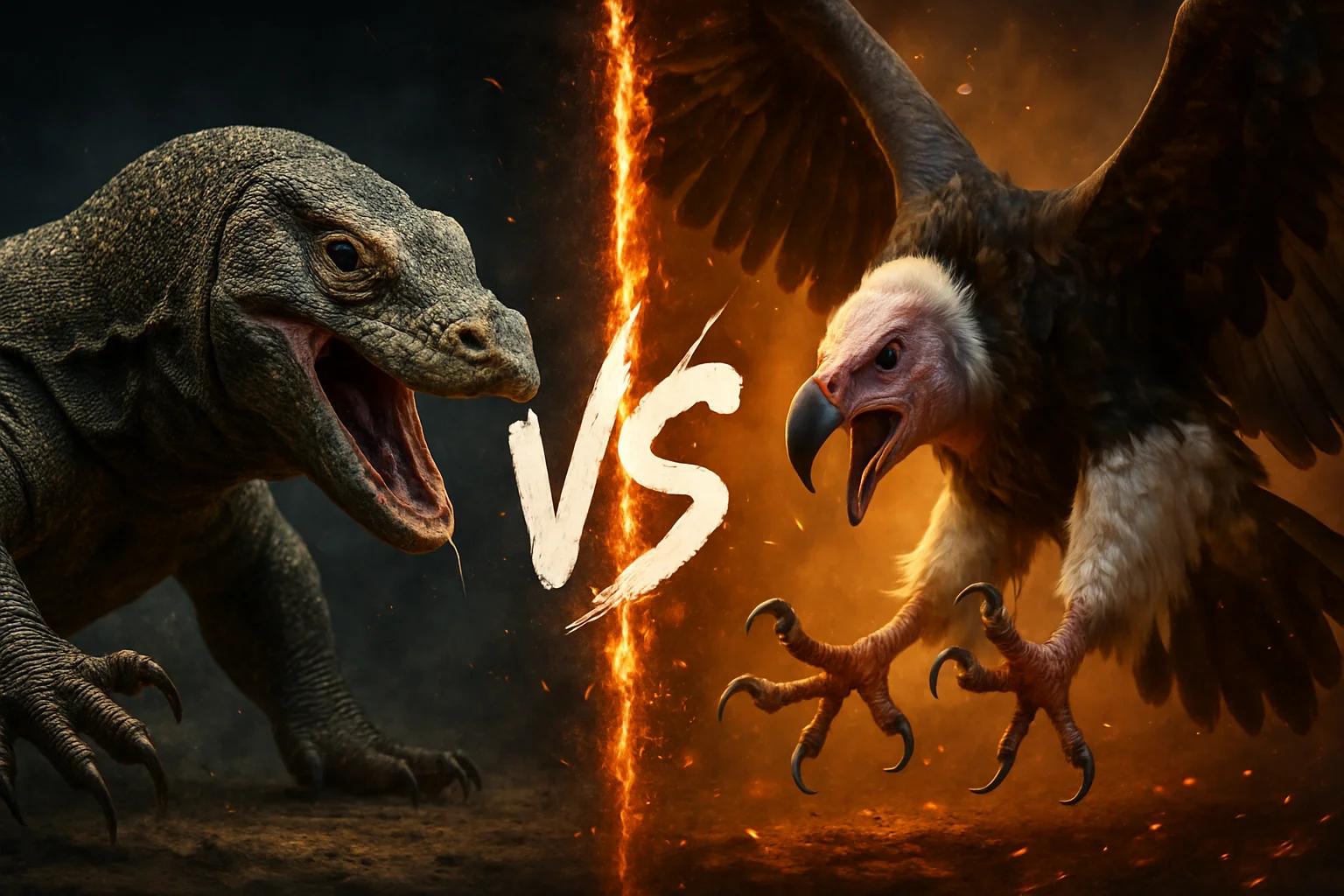
Komodo Dragon vs White-headed Vulture: Who Actually Wins?
The Komodo dragon wins clearly. An adult male can weigh 70–90 kg and reach about 3 m, armed with serrated, shark-like teeth, a venom-assisted bite that disrupts clotting, and armor-like osteoderms under its skin. The white-headed vulture weighs roughly 3.3–5.3 kg. It is a capable, assertive scavenger with a strong hooked bill, but it is built to tear open carcasses, not to fight a reptile twenty times its mass. If the vulture is caught on the ground within lunging range, the encounter is over in seconds. The vulture's real strengths are flight, early detection of food from soaring height, and the option to leave. That means it survives by avoiding the fight, not by winning it. In any scenario framed as a contest, the dragon's mass, bite, and close-range durability decide the outcome.
Read comparison
Discussion
What do you think?
Share your reasoning with other readers. Be civil and stick to the animals.
Sign in to join the discussion.
Sign inNo comments yet. Start the conversation.