

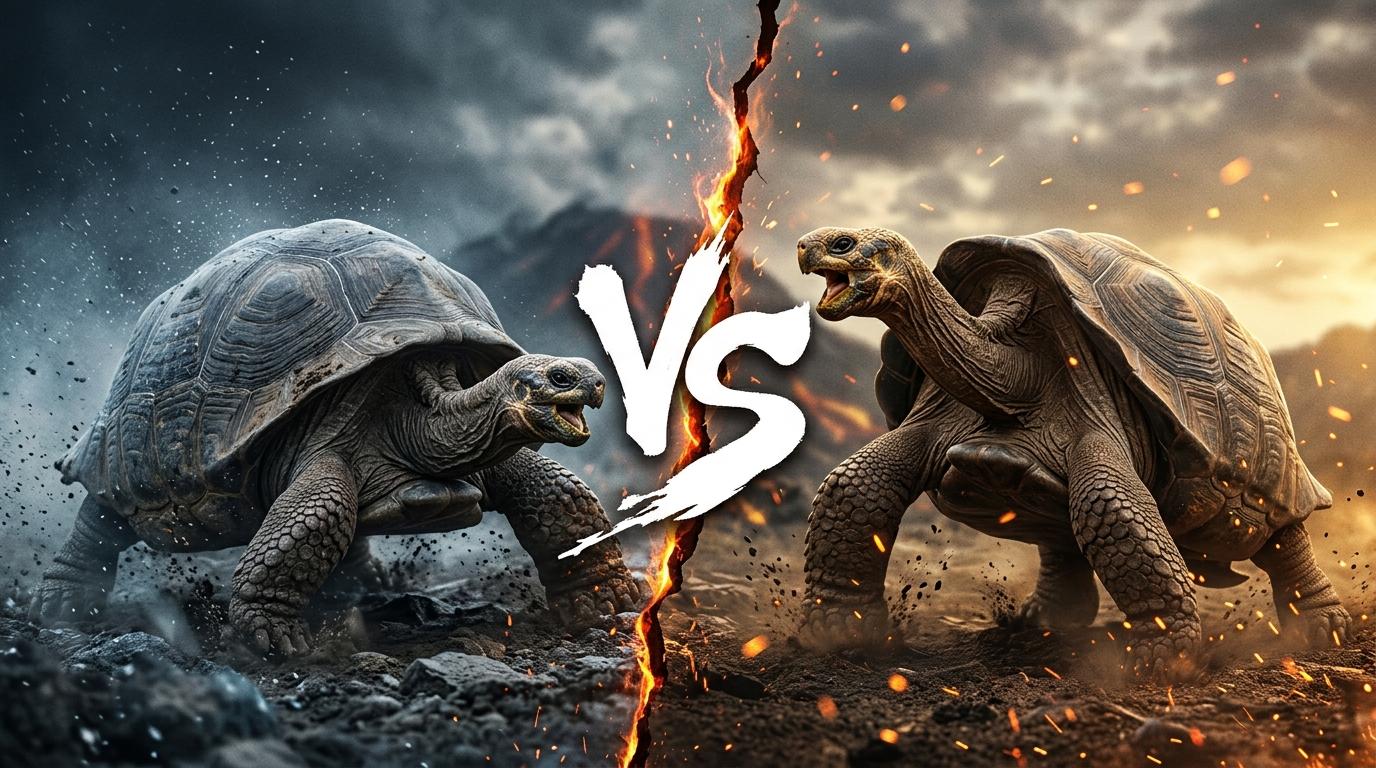
Aldabra Giant Tortoise vs Galápagos Tortoise: Who Actually Wins?
Aldabra giant tortoise vs Galápagos tortoise: a biology-first look at size, shell strength, neck reach and dominance rituals to decide which giant tortoise wins a head-to-head contest.
Aldabra Giant Tortoise vs Galápagos Tortoise
Matchup winner
Galápagos Tortoise
Quick verdict
Start with the direct answer, then use the structured comparison below to see what changes the outcome.
The Galápagos tortoise wins, though the margin is narrow. Both are armored, slow-motion heavyweights whose contests are about height, leverage and shoving rather than injury. The Galápagos lineage has the edge for three reasons. Its largest males can reach roughly 400 kg compared with about 250 kg for big Aldabra males. Its saddleback forms are built for the decisive neck-raising contest, in which the tortoise that stretches its head highest usually wins without a shove. And its slightly higher dominance score reflects ritualized standoffs that settle disputes quickly. The Aldabra tortoise is tough, socially seasoned from living in some of the densest tortoise populations on Earth, and very hard to overturn. In an even standoff, though, the Galápagos tortoise's extra mass and reach usually push it out of the space.
Read the full explanation
Winner: the Galápagos tortoise, by a modest margin.
Its biggest males outweigh big Aldabra males, sometimes by more than 100 kg.
Tortoise contests are won by height and leverage, which favors Galápagos neck reach.
The Aldabra tortoise is close in shell durability and shoving stamina, so the matchup is no blowout.
Reader vote
Who do you think wins?
Pick a side — no account needed. Results update live.
No votes yet — be the first to call it.
Editorial note
Why people disagree
The term 'Galápagos tortoise' covers several island species. A domed giant from Santa Cruz and a lighter saddleback from Española are very different opponents.
Heavyweight frame
In a shoving contest between armored animals, mass is the main currency, and the Galápagos tortoise has more of it.
Height-contest reach
Galápagos males often settle disputes by gaping and stretching upward, and the taller animal usually wins without contact.
Close-range durability
Domed shells are harder to overturn and expose less, which helps the Aldabra tortoise survive a losing shove.
Read the full explanation +
Aldabra tortoises live in crowded colonies and bump and shove each other constantly, which some readers see as more real-world contest experience.
Captive record animals skew comparisons. A famously huge zoo Aldabra can outweigh an average wild Galápagos male.
Comparison FAQ
Short, direct answers to the next questions readers usually ask after the headline verdict.
Would an Aldabra giant tortoise beat a Galápagos tortoise?+
Usually not. The Galápagos tortoise wins most contests through greater size and neck reach, although the Aldabra tortoise can hold its own on rocky, uneven ground.
Which tortoise is stronger?+
The largest Galápagos males are generally stronger in pushing power because they can be much heavier, up to around 400 kg compared with about 250 kg for big Aldabra males.
How do giant tortoises actually fight?+
Mostly through display. Rivals raise their bodies, stretch their necks and gape, and the taller animal usually wins. When a dispute escalates, they ram and shove, and occasionally one tortoise tips another over.
Why is the losing Aldabra tortoise still dangerous?+
Its thick, domed shell is very hard to overturn, it is used to constant jostling in crowded colonies, and a 250 kg animal shoving persistently can wear down or destabilize even a bigger rival.
Are Aldabra and Galápagos tortoises closely related?+
No. They resemble each other because of convergent island gigantism. Aldabra tortoises come from the Indian Ocean, while Galápagos tortoises descend from South American ancestors.
Head-to-head species stats
These are the same core AnimalDex stat dimensions used on the dedicated animal pages, pulled side by side so the matchup is faster to scan.
Aldabra Giant Tortoise
Tier CGalápagos Tortoise
Tier CTrait-by-trait comparison
Only the categories that matter to this matchup are included. The goal is not filler stats, but the real design differences that change the result.
Large males around 250 kg
Heavyweight frame
Galápagos Tortoise
Large males up to around 400 kg
Heavyweight frame
Galápagos Tortoise
Long neck under a domed shell
Height-contest reach
Galápagos Tortoise
Saddleback shells allow an extreme upward neck stretch
Height-contest reach
Galápagos Tortoise
Thick, high-domed fortress shell
Close-range durability
Aldabra Giant Tortoise
Massive shell; saddlebacks are more open at the front
Close-range durability
Aldabra Giant Tortoise
Dense colonies make shoving routine
Crowd-tested contests
Aldabra Giant Tortoise
Ritualized standoffs that resolve quickly
Crowd-tested contests
Aldabra Giant Tortoise
Moderate (48)
Dominance drive
Galápagos Tortoise
Stronger (54)
Dominance drive
Galápagos Tortoise
Very slow (8)
Slow-motion pursuit
Galápagos Tortoise
Very slow (9)
Slow-motion pursuit
Galápagos Tortoise
How the verdict forms
Verdict timeline
01 · Heavyweight frame
Galápagos Tortoise
02 · Height-contest reach
Galápagos Tortoise
03 · Close-range durability
Aldabra Giant Tortoise
04 · Crowd-tested contests
Aldabra Giant Tortoise
05 · Dominance drive
Galápagos Tortoise
06 · Slow-motion pursuit
Galápagos Tortoise
Change the conditions
Scenario breakdown
This is where shallow battle content usually fails. Terrain, spacing, timing, and engagement style can change the answer.
Scenario lean
Galápagos Tortoise
Verdict confidence
82%
The Galápagos tortoise claims the shade.
Shade is a critical resource for large tortoises, and in a tight space the contest becomes a slow ram and shove. The heavier Galápagos male can wedge the Aldabra tortoise out. The Aldabra's domed shell keeps it safe, but staying safe does not mean holding the spot.
AnimalDex field profiles
Explore these animals
Aldabra Giant Tortoise
Aldabrachelys gigantea
island scrub, grassland, and coastal woodland
Galápagos Tortoise
—
Habitat details are not published on a dedicated AnimalDex species page yet.
Species guide coming soon.
Systems Intelligence & Hidden Purpose
See the animals behind this comparison as engineered biological systems: what each one is built to do, where it gains leverage, and why the matchup changes by scenario.
Specialized Hardware
immense domed shell, very long lifespan, and slow island grazing give the Aldabra Giant Tortoise a body plan tuned for its niche.
Systems Script
Aldabra Giant Tortoises operate through island scrub, grassland, and coastal woodland Their design links movement, shelter, and feeding into one workable survival system.
Strategic Insight
The pace of a system can be a strength when the environment allows long-term stability.
Final take
This is a contest between two of evolution's best-armored herbivores, and neither is built to hurt the other. The outcome is decided by ritual, leverage and stubbornness, not by wounds.
Read the full explanation
The Galápagos tortoise wins most realistic frames. It brings more top-end mass, a taller display and a stronger push to escalate. The Aldabra tortoise is the more crowd-hardened and harder-to-flip opponent, and it can win on awkward terrain. In the classic standoff, though, the taller and heavier Galápagos male usually ends up owning the ground.
Collect both animals in AnimalDex
Track the species behind this matchup, compare their real traits, and build the rivalry into your AnimalDex collection.
Related comparisons
Continue with nearby matchups to compare more real-world animal traits without dropping into junky who-wins filler.
Galápagos Tortoise vs Giant Tortoise: Who Actually Wins?
The Giant Tortoise wins, but this matchup comes with a twist: the Galápagos tortoise is itself a giant tortoise. 'Giant Tortoise' here covers the whole heavyweight group, including the Chelonoidis species of the Galápagos and the Aldabra giant tortoise (Aldabrachelys gigantea). This page compares a typical Galápagos tortoise with the strongest contender that group can field. In the AnimalDex profile, the giant tortoise group scores higher on dominance (85 vs 54), size (80 vs 58), and speed (40 vs 9). Tortoise contests are not brawls. They are slow rituals of rising tall, gaping, and shoving, decided by height, mass, and footing. A group that can always send its biggest, most assertive male will usually out-reach and out-push a single average Galápagos individual. The upset path is real, though. A large domed Galápagos male is among the heaviest tortoises alive and can match anything in the group.
Read comparison
Boelen's Python vs Galápagos Tortoise: Who Actually Wins?
The Galápagos Tortoise wins, and it is not especially close. A Boelen's Python is a strong, glossy-black highland constrictor from New Guinea that can reach roughly 2.5 meters, but its whole kill system depends on wrapping prey, restricting circulation and breathing, and swallowing it whole. A Galápagos Tortoise can exceed 250 kg and is sealed inside a domed bony shell, so that system has nothing to work on. The python cannot meaningfully squeeze a shell, cannot pin an animal that outweighs it many times over, and cannot swallow something the size of a small armchair. The tortoise has no real hunting weapons either, but it does not need them. Its armor, mass, and patience make it untouchable here. In a contest of control and survival, the reptile that cannot be hurt beats the reptile that cannot finish.
Read comparison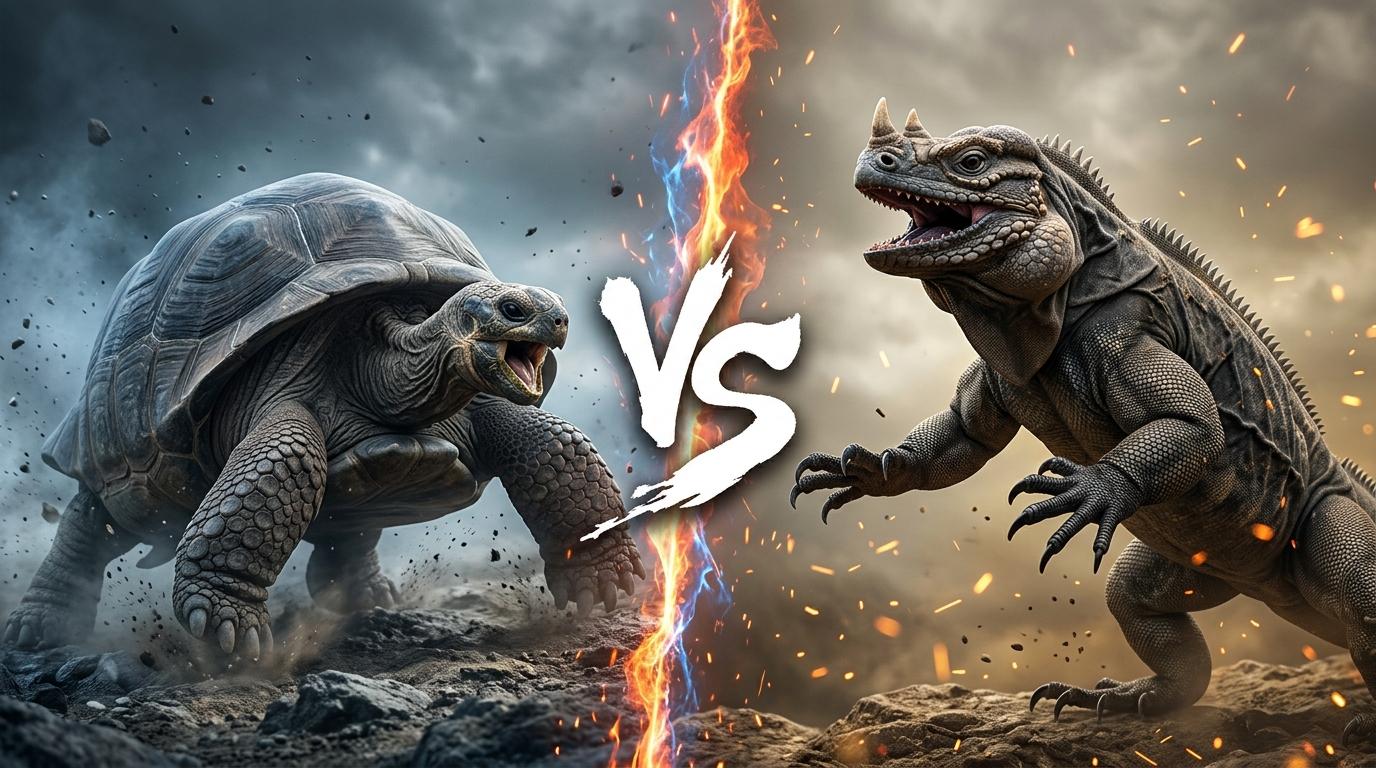
Aldabra Giant Tortoise vs Rhinoceros Iguana: Who Actually Wins?
The Aldabra Giant Tortoise wins. This is a contest between a living fortress and a fast, aggressive brawler. A big male Aldabra can top 250 kg with a carapace the iguana's jaws cannot meaningfully damage. The rhinoceros iguana is quicker and far more combative, with serrated teeth, a whipping tail, and real territorial aggression, but it weighs roughly 5–10 kg. It has no way to injure a tortoise that can pull its head and limbs behind armor. The tortoise doesn't need to hurt the iguana to win. It only needs to be unbeatable, and sheer mass lets it shove, pin, or simply outlast its rival. The iguana wins the first few seconds of tempo. The tortoise wins the outcome.
Read comparison
Discussion
What do you think?
Share your reasoning with other readers. Be civil and stick to the animals.
Sign in to join the discussion.
Sign inNo comments yet. Start the conversation.