

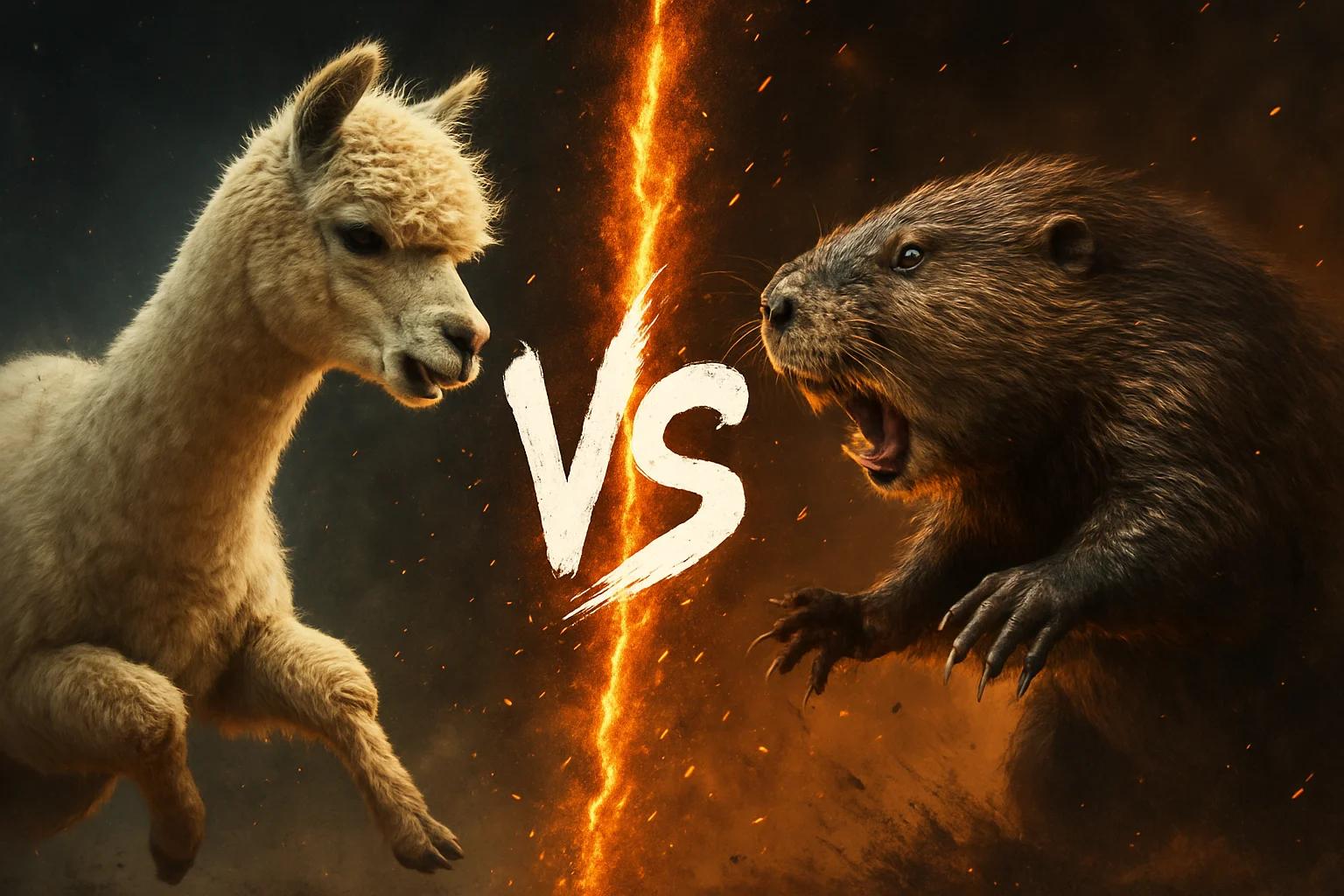
Alpaca vs North American Beaver: Who Actually Wins?
Alpaca vs beaver: who would win? We compare size, kicks, incisors, terrain, and behavior to explain why the alpaca usually wins on land and the beaver rules the water.
Alpaca vs North American Beaver
Matchup winner
Alpaca
Quick verdict
Start with the direct answer, then use the structured comparison below to see what changes the outcome.
The alpaca wins most realistic matchups, and the reason is mass and reach. An adult alpaca weighs roughly 48–84 kg and stands about 0.9 m at the shoulder. A large North American beaver weighs about 11–32 kg and stays low to the ground. On open land, the alpaca can chest-ram, stomp, and kick from above, and intact males carry sharp 'fighting teeth' built for herd disputes. The beaver brings the most dangerous single weapon in the matchup: self-sharpening, iron-reinforced orange incisors that can slice through hardwood and cause deep wounds. But the beaver is slow and awkward out of water, and it is built to escape rather than brawl. Once you move the contest into a pond, the result flips completely. Few matchups are this lopsided by terrain, but land is where the alpaca lives, and it is where most readers picture the encounter.
Read the full explanation
Alpaca wins on land: it is roughly 2–4x heavier and towers over the beaver.
The beaver's incisors are the scariest weapon here, but its body is built for water, not ground combat.
In or near water, the beaver wins easily by diving and refusing the fight.
Overall winner: Alpaca, with moderate confidence (~68%).
Reader vote
Who do you think wins?
Pick a side — no account needed. Results update live.
No votes yet — be the first to call it.
Editorial note
Why people disagree
People see 'chisel teeth that fell trees' and assume the beaver is a hidden killer. Wood-cutting power does not equal fighting reach against a tall, kicking ungulate.
Body mass & frame
Mass decides most small-animal confrontations. The alpaca can shove, trample, and absorb bites the beaver cannot.
Signature weapon
Bite for bite, the beaver's incisors cut deeper. That is its one real path to injuring an alpaca.
Ground mobility
The alpaca controls spacing and can strike and reposition. The beaver can't chase or retreat quickly on dry ground.
Read the full explanation +
Alpacas look fluffy and docile, so their kicks, chest-butts, and male fighting teeth get underrated. Guard alpacas are used to deter foxes and dogs for a reason.
The answer depends almost entirely on terrain. Beaver fans picture a pond bank, alpaca fans picture a pasture, and both are right about their own setting.
Comparison FAQ
Short, direct answers to the next questions readers usually ask after the headline verdict.
Would an alpaca beat a beaver in a fight?+
Yes, on land. The alpaca's much greater size, kicking power, and mobility usually overwhelm the beaver. Near or in water, the beaver wins by escaping.
Which is stronger, an alpaca or a beaver?+
The alpaca is stronger overall because of its far larger body. The beaver has the stronger bite: its jaws and incisors can cut through hardwood trees.
Why is a beaver still dangerous to an alpaca?+
Its self-sharpening, iron-reinforced incisors can cause deep cuts, especially to the legs. A cornered beaver fights fiercely, so even a winning alpaca could be injured.
Do alpacas fight other animals?+
Yes. Alpacas stomp, kick, chest-ram, and chase small predators like foxes, which is why farmers sometimes keep them as livestock guardians.
Would a beaver win in water?+
Yes. Beavers swim and dive expertly and can stay under for about 15 minutes, while an alpaca loses footing and agility in deep water.
Head-to-head species stats
These are the same core AnimalDex stat dimensions used on the dedicated animal pages, pulled side by side so the matchup is faster to scan.
Alpaca
Tier DNorth American Beaver
Tier CTrait-by-trait comparison
Only the categories that matter to this matchup are included. The goal is not filler stats, but the real design differences that change the result.
48–84 kg, tall leggy frame
Body mass & frame
Alpaca
11–32 kg, low stocky frame
Body mass & frame
Alpaca
Kicks, stomps, male fighting teeth
Signature weapon
North American Beaver
Self-sharpening iron-hard incisors
Signature weapon
North American Beaver
Agile, quick, padded feet
Ground mobility
Alpaca
Waddling, slow on land
Ground mobility
Alpaca
Can wade, poor in deep water
Water control
North American Beaver
Elite swimmer, 15-min dives
Water control
North American Beaver
Thick fleece padding, larger body
Close-range durability
Alpaca
Dense fur, tough hide, small target
Close-range durability
Alpaca
Alert herd guard, stomps intruders
Defensive temperament
Alpaca
Flees first, fierce when cornered
Defensive temperament
Alpaca
How the verdict forms
Verdict timeline
01 · Body mass & frame
Alpaca
02 · Signature weapon
North American Beaver
03 · Ground mobility
Alpaca
04 · Water control
North American Beaver
05 · Close-range durability
Alpaca
06 · Defensive temperament
Alpaca
Change the conditions
Scenario breakdown
This is where shallow battle content usually fails. Terrain, spacing, timing, and engagement style can change the answer.
Scenario lean
Alpaca
Verdict confidence
82%
Alpaca by a clear margin.
On dry, open land, every advantage favors the alpaca: height, mass, speed, and room to kick. The beaver has no escape route and must bite upward at a moving target protected by dense fleece. The alpaca's stomp-and-shove style is exactly how camelids drive off foxes and small dogs.
AnimalDex field profiles
Explore these animals
Alpaca
Vicugna pacos
Cool highland pasture and domestic grazing systems.
North American Beaver
Castor canadensis
Rivers, streams, ponds, and wetland systems with woody vegetation.
Systems Intelligence & Hidden Purpose
See the animals behind this comparison as engineered biological systems: what each one is built to do, where it gains leverage, and why the matchup changes by scenario.
Specialized Hardware
Small camelid body with fluffy coat, shorter face than many llamas, and fine dense fiber over much of the body give the Alpaca a body plan tuned for its niche.
Systems Script
Alpacas operate in cool highland pasture and domestic grazing systems. Their design helps them match food access, shelter, and timing inside that environment.
Strategic Insight
Gentle systems can still be highly effective when they fit their environment well.
Specialized Hardware
Large orange front teeth, flat paddle-shaped tail, and dense waterproof fur give the North American Beaver a body plan tuned for its niche.
Systems Script
North American Beavers operate in rivers, streams, ponds, and wetland systems with woody vegetation. Their design helps them match food access, shelter, and timing inside that environment.
Strategic Insight
Some of the strongest systems are built by improving the habitat, not just by surviving inside it.
Final take
The alpaca is the overall winner because most encounters people imagine happen on land, and land rewards size, reach, and agility. An alpaca outweighs a big beaver several times over and fights with a guard animal's instincts.
Read the full explanation
The beaver isn't a pushover. Its incisors are among the most formidable tools of any North American mammal. But it is a builder and a diver, not a ground brawler, and its best move is always the water. Give it a pond and it wins by vanishing. Leave it on dry ground and the alpaca takes the matchup.
Collect both animals in AnimalDex
Track the species behind this matchup, compare their real traits, and build the rivalry into your AnimalDex collection.
Related comparisons
Continue with nearby matchups to compare more real-world animal traits without dropping into junky who-wins filler.
Beaver vs Reindeer: Who Actually Wins?
The reindeer wins this matchup clearly. An adult reindeer weighs roughly 80–180 kg against a beaver's 15–30 kg, stands far taller, and carries antlers built for shoving contests plus sharp-edged hooves that strike hard and fast. Both sexes can grow antlers, which is unusual among deer. On open ground the reindeer's mass, reach and speed of around 60–80 km/h in bursts leave the beaver with no workable angle. The beaver's chisel incisors are genuinely dangerous and can open deep wounds. But a beaver's real defense is not fighting. It is water, and on land it is a slow, low-slung rodent facing an animal five to ten times its weight. Only at the pond's edge, where the beaver simply dives and vanishes, does the reindeer's advantage stop mattering.
Read comparison
Discussion
What do you think?
Share your reasoning with other readers. Be civil and stick to the animals.
Sign in to join the discussion.
Sign inNo comments yet. Start the conversation.