


Alpine Newt vs Oriental Fire-bellied Toad: Who Actually Wins?
Alpine newt vs Oriental fire-bellied toad: a biology-first breakdown of size, skin toxins, aquatic skill and behavior to settle who would win this small-amphibian matchup.
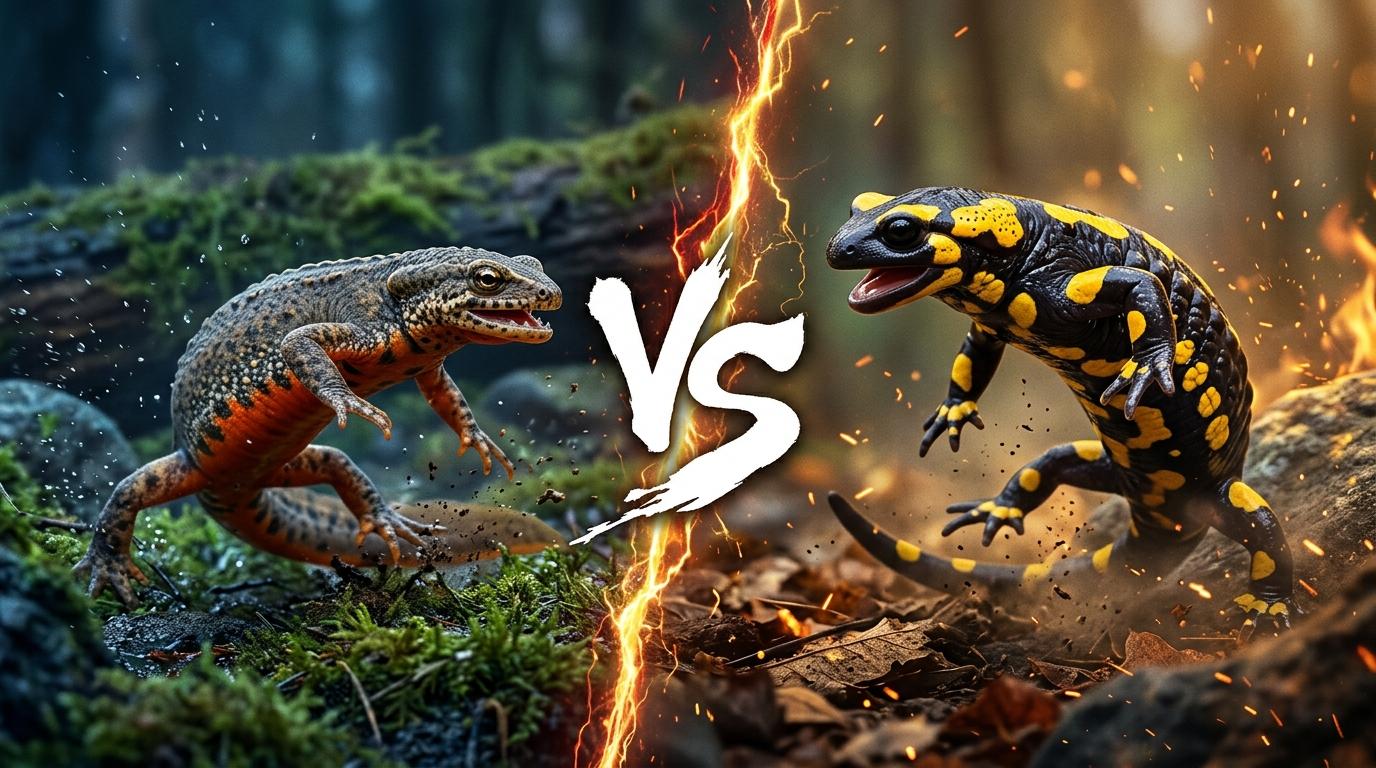
Alpine Newt vs Oriental Fire-bellied Toad
Matchup winner
Alpine Newt
Quick verdict
Start with the direct answer, then use the structured comparison below to see what changes the outcome.
The Alpine Newt wins this pond-edge showdown, but narrowly. At roughly 8–12 cm, the newt is about twice the length of the 4–5 cm Oriental Fire-bellied Toad. It also brings a long, sinuous tail built for water and a predator's habit of seizing small animals and eggs. In the water where these two would actually meet, the newt controls space, can out-maneuver the toad and can grab and pull. The toad is not helpless. Its skin secretes irritating peptide toxins, and its bright red-and-black underside, flashed in the 'unken reflex' posture, warns attackers away. That chemical defense means the newt is unlikely to kill or swallow an adult toad. However, it can win the contest of space, food and position. On size, reach and aquatic control, the newt takes it. The toad's toxins keep the outcome closer than the size gap suggests.
Read the full explanation
Alpine Newt wins overall, mainly on size and aquatic agility.
The fire-bellied toad's toxic skin and warning display make it a bad meal, not an easy victim.
In open water the newt dominates; on land the toad's hopping and chemical defense even the odds.
In real life, adults mostly avoid each other. The newt is far more dangerous to toad eggs and tadpoles.
Reader vote
Who do you think wins?
Pick a side — no account needed. Results update live.
No votes yet — be the first to call it.
Editorial note
Why people disagree
Size versus chemistry: the newt is bigger, but the toad's skin secretions are a stronger deterrent than many expect.
Size and reach
In amphibian scuffles, the larger animal sets the terms. A longer body means more grip, more push and more leverage.
Aquatic control
These two meet in breeding ponds, where the newt's swimming skill gives it positional dominance.
Chemical deterrence
Toxins don't win fights, but they stop the fight from ending in a meal. This is the toad's insurance policy.
Read the full explanation +
'Winning' is unclear in amphibians. Driving a rival off is not the same as eating it, and neither species is built to kill the other as an adult.
Habitat changes everything. Water favors the swimming newt, while damp ground and leaf litter suit the jumpy, display-ready toad.
Comparison FAQ
Short, direct answers to the next questions readers usually ask after the headline verdict.
Would an Alpine Newt beat an Oriental Fire-bellied Toad?+
Yes, most of the time, especially in water. Its larger size and swimming skill let it dominate the encounter, though it would rarely kill an adult toad.
Which is stronger, the Alpine Newt or the fire-bellied toad?+
The Alpine Newt. It is longer and heavier, with more body leverage. The toad compensates with toxins rather than strength.
Why is the fire-bellied toad still dangerous if it loses?+
Its skin secretes irritating peptides, and its red belly warns predators. Any animal that bites it risks a burning mouth and quickly learns to let go.
Is the Alpine Newt poisonous?+
It has mild skin secretions, but they are much weaker as a deterrent than the fire-bellied toad's.
Do these two species meet in the wild?+
Not naturally. Alpine newts live in Europe and fire-bellied toads in East Asia, so this is a hypothetical matchup based on their biology.
Head-to-head species stats
These are the same core AnimalDex stat dimensions used on the dedicated animal pages, pulled side by side so the matchup is faster to scan.
Alpine Newt
Tier DOriental Fire-bellied Toad
Tier CTrait-by-trait comparison
Only the categories that matter to this matchup are included. The goal is not filler stats, but the real design differences that change the result.
8–12 cm with a long tail
Size and reach
Alpine Newt
4–5 cm, compact
Size and reach
Alpine Newt
Tail-driven swimmer that hunts underwater
Aquatic control
Alpine Newt
Capable paddler that floats at the surface
Aquatic control
Alpine Newt
Mild skin secretions
Chemical deterrence
Oriental Fire-bellied Toad
Potent irritant peptides and aposematic coloring
Chemical deterrence
Oriental Fire-bellied Toad
Orange belly, rarely shown defensively
Warning display
Oriental Fire-bellied Toad
Unken reflex flashes a red belly
Warning display
Oriental Fire-bellied Toad
Quick underwater lunges
Burst movement
Oriental Fire-bellied Toad
Short hops on land, kicks in water
Burst movement
Oriental Fire-bellied Toad
Eats invertebrates, eggs and tadpoles
Predatory drive
Alpine Newt
Eats insects and small invertebrates
Predatory drive
Alpine Newt
How the verdict forms
Verdict timeline
01 · Size and reach
Alpine Newt
02 · Aquatic control
Alpine Newt
03 · Chemical deterrence
Oriental Fire-bellied Toad
04 · Warning display
Oriental Fire-bellied Toad
05 · Burst movement
Oriental Fire-bellied Toad
06 · Predatory drive
Alpine Newt
Change the conditions
Scenario breakdown
This is where shallow battle content usually fails. Terrain, spacing, timing, and engagement style can change the answer.
Scenario lean
Alpine Newt
Verdict confidence
82%
The newt dominates its home medium.
Underwater, the newt's laterally flattened tail gives it fast, precise movement. It can lunge, grab and hold position while the toad bobs near the surface. The toad's toxins may make the newt release its grip, but the newt controls the encounter and the space.
AnimalDex field profiles
Explore these animals
Alpine Newt
Ichthyosaura alpestris
pond, marsh edge, and cool mountain woodland
Oriental Fire-bellied Toad
—
Habitat details are not published on a dedicated AnimalDex species page yet.
Species guide coming soon.
Systems Intelligence & Hidden Purpose
See the animals behind this comparison as engineered biological systems: what each one is built to do, where it gains leverage, and why the matchup changes by scenario.
Specialized Hardware
orange belly in breeding season, smooth pond-ready body, and dual land-and-water life cycle give the Alpine Newt a body plan tuned for its niche.
Systems Script
Alpine Newts operate through pond, marsh edge, and cool mountain woodland. Their design links movement, feeding, shelter, and timing into one workable survival system.
Strategic Insight
In steep terrain, balance and route control matter more than brute force.
Final take
The Alpine Newt is the overall winner. It is roughly twice as long, much better adapted to underwater movement and the more opportunistic predator. In the ponds where the two species overlap, those advantages let the newt control space and resources.
Read the full explanation
The Oriental Fire-bellied Toad still holds an important card. Its peptide-laced skin and dramatic warning display mean almost nothing that grabs it enjoys the experience. Even a winning newt is unlikely to finish the job.
Think of this matchup as a contest of control versus deterrence. The newt controls the water, and the toad makes sure that control never turns into a meal.
Collect both animals in AnimalDex
Track the species behind this matchup, compare their real traits, and build the rivalry into your AnimalDex collection.
Related comparisons
Continue with nearby matchups to compare more real-world animal traits without dropping into junky who-wins filler.
Alpine Newt vs Fire Salamander: Who Actually Wins?
The fire salamander wins this matchup overall. A typical adult runs 15–20 cm and is thick-bodied and heavy for an amphibian. A typical alpine newt is about 8–12 cm and slender. The salamander also carries one of Europe's strongest amphibian chemical defenses. Its parotoid glands and dorsal pores hold samandarine-type alkaloids that it can ooze or even squirt under pressure. The alpine newt is quicker, more alert, and far better in water. On land, though, it faces an opponent it can't overpower, can't safely bite, and can't easily push off a shelter. Most realistic contact between them happens on the damp forest floor, where the salamander lives as an adult. That habitat advantage, plus its size and toxins, decides the result. The newt wins clearly in only one setting: open water, where an adult fire salamander is an awkward swimmer that can even drown.
Read comparison
Oriental Fire-bellied Toad vs Marbled Newt: Who Actually Wins?
The Marbled Newt wins this matchup overall, mainly because it is bigger. A typical adult Triturus marmoratus runs roughly 12–16 cm long, while Bombina orientalis usually tops out around 4–5 cm. Both species rely on skin toxins rather than fighting, and neither has anything like a predator's killing toolkit, so a 'fight' between them comes down to body mass, gape, reach and staying power. The newt can grab, shove and push the little toad off a contested spot, and its own skin secretions make it a poor target in return. The fire-bellied toad has sharper reactions and an excellent warning display, and its bitter, irritating secretions mean nothing that tastes it comes away comfortable. It can win short stand-offs on land, but when contact actually happens, the newt's size usually decides it.
Read comparison
Australian Green Tree Frog vs Oriental Fire-bellied Toad: Who Actually Wins?
The Australian Green Tree Frog wins this one. At roughly 7–10 cm and up to about 80+ g, it is several times heavier than the 4–5 cm Oriental Fire-bellied Toad. It also has a wide gape that lets it swallow nearly anything that fits, including small frogs. The fire-bellied toad's real weapon is chemical. Its skin secretes irritating, bad-tasting compounds, and it shows them off with a bright red-and-black belly (the unken reflex). That makes it a poor meal and an unpleasant thing to grab. But it is a deterrent, not a way to win a fight. In a size-dominated amphibian encounter, the bigger, stronger-gripping frog controls the exchange, and the toad's best outcome is being spat out unhurt.
Read comparison
Alpine Newt vs Emperor Newt: Who Actually Wins?
The Emperor Newt (Tylototriton shanjing) wins this matchup. It is the bigger, heavier-built animal at roughly 12–17 cm against the Alpine Newt's 8–12 cm. Its ridged, warty skin and rib-tip defense let it press bony rib ends against swollen poison glands to deliver toxin to anything that bites it. Newts don't fight to the death. Contests between them come down to shoving, mouth-grabbing, pushing a rival off food, and making yourself costly to bite. In that kind of contest, the Emperor Newt's mass, crocodile-like armored dorsal ridges and chemical deterrence outweigh the Alpine Newt's quicker, more agile aquatic movement. The Alpine Newt can win the race to food in open water. In any sustained grapple or bite exchange, the larger, better-defended Emperor Newt holds its ground and makes the smaller newt let go first.
Read comparison
Discussion
What do you think?
Share your reasoning with other readers. Be civil and stick to the animals.
Sign in to join the discussion.
Sign inNo comments yet. Start the conversation.