

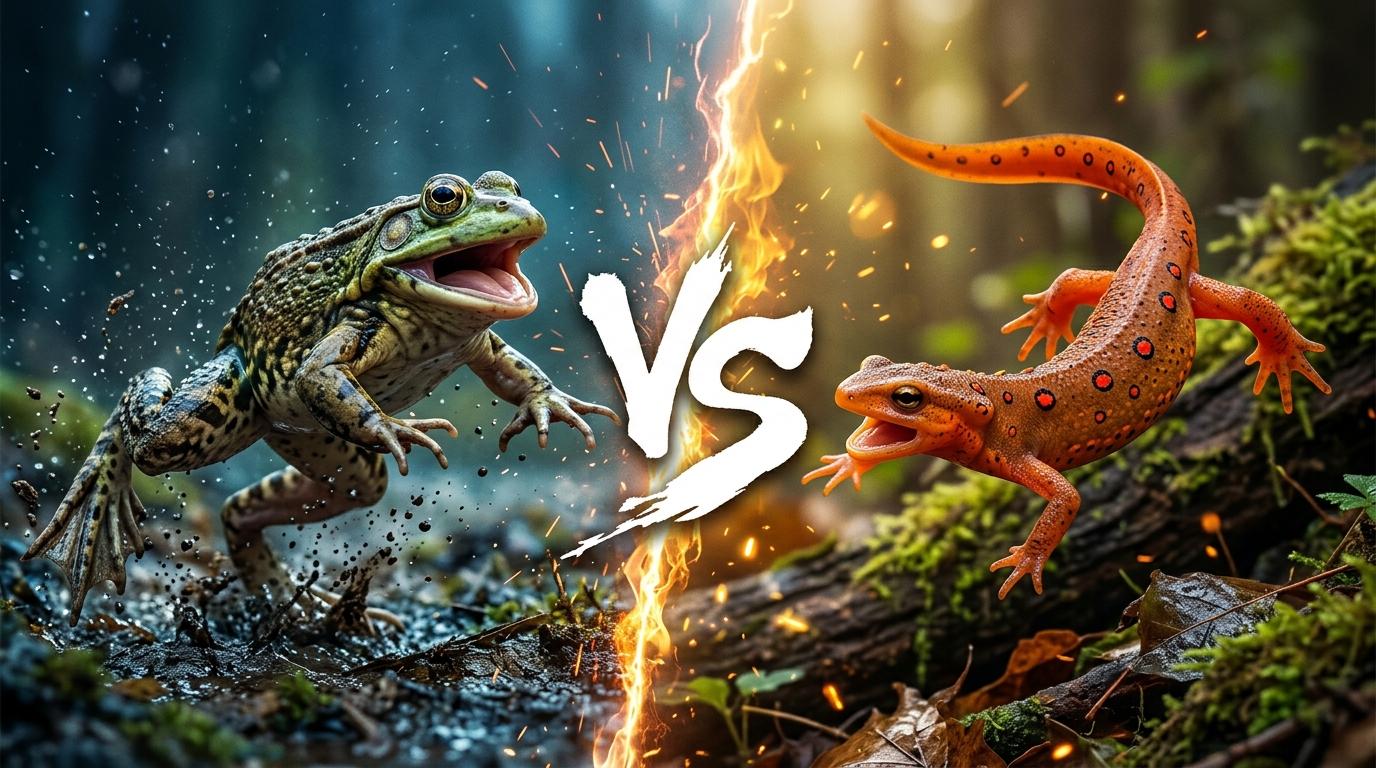
American Bullfrog vs Eastern Newt: Who Actually Wins?
American Bullfrog vs Eastern Newt: a biology-first look at size, gape, toxins and pond tactics, and why the bullfrog wins while the toxic newt stays dangerous.
American Bullfrog vs Eastern Newt
Matchup winner
American Bullfrog
Quick verdict
Start with the direct answer, then use the structured comparison below to see what changes the outcome.
The American Bullfrog wins clearly. It is the largest frog in North America at up to about 20 cm body length and over 500 g, with a gape wide enough to swallow snakes, birds, and other frogs. An adult Eastern Newt is roughly 7–12 cm long and weighs a few grams. The bullfrog's sit-and-wait lunge, sticky tongue, and swallow-whole feeding mean it rarely needs to 'fight' at all. The newt's real defense is chemical, not physical. Its skin carries tetrodotoxin, most potently in the bright red eft stage. That toxin can sicken a predator or make it spit the newt out, so many bullfrogs learn to avoid newts or reject them. But in a direct confrontation, the bullfrog controls the encounter, and the newt has no way to injure it except by being unpleasant to eat.
Read the full explanation
The American Bullfrog wins. It is dozens of times heavier and can swallow the newt whole.
The Eastern Newt cannot meaningfully attack a bullfrog. Its only weapon is skin toxin.
Tetrodotoxin makes the newt a risky meal, so 'winning' does not always mean the bullfrog eats it safely.
The newt's best result is to be spat out and survive, not to beat the bullfrog.
Reader vote
Who do you think wins?
Pick a side — no account needed. Results update live.
No votes yet — be the first to call it.
Editorial note
Why people disagree
Toxicity confuses the scoreboard. A poisonous animal can 'win' by making the predator sick, even after losing the encounter.
Size and mass
The mass gap is extreme. The bullfrog can engulf the newt entirely, which ends any contest before it starts.
Strike and capture
Bullfrogs are built to capture vertebrate prey. Newts are built to pick at small food items.
Chemical defense
This is the newt's one real edge. It turns a successful bullfrog attack into a possible bad meal.
Read the full explanation +
The red eft and the aquatic adult newt differ in toxin level and habitat, so which life stage you picture changes the story.
Bullfrogs are famous for eating almost anything. In reality they often reject newts, which looks like the newt winning when it is really predator avoidance.
Comparison FAQ
Short, direct answers to the next questions readers usually ask after the headline verdict.
Would an American Bullfrog beat an Eastern Newt?+
Yes. The bullfrog is far larger and can seize and swallow the newt. The newt has no physical way to hurt it.
Which is stronger, a bullfrog or a newt?+
The bullfrog, by a huge margin. It can weigh over a hundred times more and has powerful jumping legs and a wide gape.
Is the Eastern Newt poisonous to bullfrogs?+
Yes. Its skin contains tetrodotoxin, especially in the red eft stage. Bullfrogs that grab newts may spit them out or become sick.
Why is the newt still dangerous even though it loses?+
Its toxin punishes predators after contact. A bullfrog can win the encounter and still pay for it, which is why many predators learn to leave newts alone.
Do bullfrogs eat newts in the wild?+
Bullfrogs eat a very wide range of animals, but newts are often avoided or rejected because of their toxins.
Head-to-head species stats
These are the same core AnimalDex stat dimensions used on the dedicated animal pages, pulled side by side so the matchup is faster to scan.
American Bullfrog
Tier DEastern Newt
Tier DTrait-by-trait comparison
Only the categories that matter to this matchup are included. The goal is not filler stats, but the real design differences that change the result.
Up to ~20 cm, 500+ g
Size and mass
American Bullfrog
~7–12 cm, a few grams
Size and mass
American Bullfrog
Explosive leg-powered lunge, sticky tongue, huge gape
Strike and capture
American Bullfrog
Small jaws suited to invertebrates and eggs
Strike and capture
American Bullfrog
Mild skin secretions, not a major deterrent
Chemical defense
Eastern Newt
Tetrodotoxin in skin, strongest in red efts
Chemical defense
Eastern Newt
Camouflage greens and browns
Warning signals
Eastern Newt
Bright orange-red eft coloration, red spots on adults
Warning signals
Eastern Newt
Robust body, tolerates struggling prey
Close-range durability
American Bullfrog
Fragile, relies on regeneration after injury
Close-range durability
American Bullfrog
Powerful jumps and fast lunges
Burst mobility
American Bullfrog
Slow walking on land, moderate swimming
Burst mobility
American Bullfrog
How the verdict forms
Verdict timeline
01 · Size and mass
American Bullfrog
02 · Strike and capture
American Bullfrog
03 · Chemical defense
Eastern Newt
04 · Warning signals
Eastern Newt
05 · Close-range durability
American Bullfrog
06 · Burst mobility
American Bullfrog
Change the conditions
Scenario breakdown
This is where shallow battle content usually fails. Terrain, spacing, timing, and engagement style can change the answer.
Scenario lean
American Bullfrog
Verdict confidence
82%
Bullfrog dominates the ambush.
This is the bullfrog's home frame. It sits motionless at the waterline and lunges at anything moving that fits in its mouth. A swimming adult newt is a plausible target, and the capture is nearly instant. The newt's toxin may prompt rejection after the bite, but control of the encounter belongs entirely to the bullfrog.
AnimalDex field profiles
Explore these animals
American Bullfrog
Lithobates catesbeianus
Ponds, lakes, marshes, canals, and warm slow freshwater with aquatic vegetation.
Eastern Newt
Notophthalmus viridescens
Woodland, ponds, marshes, wet meadows, and slow freshwater habitats.
Systems Intelligence & Hidden Purpose
See the animals behind this comparison as engineered biological systems: what each one is built to do, where it gains leverage, and why the matchup changes by scenario.
Specialized Hardware
Large gape, powerful hind limbs, and broad diet flexibility make bullfrogs generalist hardware for ponds, marshes, and human-shaped water bodies.
Systems Script
Bullfrogs turn almost any still-water system into an opportunity by eating widely and reproducing effectively. They show how generalist biology can become infrastructure-level competitive advantage.
Strategic Insight
Breadth becomes power when you can perform adequately across many conditions while specialists wait for perfect ones.
Specialized Hardware
Bright orange juvenile eft stage, olive-green aquatic adult stage, and small spotted slender body give the Eastern Newt a body plan tuned for its niche.
Systems Script
Eastern Newts operate in woodland, ponds, marshes, wet meadows, and slow freshwater habitats. Their design helps them match food access, shelter, and timing inside that environment.
Strategic Insight
A system can survive more environments when it does not stay locked in one form forever.
Final take
The American Bullfrog is the clear winner. Massive size advantage, an ambush-and-engulf feeding style, and a body built for subduing vertebrate prey make this a lopsided physical matchup.
Read the full explanation
The Eastern Newt's story is about deterrence, not combat. Its tetrodotoxin and warning colors are designed to make predators choose not to engage. That strategy often works, but it does not reverse the outcome when a bullfrog commits to a strike.
Collect both animals in AnimalDex
Track the species behind this matchup, compare their real traits, and build the rivalry into your AnimalDex collection.
Related comparisons
Continue with nearby matchups to compare more real-world animal traits without dropping into junky who-wins filler.
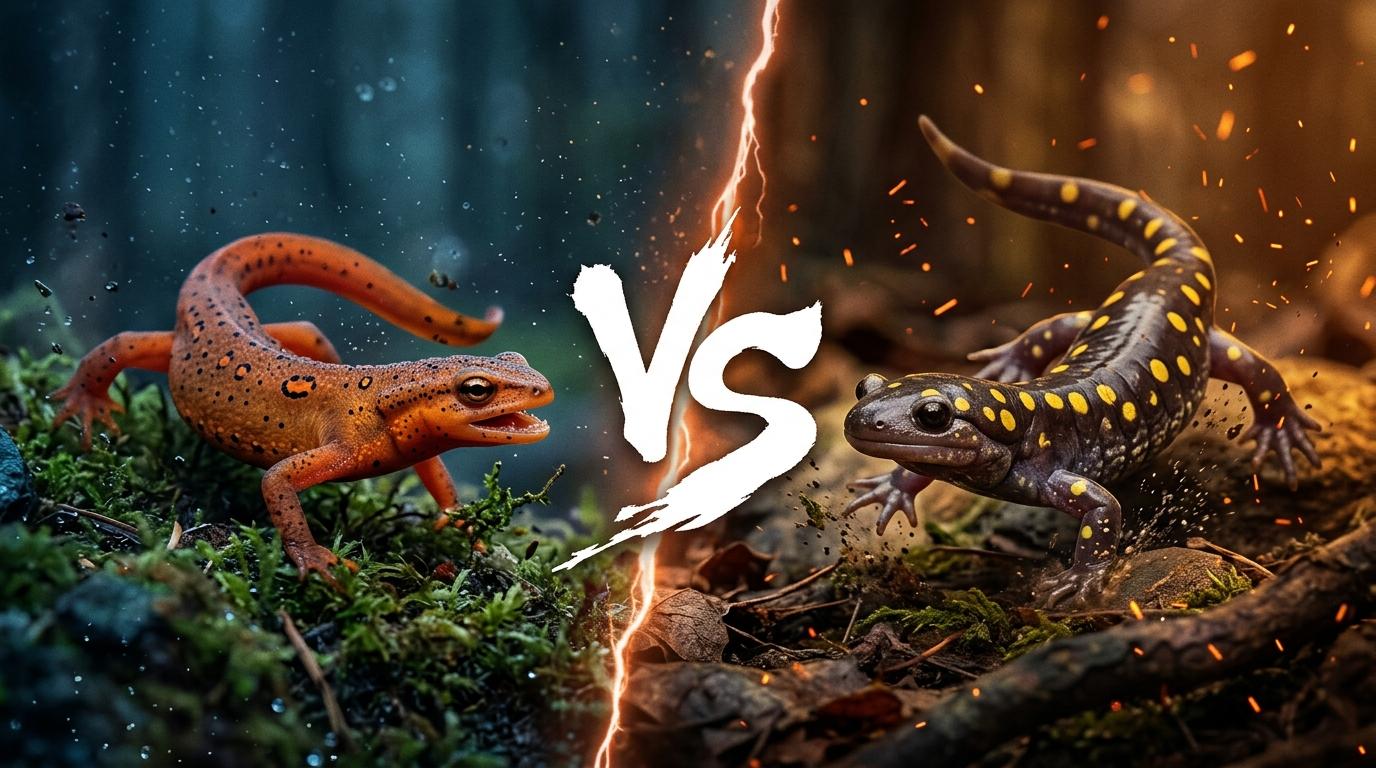
Eastern Newt vs Spotted Salamander: Who Actually Wins?
The Spotted Salamander wins this matchup overall. Adults commonly reach 15–25 cm with a stout, heavy body, while Eastern Newts usually measure about 6–14 cm and are slim. On land, under logs and leaf litter, mass and grip decide who keeps a spot, and that favors the salamander. The newt is still a real contender. Its skin carries tetrodotoxin, and in open pond water its paddle-like tail makes it the more agile animal. Its best ecological 'win' is eating spotted salamander eggs and larvae. Even so, in an adult-versus-adult contest, the spotted salamander's size advantage, defensive skin secretions, and burrow habits carry more situations.
Read comparison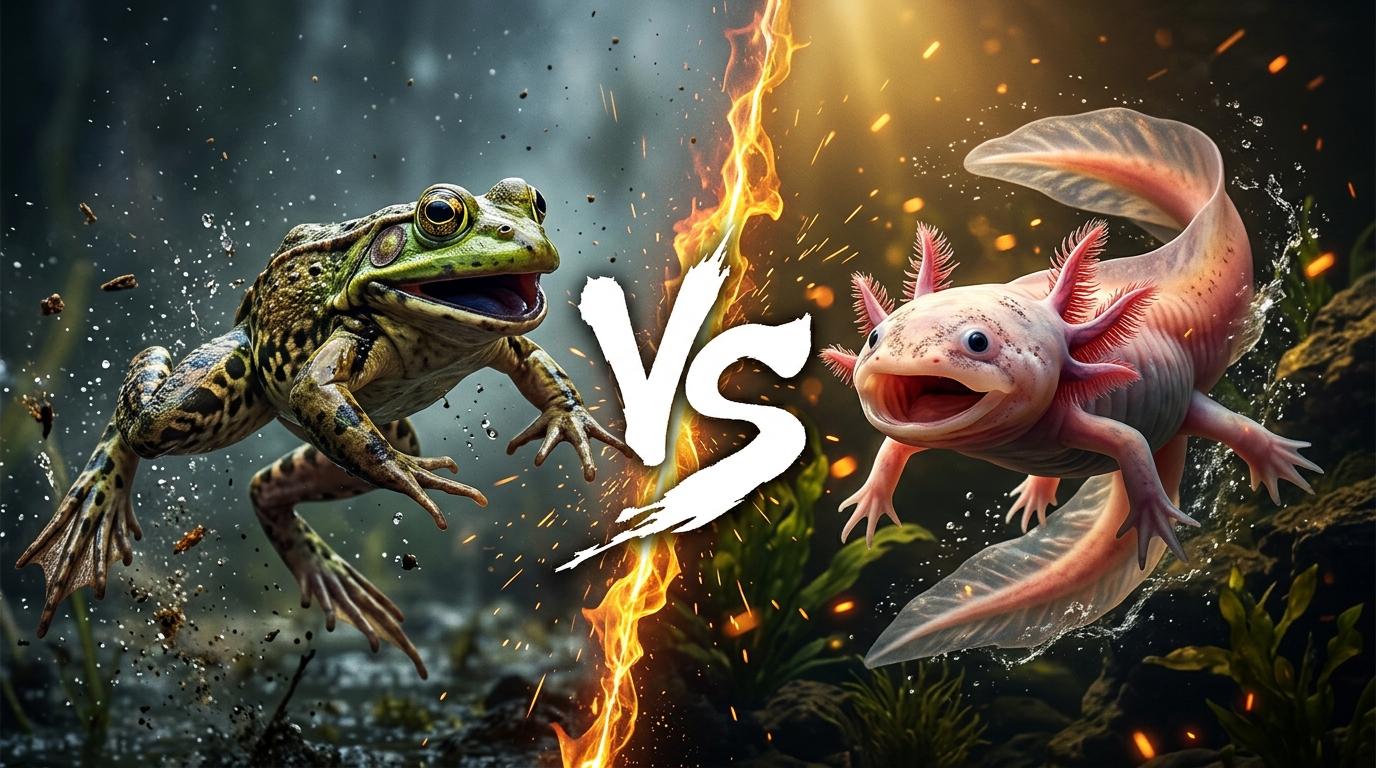
American Bullfrog vs Axolotl: Who Actually Wins?
The American Bullfrog wins, and it isn't especially close. An adult bullfrog can reach about 15–20 cm in body length and often weighs 300–500 g. It is a gape-limited swallowing predator: it lunges, pins prey with its forelimbs, and gulps down anything that fits in its mouth, including other amphibians. An adult axolotl is often 20–25 cm long, but much of that is tail, and it usually weighs only 60–110 g. It feeds by suction on small, soft prey. It has no fangs, no armored skin, and no strong burst escape on land. In shared water, the bullfrog's explosive leg drive and huge mouth beat the axolotl's slower, buoyancy-based movement. The axolotl's real superpower is regeneration, and that is a recovery trait, not a combat trait.
Read comparison
American Bullfrog vs Mudpuppy: Who Actually Wins?
The American Bullfrog wins this matchup. Both are aquatic ambush feeders that swallow prey whole, but the bullfrog brings advantages the mudpuppy cannot match: a far heavier, more muscular body (adults often reach 400–500 g, against a mudpuppy's typical 100–200 g), an enormous gape that can engulf animals nearly its own length, explosive leg-driven strikes, and a well-documented habit of eating other amphibians, including salamanders. The mudpuppy is a capable bottom predator with good chemical senses and a slippery, elongated body, but it is built for slow foraging under rocks rather than for confrontation. When the two meet, it is far more likely to be prey than predator. The mudpuppy's real edge is cold, deep, flowing water where bullfrogs are sluggish or absent. In a direct encounter in shared shallows, the frog's mass and mouth decide the outcome.
Read comparison
Discussion
What do you think?
Share your reasoning with other readers. Be civil and stick to the animals.
Sign in to join the discussion.
Sign inNo comments yet. Start the conversation.