

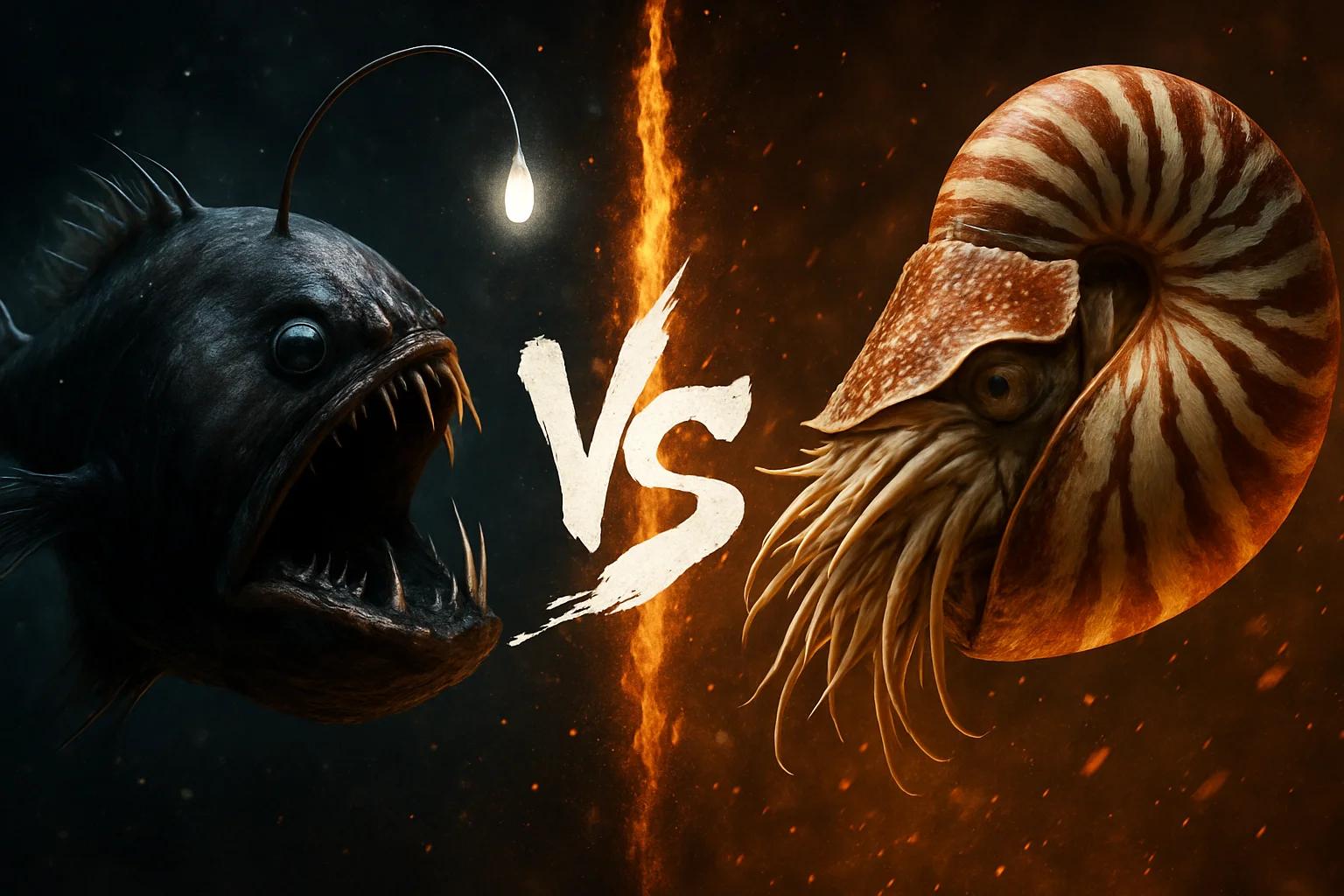
Black Seadevil vs Chambered Nautilus: Who Actually Wins?
Black Seadevil anglerfish vs Chambered Nautilus: which deep-sea animal wins? Here is a biology-first breakdown of jaws vs armor, lures vs buoyancy, and why the shell gets the edge.
Black Seadevil vs Chambered Nautilus
Matchup winner
Chambered Nautilus
Quick verdict
Start with the direct answer, then use the structured comparison below to see what changes the outcome.
The Chambered Nautilus wins this one, and it wins by refusing to be eaten more than by overpowering anything. The Black Seadevil is the scarier-looking predator. Females carry a glowing bacterial lure, hinged needle teeth, and a stretchy stomach that can swallow prey longer than their own roughly 18 cm body. That whole system is built for soft-bodied fish and crustaceans that drift into reach, though. An adult nautilus is a 15–20 cm coiled shell of calcium carbonate. It can pull its soft body inside and seal the opening with a leathery hood, and the anglerfish's teeth have no way to crack or pry that armor. The nautilus also has a sharp, parrot-like beak and dozens of grasping tentacles, and it eats carrion and slow animals. Against a flabby, weak-muscled ambusher that mostly hangs motionless in the dark, that gives the nautilus real counter-damage. The seadevil holds more threat on paper, but the nautilus controls the actual outcome. The verdict comes with an honest caveat: the two rarely if ever meet, and a fight between them would be slow, short, and mostly decided by armor.
Read the full explanation
Winner: Chambered Nautilus, on armor plus a counter-biting beak.
The Black Seadevil's gape and teeth are built for soft prey, not a sealed shell.
A small juvenile nautilus is genuinely at risk. An adult mostly is not.
In the wild they barely overlap: nautilus stays near reef slopes above about 700 m, while the seadevil drifts in open water.
Reader vote
Who do you think wins?
Pick a side — no account needed. Results update live.
No votes yet — be the first to call it.
Editorial note
Why people disagree
The seadevil looks like the ultimate predator, so people assume the fanged animal wins. Swallowing prey bigger than yourself only works if that prey can be squeezed.
Strike lethality
Against soft-bodied prey, the seadevil's swallow-whole strike is devastating, and this is its best category.
Close-range durability
This is the decisive category. Teeth that cannot grip or crack armor turn the seadevil's best weapon into a bluff.
Maneuver control
Neither is fast, but the nautilus can rise, sink, and back away at will. The seadevil depends on prey coming to it.
Read the full explanation +
Nautiluses are pegged as gentle living fossils, but they are active scavengers and predators with a hard beak. The 'harmless' label undersells them.
Some readers count 'nobody dies' as a draw. In a survival-based matchup, the animal that ends the encounter intact and in control takes it.
Comparison FAQ
Short, direct answers to the next questions readers usually ask after the headline verdict.
Would a Black Seadevil beat a Chambered Nautilus?+
Usually no. An adult nautilus's shell and hood defeat the seadevil's teeth and gape, and the nautilus can bite back or swim away. Only a small juvenile nautilus is at real risk.
Which is stronger, the Black Seadevil or the Chambered Nautilus?+
The nautilus is sturdier and better at gripping and handling, while the seadevil has the deadlier strike against soft prey. Raw muscle is low in both. The seadevil in particular has a weak, watery body.
Can an anglerfish eat a nautilus?+
A hatchling, possibly. An adult nautilus is too rigid and bulky for the seadevil to swallow, and too hard to crack.
Why is the Black Seadevil still dangerous even if it loses?+
Its lure gives it control of the first moment in total darkness, and its gape can take prey longer than its own body. Any soft-bodied or small animal that approaches is in serious danger.
Do they live in the same place?+
Barely. Nautiluses live on Indo-Pacific reef slopes, typically about 100–500 m deep, and their shells risk implosion much deeper. Black seadevils drift in open ocean water, mostly a few hundred to over 1,000 m down.
Head-to-head species stats
These are the same core AnimalDex stat dimensions used on the dedicated animal pages, pulled side by side so the matchup is faster to scan.
Black Seadevil
Tier CChambered Nautilus
Tier CTrait-by-trait comparison
Only the categories that matter to this matchup are included. The goal is not filler stats, but the real design differences that change the result.
Hinged needle teeth, huge gape, distensible stomach
Strike lethality
Black Seadevil
Sharp chitinous beak, no venom of note
Strike lethality
Black Seadevil
Soft, flabby body with weak skeleton
Close-range durability
Chambered Nautilus
Coiled chambered shell plus protective hood
Close-range durability
Chambered Nautilus
Mostly motionless hunter, slow bursts
Maneuver control
Chambered Nautilus
Jet propulsion plus precise buoyancy control
Maneuver control
Chambered Nautilus
Bioluminescent lure in total darkness
Ambush control
Black Seadevil
Smell-driven forager, no lure
Ambush control
Black Seadevil
Jaws only
Grappling and handling
Chambered Nautilus
About 90 sucker-less, adhesive-ridged tentacles
Grappling and handling
Chambered Nautilus
Females about 18 cm, much of it head and mouth
Mass in the matchup
Chambered Nautilus
Shell about 15–20 cm in adults
Mass in the matchup
Chambered Nautilus
How the verdict forms
Verdict timeline
01 · Strike lethality
Black Seadevil
02 · Close-range durability
Chambered Nautilus
03 · Maneuver control
Chambered Nautilus
04 · Ambush control
Black Seadevil
05 · Grappling and handling
Chambered Nautilus
06 · Mass in the matchup
Chambered Nautilus
Change the conditions
Scenario breakdown
This is where shallow battle content usually fails. Terrain, spacing, timing, and engagement style can change the answer.
Scenario lean
Chambered Nautilus
Verdict confidence
82%
The seadevil lands the first strike, and it does no good.
In darkness the lure may draw a curious nautilus close, and the seadevil gets first contact. Its jaws close on shell, though, and the nautilus retracts and seals itself with its hood. With nothing soft to grip and too much bulk to swallow, the anglerfish risks jamming its own mouth. The nautilus gets the payoff from first-strike failure.
AnimalDex field profiles
Explore these animals
Black Seadevil
—
Habitat details are not published on a dedicated AnimalDex species page yet.
Species guide coming soon.
Chambered Nautilus
Nautilus pompilius
Deep reef slopes and upper continental shelf drop-offs with access to shelter and cooler water.
Systems Intelligence & Hidden Purpose
See the animals behind this comparison as engineered biological systems: what each one is built to do, where it gains leverage, and why the matchup changes by scenario.
Specialized Hardware
Gas-filled shell chambers, simple but effective sensory setup, and vertical migration behavior make nautiluses depth-management hardware.
Systems Script
Nautiluses occupy a slow, deliberate niche in deep reef-adjacent waters, turning buoyancy control into long-term stability. They are proof that elegant engineering does not always need novelty to remain viable.
Strategic Insight
A durable system often comes from careful calibration, not constant reinvention.
Final take
The Black Seadevil is one of evolution's sharpest low-energy predators. It lights a lure, waits, and swallows whatever is fooled. That strategy is ruthless against soft prey and nearly useless against a sealed, rigid shell it cannot bite through or swallow.
Read the full explanation
The Chambered Nautilus has survived roughly 500 million years of lineage history by being hard to eat and slow to commit. In this matchup, armor, buoyancy control, and a counter-biting beak turn a scary-looking threat into a non-event. Overall winner: Chambered Nautilus.
Collect both animals in AnimalDex
Track the species behind this matchup, compare their real traits, and build the rivalry into your AnimalDex collection.
Related comparisons
Continue with nearby matchups to compare more real-world animal traits without dropping into junky who-wins filler.
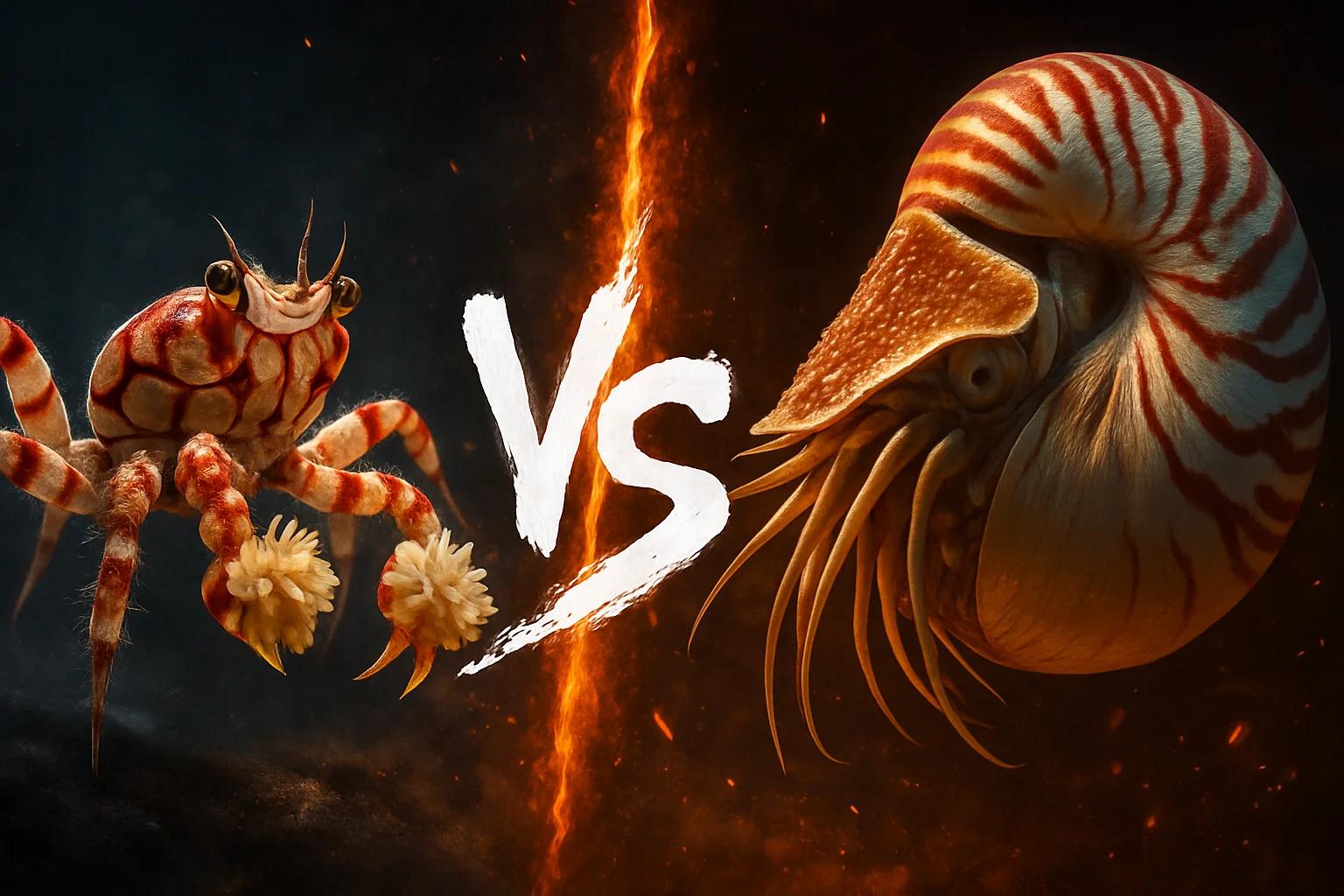
Boxer Crab vs Chambered Nautilus: Who Actually Wins?
The chambered nautilus wins this matchup, and it isn't especially close. A boxer crab is a thumbnail-sized reef crab, roughly 1–2.5 cm across, that carries tiny sea anemones in its claws as stinging pom-poms. That's a clever defensive trick for deterring small fish. The nautilus brings a shell around 15–20 cm across, dozens of grasping tentacles, and a hard, parrot-like beak built for cracking crustaceans. Nautiluses are active scavengers and predators that routinely eat crabs and molted shells. The boxer crab's anemones deliver a mild sting that can sting soft tissue, but the nautilus can avoid it by closing its hood and attacking from a different angle. The crab has no way to get through ten-plus centimeters of chambered armor. The nautilus doesn't need speed or cunning to win. Its size, its armor, and a beak made for exactly this kind of prey settle the question.
Read comparison
Discussion
What do you think?
Share your reasoning with other readers. Be civil and stick to the animals.
Sign in to join the discussion.
Sign inNo comments yet. Start the conversation.