

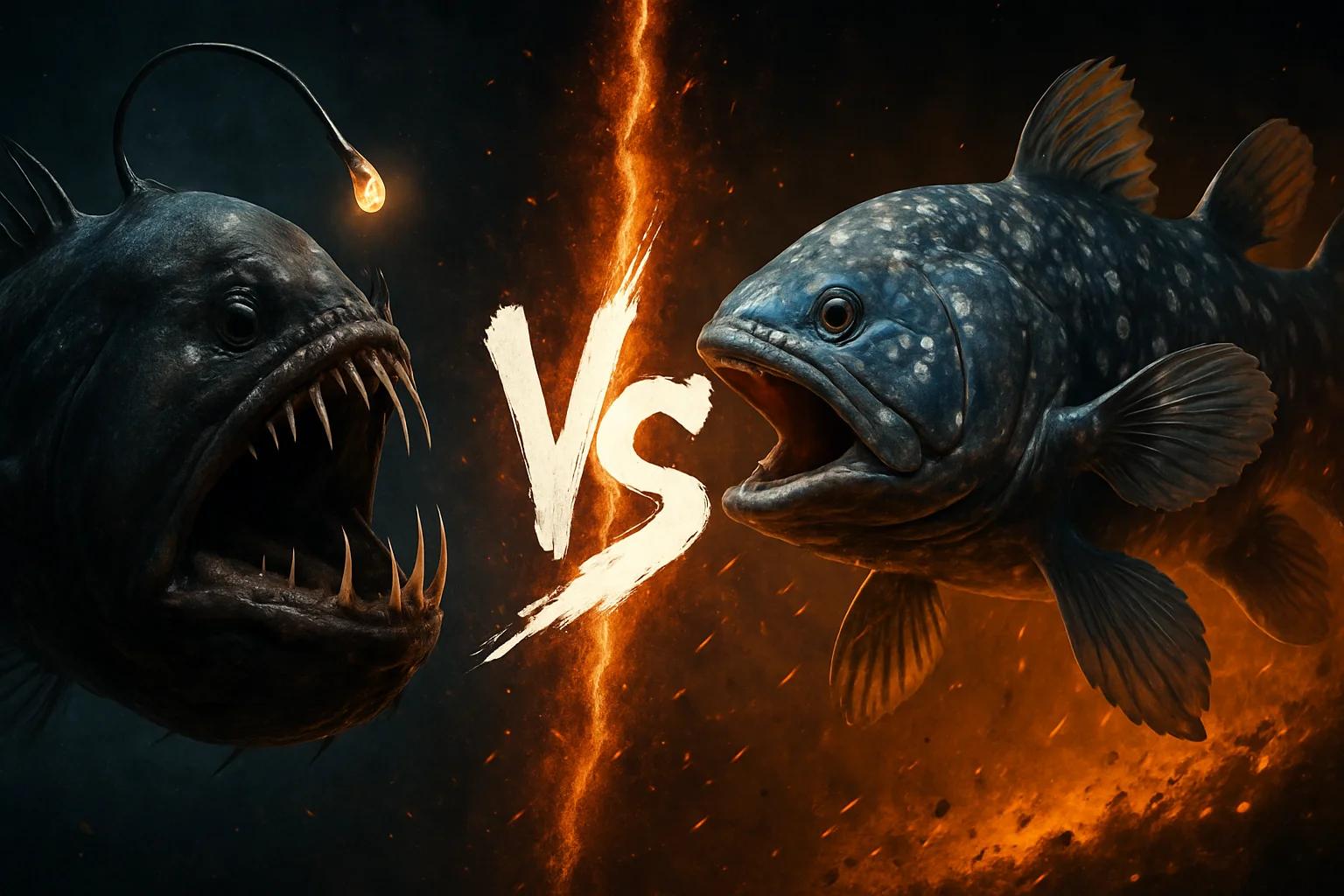
Black Seadevil vs Coelacanth: Who Actually Wins?
Black seadevil anglerfish vs coelacanth: a biology-first look at size, jaws, armor, and deep-sea strategy to see who would win.
Black Seadevil vs Coelacanth
Matchup winner
Coelacanth
Quick verdict
Start with the direct answer, then use the structured comparison below to see what changes the outcome.
The coelacanth wins clearly. The black seadevil is one of the ocean's most efficient ambush predators, with a glowing lure, inward-folding fangs, and a stomach that can stretch around prey close to its own size. But a large female seadevil reaches only about 18 cm, while an adult coelacanth can approach 2 m and weigh up to about 90 kg. That is roughly a hundredfold mass gap, and the coelacanth's heavy, bony scales cover all of it. The seadevil's whole design depends on swallowing what it lures, and it cannot swallow, pierce, or meaningfully injure an animal that large. Its jaws are built for engulfing prey, and its body is not built for fighting. In any realistic encounter, the slow, armored coelacanth simply outclasses it on scale, durability, and bite reach.
Read the full explanation
Coelacanth wins: up to about 2 m and 90 kg against a seadevil of about 18 cm.
The seadevil's swallow-whole strategy fails against prey many times its size.
Thick, heavy scales make the coelacanth nearly immune to a seadevil's bite.
The seadevil's only real edge is pitch-dark ambush against small prey, not against a giant.
Reader vote
Who do you think wins?
Pick a side — no account needed. Results update live.
No votes yet — be the first to call it.
Editorial note
Why people disagree
The seadevil looks terrifying, and its nightmare fangs make people overrate it against much larger fish.
Size and mass
The mass gap decides the matchup before any behavior comes into play.
Ambush control
The seadevil is a better hunter of small things, but that skill only works on prey that fits in its mouth.
Jaw design
Seadevil jaws are a one-way trap for small prey. The coelacanth's bite can actually damage a fish the seadevil's size.
Read the full explanation +
The anglerfish's famous ability to swallow prey bigger than itself gets stretched into something it can't actually do against a 2 m fish.
The coelacanth's sluggish, drifting lifestyle reads as weakness, but in this matchup slowness costs it almost nothing.
Comparison FAQ
Short, direct answers to the next questions readers usually ask after the headline verdict.
Would a black seadevil beat a coelacanth?+
No. The coelacanth is roughly 100 times heavier and covered in heavy scales, so the seadevil cannot swallow it or seriously injure it.
Which is stronger, the black seadevil or the coelacanth?+
The coelacanth, by a wide margin. Its muscular lobe fins and large body far outclass the seadevil's soft, low-muscle frame.
Why is the black seadevil still dangerous?+
For small animals it is lethal. Its lure draws prey in, its fangs fold inward so captured prey can't escape, and its stretchy stomach can hold prey close to its own size.
Do black seadevils and coelacanths ever meet?+
Rarely, if ever. Coelacanths mostly live around 150 to 700 m in rocky caves, while black seadevils are usually found deeper in open water, so their ranges overlap little.
Can an anglerfish eat a fish bigger than itself?+
It can swallow prey somewhat larger than itself, but not prey that is 10 times longer and 100 times heavier, like an adult coelacanth.
Head-to-head species stats
These are the same core AnimalDex stat dimensions used on the dedicated animal pages, pulled side by side so the matchup is faster to scan.
Black Seadevil
Tier CCoelacanth
Tier BTrait-by-trait comparison
Only the categories that matter to this matchup are included. The goal is not filler stats, but the real design differences that change the result.
Females up to about 18 cm, males far smaller
Size and mass
Coelacanth
Up to about 2 m and about 90 kg
Size and mass
Coelacanth
Bioluminescent lure, sit-and-wait in total darkness
Ambush control
Black Seadevil
Slow drift-hunter that uses electroreception
Ambush control
Black Seadevil
Huge gape, inward-hinging fangs built to trap prey
Jaw design
Coelacanth
Hinged intracranial joint for a strong suction-snap bite
Jaw design
Coelacanth
Soft, flabby body with weak muscle
Close-range durability
Coelacanth
Heavy, tooth-studded scales covering a robust body
Close-range durability
Coelacanth
Extreme low-energy waiting machine
Energy economy
Black Seadevil
Low metabolism, long-lived and passive
Energy economy
Black Seadevil
Brief gulp-lunge only
Burst speed
Coelacanth
Slow, deliberate, but powerful fin strokes
Burst speed
Coelacanth
How the verdict forms
Verdict timeline
01 · Size and mass
Coelacanth
02 · Ambush control
Black Seadevil
03 · Jaw design
Coelacanth
04 · Close-range durability
Coelacanth
05 · Energy economy
Black Seadevil
06 · Burst speed
Coelacanth
Change the conditions
Scenario breakdown
This is where shallow battle content usually fails. Terrain, spacing, timing, and engagement style can change the answer.
Scenario lean
Coelacanth
Verdict confidence
82%
Coelacanth, easily
Coelacanths rest in volcanic caves by day. A seadevil lurking at a cave mouth can lure and snap, but its fangs meet heavy scales on a body more than ten times its length. The coelacanth shrugs off the contact. If it chooses to, it can turn and seize the much smaller anglerfish.
AnimalDex field profiles
Explore these animals
Black Seadevil
—
Habitat details are not published on a dedicated AnimalDex species page yet.
Species guide coming soon.
Coelacanth
Latimeria chalumnae
deep volcanic slope and underwater cave system
Systems Intelligence & Hidden Purpose
See the animals behind this comparison as engineered biological systems: what each one is built to do, where it gains leverage, and why the matchup changes by scenario.
Specialized Hardware
ancient lobe-finned body plan, deep cave-sea life, and slow nocturnal movement give the Coelacanth a body plan tuned for its niche.
Systems Script
Coelacanths operate through deep volcanic slope and underwater cave system Their design links movement, shelter, and feeding into one workable survival system.
Strategic Insight
Persistence can matter as much as change when a design still fits its hidden niche.
Final take
The black seadevil is a masterpiece of deep-sea efficiency: it glows, waits, and swallows. Every part of that system assumes the prey will fit inside it.
Read the full explanation
The coelacanth breaks that assumption. It is huge, armored, slow, and patient, an ancient lineage that has lasted because it is hard to hurt. In a battle frame the coelacanth wins decisively, while the seadevil wins only the contest of who catches the small prey first.
Collect both animals in AnimalDex
Track the species behind this matchup, compare their real traits, and build the rivalry into your AnimalDex collection.
Related comparisons
Continue with nearby matchups to compare more real-world animal traits without dropping into junky who-wins filler.
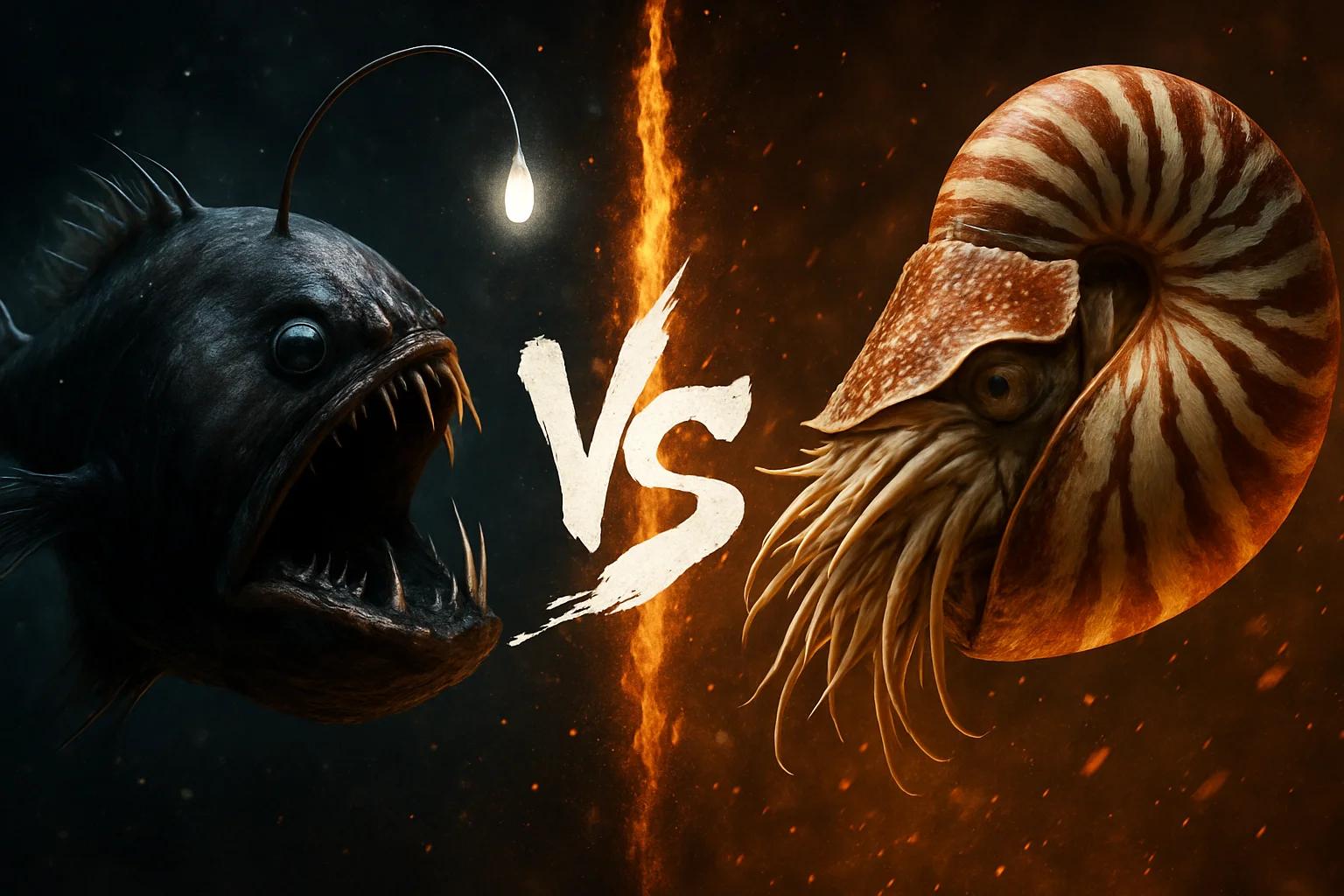
Black Seadevil vs Chambered Nautilus: Who Actually Wins?
The Chambered Nautilus wins this one, and it wins by refusing to be eaten more than by overpowering anything. The Black Seadevil is the scarier-looking predator. Females carry a glowing bacterial lure, hinged needle teeth, and a stretchy stomach that can swallow prey longer than their own roughly 18 cm body. That whole system is built for soft-bodied fish and crustaceans that drift into reach, though. An adult nautilus is a 15–20 cm coiled shell of calcium carbonate. It can pull its soft body inside and seal the opening with a leathery hood, and the anglerfish's teeth have no way to crack or pry that armor. The nautilus also has a sharp, parrot-like beak and dozens of grasping tentacles, and it eats carrion and slow animals. Against a flabby, weak-muscled ambusher that mostly hangs motionless in the dark, that gives the nautilus real counter-damage. The seadevil holds more threat on paper, but the nautilus controls the actual outcome. The verdict comes with an honest caveat: the two rarely if ever meet, and a fight between them would be slow, short, and mostly decided by armor.
Read comparison
Discussion
What do you think?
Share your reasoning with other readers. Be civil and stick to the animals.
Sign in to join the discussion.
Sign inNo comments yet. Start the conversation.