

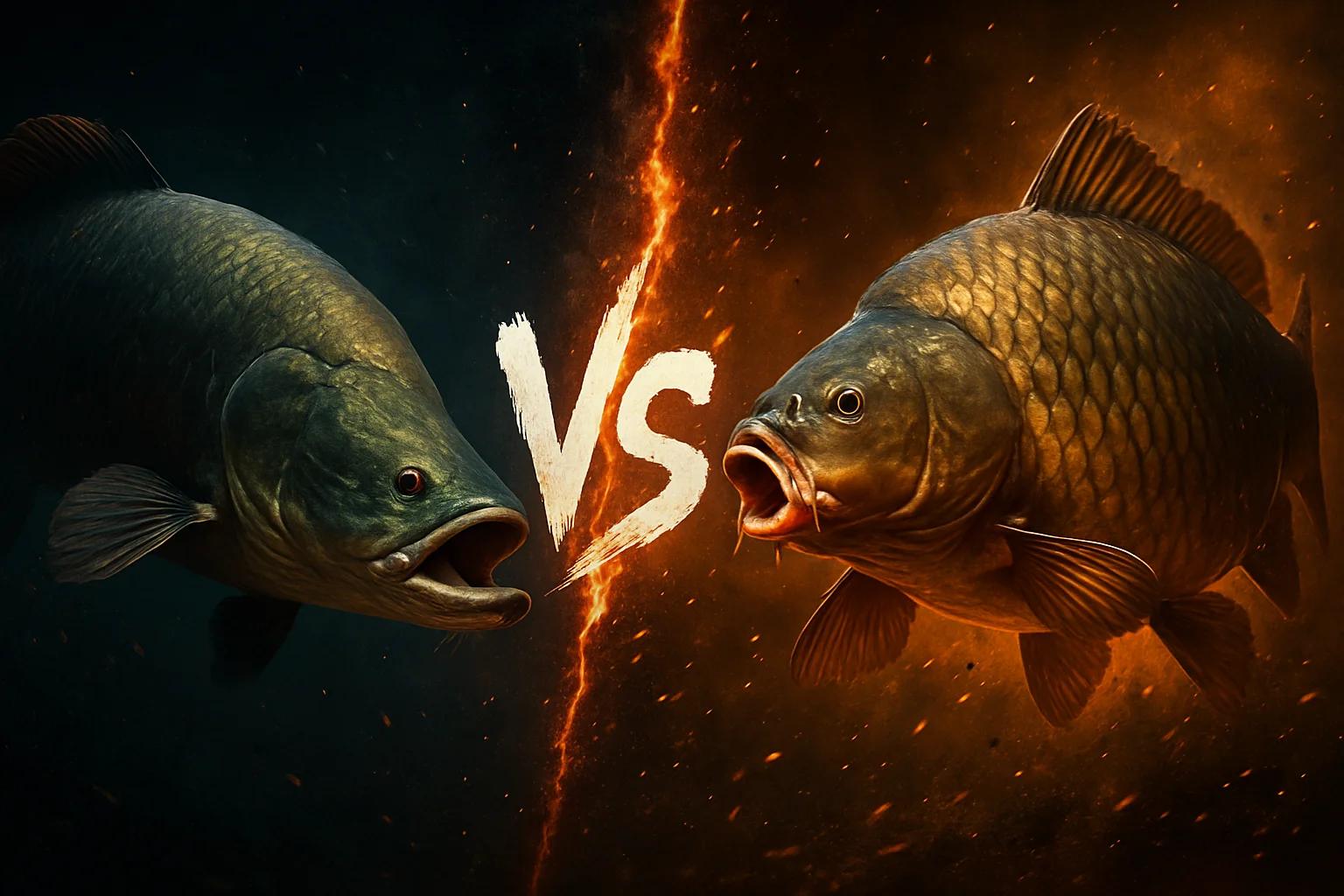
Arapaima vs Common Carp: Who Actually Wins?
Arapaima vs common carp: a biology-first look at size, armor, bite, and endurance to see which freshwater heavyweight wins, and why the carp is still a survivor worth respecting.
Arapaima vs Carp
Matchup winner
Arapaima
Quick verdict
Start with the direct answer, then use the structured comparison below to see what changes the outcome.
The arapaima wins, and it isn't close. Arapaima gigas is one of the largest scaled freshwater fish on Earth. Big adults can pass 2–3 m and 100+ kg, and they carry mineralized, layered scales tough enough to resist piranha bites. They also have a bony, tooth-studded tongue and a powerful suction strike built for engulfing fish. A common carp is a sturdy, adaptable bottom-feeder, usually 2–14 kg and occasionally much bigger. It has no teeth in its jaws, only pharyngeal teeth in the throat for grinding food, and its body is built for rooting through mud, not for fighting. In any shared-water encounter, the arapaima's size gap, predatory toolkit, and armor decide it fast. Small or mid-sized carp are realistic arapaima prey. The carp's real edge is resilience over time, not winning a confrontation.
Read the full explanation
Winner: Arapaima. It is a far larger predatory fish with armor-grade scales and a suction-and-tongue strike.
A big arapaima can outweigh a typical carp by 10 times or more.
The carp has no jaw teeth and no offensive weapon that matters against an arapaima.
The carp wins at being hard to kill as a species: tolerant of cold, low oxygen, and pollution, and extremely fertile.
Reader vote
Who do you think wins?
Pick a side — no account needed. Results update live.
No votes yet — be the first to call it.
Editorial note
Why people disagree
Trophy carp photos make them look huge, but even a 30 kg record carp is small next to a mature arapaima.
Raw mass and length
In fish encounters, body size largely sets who can engulf, ram, or ignore whom. This gap is enormous.
Strike mechanics
The arapaima's mouth is a capture system. The carp's is a feeding vacuum for invertebrates and plants.
Close-range durability
The carp has no tool to damage the arapaima, so the arapaima's armor makes the encounter one-sided.
Read the full explanation +
Carp are famously tough invasive species, and people confuse 'hard to eradicate' with 'hard to beat.'
The two rarely meet in the wild (Amazon basin vs Eurasia), so most comparisons are hypothetical or based on stocked fishing lakes.
Comparison FAQ
Short, direct answers to the next questions readers usually ask after the headline verdict.
Would an arapaima beat a carp?+
Yes. Its size, suction strike, and bony tongue let it overpower or swallow small and medium carp, and even large carp face a huge mass disadvantage.
Which is stronger, an arapaima or a carp?+
The arapaima. Adults are many times heavier, with powerful tail-driven bursts strong enough to leap out of the water.
Can a carp hurt an arapaima?+
Barely. A carp has no jaw teeth and only grinding throat teeth, and the arapaima's layered scales resist far more dangerous biters like piranhas.
Why is the carp still considered dangerous?+
Ecologically, not physically. Carp uproot vegetation, muddy the water, and outcompete native fish, which makes them one of the world's most damaging invasive species.
Do arapaima and carp live together?+
Not naturally. Arapaima are South American and carp are Eurasian, but both are stocked in some fishing lakes, especially in Southeast Asia.
Head-to-head species stats
These are the same core AnimalDex stat dimensions used on the dedicated animal pages, pulled side by side so the matchup is faster to scan.
Arapaima
Tier ACarp
Tier CTrait-by-trait comparison
Only the categories that matter to this matchup are included. The goal is not filler stats, but the real design differences that change the result.
Often 1.5–2.5 m, up to ~200 kg claimed
Raw mass and length
Arapaima
Usually 30–80 cm, 2–14 kg
Raw mass and length
Arapaima
Explosive suction gulp plus bony toothed tongue
Strike mechanics
Arapaima
Protrusible sucking mouth for sifting sediment
Strike mechanics
Arapaima
Layered, mineralized scales that resist piranha bites
Close-range durability
Arapaima
Large protective scales, thick mucus, sturdy build
Close-range durability
Arapaima
Short, violent bursts and powerful tail thrust
Explosive power
Arapaima
Steady cruiser with a decent escape surge
Explosive power
Arapaima
Obligate air-breather that must surface every 5–20 minutes
Low-oxygen survival
Carp
Tolerates hypoxic, warm, murky water
Low-oxygen survival
Carp
Slow to mature, vulnerable to overfishing
Population resilience
Carp
Lays hundreds of thousands of eggs, invades worldwide
Population resilience
Carp
How the verdict forms
Verdict timeline
01 · Raw mass and length
Arapaima
02 · Strike mechanics
Arapaima
03 · Close-range durability
Arapaima
04 · Explosive power
Arapaima
05 · Low-oxygen survival
Carp
06 · Population resilience
Carp
Change the conditions
Scenario breakdown
This is where shallow battle content usually fails. Terrain, spacing, timing, and engagement style can change the answer.
Scenario lean
Arapaima
Verdict confidence
82%
Arapaima ambush ends it.
Arapaima hunt by hanging still near cover in flooded forest and then lunging. A carp rooting nearby is exactly the profile of prey it engulfs. Cover helps the ambusher more than the forager.
AnimalDex field profiles
Explore these animals
Arapaima
Arapaima gigas
slow Amazonian river, oxbow lake, and flooded forest
Carp
Cyprinus carpio
pond, lake, reservoir, and slow river
Systems Intelligence & Hidden Purpose
See the animals behind this comparison as engineered biological systems: what each one is built to do, where it gains leverage, and why the matchup changes by scenario.
Specialized Hardware
huge freshwater body, air-gulping surface breathing, and armor-like scales give the Arapaima a body plan tuned for its niche.
Systems Script
Arapaimas operate through slow Amazonian river, oxbow lake, and flooded forest Their design links movement, shelter, and feeding into one workable survival system.
Strategic Insight
A system can keep growing in difficult water if it solves one major limit directly.
Final take
The arapaima is the clear winner. It is an armored, air-breathing Amazon giant built to engulf fish, while the common carp is a tough, toothless bottom-feeder. Put them in the same warm water and the carp is a potential meal, not a rival.
Read the full explanation
The carp still earns respect. It doesn't win by fighting. It wins by being nearly impossible to remove from a habitat, outbreeding and outlasting more specialized species across continents.
Collect both animals in AnimalDex
Track the species behind this matchup, compare their real traits, and build the rivalry into your AnimalDex collection.
Related comparisons
Continue with nearby matchups to compare more real-world animal traits without dropping into junky who-wins filler.
Common Carp vs Zander: Who Actually Wins?
The zander wins this matchup overall. It is a true piscivore. Its long canine fangs are built to seize fish, its tapetum-backed eyes let it hunt in murky and low-light water, and a fast-start pikeperch body lets it strike before prey reacts. The common carp is a bottom-sifting omnivore with no weapons beyond mass, tough scales, and stamina. That makes it extremely hard to finish, and a fully grown carp often outweighs any zander nearby. In a size-matched encounter, though, initiative belongs to the predator: the zander chooses when and how contact happens, and the carp can only absorb and flee. The carp's real edge is that big adults outgrow the zander's menu entirely.
Read comparison
Common Carp vs Silver Arowana: Who Actually Wins?
The silver arowana wins most realistic confrontations. It is a long, surface-cruising predator that can reach roughly 90 cm. It has an upturned, bony mouth built to snap prey, explosive bursts of speed, and the aggressive temperament that makes it notorious in shared aquariums. The common carp is often heavier and is very hard to kill. Its thick scales, deep body, and tolerance for low oxygen, cold, and murky water make it one of the most resilient freshwater fish on Earth. But it is a bottom-sifting omnivore with toothless jaws. It has no real offensive weapon, so it can only endure, displace, or flee. In any contest decided by who strikes, chases, and controls space, the arowana dictates terms. The carp's best outcome is survival, not victory.
Read comparison
Discussion
What do you think?
Share your reasoning with other readers. Be civil and stick to the animals.
Sign in to join the discussion.
Sign inNo comments yet. Start the conversation.