

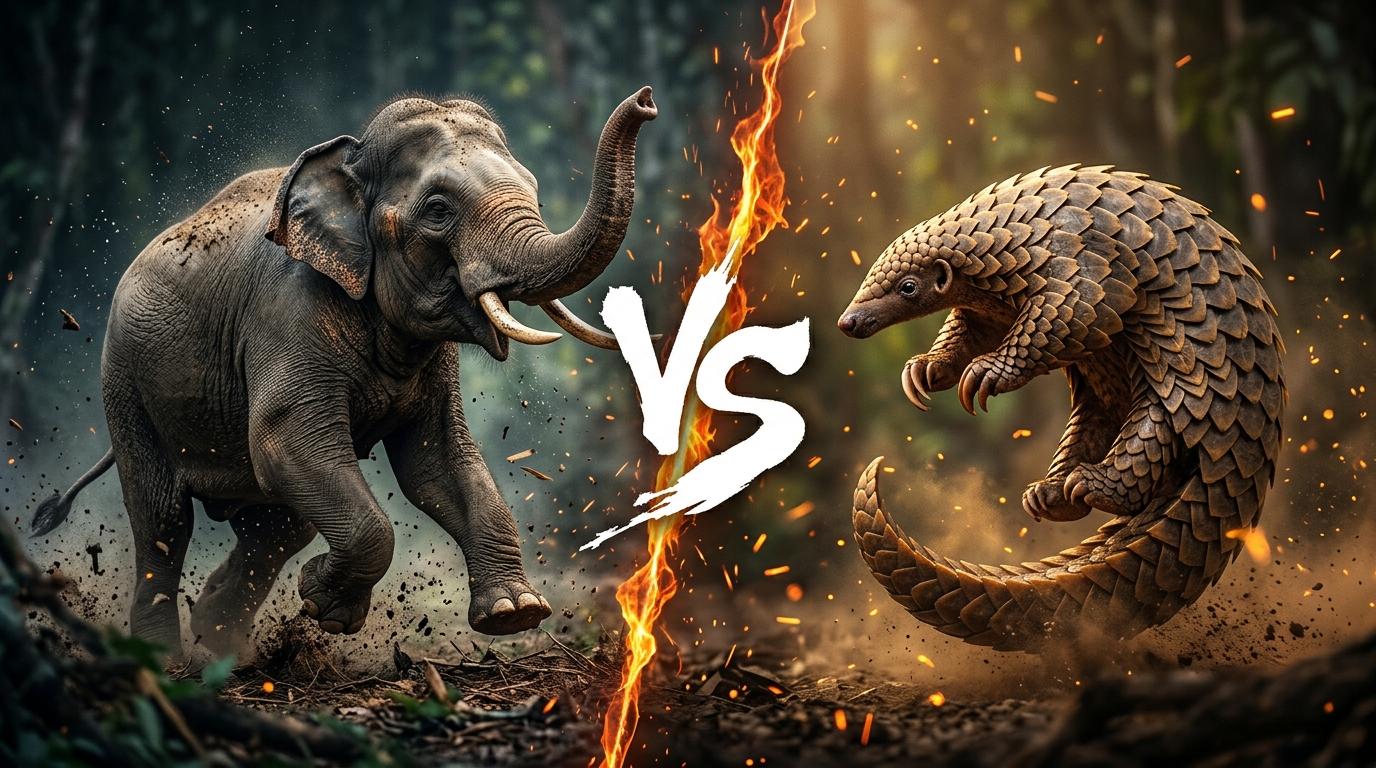
Asian Elephant vs Sunda Pangolin: Who Actually Wins?
Asian elephant vs Sunda pangolin: a 4-ton forest engineer meets an armored ant-eater. See who wins, why the pangolin's scales still matter, and how each survives.
Asian Elephant vs Sunda Pangolin
Matchup winner
Asian Elephant
Quick verdict
Start with the direct answer, then use the structured comparison below to see what changes the outcome.
The Asian elephant wins decisively. At roughly 3,000–5,000 kg against a 2–7 kg pangolin, the size gap is about a thousandfold, and the elephant brings dominance, intelligence and a trunk that can lift, push and toss. The Sunda pangolin has no offensive weapons at all. It has no teeth, and its whole strategy is to curl into a ball of overlapping keratin scales and wait. That armor works brilliantly against leopards and dogs that try to bite. It does not work against an animal that can simply push it aside, step around it or walk away. Elephants rarely bother small animals, so a realistic encounter ends with the pangolin rolled up and the elephant moving on. Still, if the question is who controls the interaction, the answer is the elephant every time.
Read the full explanation
Asian elephant wins: roughly 1,000x heavier, with total control of the encounter.
The pangolin has no attack. Its scales are built for passive defense against biting predators.
Rolling into a ball protects the pangolin from teeth, not from being shoved aside.
In practice, the elephant usually ignores it, and the pangolin survives by being not worth the trouble.
Reader vote
Who do you think wins?
Pick a side — no account needed. Results update live.
No votes yet — be the first to call it.
Editorial note
Why people disagree
Pangolin armor is famous. Some readers assume scales that stop lions should frustrate anything, but scales defeat bites, not mass.
Raw mass
Mass sets the terms. The elephant can move the pangolin, and the pangolin cannot move anything back.
Armor & passive defense
This is the pangolin's one real edge. It makes the pangolin very hard for predators to injure with teeth or claws.
Offensive tools
A fighter with no way to deal damage cannot win, only endure.
Read the full explanation +
'Winning' is ambiguous. The pangolin often walks away alive, which some count as a draw. But surviving is not the same as winning.
Elephants are cautious around small, unfamiliar animals, so a fearful reaction gets misread as the smaller animal having the edge.
Comparison FAQ
Short, direct answers to the next questions readers usually ask after the headline verdict.
Would an Asian elephant beat a Sunda pangolin?+
Yes, easily. The elephant is about a thousand times heavier and the pangolin has no way to attack, so the elephant controls the outcome.
Which is stronger, an elephant or a pangolin?+
The elephant, by an enormous margin. Its trunk alone can lift hundreds of kilograms. Pangolins are strong diggers for their size but weigh only a few kilograms.
Can pangolin scales stop an elephant?+
The scales resist bites and claws well, so the pangolin is unlikely to be torn open. They cannot stop the elephant from moving it, pushing it or forcing it away.
Why is the pangolin still dangerous to underestimate?+
Its defense is one of the best in nature. Predators like leopards often give up on a rolled pangolin, and its sharp scale edges and powerful claws discourage handling. It survives encounters that would kill most animals its size.
Do elephants and pangolins meet in the wild?+
Their ranges overlap in Southeast Asian forests, but encounters are rare and almost always non-violent. The pangolin is nocturnal and the elephant has no reason to engage it.
Head-to-head species stats
These are the same core AnimalDex stat dimensions used on the dedicated animal pages, pulled side by side so the matchup is faster to scan.
Asian Elephant
Tier CSunda Pangolin
Tier BTrait-by-trait comparison
Only the categories that matter to this matchup are included. The goal is not filler stats, but the real design differences that change the result.
3–5 tonnes
Raw mass
Asian Elephant
2–7 kg
Raw mass
Asian Elephant
Thick skin, no specialized armor
Armor & passive defense
Sunda Pangolin
Overlapping keratin scales, curl-up ball defense
Armor & passive defense
Sunda Pangolin
Trunk, tusks (males), crushing weight
Offensive tools
Asian Elephant
None; toothless, digging claws only
Offensive tools
Asian Elephant
Problem-solving, long memory, social learning
Situational intelligence
Asian Elephant
Instinct-driven, specialized forager
Situational intelligence
Asian Elephant
Too large to hide
Concealment & escape
Sunda Pangolin
Nocturnal, burrows and climbs trees
Concealment & escape
Sunda Pangolin
Endangered
Conservation fragility
Asian Elephant
Critically endangered
Conservation fragility
Asian Elephant
How the verdict forms
Verdict timeline
01 · Raw mass
Asian Elephant
02 · Armor & passive defense
Sunda Pangolin
03 · Offensive tools
Asian Elephant
04 · Situational intelligence
Asian Elephant
05 · Concealment & escape
Sunda Pangolin
06 · Conservation fragility
Asian Elephant
Change the conditions
Scenario breakdown
This is where shallow battle content usually fails. Terrain, spacing, timing, and engagement style can change the answer.
Scenario lean
Asian Elephant
Verdict confidence
82%
The elephant controls the encounter. The pangolin can only hide.
Thick undergrowth helps the pangolin avoid notice. If contact happens, though, the elephant's trunk can probe, nudge or push the curled pangolin aside. Cover delays the outcome but does not change it.
AnimalDex field profiles
Explore these animals
Asian Elephant
Elephas maximus
forest, grassland edge, floodplain, and scrub woodland
Sunda Pangolin
Manis javanica
Lowland forest, secondary woodland, plantations, and forest-edge mosaics with ant and termite abundance.
Systems Intelligence & Hidden Purpose
See the animals behind this comparison as engineered biological systems: what each one is built to do, where it gains leverage, and why the matchup changes by scenario.
Specialized Hardware
Heavy digging claws, overlapping scales, and a long adhesive tongue make Sunda pangolins specialized hardware for opening insect fortresses cleanly.
Systems Script
Pangolins convert ant and termite abundance into predator pressure that other mammals often cannot apply efficiently. They are niche specialists that keep one huge invertebrate resource from remaining unchallenged.
Strategic Insight
A narrow toolset can still be premium if it solves a hard problem no one else wants.
Final take
This is a mismatch of scale. The Asian elephant wins because it controls space, force and decisions, and the Sunda pangolin controls only its own survival.
Read the full explanation
The pangolin deserves respect for a defense that frustrates big cats. But armor is a strategy for enduring predators, not for overpowering giants. Against an animal that doesn't need to bite, the scales mostly buy time.
The real threat to both animals is human. Pangolins are among the most trafficked mammals on Earth, and Asian elephants are losing their forests. Neither would ever pick this fight.
Collect both animals in AnimalDex
Track the species behind this matchup, compare their real traits, and build the rivalry into your AnimalDex collection.
Related comparisons
Continue with nearby matchups to compare more real-world animal traits without dropping into junky who-wins filler.
Asian Elephant vs Bawean Deer: Who Actually Wins?
The Asian elephant wins decisively. At roughly 2,500–5,000 kg against a Bawean deer of about 50–60 kg, the elephant holds an advantage of nearly a hundredfold in body mass, plus a trunk capable of lifting and shoving with enormous force, thick skin, and the social intelligence to read and control a confrontation. The Bawean deer, a critically endangered small deer found only on Bawean Island off Java, has no weapon or defense that scales to this matchup. Its antlers are modest, and its real strategy is to vanish into dense secondary forest and teak scrub. In any direct contest the elephant controls space completely. The deer's only win condition is to never engage at all.
Read comparison
Asian Elephant vs Cotton-top Tamarin: Who Actually Wins?
The Asian elephant wins decisively. An adult weighs roughly 3,000–5,000 kg. A cotton-top tamarin weighs about 400–500 g, so the elephant is around ten thousand times heavier. The elephant also has a muscular, prehensile trunk, thick skin, and a strong threat-response instinct, which gives the tamarin no realistic way to hurt it. The tamarin's real strengths are speed through branches, alertness, and group vigilance. Those are survival tools, not fighting tools. If the two ever came into conflict, the elephant would control the space and the tamarin would simply leave. The only 'contest' the tamarin can win is not being caught.
Read comparison
Asian Elephant vs Hog Badger: Who Actually Wins?
The Asian elephant wins decisively. At roughly 2,500–5,000 kg against a hog badger's 7–14 kg, the mass gap is a few hundred to one. The elephant also brings a muscular trunk, pillar legs and, in many bulls, tusks, all guided by excellent spatial memory and threat assessment. The hog badger is a tough, thick-skinned digger with strong claws and a bad temper when cornered, but it has no tool that can seriously injure an animal of that size. Realistically, the badger's best outcome is to make enough noise to be ignored, or to get underground before the elephant decides it is worth stepping on.
Read comparison
Discussion
What do you think?
Share your reasoning with other readers. Be civil and stick to the animals.
Sign in to join the discussion.
Sign inNo comments yet. Start the conversation.