

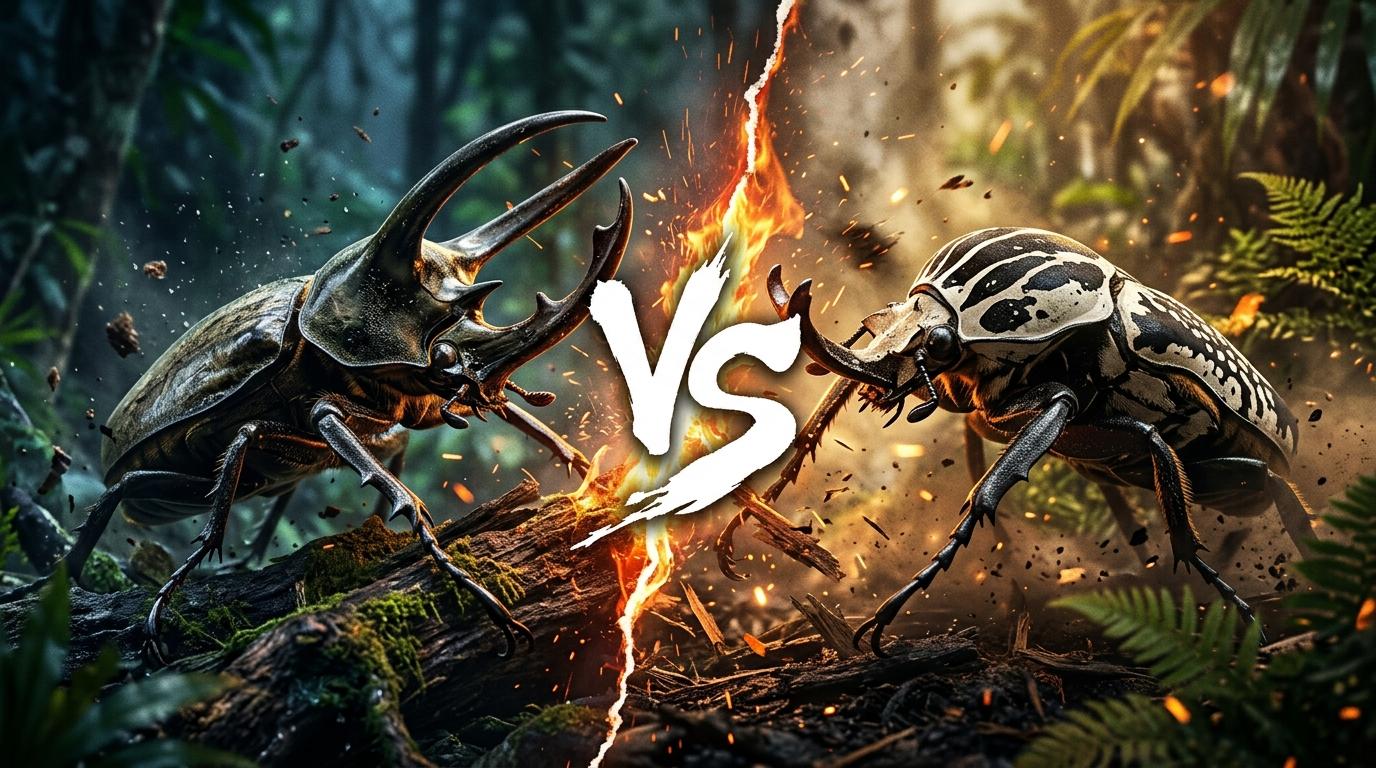
Atlas Beetle vs Goliath Beetle: Who Actually Wins?
Atlas beetle vs Goliath beetle: Southeast Asia's three-horned pincer fighter against Africa's heavyweight flower beetle. See who wins on traits, scenarios and biology.
Atlas Beetle vs Goliath Beetle
Matchup winner
Atlas Beetle
Quick verdict
Start with the direct answer, then use the structured comparison below to see what changes the outcome.
The Atlas beetle wins this matchup more often than not, at about 62% confidence. The Goliath beetle is the heavier, bulkier insect and one of the heaviest adult beetles on Earth, so it has the advantage in raw mass and grip. But a male Atlas beetle carries dedicated combat hardware: long curved horns on its thorax that work against its head horn like a clamp. Its whole fighting style is built around one goal, which is getting under a rival, pinching it, and levering it off a branch. A male Goliath has a Y-shaped head horn and real shoving power, but its body plan leans more toward feeding, flying and carrying weight than toward specialized wrestling. In a contest decided by flipping or dislodging the opponent, which is how beetle fights actually end, the specialist's leverage beats the generalist's heft in most settings.
Read the full explanation
Atlas beetle wins overall: its three-horn clamp is purpose-built for prying rivals off branches.
Goliath beetle is heavier and harder to move, and it wins straight shoving contests on flat, open surfaces.
Neither beetle can seriously hurt the other. Fights end with a flip, a fall or a retreat, not a kill.
The two never meet in the wild: Atlas lives in Southeast Asia, Goliath in tropical Africa.
Reader vote
Who do you think wins?
Pick a side — no account needed. Results update live.
No votes yet — be the first to call it.
Editorial note
Why people disagree
Mass versus mechanics: Goliath fans point to its sheer weight. Atlas fans point out that beetle fights are leverage contests, and a clamp beats a shove.
Weapon design
A clamp lets the Atlas beetle trap and lift a rival. The Goliath's horn mostly pushes.
Body mass and anchoring
Extra weight makes the Goliath genuinely hard to flip on stable footing.
Leverage control
Beetle fights are usually won by breaking the opponent's grip, not by out-pushing it.
Read the full explanation +
Rankings often mix up larvae and adults. Goliath grubs are enormous, but adult-versus-adult fights are a different question.
Viral 'beetle battle' videos come from artificial arenas. The flat floor and missing branches change who looks dominant.
Comparison FAQ
Short, direct answers to the next questions readers usually ask after the headline verdict.
Would an Atlas beetle beat a Goliath beetle?+
Usually, yes. Its three-horn clamp is built to pry and flip rivals, especially on branches and tree trunks.
Which beetle is stronger?+
The Goliath is heavier and generates more raw pushing force. The Atlas is better at applying force through leverage.
Why is the Goliath beetle still dangerous to the Atlas?+
Its mass and hooked legs make it very hard to dislodge. On flat footing, it can bulldoze the Atlas and win outright.
Would either beetle get hurt?+
Rarely. Their thick exoskeletons mean fights end with one beetle flipped or fallen, not injured.
Do Atlas and Goliath beetles ever meet in the wild?+
No. The Atlas beetle lives in Southeast Asia and the Goliath beetle in tropical Africa.
Head-to-head species stats
These are the same core AnimalDex stat dimensions used on the dedicated animal pages, pulled side by side so the matchup is faster to scan.
Atlas Beetle
Tier CGoliath Beetle
Tier CTrait-by-trait comparison
Only the categories that matter to this matchup are included. The goal is not filler stats, but the real design differences that change the result.
Three-horn clamp (two thoracic horns plus a head horn)
Weapon design
Atlas Beetle
Short Y-shaped head horn
Weapon design
Atlas Beetle
Large but leaner build
Body mass and anchoring
Goliath Beetle
Among the heaviest adult beetles
Body mass and anchoring
Goliath Beetle
Specialist at prying under and lifting
Leverage control
Atlas Beetle
Pushes forward, weaker lifting angle
Leverage control
Atlas Beetle
Strong tarsal claws for climbing
Grip and footing
Goliath Beetle
Powerful hooked legs built for clinging to bark
Grip and footing
Goliath Beetle
Glossy, thick exoskeleton
Close-range durability
Goliath Beetle
Dense, heavily built cuticle
Close-range durability
Goliath Beetle
Males fight readily over sap and mates
Combat instinct
Atlas Beetle
Males contest feeding sites but less ritualized
Combat instinct
Atlas Beetle
How the verdict forms
Verdict timeline
01 · Weapon design
Atlas Beetle
02 · Body mass and anchoring
Goliath Beetle
03 · Leverage control
Atlas Beetle
04 · Grip and footing
Goliath Beetle
05 · Close-range durability
Goliath Beetle
06 · Combat instinct
Atlas Beetle
Change the conditions
Scenario breakdown
This is where shallow battle content usually fails. Terrain, spacing, timing, and engagement style can change the answer.
Scenario lean
Atlas Beetle
Verdict confidence
82%
Atlas beetle pries the Goliath off the branch.
On a narrow perch, nobody can win by pushing straight ahead. The Atlas slides its head horn under the rival, closes its thoracic horns on top and lifts. The Goliath's mass and grip help it hold on, but once its legs lose contact with the bark, gravity finishes the fight.
AnimalDex field profiles
Explore these animals
Atlas Beetle
Chalcosoma atlas
rainforest canopy and humid woodland edge
Goliath Beetle
Goliathus goliatus
tropical forest canopy and woodland edge
Systems Intelligence & Hidden Purpose
See the animals behind this comparison as engineered biological systems: what each one is built to do, where it gains leverage, and why the matchup changes by scenario.
Specialized Hardware
massive horned male body, heavy armored shell, and forest-sap feeding give the Atlas Beetle a body plan tuned for its niche.
Systems Script
Atlas Beetles operate through rainforest canopy and humid woodland edge. Their design links movement, feeding, shelter, and timing into one workable survival system.
Strategic Insight
Dense environments reward precision, patience, and the ability to read layered cover.
Specialized Hardware
massive armored body, bold black-and-white pattern, and flower and sap feeding give the Goliath Beetle a body plan tuned for its niche.
Systems Script
Goliath Beetles operate through tropical forest canopy and woodland edge. Their design links movement, feeding, shelter, and timing into one workable survival system.
Strategic Insight
Dense environments reward precision, patience, and the ability to read layered cover.
Final take
The Atlas beetle is the better fighter, and the Goliath beetle is the bigger animal. That distinction decides most matchups. In beetle combat, the winner is usually whichever animal breaks the other's footing, so a weapon built to clamp and lift outranks extra body mass in the vertical, branch-and-trunk settings where these insects actually live.
Read the full explanation
The Goliath is not a pushover. On flat ground or in a cramped arena, its weight and clinging legs can stall the Atlas or drive it back. That is why our confidence sits near 62% rather than higher.
Collect both animals in AnimalDex
Track the species behind this matchup, compare their real traits, and build the rivalry into your AnimalDex collection.
Related comparisons
Continue with nearby matchups to compare more real-world animal traits without dropping into junky who-wins filler.
Giraffe Weevil vs Goliath Beetle: Who Actually Wins?
The Goliath beetle wins, and it is not close. Goliathus goliatus is one of the heaviest insects on Earth. Adults reach roughly 6–11 cm and can weigh tens of grams in the larval stage. Madagascar's giraffe weevil is a slender 2–2.5 cm specialist built around an elongated neck for leaf-rolling and male sparring. The Goliath's thick, domed elytra and powerful tarsal claws give it a massive mass and armor edge. Males also carry a Y-shaped head horn used to shove rivals off feeding sites. The weevil's neck is a display-and-leverage tool, not a weapon that can pry open beetle armor. In any contact scenario the Goliath simply outweighs, out-grips and out-shoves it. The weevil's real 'wins' come from not being there: it can fly off, drop from the plant, or avoid the confrontation entirely.
Read comparison
Atlas Beetle vs Orchid Mantis: Who Actually Wins?
The Atlas Beetle wins this matchup clearly. Chalcosoma atlas is a heavily armored rhinoceros beetle. Its three-horned males are built for prying and flipping rivals, its grip is strong, and its body mass dwarfs most orchid mantises. The Orchid Mantis is an elite ambush hunter, but its toolkit is calibrated for soft-bodied pollinators like bees, flies and moths. Its spined raptorial forelegs can't get a meaningful purchase on thick elytra and a chitin-plated thorax. The mantis needs a vulnerable target and a fast kill. The beetle offers neither, and it can shove, pin or simply outlast an attacker that has no way through its shell.
Read comparison
Goliath Beetle vs Sunset Moth: Who Actually Wins?
The Goliath beetle wins clearly. It is one of the heaviest insects on Earth, with adult males reaching about 11 cm and up to roughly 50 g as larvae. It carries a hardened exoskeleton, gripping tarsal claws, and males have a forked head horn built for shoving rivals off sap flows and branches. The sunset moth (Chrysiridia rhipheus) is a spectacular day-flier with iridescent wings and toxins sequestered from its Omphalea host plants as a caterpillar. Its body is light, soft, and built for flight, not contact. It has no weapon that can hurt an armored beetle, and its chemical defense deters vertebrate predators, not a beetle that only feeds on sap and fruit. In any forced physical contest, the beetle's mass and armor decide it. The moth's real win condition is leaving, and leaving is not winning.
Read comparison
Discussion
What do you think?
Share your reasoning with other readers. Be civil and stick to the animals.
Sign in to join the discussion.
Sign inNo comments yet. Start the conversation.