


Atlas Moth vs Orchid Mantis: Who Actually Wins?
Atlas moth vs orchid mantis: a giant, mouthless moth against a flower-disguised ambush predator. See who wins, why size isn't enough, and when the moth escapes.
Atlas Moth vs Orchid Mantis
Matchup winner
Orchid Mantis
Quick verdict
Start with the direct answer, then use the structured comparison below to see what changes the outcome.
The Orchid Mantis wins this matchup, and the reason is simple biology: it is a predator built to seize flying insects, while the Atlas Moth is a short-lived adult built only to mate and lay eggs. Its wingspan can approach 25 cm and dwarfs a female orchid mantis, which is roughly 6–7 cm long, but the moth's adult stage has no functional mouthparts, no weapon, and no reason to fight. A female orchid mantis that locks its spined raptorial forelegs around the moth's soft thorax holds the only offensive tool in the matchup. The moth's real defenses are size, snake-head wingtip bluffing, and slippery scales that can tear away from a predator's grip. Those defenses make it a dangerous mark to hold, not a winner. If the mantis lands a clean grab, the contest is effectively over. The moth wins only by never being grabbed.
Read the full explanation
Orchid Mantis wins: it has raptorial forelegs, ambush timing, and a predator's nervous system tuned for grabbing flying insects.
The Atlas Moth is far larger by wing area, but adults can't eat, can't bite, and live only about one to two weeks.
The moth's best outcome is escape. Powerful wingbeats and detachable wing scales can break a poor grip.
A small male orchid mantis is a much weaker threat. This verdict assumes the larger female.
Reader vote
Who do you think wins?
Pick a side — no account needed. Results update live.
No votes yet — be the first to call it.
Editorial note
Why people disagree
Size bias: a moth with a wingspan near 25 cm looks unbeatable next to a mantis the length of a thumb, but most of that span is lightweight wing membrane, not fighting mass.
Offensive weaponry
Only one animal can actually damage the other. A fight with one armed side tilts hard toward that side.
Raw size and wing area
Size makes the moth hard to pin and lets it generate strong, thrashing wingbeats that can break a weak hold.
Ambush control
The mantis chooses the moment of contact. The moth only reacts once it is already grabbed.
Read the full explanation +
Escape vs. victory: some readers count a moth flying away as a win. In a battle framing, surviving is not the same as beating the opponent.
Male vs. female mantis: orchid mantis females are often more than twice the length of males. A male would struggle to control an atlas moth at all.
Comparison FAQ
Short, direct answers to the next questions readers usually ask after the headline verdict.
Would an orchid mantis beat an atlas moth?+
Usually, yes. A female orchid mantis that grabs the moth's body can hold and bite it, and the moth has no way to fight back. The moth wins only by escaping.
Which is stronger, the atlas moth or the orchid mantis?+
The atlas moth generates more raw force through its large wings, but the orchid mantis has far more usable strength. Its grasping forelegs and bite are the only tools in this matchup that can cause harm.
Why is the atlas moth still dangerous to a mantis?+
Its size and powerful flapping can knock a mantis off its perch or tear free from a poor grip, and its scales slip from spined legs. A small male mantis risks getting thrown off the branch rather than winning.
Do atlas moths and orchid mantises live in the same place?+
Yes. Both are found in Southeast Asian tropical forests, so an encounter is plausible. Mantises are generally opportunistic predators of insects that come within striking range.
Can an atlas moth bite or sting?+
No. Adult atlas moths have no functional mouthparts and no sting. They live off fat reserves stored during the caterpillar stage.
Head-to-head species stats
These are the same core AnimalDex stat dimensions used on the dedicated animal pages, pulled side by side so the matchup is faster to scan.
Atlas Moth
Tier COrchid Mantis
Tier DTrait-by-trait comparison
Only the categories that matter to this matchup are included. The goal is not filler stats, but the real design differences that change the result.
None; adults have no functional mouthparts
Offensive weaponry
Orchid Mantis
Spined raptorial forelegs plus chewing mandibles
Offensive weaponry
Orchid Mantis
Wingspan up to about 25 cm, huge wing surface
Raw size and wing area
Atlas Moth
Females about 6–7 cm, males much smaller
Raw size and wing area
Atlas Moth
Passive; rests motionless, mostly by day
Ambush control
Orchid Mantis
Elite flower mimic; strikes prey that comes close
Ambush control
Orchid Mantis
Detachable scales, powerful flaps, snake-head wingtip bluff
Escape tools
Atlas Moth
Camouflage; poor at outrunning anything
Escape tools
Atlas Moth
Soft, thick abdomen; no armor
Close-range durability
Orchid Mantis
Light frame, vulnerable if knocked loose
Close-range durability
Orchid Mantis
Fixed adult script: mate, lay eggs, die
Predatory intelligence
Orchid Mantis
Tracks motion, adjusts strike timing
Predatory intelligence
Orchid Mantis
How the verdict forms
Verdict timeline
01 · Offensive weaponry
Orchid Mantis
02 · Raw size and wing area
Atlas Moth
03 · Ambush control
Orchid Mantis
04 · Escape tools
Atlas Moth
05 · Close-range durability
Orchid Mantis
06 · Predatory intelligence
Orchid Mantis
Change the conditions
Scenario breakdown
This is where shallow battle content usually fails. Terrain, spacing, timing, and engagement style can change the answer.
Scenario lean
Orchid Mantis
Verdict confidence
82%
Mantis wins decisively.
This is the orchid mantis's home turf. Disguised among blossoms, it waits for flying insects to come within reach and strikes in a fraction of a second. A moth blundering into range takes a grab to the thorax before any bluff can play out. The mantis then bites near the head to disable it. The moth's size only matters if the grip is poor.
AnimalDex field profiles
Explore these animals
Atlas Moth
Attacus atlas
Tropical forest, plantation edge, and wooded gardens with suitable host plants.
Orchid Mantis
Hymenopus coronatus
Humid tropical forest and flowering understory vegetation.
Systems Intelligence & Hidden Purpose
See the animals behind this comparison as engineered biological systems: what each one is built to do, where it gains leverage, and why the matchup changes by scenario.
Specialized Hardware
Massive wing display, stored larval energy, and adult life focused almost entirely on reproduction make atlas moths short-window signaling hardware.
Systems Script
Atlas moths compress their adult mission into mating, while caterpillars do the real accumulation phase earlier. The design is blunt but effective: build first, signal later.
Strategic Insight
Not every phase should multitask. Some windows are for building, others are for deploying.
Specialized Hardware
Petal-like limbs, color mimicry, and still hunting posture make orchid mantises deception hardware tuned for pollinator-rich environments.
Systems Script
This mantis exploits the visual trust insects place in flowers, converting attraction into predation. It is an elegant reminder that signal systems can always be gamed by a skilled mimic.
Strategic Insight
If attention flows predictably, someone will learn to intercept it. Design with signal security in mind.
Final take
The Orchid Mantis is the overall winner because the battle asks who can defeat whom, and only the mantis carries weapons. Its flower disguise, strike timing, and spined forelegs are all built to end encounters with flying insects quickly.
Read the full explanation
The Atlas Moth's huge wings are an impressive display of size, but as a fighter it is a non-combatant. Its adult life is a brief reproductive sprint that doesn't even include eating. Its defenses are about walking away intact: bluffing like a snake, shedding scales, and overpowering a weak grip.
Expect the mantis to win most staged encounters, especially in cover. Expect the moth to survive whenever the mantis has to chase it or misjudges its first strike.
Collect both animals in AnimalDex
Track the species behind this matchup, compare their real traits, and build the rivalry into your AnimalDex collection.
Related comparisons
Continue with nearby matchups to compare more real-world animal traits without dropping into junky who-wins filler.
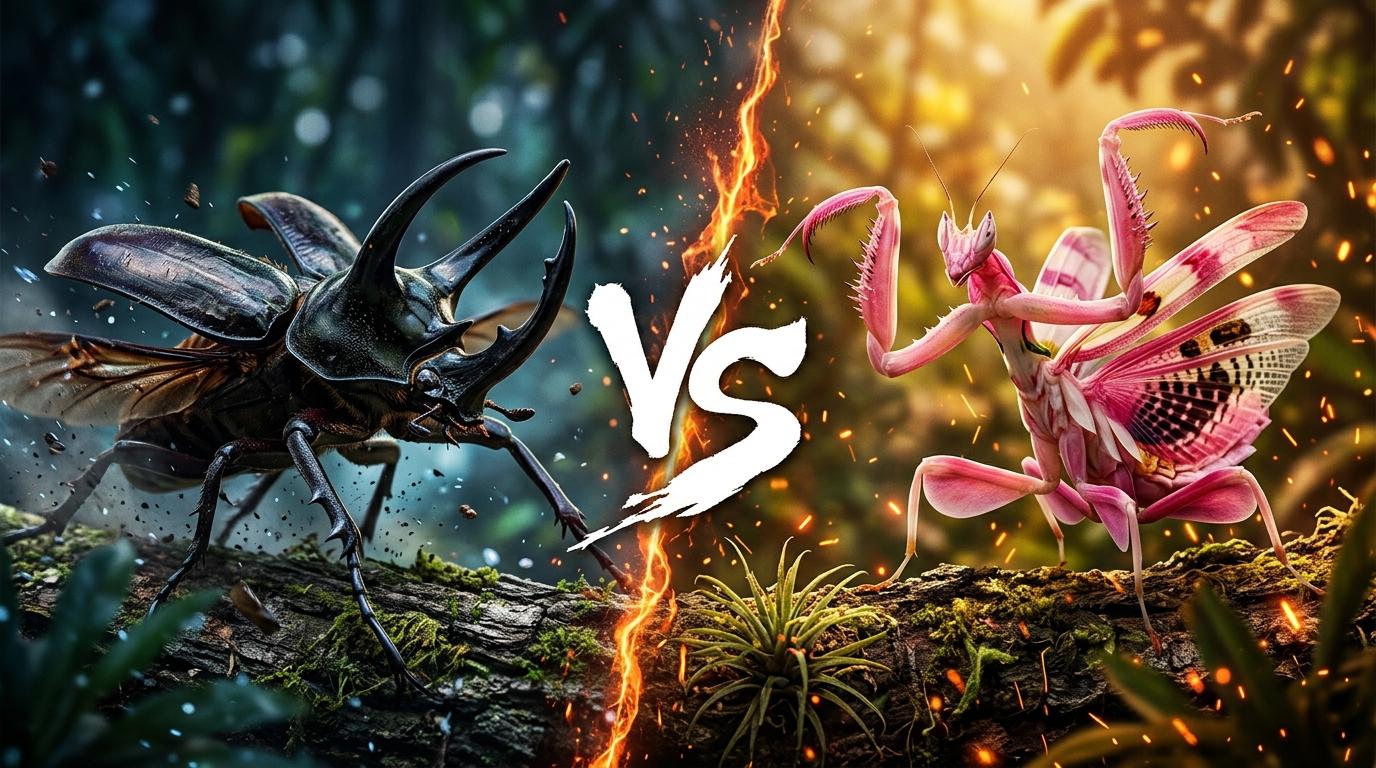
Atlas Beetle vs Orchid Mantis: Who Actually Wins?
The Atlas Beetle wins this matchup clearly. Chalcosoma atlas is a heavily armored rhinoceros beetle. Its three-horned males are built for prying and flipping rivals, its grip is strong, and its body mass dwarfs most orchid mantises. The Orchid Mantis is an elite ambush hunter, but its toolkit is calibrated for soft-bodied pollinators like bees, flies and moths. Its spined raptorial forelegs can't get a meaningful purchase on thick elytra and a chitin-plated thorax. The mantis needs a vulnerable target and a fast kill. The beetle offers neither, and it can shove, pin or simply outlast an attacker that has no way through its shell.
Read comparison
Orchid Mantis vs Philippine Leaf Insect: Who Actually Wins?
The orchid mantis wins this matchup decisively. It is a true ambush predator with raptorial forelegs lined with spines, binocular vision tuned to detect motion, and strike reflexes measured in tens of milliseconds. The Philippine leaf insect is a slow, plant-eating stick-insect relative. Its whole survival strategy is not being noticed, and it carries no grasping weapons, venom, or real bite to use against an attacker. The leaf insect does have some advantages. It is a bit longer and broader, especially adult females, its armor-like flattened body is awkward to grip, and its camouflage is among the best in the insect world. Once a mantis has detected it, though, the fight is mostly over. In any encounter where the mantis knows the leaf insect is there, the predator's hardware beats the prey's disguise.
Read comparison
Discussion
What do you think?
Share your reasoning with other readers. Be civil and stick to the animals.
Sign in to join the discussion.
Sign inNo comments yet. Start the conversation.