


Axolotl vs Cayenne Caecilian: Who Actually Wins?
Axolotl vs Cayenne caecilian: two odd aquatic amphibians compared on size, bite, defenses, and behavior. See who wins, why, and in which situations the axolotl does best.
Axolotl vs Cayenne Caecilian
Matchup winner
Cayenne Caecilian
Quick verdict
Start with the direct answer, then use the structured comparison below to see what changes the outcome.
The Cayenne caecilian (Typhlonectes compressicauda) wins this matchup. It is the longer, more muscular animal, often reaching 50–60 cm against the axolotl's typical 20–30 cm, and its whole body is built for close contact. It has a reinforced, bullet-shaped skull and needle-like recurved teeth. It can also spin its entire body to wrench grip-held food apart, and its skin produces noxious secretions that discourage biting back. The axolotl is a suction feeder with a weak bite. Its feathery external gills are delicate, exposed, and sit right where an opponent would strike. The axolotl's famous ability to regrow limbs helps it survive damage, but it does not help it win an encounter. In almost every realistic contact scenario, the caecilian controls the engagement and the axolotl's best move is to leave.
Read the full explanation
The Cayenne caecilian wins, mainly through length, muscle mass, and a gripping, twisting bite.
The axolotl's exposed external gills are a major weakness in any close encounter.
Caecilian skin secretions make it an unpleasant target, which blunts the axolotl's only offensive option.
The axolotl survives by regenerating tissue, not by beating opponents.
Reader vote
Who do you think wins?
Pick a side — no account needed. Results update live.
No votes yet — be the first to call it.
Editorial note
Why people disagree
The stat cards give the axolotl higher 'dominance,' but in the water the deciding factor is body build, and the caecilian's is far better suited to physical contact.
Body length and mass
Small aquatic animals usually settle encounters by size, and the caecilian has roughly twice the length.
Bite and grip
The caecilian can hold on and twist. The axolotl can only gulp things small enough to swallow whole.
Exposed weak points
The axolotl wears its breathing organs on the outside, which makes it the easier animal to injure.
Read the full explanation +
Many people see caecilians as harmless 'blind worms,' but Typhlonectes is an active predator and scavenger with real teeth and a rotational feeding technique.
Regeneration feels like a superpower, so fans overrate it. It is a recovery strategy, not a way to win.
Comparison FAQ
Short, direct answers to the next questions readers usually ask after the headline verdict.
Would an axolotl beat a Cayenne caecilian?+
Generally no. The caecilian is larger, grips harder, and has protective skin secretions. The axolotl's best realistic outcome is escaping in open water.
Which is stronger, an axolotl or a caecilian?+
The Cayenne caecilian. Its long, muscular body and full-body twisting bite produce far more usable force than the axolotl's suction feeding.
Why does the axolotl stay dangerous even when it loses?+
Its regeneration makes it hard to disable permanently, and its quick tail dart lets it break contact. A lost encounter rarely means a lost axolotl.
Are Cayenne caecilians venomous?+
They are not venomous in the snake sense, but their skin produces noxious secretions that deter predators and biters.
Do axolotls and caecilians live together?+
No. Axolotls come from Mexico and Cayenne caecilians from South America, and they should not be housed together.
Head-to-head species stats
These are the same core AnimalDex stat dimensions used on the dedicated animal pages, pulled side by side so the matchup is faster to scan.
Axolotl
Tier CCayenne Caecilian
Tier CTrait-by-trait comparison
Only the categories that matter to this matchup are included. The goal is not filler stats, but the real design differences that change the result.
20–30 cm, stocky but soft
Body length and mass
Cayenne Caecilian
Up to ~55 cm, dense, eel-like muscle
Body length and mass
Cayenne Caecilian
Suction gulp, tiny teeth for gripping prey
Bite and grip
Cayenne Caecilian
Recurved teeth plus a full-body spin
Bite and grip
Cayenne Caecilian
Frilly external gills on the head
Exposed weak points
Cayenne Caecilian
Smooth, streamlined, few exposed parts
Exposed weak points
Cayenne Caecilian
Mild skin defenses
Chemical deterrence
Cayenne Caecilian
Noxious skin secretions
Chemical deterrence
Cayenne Caecilian
Elite regeneration of limbs, gills, even spinal cord
Damage recovery
Axolotl
Ordinary amphibian healing
Damage recovery
Axolotl
Sit-and-wait lunge on prey
Ambush control
Cayenne Caecilian
Chemical tracking through mud and murk
Ambush control
Cayenne Caecilian
How the verdict forms
Verdict timeline
01 · Body length and mass
Cayenne Caecilian
02 · Bite and grip
Cayenne Caecilian
03 · Exposed weak points
Cayenne Caecilian
04 · Chemical deterrence
Cayenne Caecilian
05 · Damage recovery
Axolotl
06 · Ambush control
Cayenne Caecilian
Change the conditions
Scenario breakdown
This is where shallow battle content usually fails. Terrain, spacing, timing, and engagement style can change the answer.
Scenario lean
Cayenne Caecilian
Verdict confidence
82%
Caecilian, by close-range control.
In tight spaces among roots and leaf litter, the encounter is decided at contact range. The caecilian's tentacle chemosensors find the axolotl without needing sight. Its long body can then press and grip in confined space. The axolotl's gills snag and expose it, and it has no room for an escape dart.
AnimalDex field profiles
Explore these animals
Axolotl
Ambystoma mexicanum
Cool freshwater canals, remnant lakes, and slow wetland channels with cover.
Cayenne Caecilian
Typhlonectes compressicauda
slow freshwater, swamp, and muddy tropical wetland
Systems Intelligence & Hidden Purpose
See the animals behind this comparison as engineered biological systems: what each one is built to do, where it gains leverage, and why the matchup changes by scenario.
Specialized Hardware
External gills, aquatic neoteny, and unusual regenerative capacity make axolotls living hardware for low-motion survival and tissue rebuilding.
Systems Script
Axolotls occupy cool freshwater systems where regeneration, camouflage, and patience outperform speed. They are less about domination and more about biological repair efficiency under pressure.
Strategic Insight
Some systems win not by avoiding damage entirely, but by rebuilding faster than disruption compounds.
Specialized Hardware
legless eel-like body, mostly hidden aquatic life, and mud-and-water burrowing give the Cayenne Caecilian a body plan tuned for its niche.
Systems Script
Cayenne Caecilians operate through slow freshwater, swamp, and muddy tropical wetland Their design links movement, shelter, feeding, and survival into one workable system.
Strategic Insight
Important systems often exist below the surface of what people usually see.
Final take
The Cayenne caecilian is the clear winner. It is bigger, built for contact, and harder to bite, and its rotational feeding technique gives it control no axolotl can match. The axolotl's real strength is staying alive: it regenerates, recovers, and escapes.
Read the full explanation
The two species never meet in nature. Axolotls are native only to the Xochimilco canals in Mexico, while Typhlonectes lives in the waterways of northern South America. As a biology thought experiment, though, the outcome is consistent: in close quarters the caecilian wins, and in open water the axolotl survives by leaving.
Collect both animals in AnimalDex
Track the species behind this matchup, compare their real traits, and build the rivalry into your AnimalDex collection.
Related comparisons
Continue with nearby matchups to compare more real-world animal traits without dropping into junky who-wins filler.
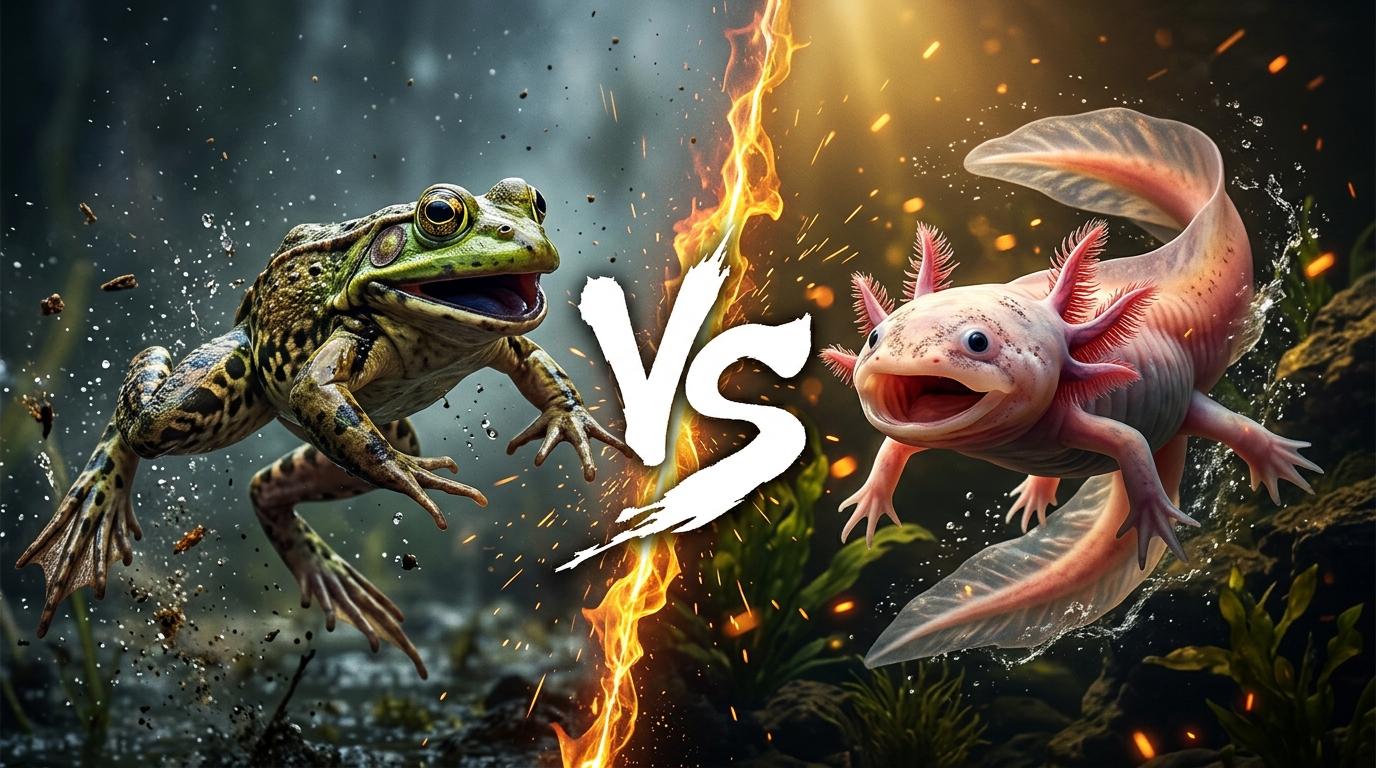
American Bullfrog vs Axolotl: Who Actually Wins?
The American Bullfrog wins, and it isn't especially close. An adult bullfrog can reach about 15–20 cm in body length and often weighs 300–500 g. It is a gape-limited swallowing predator: it lunges, pins prey with its forelimbs, and gulps down anything that fits in its mouth, including other amphibians. An adult axolotl is often 20–25 cm long, but much of that is tail, and it usually weighs only 60–110 g. It feeds by suction on small, soft prey. It has no fangs, no armored skin, and no strong burst escape on land. In shared water, the bullfrog's explosive leg drive and huge mouth beat the axolotl's slower, buoyancy-based movement. The axolotl's real superpower is regeneration, and that is a recovery trait, not a combat trait.
Read comparison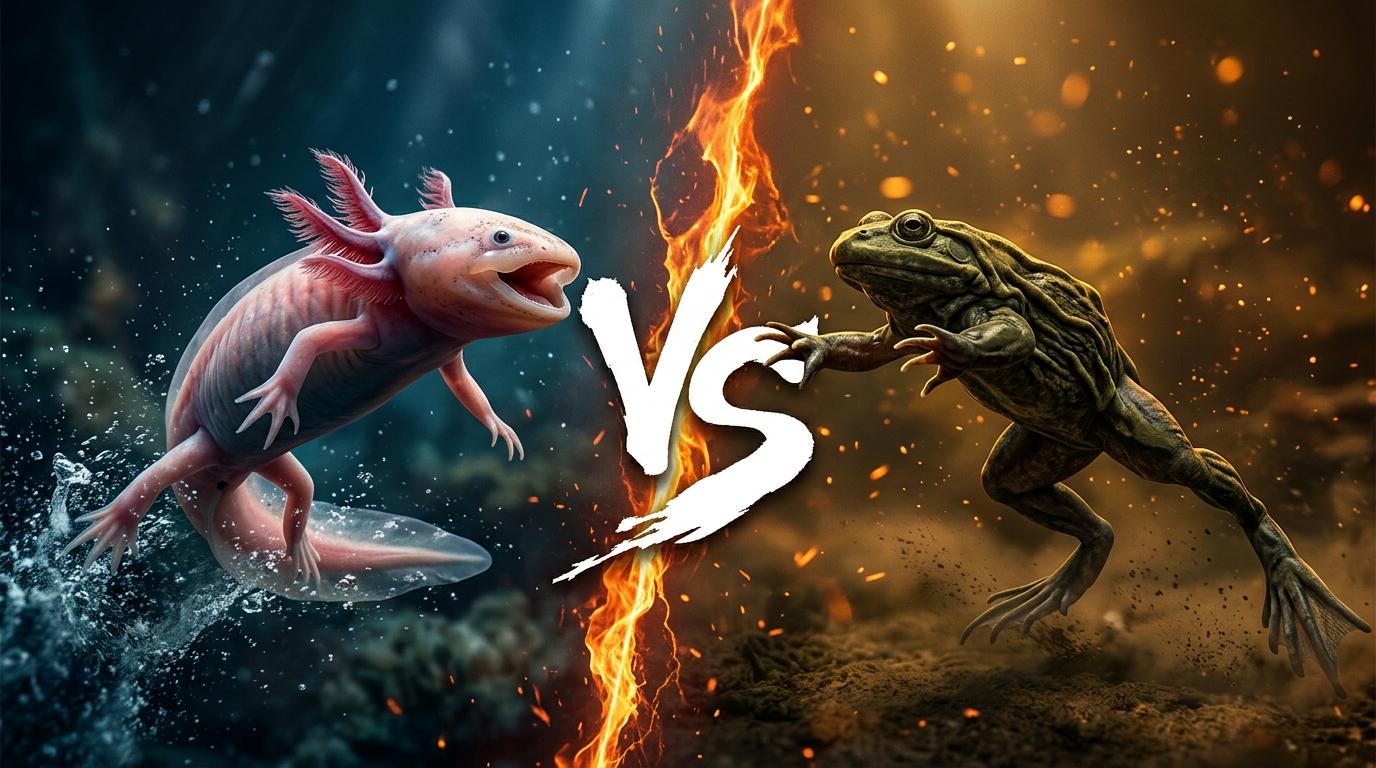
Axolotl vs Titicaca Water Frog: Who Actually Wins?
The axolotl wins, but only narrowly. This is a contest between two critically endangered aquatic oddballs built for still, cold water rather than combat, and neither one would normally pick a fight. The axolotl's edge comes from three things. It has a longer, more muscular body that commonly reaches 23–30 cm, while the frog's typical body runs well under that. It has a wide suction-gape that snaps shut fast on anything mouth-sized. And it can regenerate limbs, gills and even parts of organs, so nips that would cripple most amphibians barely slow it down. The Titicaca water frog is no pushover. Its powerful hind legs deliver real kicks, and heavyweight individuals can outweigh a small axolotl. But it is a slow, low-energy specialist that breathes mostly through its loose skin folds. That skin is a huge, fragile surface that suffers in any prolonged scuffle, especially in warmer or less oxygenated water. Over a sustained encounter, the axolotl's reach, grip and recovery tip the outcome.
Read comparison
Discussion
What do you think?
Share your reasoning with other readers. Be civil and stick to the animals.
Sign in to join the discussion.
Sign inNo comments yet. Start the conversation.