


Banded Linsang vs Banded Palm Civet: Who Actually Wins?
Banded linsang vs banded palm civet: a biology-first breakdown of size, weapons, agility and habitat to show which Southeast Asian small carnivoran would win a fight.
Banded Linsang vs Banded Palm Civet
Matchup winner
Banded Palm Civet
Quick verdict
Start with the direct answer, then use the structured comparison below to see what changes the outcome.
The banded palm civet wins most realistic confrontations, and the reason is simple: mass. Both animals are banded, nocturnal small carnivorans from the rainforests of the Thai-Malay Peninsula, Sumatra and Borneo, and they look like close cousins. The linsang, however, belongs to Prionodontidae, a family more closely related to cats than to true civets. A banded palm civet typically weighs around 1.5 to 3 kg. A banded linsang is a featherweight at roughly 0.6 to 0.8 kg. That two- to four-fold weight gap gives the civet a bulkier head, a heavier bite and far more grappling stability on the forest floor, where it does most of its foraging. The linsang is the purer predator, with retractile, cat-like claws, an extremely slender body, elite climbing ability and a diet built around catching live vertebrates like birds and squirrels. That makes it dangerous to approach and very hard to pin down in the canopy. In a sustained close-range struggle, though, its lightweight frame is a liability. Expect the linsang to win the escape and the civet to win the fight.
Read the full explanation
Winner: Banded Palm Civet. It is roughly 2 to 4 times heavier, and among small carnivorans, mass decides grappling outcomes.
The Banded Linsang is the more specialized hunter: faster, more arboreal and more carnivorous, with retractile claws.
In trees, the linsang avoids losing far more often than it wins. On the ground, the civet controls the encounter.
In the wild, the two would almost always avoid each other. They hunt different prey in different forest layers.
Reader vote
Who do you think wins?
Pick a side — no account needed. Results update live.
No votes yet — be the first to call it.
Editorial note
Why people disagree
Photos make them look similar in size. Long tails and slim bodies hide how much lighter the linsang really is.
Body mass & frame
In small-carnivoran scuffles, the heavier animal can pin, shove and absorb bites. This is the single biggest factor in the matchup.
Bite & head power
A bigger skull means more muscle attachment and more damage per bite once the two are locked together.
Claw weaponry
The linsang's claws stay sharp and grip prey well, so it can rake and hold better than its size suggests.
Read the full explanation +
The linsang's predator reputation (live birds, squirrels, cat-like claws) leads people to assume it is the better fighter. Hunting skill and fighting mass are not the same thing.
Habitat changes everything. Canopy fans picture a linsang running rings around a clumsy civet, while ground-level matchups favor the heavier, sturdier palm civet.
Comparison FAQ
Short, direct answers to the next questions readers usually ask after the headline verdict.
Would a banded linsang beat a banded palm civet?+
Usually not. The banded palm civet wins most close-range fights because it is roughly 2 to 4 times heavier. The linsang's best realistic outcome is escaping or holding off the civet in the trees.
Which is stronger, the banded linsang or the banded palm civet?+
The banded palm civet is stronger in absolute terms. Its larger body and longer jaws give it more force. The linsang is stronger relative to its size and more agile.
Why is the banded linsang still dangerous even though it loses?+
It is a dedicated vertebrate hunter with sharp, retractile cat-like claws and fast strike reflexes. It can inflict real wounds, and in the canopy it can avoid being caught at all.
Is the banded linsang a civet?+
No. Although it looks civet-like, the linsang belongs to its own family, Prionodontidae, which is more closely related to cats (Felidae) than to the civets of Viverridae.
Do banded linsangs and banded palm civets fight in the wild?+
Confrontations are probably rare. They share forests in Southeast Asia but use different layers and different prey, which keeps them out of each other's way.
Head-to-head species stats
These are the same core AnimalDex stat dimensions used on the dedicated animal pages, pulled side by side so the matchup is faster to scan.
Banded Linsang
Tier ABanded Palm Civet
Tier BTrait-by-trait comparison
Only the categories that matter to this matchup are included. The goal is not filler stats, but the real design differences that change the result.
~0.6–0.8 kg, ultra-slender
Body mass & frame
Banded Palm Civet
~1.5–3 kg, longer and stockier
Body mass & frame
Banded Palm Civet
Narrow skull, precise killing bite
Bite & head power
Banded Palm Civet
Longer, heavier jaws
Bite & head power
Banded Palm Civet
Retractile, sharp, cat-like
Claw weaponry
Banded Linsang
Semi-retractile, built for digging and foraging
Claw weaponry
Banded Linsang
Elite leaper and climber
Explosive agility
Banded Linsang
Capable climber, mainly ground forager
Explosive agility
Banded Linsang
Lives and hunts in the trees
Canopy control
Banded Linsang
Climbs but prefers the floor
Canopy control
Banded Linsang
Light frame, little padding
Close-range durability
Banded Palm Civet
Sturdier torso, more mass to spare
Close-range durability
Banded Palm Civet
How the verdict forms
Verdict timeline
01 · Body mass & frame
Banded Palm Civet
02 · Bite & head power
Banded Palm Civet
03 · Claw weaponry
Banded Linsang
04 · Explosive agility
Banded Linsang
05 · Canopy control
Banded Linsang
06 · Close-range durability
Banded Palm Civet
Change the conditions
Scenario breakdown
This is where shallow battle content usually fails. Terrain, spacing, timing, and engagement style can change the answer.
Scenario lean
Banded Palm Civet
Verdict confidence
82%
The civet's mass and footing win the grapple.
The forest floor is the palm civet's home turf. With stable footing, its weight advantage turns every clinch into a shove-and-pin contest the linsang cannot match. The linsang's claws can draw blood, but it cannot keep a heavier animal off it for long. Once the civet lands a bite on that slender frame, the exchange tilts hard in its favor.
AnimalDex field profiles
Explore these animals
Banded Linsang
Prionodon linsang
rainforest canopy and dense tropical woodland
Banded Palm Civet
Hemigalus derbyanus
rainforest, peat swamp forest, and dense tropical woodland
Systems Intelligence & Hidden Purpose
See the animals behind this comparison as engineered biological systems: what each one is built to do, where it gains leverage, and why the matchup changes by scenario.
Specialized Hardware
long ribbon-striped body, short catlike legs, and silent branch stalking give the Banded Linsang a body plan tuned for its niche.
Systems Script
Banded Linsangs operate through rainforest canopy and dense tropical woodland. Their design links movement, feeding, shelter, and timing into one workable survival system.
Strategic Insight
Dense environments reward precision, patience, and the ability to read layered cover.
Specialized Hardware
dark coat with pale bands, large night-adapted eyes, and tree-and-ground foraging give the Banded Palm Civet a body plan tuned for its niche.
Systems Script
Banded Palm Civets operate through rainforest, peat swamp forest, and dense tropical woodland. Their design links movement, feeding, shelter, and timing into one workable survival system.
Strategic Insight
Dense environments reward precision, patience, and the ability to read layered cover.
Final take
The Banded Palm Civet is the overall winner because this fight comes down to physics more than talent. The linsang is arguably the more impressive predator, a cat-like rainforest hunter that catches birds and squirrels. But at well under a kilogram, it is fighting an animal several times its weight.
Read the full explanation
The linsang keeps its dignity in the trees, where its balance and speed let it dictate or abandon any encounter. Most of the time, though, a heavier opponent with a bigger bite and a sturdier body wins when the two are forced into close contact. In reality, the two rarely compete at all: one hunts vertebrates in the canopy, and the other probes the leaf litter for invertebrates.
Collect both animals in AnimalDex
Track the species behind this matchup, compare their real traits, and build the rivalry into your AnimalDex collection.
Related comparisons
Continue with nearby matchups to compare more real-world animal traits without dropping into junky who-wins filler.

Banded Palm Civet vs Sunda Flying Lemur: Who Actually Wins?
The banded palm civet wins. The two animals are close in weight: the civet runs roughly 1.5 to 3 kg, and the colugo roughly 1 to 2 kg. The difference is in what each body is built to do. The civet is a true carnivoran with shearing carnassial teeth, a predatory bite, and the reflexes of a nocturnal hunter that seizes struggling prey on the ground and in low vegetation. The Sunda flying lemur is a leaf-eating glider. Its comb-like lower incisors are grooming and food-scraping tools, not weapons, and its skin membrane makes it clumsy and slow on any flat surface. The colugo's best move is not to fight at all but to climb high and glide away, and in a sustained close-range contest the civet's bite decides it.
Read comparison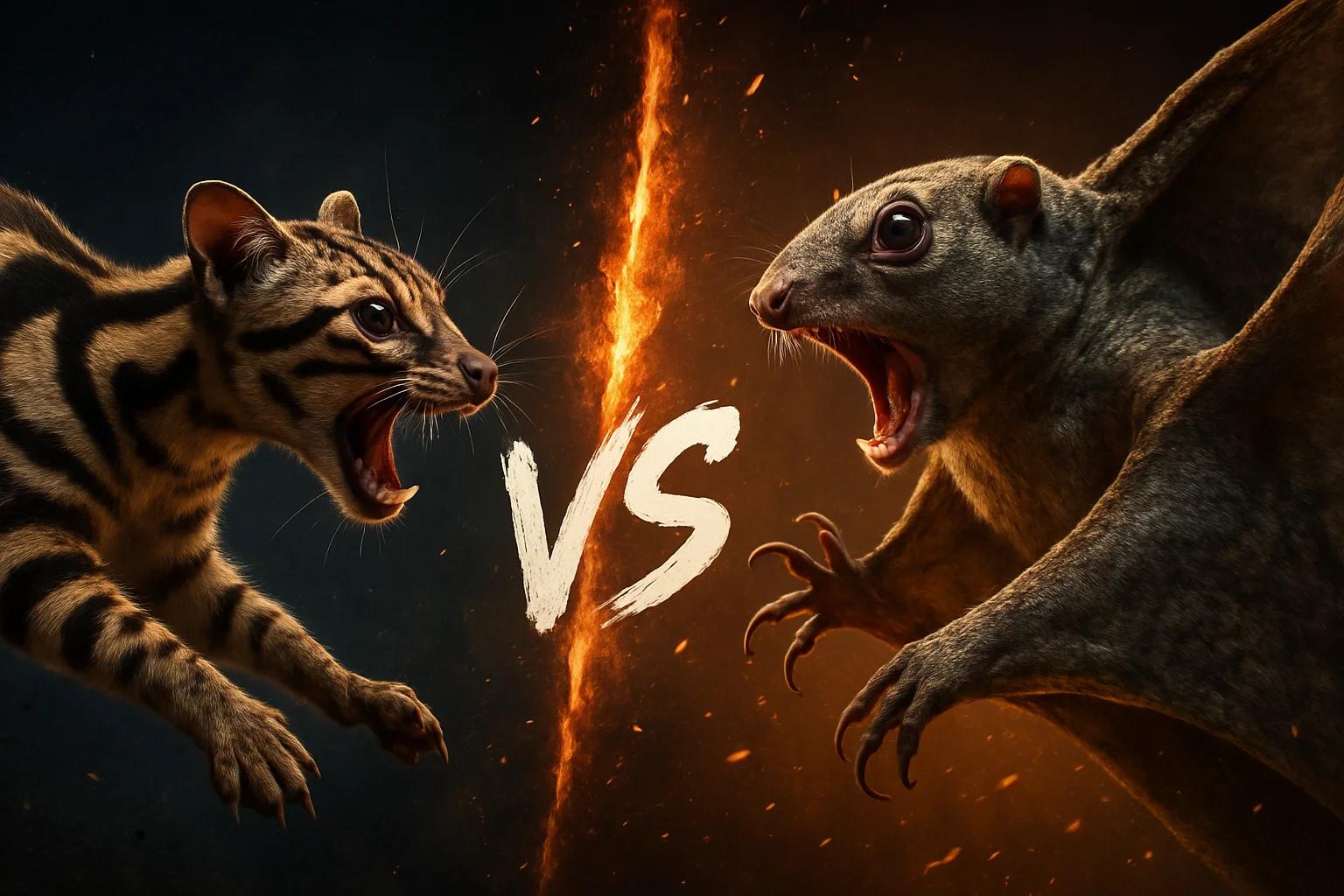
Banded Linsang vs Sunda Flying Lemur: Who Actually Wins?
The banded linsang wins. It is the smaller animal, often around 0.6–0.8 kg against a colugo that can weigh twice as much, but it is built to kill. The linsang is a lean, almost entirely carnivorous climber with retractile claws, a fast neck-directed bite, and a hunter's habit of committing to small, struggling prey. The Sunda flying lemur is a nocturnal folivore. Its body is designed around a huge gliding membrane, a leaf-processing gut, and grasping claws that are made for clinging rather than fighting. If the colugo is forced to stand and fight, its extra mass buys it time but no real offense. Its genuine advantage is leaving. A colugo that reaches launch height can glide away and end the encounter. So the colugo wins the escape game, but the linsang wins the fight.
Read comparison
Banded Linsang vs Pygmy Marmoset: Who Actually Wins?
The banded linsang wins this matchup decisively. It is a slender, arboreal hypercarnivore from Southeast Asia's forests, built to catch small vertebrates: birds, rodents, lizards and other small mammals. It has retractable claws, sharp carnassial-style shearing teeth and a body that moves through branches like a ribbon. At roughly 600–800 g, it outweighs the pygmy marmoset several times over. The marmoset typically weighs around 100–120 g and is among the smallest primates on Earth. That is the exact prey size the linsang evolved to handle. The marmoset's real strengths are vigilance, alarm calls, group coordination and a lightning scramble to the far side of a trunk. Those are tools for avoiding a fight, not winning one. If contact happens, the linsang's bite-and-grip predatory system ends it quickly. One note keeps this honest: the two species don't share a continent. Marmosets live in the western Amazon and linsangs in Southeast Asia, so this is a pure biology thought experiment.
Read comparison
Abyssinian Ground Hornbill vs Banded Linsang: Who Actually Wins?
In a confrontation between the Abyssinian Ground Hornbill and the Banded Linsang, the Abyssinian Ground Hornbill emerges as the clear winner. With its greater size, dominance, and potential for explosive power, this impressive bird can outmatch the smaller, quicker linsang in most scenarios, particularly in open ground situations where it can leverage its physical advantages.
Read comparison
Discussion
What do you think?
Share your reasoning with other readers. Be civil and stick to the animals.
Sign in to join the discussion.
Sign inNo comments yet. Start the conversation.