


Banded Linsang vs Binturong: Who Actually Wins?
Banded linsang vs binturong: a biology-first breakdown of size, speed, climbing and defense in Southeast Asian forests. See who wins and why.
Banded Linsang vs Binturong
Matchup winner
Binturong
Quick verdict
Start with the direct answer, then use the structured comparison below to see what changes the outcome.
The binturong wins this matchup clearly. It is a heavyweight arboreal specialist, typically 9–20 kg against the banded linsang's roughly 0.6–0.8 kg. That is more than a tenfold mass gap. The binturong adds a muscular prehensile tail, a thick shaggy coat, strong jaws and a calm, deliberate temperament that does not panic in a scrap. The linsang is one of Asia's most elegant small predators: slender, lightning-quick and deadly to birds, rodents and lizards. But its hardware is tuned to kill small prey, not to dismantle an animal that outweighs it many times over. In any committed close-range contest, the binturong's mass and grip decide it. The linsang's best realistic outcome is a fast escape through thin branches.
Read the full explanation
Binturong wins: it outweighs the banded linsang by roughly 10–25 times.
The linsang is faster and more agile, but speed cannot offset that size gap in a real clash.
A prehensile tail and dense coat give the binturong stability and protection in the canopy.
The linsang's real 'win' condition is escape, not victory.
Reader vote
Who do you think wins?
Pick a side — no account needed. Results update live.
No votes yet — be the first to call it.
Editorial note
Why people disagree
Both look like 'cat-like' civet relatives, so people assume they're roughly comparable. They are not even close in size.
Mass and frame
In close contact, mass controls who gets pinned and who gets pushed off a branch. This category alone largely decides the fight.
Explosive speed
The linsang chooses when engagement starts or ends. That gives it control of escape, not of the outcome.
Canopy grip and stability
An anchored binturong can fight with its forelimbs while staying secure. That is a huge edge in arboreal grappling.
Read the full explanation +
The linsang is the more active predator, which makes fans overrate its fighting edge against non-prey animals.
The binturong eats lots of fruit and looks sleepy, so it gets underrated. Its bulk, teeth and tail still make it formidable.
Comparison FAQ
Short, direct answers to the next questions readers usually ask after the headline verdict.
Would a banded linsang beat a binturong in a fight?+
No. The binturong would win a committed fight. It outweighs the linsang by roughly 10–25 times and has stronger jaws, thicker protection and a prehensile tail for stability.
Which is stronger, the banded linsang or the binturong?+
The binturong is far stronger. Its heavy, muscular frame and grasping tail give it much more raw power than the slender, lightweight linsang.
Is the banded linsang still dangerous?+
Yes, to the right targets. It is a sharp-toothed, ultra-agile predator of birds, rodents and reptiles. If cornered, it bites quickly and accurately. Its speed also means a larger animal rarely gets the chance to catch it.
Is the banded linsang a cat?+
No. Despite its feline look, the linsang belongs to its own family, Prionodontidae. Genetic studies suggest its closest relatives are actually the cats (Felidae), not the civets it resembles.
Are binturongs aggressive?+
Usually not. They are generally calm and deliberate, but they will growl, release a strong musky scent and fight back hard when threatened.
Do banded linsangs and binturongs live in the same place?+
Their ranges overlap in parts of Southeast Asia's tropical forests, including the Malay Peninsula, Sumatra, Borneo and Java. Both are mainly arboreal and nocturnal.
Head-to-head species stats
These are the same core AnimalDex stat dimensions used on the dedicated animal pages, pulled side by side so the matchup is faster to scan.
Banded Linsang
Tier ABinturong
Tier CTrait-by-trait comparison
Only the categories that matter to this matchup are included. The goal is not filler stats, but the real design differences that change the result.
~0.6–0.8 kg, whip-thin
Mass and frame
Binturong
~9–20 kg, heavy and solid
Mass and frame
Binturong
Elite bursts, rapid pounces
Explosive speed
Banded Linsang
Slow, methodical climber
Explosive speed
Banded Linsang
Agile paws, balancing tail
Canopy grip and stability
Binturong
True prehensile tail as a fifth limb
Canopy grip and stability
Binturong
Specialist small-vertebrate killer
Predatory precision
Banded Linsang
Opportunistic omnivore
Predatory precision
Banded Linsang
Fragile, light build
Close-range durability
Binturong
Thick coat, robust body
Close-range durability
Binturong
Relies on stealth and flight
Threat display and deterrence
Binturong
Growls, musky scent, standing bulk
Threat display and deterrence
Binturong
How the verdict forms
Verdict timeline
01 · Mass and frame
Binturong
02 · Explosive speed
Banded Linsang
03 · Canopy grip and stability
Binturong
04 · Predatory precision
Banded Linsang
05 · Close-range durability
Binturong
06 · Threat display and deterrence
Binturong
Change the conditions
Scenario breakdown
This is where shallow battle content usually fails. Terrain, spacing, timing, and engagement style can change the answer.
Scenario lean
Binturong
Verdict confidence
82%
Binturong holds the branch; the linsang retreats.
In tangled vegetation, the binturong anchors with its tail and faces the threat head-on. The linsang can harass, but any grappling exchange favors the animal ten times heavier. Dense cover does give the linsang an easy exit, so the most likely ending is the linsang disengaging, not dying.
AnimalDex field profiles
Explore these animals
Banded Linsang
Prionodon linsang
rainforest canopy and dense tropical woodland
Binturong
Arctictis binturong
Lowland tropical forest, hill forest, and mature canopy systems with fruiting trees.
Systems Intelligence & Hidden Purpose
See the animals behind this comparison as engineered biological systems: what each one is built to do, where it gains leverage, and why the matchup changes by scenario.
Specialized Hardware
long ribbon-striped body, short catlike legs, and silent branch stalking give the Banded Linsang a body plan tuned for its niche.
Systems Script
Banded Linsangs operate through rainforest canopy and dense tropical woodland. Their design links movement, feeding, shelter, and timing into one workable survival system.
Strategic Insight
Dense environments reward precision, patience, and the ability to read layered cover.
Specialized Hardware
Prehensile tail support, strong climbing limbs, and fruit-oriented digestive strategy make binturongs effective arboreal transport hardware for tropical forests.
Systems Script
Binturongs help move seeds through forest canopies and edges where fruit availability shapes wildlife traffic. They are not flashy apex actors; they are logistics embedded in fur.
Strategic Insight
Systems often depend on carriers more than stars. Move the valuable material and the structure keeps rebuilding itself.
Final take
The binturong is the clear winner. This is a heavyweight-versus-featherweight matchup inside the same broad carnivoran lineage. The binturong's mass, prehensile tail, dense coat and composed defensive style overwhelm anything a sub-kilogram predator can bring to a direct fight.
Read the full explanation
None of that diminishes the banded linsang. It is a precision instrument: fast, silent and lethal to the small animals it evolved to catch. Its survival rule is avoidance, and against a binturong that rule works perfectly. The linsang wins the chase, the binturong wins the fight, and in a 'who wins' question, the fight is what counts.
Collect both animals in AnimalDex
Track the species behind this matchup, compare their real traits, and build the rivalry into your AnimalDex collection.
Related comparisons
Continue with nearby matchups to compare more real-world animal traits without dropping into junky who-wins filler.

Banded Linsang vs Dusky Pademelon: Who Actually Wins?
The dusky pademelon wins overall. This is a classic hunter-versus-mass mismatch. The banded linsang is a true predator with sharp teeth, retractable claws, and excellent climbing skill, but an adult usually weighs under a kilogram. A grown dusky pademelon is a compact wallaby that typically weighs several times more and is powered by thick-muscled hind legs built for bounding and defensive kicks. The linsang's toolkit is designed for rodents, birds, lizards, and insects, not for subduing a heavy, kicking marsupial. On the ground, the pademelon's weight, balance, and leg drive decide the encounter. The linsang wins only when it can simply leave the fight by going up into the trees. The two species never meet in the wild, because the linsang lives in Southeast Asia and the pademelon in New Guinea and nearby islands. As a biology thought experiment, though, mass beats finesse.
Read comparison
Banded Linsang vs Banded Palm Civet: Who Actually Wins?
The banded palm civet wins most realistic confrontations, and the reason is simple: mass. Both animals are banded, nocturnal small carnivorans from the rainforests of the Thai-Malay Peninsula, Sumatra and Borneo, and they look like close cousins. The linsang, however, belongs to Prionodontidae, a family more closely related to cats than to true civets. A banded palm civet typically weighs around 1.5 to 3 kg. A banded linsang is a featherweight at roughly 0.6 to 0.8 kg. That two- to four-fold weight gap gives the civet a bulkier head, a heavier bite and far more grappling stability on the forest floor, where it does most of its foraging. The linsang is the purer predator, with retractile, cat-like claws, an extremely slender body, elite climbing ability and a diet built around catching live vertebrates like birds and squirrels. That makes it dangerous to approach and very hard to pin down in the canopy. In a sustained close-range struggle, though, its lightweight frame is a liability. Expect the linsang to win the escape and the civet to win the fight.
Read comparison
Binturong vs Sun Bear: Who Actually Wins?
The sun bear wins, and it is not especially close. An adult sun bear typically weighs 27–65 kg, which is roughly two to five times the weight of a binturong at 9–20 kg. It brings long, curved claws built for ripping open hardwood, a powerful jaw that cracks termite mounds and tree bark, and a famously short fuse. The binturong is a muscular, slow-moving viverrid with a strong bite and a prehensile tail. It is a canopy specialist that eats mostly fruit, not a brawler. In any forced ground confrontation, the bear's mass, armored loose skin, and claw reach overwhelm anything the binturong can answer with. The binturong's realistic win condition is not to fight at all but to stay in thin branches where the heavier bear can't follow safely.
Read comparison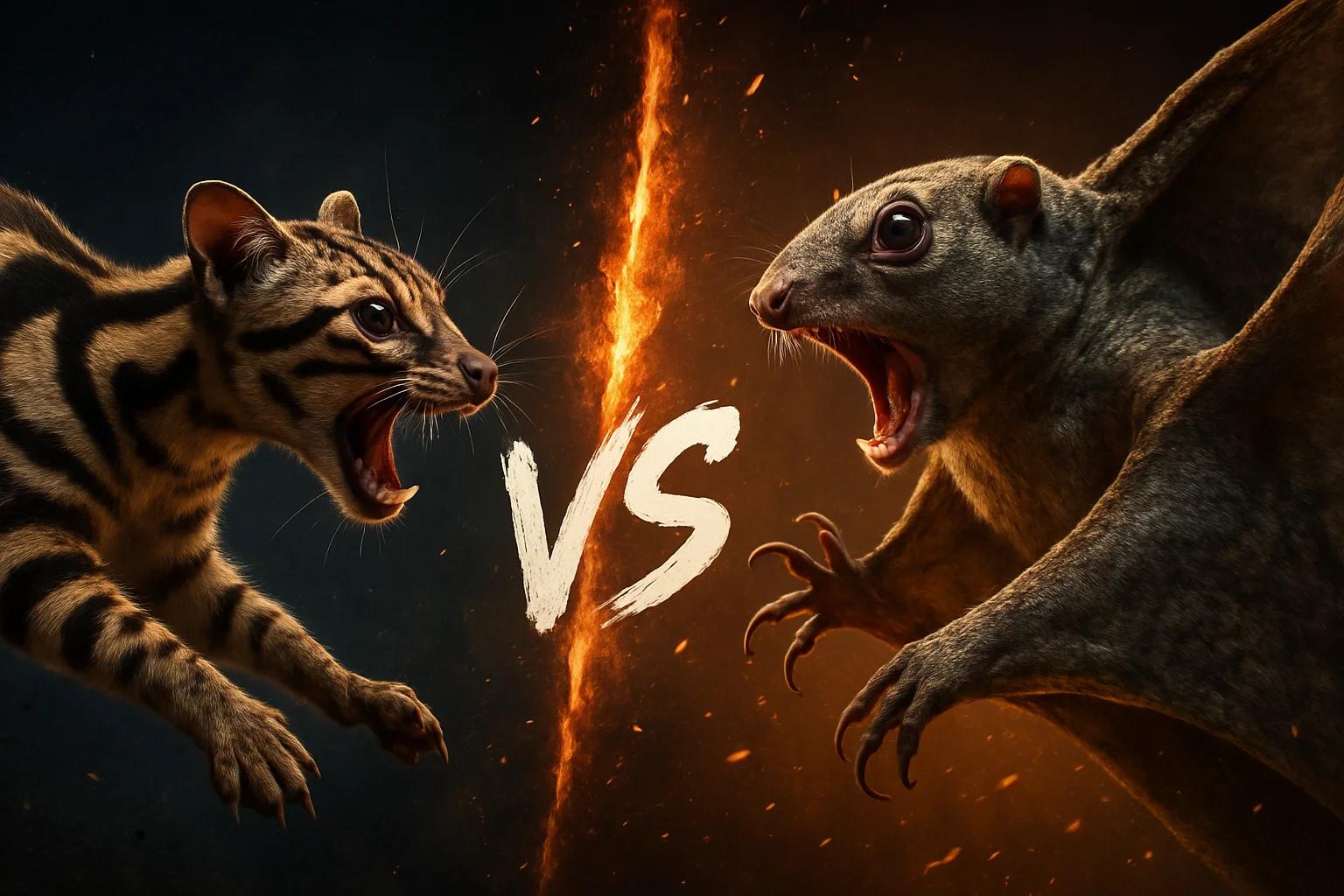
Banded Linsang vs Sunda Flying Lemur: Who Actually Wins?
The banded linsang wins. It is the smaller animal, often around 0.6–0.8 kg against a colugo that can weigh twice as much, but it is built to kill. The linsang is a lean, almost entirely carnivorous climber with retractile claws, a fast neck-directed bite, and a hunter's habit of committing to small, struggling prey. The Sunda flying lemur is a nocturnal folivore. Its body is designed around a huge gliding membrane, a leaf-processing gut, and grasping claws that are made for clinging rather than fighting. If the colugo is forced to stand and fight, its extra mass buys it time but no real offense. Its genuine advantage is leaving. A colugo that reaches launch height can glide away and end the encounter. So the colugo wins the escape game, but the linsang wins the fight.
Read comparison
Discussion
What do you think?
Share your reasoning with other readers. Be civil and stick to the animals.
Sign in to join the discussion.
Sign inNo comments yet. Start the conversation.