


Barramundi vs Largetooth Sawfish: Who Actually Wins?
Barramundi vs largetooth sawfish: who would win? A biology-first breakdown of size, weaponry, speed, and habitat shows why the sawfish's sheer mass and rostrum outclass Australia's famous ambush predator.
Barramundi vs Largetooth Sawfish
Matchup winner
Barramundi
Quick verdict
Start with the direct answer, then use the structured comparison below to see what changes the outcome.
The largetooth sawfish wins, and it isn't especially close. An adult Pristis pristis can exceed 6 meters and several hundred kilograms. The barramundi tops out around 1.2–1.8 meters and roughly 60 kg. The sawfish also carries a tooth-studded rostrum that it uses to slash and stun fish, and it is a fish-eater that shares the barramundi's rivers, estuaries, and floodplain billabongs. The barramundi's real gifts are a lightning-fast suction strike, ambush timing around snags, and acceleration. Those make it a superb hunter of smaller prey, but they give it no way to injure a giant ray with a sandpaper hide. In most realistic encounters the barramundi's best outcome is escape, not victory. Juvenile sawfish are a different story, and that nuance is why some people still argue about this matchup.
Read the full explanation
Winner: Largetooth Sawfish, thanks to a massive size advantage and a purpose-built slashing weapon.
An adult sawfish can outweigh a big barramundi by five times or more.
The barramundi's speed and ambush skill help it escape, not win.
Juvenile sawfish under about 1 m are vulnerable, but adults are not.
Reader vote
Who do you think wins?
Pick a side — no account needed. Results update live.
No votes yet — be the first to call it.
Editorial note
Why people disagree
Anglers know barramundi as explosive, aggressive fighters and assume that ferocity carries over to any matchup. Line-pulling power is not the same as damage output.
Raw mass & frame
In fish-on-fish contact, mass decides who can be bitten, rammed, or pinned. The sawfish is in another weight class entirely.
Built-in weaponry
The barramundi swallows prey whole and lacks cutting tools. The sawfish has a dedicated strike weapon.
Explosive strike speed
The barra wins the reaction-time race. That decides escapes but not damage.
Read the full explanation +
Sawfish look slow and docile on the bottom, so people underrate how fast that rostrum sweeps sideways through a school of fish.
The two species overlap as predator and prey at small sizes. A big barra can threaten a pup sawfish, which blurs the answer if age isn't specified.
Comparison FAQ
Short, direct answers to the next questions readers usually ask after the headline verdict.
Would a barramundi beat a largetooth sawfish?+
Not an adult one. The sawfish's size, armored hide, and toothed rostrum overwhelm the barramundi. Only a large barra facing a small juvenile sawfish has the edge.
Which is stronger, barramundi or sawfish?+
The largetooth sawfish by far. It can be several times longer and many times heavier, and it has far more raw power behind each strike.
Why is the barramundi still dangerous?+
Its explosive suction strike and ambush timing make it a top predator of smaller fish, including young sawfish in nursery creeks. Around cover it is also extremely hard to catch.
Do barramundi and sawfish live together?+
Yes. Both use northern Australian and Indo-Pacific rivers, estuaries, and floodplains, so their ranges genuinely overlap.
Is the largetooth sawfish endangered?+
Yes. It is Critically Endangered, largely because its rostrum tangles easily in fishing nets.
Head-to-head species stats
These are the same core AnimalDex stat dimensions used on the dedicated animal pages, pulled side by side so the matchup is faster to scan.
Barramundi
Tier CLargetooth Sawfish
Tier BTrait-by-trait comparison
Only the categories that matter to this matchup are included. The goal is not filler stats, but the real design differences that change the result.
Up to ~1.8 m, ~60 kg
Raw mass & frame
Largetooth Sawfish
Over 6 m, several hundred kg
Raw mass & frame
Largetooth Sawfish
Large gape, small rasping teeth
Built-in weaponry
Largetooth Sawfish
Toothed rostrum for slashing and pinning
Built-in weaponry
Largetooth Sawfish
Elite suction-ambush burst
Explosive strike speed
Barramundi
Sudden lateral rostrum sweeps
Explosive strike speed
Barramundi
Snag-hugging, low-light opportunist
Ambush control
Barramundi
Bottom-patrolling electrosensory hunter
Ambush control
Barramundi
Scaled but modest frame
Close-range durability
Largetooth Sawfish
Thick, denticle-armored hide
Close-range durability
Largetooth Sawfish
Strong eyes, lateral line
Sensory reach in murky water
Largetooth Sawfish
Electroreceptors along the rostrum
Sensory reach in murky water
Largetooth Sawfish
How the verdict forms
Verdict timeline
01 · Raw mass & frame
Largetooth Sawfish
02 · Built-in weaponry
Largetooth Sawfish
03 · Explosive strike speed
Barramundi
04 · Ambush control
Barramundi
05 · Close-range durability
Largetooth Sawfish
06 · Sensory reach in murky water
Largetooth Sawfish
Change the conditions
Scenario breakdown
This is where shallow battle content usually fails. Terrain, spacing, timing, and engagement style can change the answer.
Scenario lean
Barramundi
Verdict confidence
82%
Barramundi survives and effectively wins by escaping.
Tangled mangrove roots and drowned timber limit the space for wide rostrum sweeps and reward a nimble fish. The barramundi can dart deeper into structure where a long, heavy sawfish can't follow. This is a survival win rather than a knockout, but it is the barra's best terrain.
AnimalDex field profiles
Explore these animals
Barramundi
Lates calcarifer
estuary, mangrove creek, and tropical river
Largetooth Sawfish
Pristis pristis
river mouth, estuary, and large tropical river
Systems Intelligence & Hidden Purpose
See the animals behind this comparison as engineered biological systems: what each one is built to do, where it gains leverage, and why the matchup changes by scenario.
Specialized Hardware
large silver predatory body, salt-and-freshwater adaptability, and surface-striking ambush give the Barramundi a body plan tuned for its niche.
Systems Script
Barramundis operate through estuary, mangrove creek, and tropical river. Their design links movement, feeding, shelter, and timing into one workable survival system.
Strategic Insight
Where water controls movement, position and timing often matter more than speed.
Specialized Hardware
long tooth-lined saw rostrum, broad estuary-moving body, and muddy-water bottom cruising give the Largetooth Sawfish a body plan tuned for its niche.
Systems Script
Largetooth Sawfishs operate through river mouth, estuary, and large tropical river. Their design links movement, feeding, shelter, and timing into one workable survival system.
Strategic Insight
Where water controls movement, position and timing often matter more than speed.
Final take
The largetooth sawfish is the clear winner. It brings massive size, armored skin, electrosensory targeting, and a rostrum that functions as a living saw. Against all that, a barramundi has no offensive answer for an adult.
Read the full explanation
The barramundi's genius is selective aggression. It strikes what it can swallow and hides from what it can't. That makes it a survivor in sawfish country rather than a challenger. The confidence gap closes only when the sawfish is a juvenile.
Collect both animals in AnimalDex
Track the species behind this matchup, compare their real traits, and build the rivalry into your AnimalDex collection.
Related comparisons
Continue with nearby matchups to compare more real-world animal traits without dropping into junky who-wins filler.

Beluga Sturgeon vs Largetooth Sawfish: Who Actually Wins?
The largetooth sawfish wins. Both are giant, ancient-lineage fish built for river mouths and murky water, but only one carries a weapon. The beluga sturgeon is a huge, armored bottom-cruiser. Its bony scutes and sheer bulk make it hard to hurt, but it has no teeth as an adult and feeds by suction through a toothless, protrusible mouth. The largetooth sawfish is a ray that routinely reaches 6–7 m. It packs a toothed rostrum that sweeps side to side, an electroreceptive sensor array along that saw, and a muscular shark-like tail. In any meaningful confrontation, the sawfish holds the only real offensive tool and the sensory edge in turbid water. The sturgeon's realistic best outcome is to absorb blows and leave.
Read comparison
Coelacanth vs Largetooth Sawfish: Who Actually Wins?
The largetooth sawfish wins clearly. It is one of the largest rays on Earth. Big adults commonly pass 5 to 6 meters and several hundred kilograms, and some reach around 7 meters. Its rostrum is a toothed, sensor-packed blade that it whips sideways to stun and slash fish. The coelacanth is a slow, roughly 2-meter, 90-kilogram deep-reef drifter. It is built to save energy, not to fight, and its main defenses are heavy cosmine-coated scales and a habit of hiding in volcanic caves. In any frame where the two actually meet, the sawfish's three-to-one length edge, electroreceptive targeting and lateral slashing weapon outmatch the coelacanth's armor and patience. The coelacanth's real 'win condition' is avoidance: staying deep and in the rocks, where a shallow-water sawfish rarely goes.
Read comparison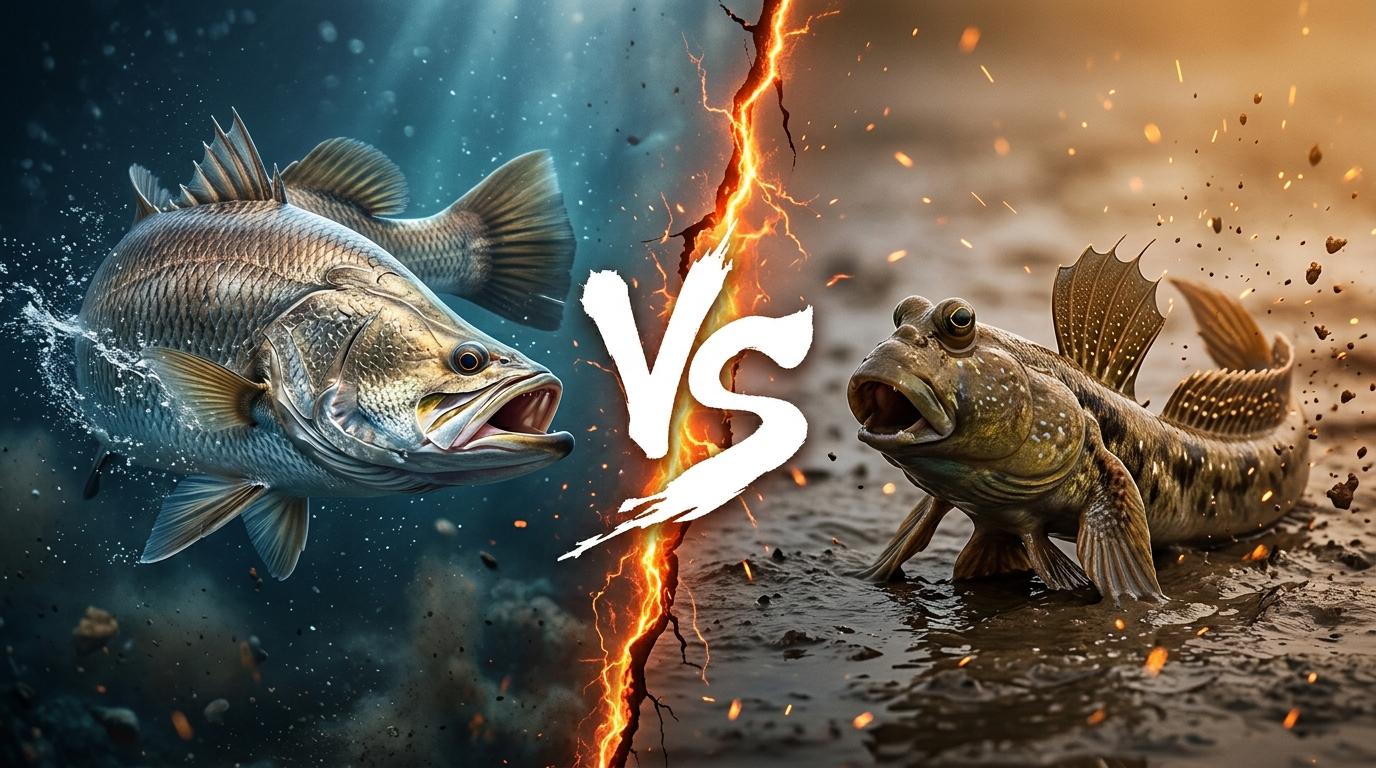
Barramundi vs Mudskipper: Who Actually Wins?
The barramundi wins overall, and in open water it is barely a contest. Lates calcarifer is a powerful estuarine ambush predator that can grow past a meter long. It feeds by suction: it flares its huge mouth and inhales prey whole in a fraction of a second. Small fish like mudskippers sit squarely on its menu. The mudskipper usually measures 10–20 cm and has no bite or armor that can hurt a barramundi. Its real weapon is leaving the water. It breathes through moist skin and gill chambers, skips across mud with its pectoral fins, and retreats into burrows a barramundi cannot follow. So the mudskipper doesn't win fights; it refuses them. Wherever the water is deep enough to swim, the barramundi is the clear winner.
Read comparison
Archerfish vs Barramundi: Who Actually Wins?
The barramundi wins, and it isn't close. Lates calcarifer is a large predatory perch that commonly reaches 60–120 cm and can pass 1.5 m. It has a huge bucket mouth built to suck in whole fish, and it ambushes from snags in the same estuaries and mangrove creeks where archerfish live. The banded archerfish usually tops out around 20–30 cm. Its signature weapon is a precision water jet aimed at insects above the surface, and that jet does nothing to a submerged predator. In real overlap, an archerfish is not an opponent for a barramundi. It is a plausible meal. The archerfish's best outcome is to avoid the encounter: it stays near the surface, keeps its eyes sharp, and slips through tight root tangles.
Read comparison
Discussion
What do you think?
Share your reasoning with other readers. Be civil and stick to the animals.
Sign in to join the discussion.
Sign inNo comments yet. Start the conversation.