

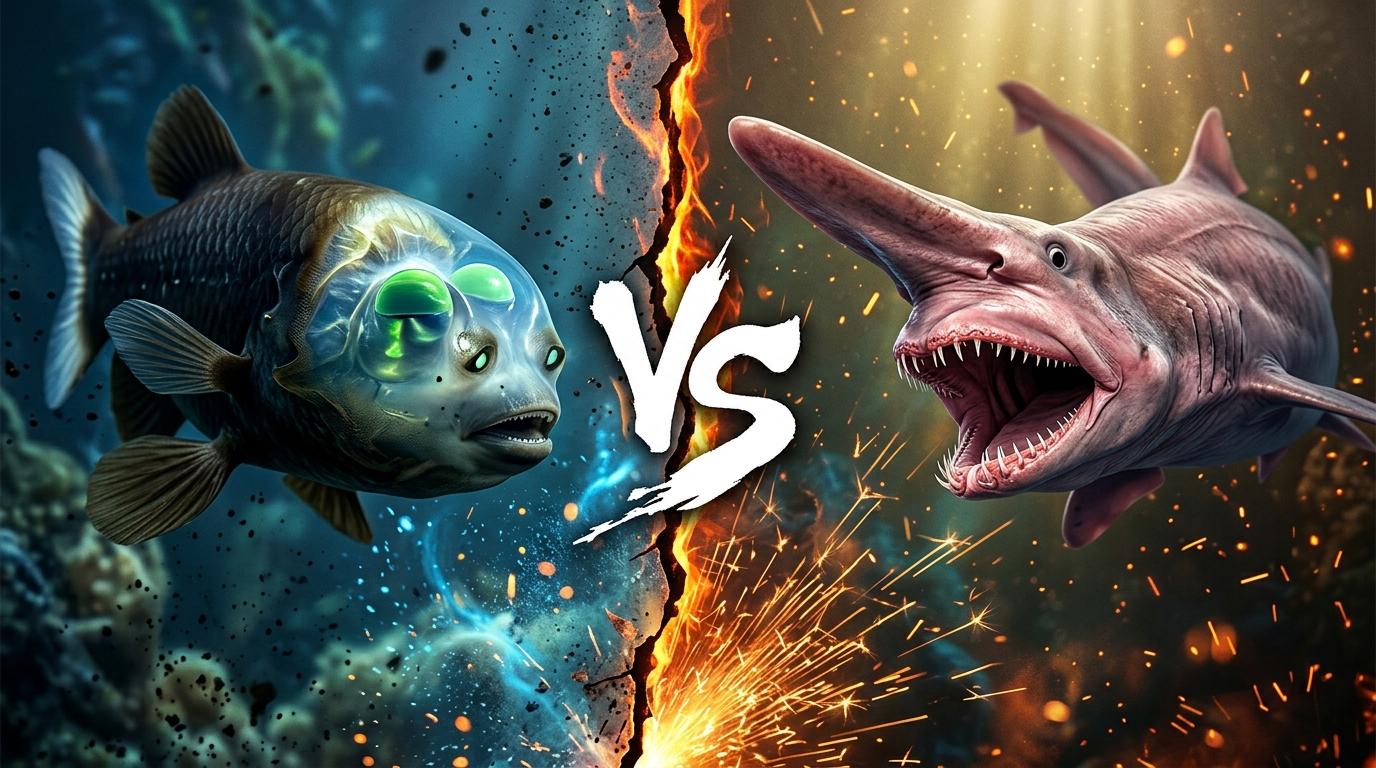
Barreleye vs Goblin Shark: Who Actually Wins?
Barreleye vs goblin shark: a biology-first look at size, jaws, senses and deep-sea survival to find out which midwater oddity wins a head-to-head clash.
Barreleye vs Goblin Shark
Matchup winner
Goblin Shark
Quick verdict
Start with the direct answer, then use the structured comparison below to see what changes the outcome.
The goblin shark wins, and it is not close. The goblin shark is a 3–4 meter (sometimes larger) deep-sea predator built around a slingshot jaw that shoots forward to snatch prey. The barreleye is a palm-sized fish roughly 15 cm long, and its real weapons are detection and avoidance. Its tubular, rotating eyes inside a transparent head shield let it spot faint silhouettes and bioluminescent flashes. They help it steal food and stay out of trouble, but they do nothing to stop a predator that outweighs it by hundreds of times. In any frame where the two actually meet, size, jaw mechanics and electroreception put the barreleye on the menu. The barreleye's only 'win' condition is never being noticed.
Read the full explanation
Goblin shark wins decisively: it is hundreds of times heavier and armed with a protrusible, fang-lined jaw.
The barreleye has no offensive weapons. Its edge is extraordinary low-light vision and stillness.
The barreleye survives encounters by detecting threats early and avoiding them, not by fighting.
The goblin shark's electroreceptive snout can find motionless prey that vision alone would miss.
Reader vote
Who do you think wins?
Pick a side — no account needed. Results update live.
No votes yet — be the first to call it.
Editorial note
Why people disagree
Viral clips of the barreleye's see-through head make it seem high-tech and capable, but advanced eyes are a survival tool, not a weapon.
Size and mass
In a direct clash, a mass gap this large decides everything before tactics even matter.
Strike weaponry
The goblin shark's protrusible jaw closes distance in a fraction of a second, so a small fish has almost no reaction window.
Low-light detection
The barreleye sees silhouettes and glows best, which is its whole survival strategy for detecting danger early.
Read the full explanation +
Both animals are 'weird deep-sea fish,' so people assume they belong in the same weight class. They don't: one is a shark, the other a fish that fits in your hand.
The goblin shark's flabby body and slow cruising speed make it look weak. Its jaw strike, though, is one of the fastest feeding motions among sharks.
Comparison FAQ
Short, direct answers to the next questions readers usually ask after the headline verdict.
Would a barreleye beat a goblin shark?+
No. The goblin shark is hundreds of times heavier and has a fast, toothed protrusible jaw. The barreleye has no weapons capable of hurting it.
Which is stronger, the barreleye or the goblin shark?+
The goblin shark, by a huge margin. It reaches 3–4 meters or more, while the barreleye is about 15 centimeters long.
How would a fight between them actually play out?+
Realistically, it would be a single strike. The goblin shark would locate the barreleye with electroreception and snap it up with its slingshot jaw before the fish could react.
Why does the barreleye stay dangerous to underestimate?+
Its rotating tubular eyes detect faint silhouettes and bioluminescence, so it often spots predators early and slips away. It is not dangerous to the shark, but it is very hard to catch off guard in dim light.
Is the goblin shark dangerous to humans?+
No. It lives deep and is rarely encountered, and there are no confirmed attacks on people.
Head-to-head species stats
These are the same core AnimalDex stat dimensions used on the dedicated animal pages, pulled side by side so the matchup is faster to scan.
Barreleye
Tier BGoblin Shark
Tier BTrait-by-trait comparison
Only the categories that matter to this matchup are included. The goal is not filler stats, but the real design differences that change the result.
About 15 cm, a few grams
Size and mass
Goblin Shark
3–4+ m, up to roughly 200 kg
Size and mass
Goblin Shark
Tiny mouth for small prey and stolen siphonophore food
Strike weaponry
Goblin Shark
Slingshot jaw with nail-like teeth
Strike weaponry
Goblin Shark
Rotating tubular eyes and a transparent shield
Low-light detection
Barreleye
Small eyes, but an electroreceptive snout
Low-light detection
Barreleye
Needs faint light or bioluminescence
Sensory reach in total darkness
Goblin Shark
Ampullae of Lorenzini sense bioelectric fields
Sensory reach in total darkness
Goblin Shark
Hovers almost motionless with large stabilizing fins
Stealth and stillness
Barreleye
Slow, low-energy cruiser
Stealth and stillness
Barreleye
Fragile body and a soft dome
Close-range durability
Goblin Shark
Large, though soft-bodied, frame
Close-range durability
Goblin Shark
How the verdict forms
Verdict timeline
01 · Size and mass
Goblin Shark
02 · Strike weaponry
Goblin Shark
03 · Low-light detection
Barreleye
04 · Sensory reach in total darkness
Goblin Shark
05 · Stealth and stillness
Barreleye
06 · Close-range durability
Goblin Shark
Change the conditions
Scenario breakdown
This is where shallow battle content usually fails. Terrain, spacing, timing, and engagement style can change the answer.
Scenario lean
Goblin Shark
Verdict confidence
82%
Goblin shark wins: darkness takes away the barreleye's best tool.
The barreleye's eyes depend on faint downwelling light or bioluminescent flashes. In true darkness its detection range drops, while the goblin shark's electroreceptors keep working. Once the shark is close, its jaw strike ends the encounter instantly.
AnimalDex field profiles
Explore these animals
Goblin Shark
Mitsukurina owstoni
deep ocean slope and offshore marine depths
Systems Intelligence & Hidden Purpose
See the animals behind this comparison as engineered biological systems: what each one is built to do, where it gains leverage, and why the matchup changes by scenario.
Specialized Hardware
transparent head shield, upward-pointing tubular eyes, and midwater deep-sea hovering give the Barreleye a body plan tuned for its niche.
Systems Script
Barreleyes operate through deep midwater ocean Their design links movement, shelter, feeding, and survival into one workable system.
Strategic Insight
Different environments reward very different kinds of seeing.
Specialized Hardware
long blade-like snout, projecting jaws, and deep-sea habitat give the Goblin Shark a body plan tuned for its niche.
Systems Script
Goblin Sharks operate through deep ocean slope and offshore marine depths Their design links movement, shelter, and feeding into one workable survival system.
Strategic Insight
A brief extension at the exact moment can solve what a fixed structure cannot.
Final take
The goblin shark is the clear winner. It is a large predator whose whole body plan revolves around catching animals much like the barreleye: soft, small midwater prey. Its electroreception and lightning-fast protrusible jaw mean that once contact happens, the barreleye has no counterplay.
Read the full explanation
The barreleye deserves respect, but for a different skill. It is one of the ocean's most refined detection machines, a fish that survives by seeing danger before danger sees it. In nature that is how small animals 'win': by never being in the fight at all.
Collect both animals in AnimalDex
Track the species behind this matchup, compare their real traits, and build the rivalry into your AnimalDex collection.
Related comparisons
Continue with nearby matchups to compare more real-world animal traits without dropping into junky who-wins filler.
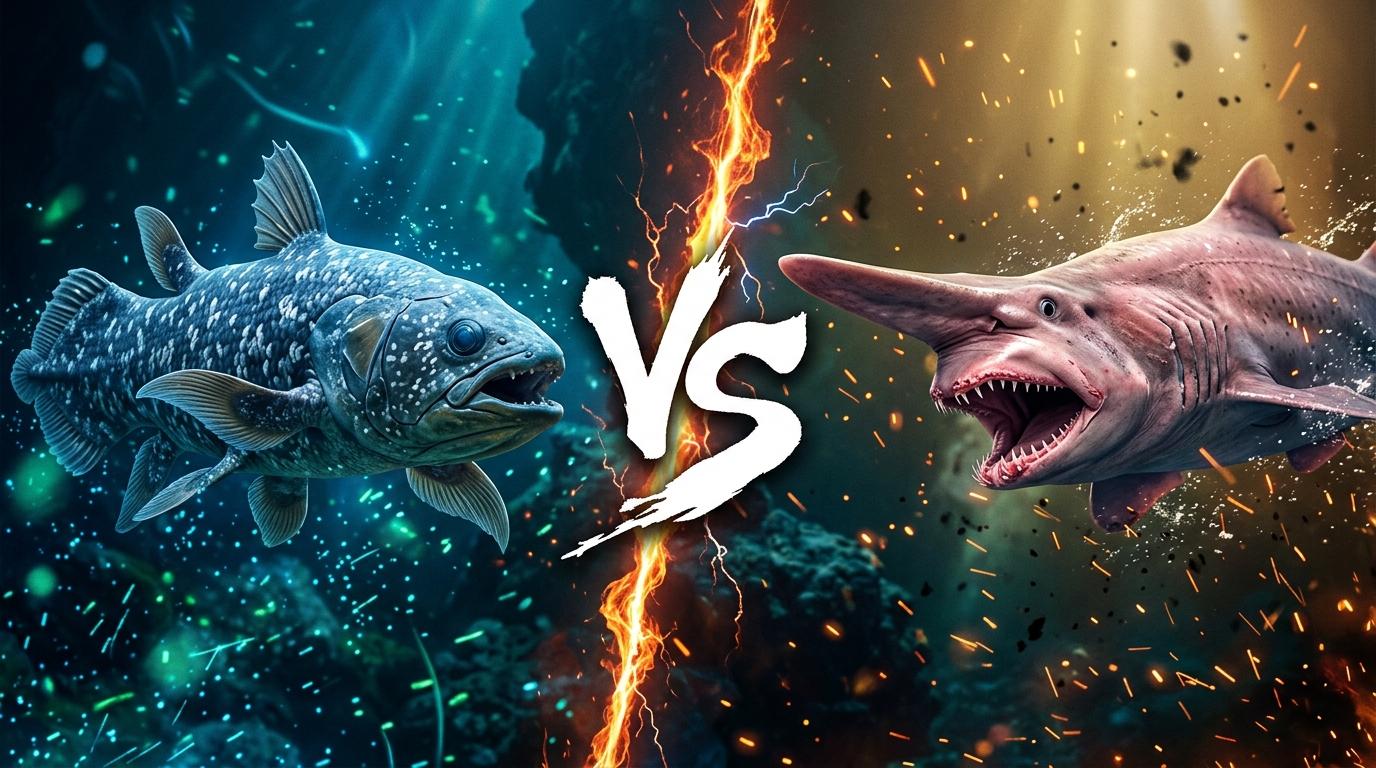
Coelacanth vs Goblin Shark: Who Actually Wins?
The goblin shark wins this deep-sea matchup with clear confidence. It is longer (adults commonly reach 3–4 m, against roughly 2 m for a large coelacanth) and faster in short bursts. Its signature weapon, a slingshot jaw that shoots forward to snag prey, is purpose-built for seizing medium-sized animals in dim water. The coelacanth is no pushover. Its thick, bony cosmine-coated scales act like chain mail, and its slow, deliberate drift-hunting makes it hard to surprise. But it is a low-energy ambush feeder of small fish and squid, with no real fighting toolkit. In most realistic encounters the shark dictates range, strikes first, and the coelacanth's best outcome is to absorb the bite and slip back into the rocks.
Read comparison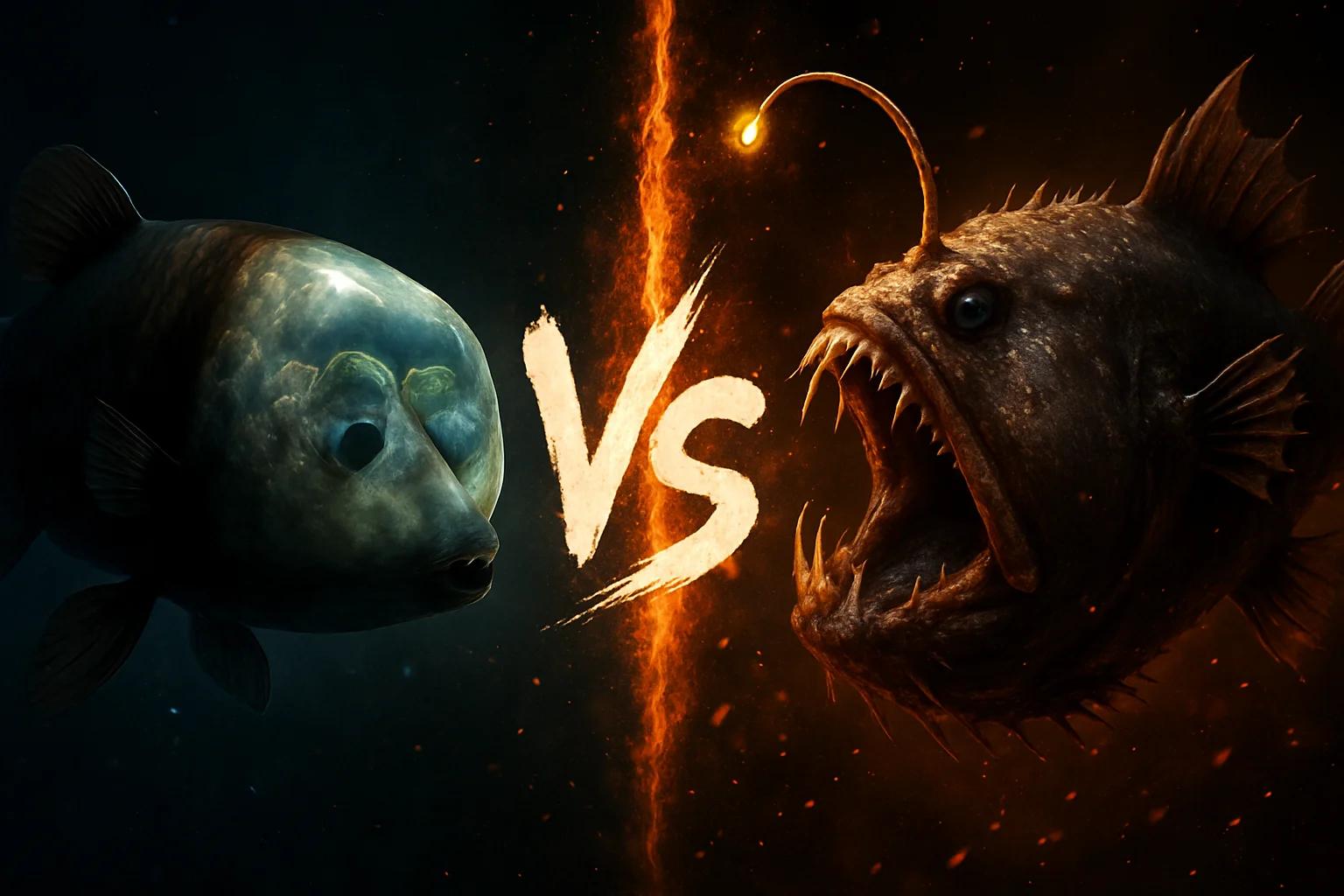
Barreleye vs Humpback Anglerfish: Who Actually Wins?
The humpback anglerfish wins this deep-sea matchup. A female Melanocetus johnsonii is a living trap. She carries a glowing, bacteria-lit lure and needle-like inward-curving teeth. Her oversized jaw and stretchable stomach let her swallow prey as long as she is, and sometimes longer. The barreleye is a similar-sized fish of roughly 15 cm. It is a brilliant sensory specialist, with rotating tubular eyes behind a transparent shield, and it is built to find small drifting food and steal from jellies. It has no real weapons, so it cannot turn its superior vision into damage. If the two meet at close range, the anglerfish's mouth decides the contest. The barreleye's only winning line is to see the threat early and never come close.
Read comparison
Discussion
What do you think?
Share your reasoning with other readers. Be civil and stick to the animals.
Sign in to join the discussion.
Sign inNo comments yet. Start the conversation.