

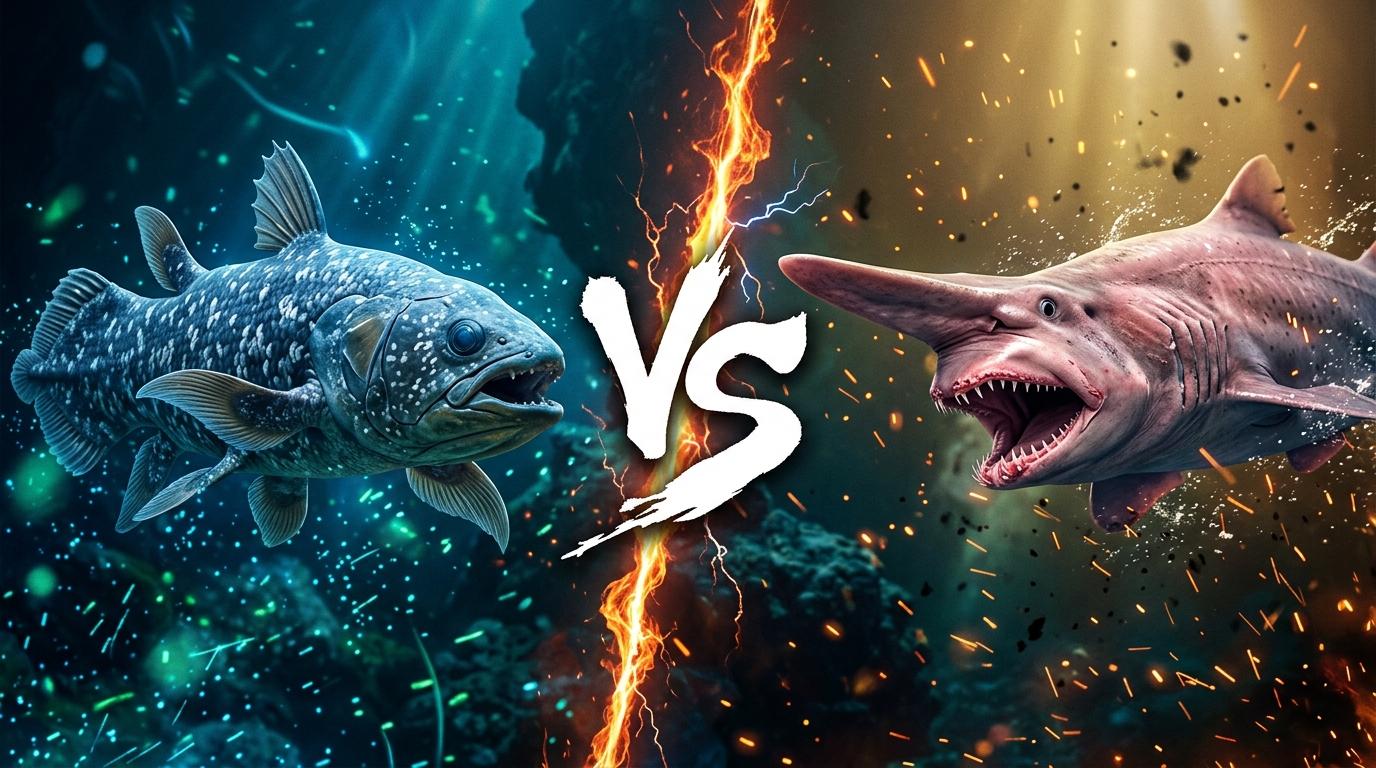
Coelacanth vs Goblin Shark: Who Actually Wins?
Coelacanth vs goblin shark: a biology-first look at two deep-sea relics, the goblin shark's slingshot jaws against the coelacanth's armored scales, and who wins a deep-water clash.
Coelacanth vs Goblin Shark
Matchup winner
Goblin Shark
Quick verdict
Start with the direct answer, then use the structured comparison below to see what changes the outcome.
The goblin shark wins this deep-sea matchup with clear confidence. It is longer (adults commonly reach 3–4 m, against roughly 2 m for a large coelacanth) and faster in short bursts. Its signature weapon, a slingshot jaw that shoots forward to snag prey, is purpose-built for seizing medium-sized animals in dim water. The coelacanth is no pushover. Its thick, bony cosmine-coated scales act like chain mail, and its slow, deliberate drift-hunting makes it hard to surprise. But it is a low-energy ambush feeder of small fish and squid, with no real fighting toolkit. In most realistic encounters the shark dictates range, strikes first, and the coelacanth's best outcome is to absorb the bite and slip back into the rocks.
Read the full explanation
Goblin Shark wins most encounters thanks to size, burst speed, and its protrusible slingshot jaws.
Coelacanth's heavy armored scales make it a tough, awkward target rather than an easy kill.
In tight cave and ledge cover, the coelacanth can survive by retreating, but it rarely 'wins.'
Neither animal seeks this fight: both are energy-saving deep-water specialists.
Reader vote
Who do you think wins?
Pick a side — no account needed. Results update live.
No votes yet — be the first to call it.
Editorial note
Why people disagree
The coelacanth's 'living fossil' fame makes people assume it is tougher than it is. Its armor is real, but it lacks offensive weapons.
Explosive power
The first decisive contact usually belongs to the goblin shark's jaw launch.
Size and reach
Extra length and jaw reach let the shark engage before the coelacanth can react.
Close-range durability
The coelacanth can survive bites that would badly wound a softer fish.
Read the full explanation +
The goblin shark looks terrifying, yet it is a flabby, slow-cruising fish, which leads some to underrate how effective its jaw strike is.
Both are rarely observed alive, so much of the debate fills gaps with guesses about deep-sea behavior.
Comparison FAQ
Short, direct answers to the next questions readers usually ask after the headline verdict.
Would a goblin shark beat a coelacanth?+
Yes, in most encounters. It is larger, faster in bursts, and armed with protrusible jaws, though the coelacanth's armor means the shark may struggle to finish the job quickly.
Which is stronger, the coelacanth or the goblin shark?+
The goblin shark has more offensive power and size. The coelacanth is sturdier per body length because of its heavy bony scales.
Why is the coelacanth still dangerous to fight?+
Its cosmine scales resist bites, it maneuvers precisely in caves, and its patience lets it wait out attackers in cover where the shark can't strike cleanly.
Do coelacanths and goblin sharks actually meet?+
Their depth ranges can overlap in parts of the Indian Ocean, but documented interactions are essentially unknown. This is a biology-based comparison.
How big is a goblin shark compared to a coelacanth?+
Goblin sharks typically reach 3–4 m, with rare larger reports. Coelacanths reach about 2 m and up to roughly 90 kg.
Head-to-head species stats
These are the same core AnimalDex stat dimensions used on the dedicated animal pages, pulled side by side so the matchup is faster to scan.
Coelacanth
Tier BGoblin Shark
Tier BTrait-by-trait comparison
Only the categories that matter to this matchup are included. The goal is not filler stats, but the real design differences that change the result.
Slow drifter with modest bursts
Explosive power
Goblin Shark
Slingshot jaw strike plus short lunges
Explosive power
Goblin Shark
Up to about 2 m, stocky
Size and reach
Goblin Shark
Typically 3–4 m, long-snouted
Size and reach
Goblin Shark
Thick bony cosmine scales
Close-range durability
Coelacanth
Soft, lightly calcified body
Close-range durability
Coelacanth
Patient drift-hunter, uses caves
Ambush control
Goblin Shark
Electroreceptive snout detects hidden prey
Ambush control
Goblin Shark
Ultra-low metabolism, rests in caves
Energy economy
Coelacanth
Slow cruiser, also energy-thrifty
Energy economy
Coelacanth
Small teeth for swallowing small prey
Offensive weaponry
Goblin Shark
Nail-like teeth on launching jaws
Offensive weaponry
Goblin Shark
How the verdict forms
Verdict timeline
01 · Explosive power
Goblin Shark
02 · Size and reach
Goblin Shark
03 · Close-range durability
Coelacanth
04 · Ambush control
Goblin Shark
05 · Energy economy
Coelacanth
06 · Offensive weaponry
Goblin Shark
Change the conditions
Scenario breakdown
This is where shallow battle content usually fails. Terrain, spacing, timing, and engagement style can change the answer.
Scenario lean
Coelacanth
Verdict confidence
82%
Coelacanth survives by holding its ground.
Coelacanths spend daylight sheltering in volcanic caves at 150–250 m. Tight rock limits the goblin shark's long snout and its forward jaw launch. Meanwhile, the coelacanth's lobed fins give it precise, almost crawling-like maneuvering. Armor plus geometry turns this into a stalemate the coelacanth effectively wins by not being caught.
AnimalDex field profiles
Explore these animals
Coelacanth
Latimeria chalumnae
deep volcanic slope and underwater cave system
Goblin Shark
Mitsukurina owstoni
deep ocean slope and offshore marine depths
Systems Intelligence & Hidden Purpose
See the animals behind this comparison as engineered biological systems: what each one is built to do, where it gains leverage, and why the matchup changes by scenario.
Specialized Hardware
ancient lobe-finned body plan, deep cave-sea life, and slow nocturnal movement give the Coelacanth a body plan tuned for its niche.
Systems Script
Coelacanths operate through deep volcanic slope and underwater cave system Their design links movement, shelter, and feeding into one workable survival system.
Strategic Insight
Persistence can matter as much as change when a design still fits its hidden niche.
Specialized Hardware
long blade-like snout, projecting jaws, and deep-sea habitat give the Goblin Shark a body plan tuned for its niche.
Systems Script
Goblin Sharks operate through deep ocean slope and offshore marine depths Their design links movement, shelter, and feeding into one workable survival system.
Strategic Insight
A brief extension at the exact moment can solve what a fixed structure cannot.
Final take
The goblin shark is the overall winner. It brings the three things that decide deep-water encounters: detection, reach, and a dedicated capture weapon. Its slingshot jaw is one of the strangest feeding adaptations in the ocean, and it works.
Read the full explanation
The coelacanth's lesson is survival, not dominance. It has persisted for roughly 400 million years as a lineage by being armored, thrifty, and cave-bound. Pin it against rock and it is a frustrating target; leave it in open water and the shark takes control.
Collect both animals in AnimalDex
Track the species behind this matchup, compare their real traits, and build the rivalry into your AnimalDex collection.
Related comparisons
Continue with nearby matchups to compare more real-world animal traits without dropping into junky who-wins filler.
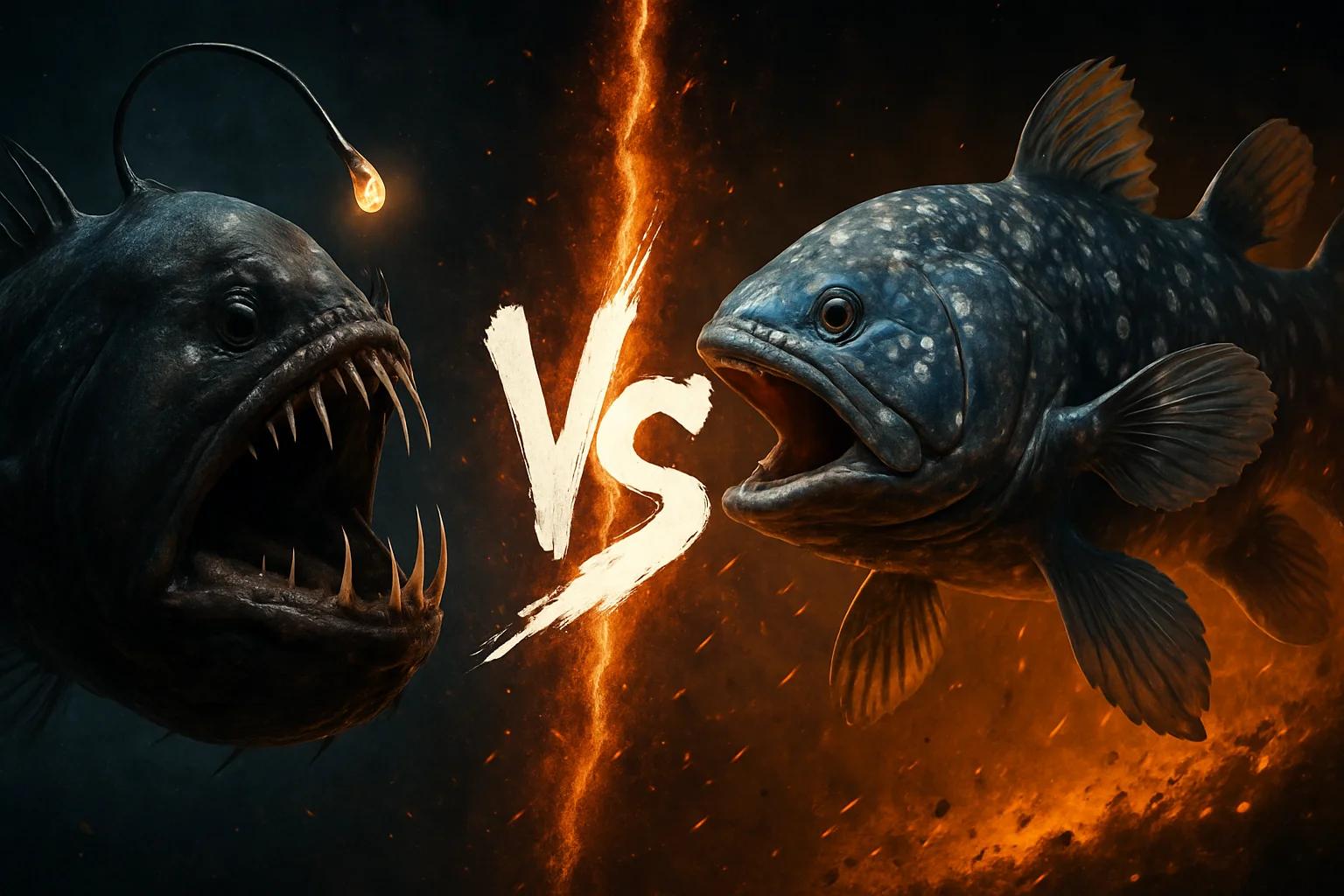
Black Seadevil vs Coelacanth: Who Actually Wins?
The coelacanth wins clearly. The black seadevil is one of the ocean's most efficient ambush predators, with a glowing lure, inward-folding fangs, and a stomach that can stretch around prey close to its own size. But a large female seadevil reaches only about 18 cm, while an adult coelacanth can approach 2 m and weigh up to about 90 kg. That is roughly a hundredfold mass gap, and the coelacanth's heavy, bony scales cover all of it. The seadevil's whole design depends on swallowing what it lures, and it cannot swallow, pierce, or meaningfully injure an animal that large. Its jaws are built for engulfing prey, and its body is not built for fighting. In any realistic encounter, the slow, armored coelacanth simply outclasses it on scale, durability, and bite reach.
Read comparison
Discussion
What do you think?
Share your reasoning with other readers. Be civil and stick to the animals.
Sign in to join the discussion.
Sign inNo comments yet. Start the conversation.