

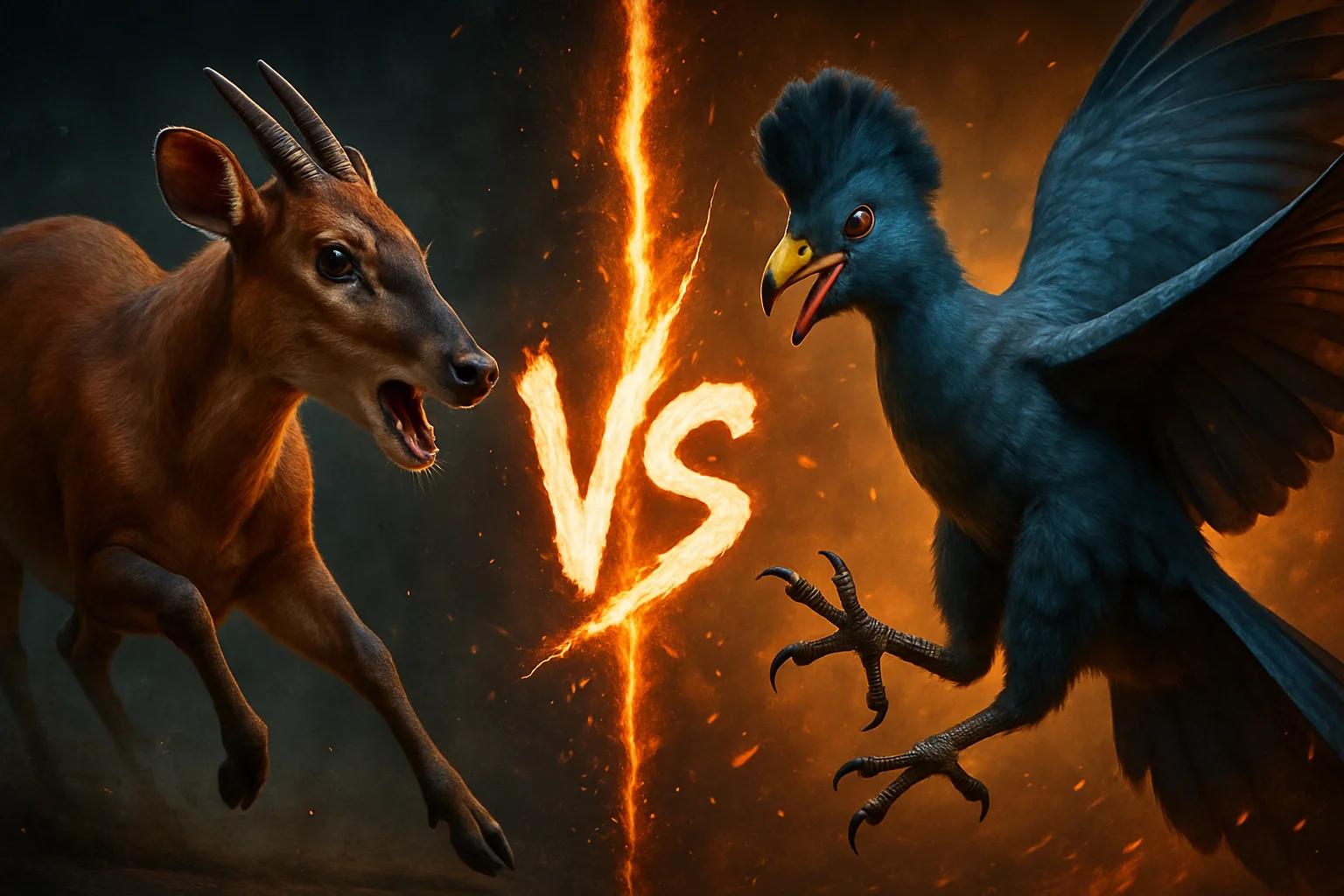
Bay Duiker vs Great Blue Turaco: Who Actually Wins?
Bay duiker vs great blue turaco: a forest-floor antelope against Africa's largest turaco. See who wins on mass, weapons, escape, and canopy control.
Bay Duiker vs Great Blue Turaco
Matchup winner
Bay Duiker
Quick verdict
Start with the direct answer, then use the structured comparison below to see what changes the outcome.
The bay duiker wins. A bay duiker weighs roughly 15–25 kg, against about 1 kg for a great blue turaco, so it brings around twenty times the mass. It also has short, spike-like horns, a dense forehead built for butting, and hard hooves on a compact sprinter's frame. The turaco is a striking canopy specialist: about 70–75 cm long, with a heavy bill, strong feet, and a habit of bounding along branches. But it has no weapon that can seriously threaten a mammal of that size. Its real advantage is altitude, not force. If the meeting happens where the duiker can reach it, on the ground or at a fallen-fruit patch, the antelope's mass and horns settle things fast. The turaco's only reliable 'win' is to leave, usually by hopping upward and gliding away in its famously clumsy style. That counts as survival, not victory.
Read the full explanation
Bay duiker wins overall. Roughly 20x heavier, horned, and built for headlong charges.
The great blue turaco's best tool is escape. It climbs and glides into the canopy, where the duiker can't follow.
Contested fallen fruit on the forest floor is the most realistic meeting point, and it favors the duiker.
The turaco's bill and claws can startle, but they can't seriously injure an adult duiker.
Reader vote
Who do you think wins?
Pick a side — no account needed. Results update live.
No votes yet — be the first to call it.
Editorial note
Why people disagree
Rating scores give the turaco a slight edge in 'dominance', but those scores describe presence within its own niche, not head-to-head force against a 20-kg mammal.
Body mass
An order-of-magnitude mass gap decides almost every physical contest. The duiker can simply shove or butt through the bird.
Built-in weapons
The duiker's horns and skull evolved for butting rivals. The turaco's bill evolved to strip fruit and leaves, not to fight.
Explosive power
In the first two seconds of contact, the duiker can close distance faster than the turaco can get airborne.
Read the full explanation +
The turaco looks big for a bird and is loud and showy, so people overestimate its combat value. Turacos are fruit-eaters, not raptors.
Some argue a bird that can always fly away 'can't lose'. That is true for survival but false for winning, and the turaco is a weak, labored flier that needs a head start.
Comparison FAQ
Short, direct answers to the next questions readers usually ask after the headline verdict.
Would a bay duiker beat a great blue turaco in a fight?+
Yes. The duiker is around 20 times heavier and has horns and a butting skull. On the ground, it would overpower the turaco quickly. The bird's best option is to escape upward.
Which is stronger, a bay duiker or a great blue turaco?+
The bay duiker, by a wide margin. It is a compact forest antelope of roughly 15–25 kg, while the turaco weighs about a kilogram despite its long body and tail.
Why is the great blue turaco still hard to beat?+
Because it rarely has to fight. Group alarm calls, sharp daytime vision, and its ability to climb and glide into the canopy let it avoid ground threats entirely. Its stout bill can also deliver a startling peck at close range.
Do bay duikers and great blue turacos actually meet?+
Their ranges overlap in Central and West African rainforests. Encounters are most likely under fruiting trees, where turacos feed above and duikers collect fallen fruit below.
Can a great blue turaco fly away from a duiker?+
Usually, if it has warning. Turacos are labored fliers that prefer hopping up through branches and then gliding. A surprised turaco on the ground is vulnerable for a moment.
Head-to-head species stats
These are the same core AnimalDex stat dimensions used on the dedicated animal pages, pulled side by side so the matchup is faster to scan.
Bay Duiker
Tier BGreat Blue Turaco
Tier BTrait-by-trait comparison
Only the categories that matter to this matchup are included. The goal is not filler stats, but the real design differences that change the result.
About 15–25 kg, compact and muscular
Body mass
Bay Duiker
About 0.8–1.2 kg, mostly feathers and tail
Body mass
Bay Duiker
Short conical horns, thick skull, sharp hooves
Built-in weapons
Bay Duiker
Stout yellow-red bill, grasping zygodactyl feet
Built-in weapons
Bay Duiker
Low-slung burst sprinter that dives into thickets
Explosive power
Bay Duiker
Bounding branch-runner with short, heavy takeoffs
Explosive power
Bay Duiker
Stays on the ground
Vertical escape
Great Blue Turaco
Climbs, hops, and glides through the canopy
Vertical escape
Great Blue Turaco
Keen nose and ears, mostly active at night
Early warning
Great Blue Turaco
Sharp daytime eyes, loud group alarm calls
Early warning
Great Blue Turaco
Dense body, tough hide, built to absorb collisions
Close-range durability
Bay Duiker
Light, hollow-boned frame
Close-range durability
Bay Duiker
How the verdict forms
Verdict timeline
01 · Body mass
Bay Duiker
02 · Built-in weapons
Bay Duiker
03 · Explosive power
Bay Duiker
04 · Vertical escape
Great Blue Turaco
05 · Early warning
Great Blue Turaco
06 · Close-range durability
Bay Duiker
Change the conditions
Scenario breakdown
This is where shallow battle content usually fails. Terrain, spacing, timing, and engagement style can change the answer.
Scenario lean
Bay Duiker
Verdict confidence
82%
Duiker dominates in dense undergrowth.
Under the low tangle of the rainforest floor, the turaco loses its takeoff lanes. Its wings need space to beat and glide. The duiker is a 'ducker' by name: it is shaped to wedge through thickets head-first. In tight cover, its mass, horns, and charging style give the bird almost no room to work.
AnimalDex field profiles
Explore these animals
Bay Duiker
Cephalophus dorsalis
lowland rainforest, dense thicket, and swamp forest edge
Great Blue Turaco
Corythaeola cristata
rainforest canopy and dense tropical forest
Systems Intelligence & Hidden Purpose
See the animals behind this comparison as engineered biological systems: what each one is built to do, where it gains leverage, and why the matchup changes by scenario.
Specialized Hardware
chestnut forest-floor coat, arched back posture, and secretive understory browsing give the Bay Duiker a body plan tuned for its niche.
Systems Script
Bay Duikers operate through lowland rainforest, dense thicket, and swamp forest edge. Their design links movement, feeding, shelter, and timing into one workable survival system.
Strategic Insight
Dense environments reward precision, patience, and the ability to read layered cover.
Specialized Hardware
towering blue canopy body, yellow bill and crest, and heavy fruit-carrying flight give the Great Blue Turaco a body plan tuned for its niche.
Systems Script
Great Blue Turacos operate through rainforest canopy and dense tropical forest. Their design links movement, feeding, shelter, and timing into one workable survival system.
Strategic Insight
Dense environments reward precision, patience, and the ability to read layered cover.
Final take
The bay duiker is the clear overall winner. Every physical metric that matters in contact favors it: mass, skull and horn weaponry, collision durability, and burst power at ground level. The great blue turaco is a magnificent canopy fruit-eater, but its body is built for clambering, gliding, and calling, not combat.
Read the full explanation
The turaco's real counter is vertical. As long as it keeps height, the duiker is irrelevant to it. That is why the two share Central African forests without conflict: one owns the floor, the other owns the crown, and the duiker often eats what the canopy drops. In a true head-to-head on the ground, though, the antelope wins comfortably.
Collect both animals in AnimalDex
Track the species behind this matchup, compare their real traits, and build the rivalry into your AnimalDex collection.
Related comparisons
Continue with nearby matchups to compare more real-world animal traits without dropping into junky who-wins filler.
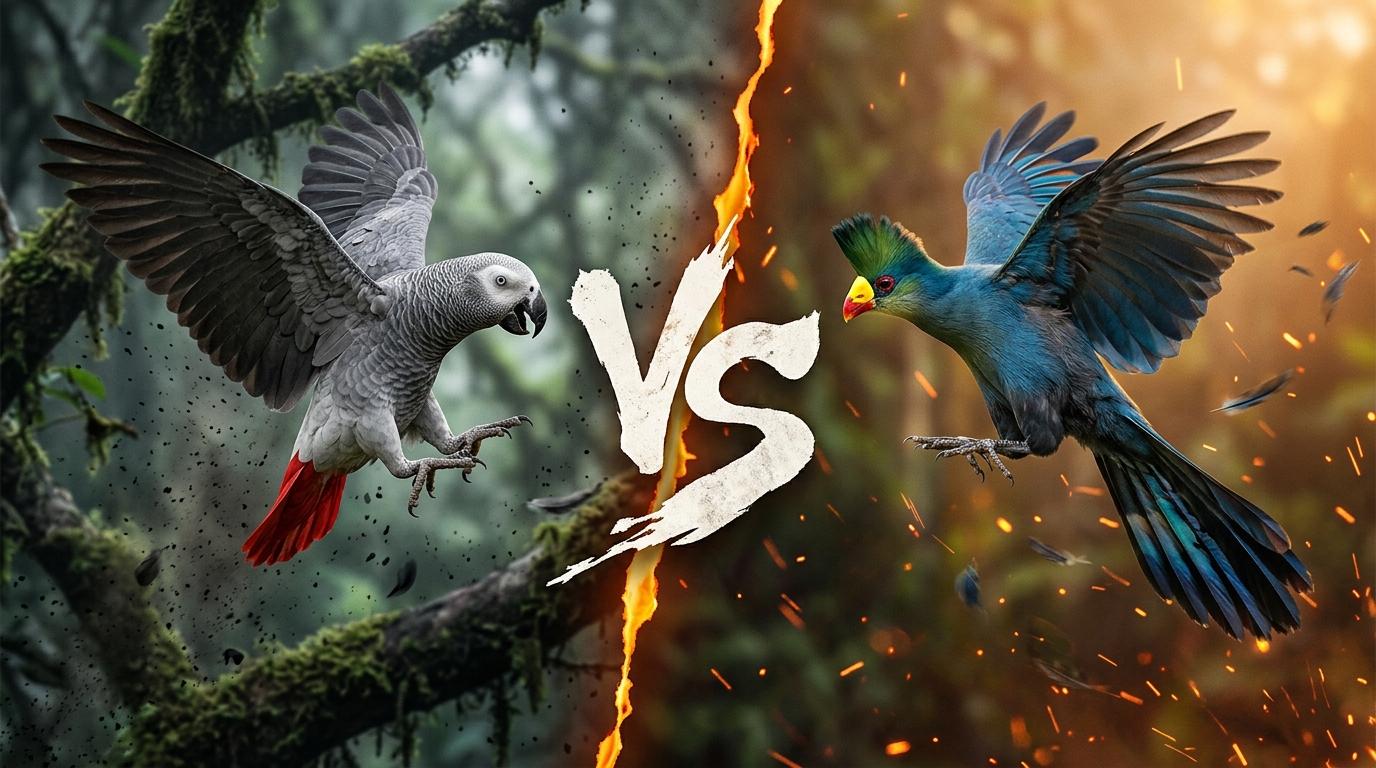
African Grey Parrot vs Great Blue Turaco: Who Actually Wins?
The African grey parrot wins this one. The great blue turaco is the larger bird, nearly 75 cm long and often around a kilogram, compared with the grey's roughly 33 cm and 400–650 g. But size is not the deciding factor here. The grey carries a hooked beak built to crack hard palm nuts and seeds, backed by strong jaw muscles and a zygodactyl grip that lets it clamp, climb and lever at close range. The turaco is a leaf- and fruit-eater with a relatively light bill made for plucking soft food. It lacks a real crushing tool. It moves well along branches, running and bounding through the canopy, but it is a weak, gliding flier and has little to answer a bird that can bite through a nut shell. In any close contest, the parrot's beak and quick problem-solving outweigh the turaco's extra mass. The turaco's best plan is to bluff with its size and loud calls, then bound away.
Read comparison
Discussion
What do you think?
Share your reasoning with other readers. Be civil and stick to the animals.
Sign in to join the discussion.
Sign inNo comments yet. Start the conversation.