


Mantled Guereza vs Emperor Tamarin: Who Actually Wins?
Mantled guereza vs emperor tamarin: a biology-first look at size, canines, agility and canopy tactics to explain which primate wins and why the tiny tamarin stays hard to catch.
Black-and-white Colobus vs Emperor Tamarin
Matchup winner
Black-and-white Colobus
Quick verdict
Start with the direct answer, then use the structured comparison below to see what changes the outcome.
The mantled guereza wins clearly. An adult male Colobus guereza typically weighs around 9–14 kg, roughly twenty to thirty times the 400–500 g emperor tamarin. He has a robust skull and long canines that males use in real territorial disputes. The tamarin is quick, alert and armed with a sharp bite, but its toolkit is built for escaping predators and harvesting insects and fruit, not for grappling an animal that outweighs it so heavily. If contact happens, mass and canine reach end it fast. The tamarin's real advantage is choosing not to fight: it can vanish through fine branches the colobus cannot follow.
Read the full explanation
Overall winner: Mantled Guereza, decisively.
Size gap is enormous: about 10+ kg vs about 0.5 kg.
Guereza males have long canines and real contest experience; tamarins rely on flight and group alarm calls.
The tamarin's best outcome is escape, not victory.
Reader vote
Who do you think wins?
Pick a side — no account needed. Results update live.
No votes yet — be the first to call it.
Editorial note
Why people disagree
Colobus monkeys are gentle-looking leaf-eaters, so people underestimate how seriously males defend territory.
Body mass advantage
A twentyfold-plus weight gap means the tamarin cannot pin, push or absorb blows; the outcome is decided before skill matters.
Bite and canine reach
Both can bite, but only the guereza can deliver a bite that ends a contest in one exchange.
Fine-branch agility
The tamarin can reach supports that would snap under a colobus, which is its escape route.
Read the full explanation +
The tamarin's flashy white mustache and fast, jittery movement read as feisty, but feisty is not the same as dangerous at 500 g.
These species never meet in the wild (Africa vs Amazonia), so every answer is a thought experiment built on anatomy and behavior.
Comparison FAQ
Short, direct answers to the next questions readers usually ask after the headline verdict.
Would a mantled guereza beat an emperor tamarin?+
Yes. The guereza's size, canines and durability make it the overwhelming favorite in any direct confrontation.
Which is stronger, the colobus or the tamarin?+
The mantled guereza by a huge margin. It outweighs the tamarin roughly twentyfold or more and has a far more powerful jaw and body.
How would the fight actually play out?+
Most likely the tamarin would flee immediately. If cornered, it might bite, but the guereza could overpower it at once.
Why is the emperor tamarin still dangerous?+
Its sharp canines can inflict painful puncture wounds, and its speed and grip on thin branches make it very hard to catch or corner. It is a nuisance rather than a real threat, but it is not helpless.
Do these monkeys ever meet in the wild?+
No. Guerezas live in African forests and emperor tamarins in the southwestern Amazon, so this is a hypothetical comparison.
Head-to-head species stats
These are the same core AnimalDex stat dimensions used on the dedicated animal pages, pulled side by side so the matchup is faster to scan.
Black-and-white Colobus
Tier BEmperor Tamarin
Tier CTrait-by-trait comparison
Only the categories that matter to this matchup are included. The goal is not filler stats, but the real design differences that change the result.
About 9–14 kg adult males
Body mass advantage
Black-and-white Colobus
About 0.4–0.5 kg
Body mass advantage
Black-and-white Colobus
Long male canines, strong jaw built for tough leaves
Bite and canine reach
Black-and-white Colobus
Sharp, tusk-like lower canines; tiny gape
Bite and canine reach
Black-and-white Colobus
Powerful leaper but heavy and thumbless
Fine-branch agility
Emperor Tamarin
Claw-like nails cling to trunks and thin twigs
Fine-branch agility
Emperor Tamarin
Dense build, thick mantle of fur
Close-range durability
Black-and-white Colobus
Fragile frame, minimal padding
Close-range durability
Black-and-white Colobus
Loud roaring choruses, group spacing
Threat detection and alarm
Emperor Tamarin
Hyper-vigilant, rapid alarm calls, mixed-species groups
Threat detection and alarm
Emperor Tamarin
How the verdict forms
Verdict timeline
01 · Body mass advantage
Black-and-white Colobus
02 · Bite and canine reach
Black-and-white Colobus
03 · Fine-branch agility
Emperor Tamarin
04 · Close-range durability
Black-and-white Colobus
05 · Threat detection and alarm
Emperor Tamarin
Change the conditions
Scenario breakdown
This is where shallow battle content usually fails. Terrain, spacing, timing, and engagement style can change the answer.
Scenario lean
Black-and-white Colobus
Verdict confidence
82%
Guereza wins easily.
On limbs strong enough to hold the colobus, the tamarin has nowhere to outmaneuver him. Mass, reach and canines dominate at contact range, and a single grab or bite settles it.
AnimalDex field profiles
Explore these animals
Black-and-white Colobus
Colobus guereza
montane forest, river forest, and tropical woodland
Emperor Tamarin
Saguinus imperator
rainforest canopy, river-edge forest, and dense woodland
Systems Intelligence & Hidden Purpose
See the animals behind this comparison as engineered biological systems: what each one is built to do, where it gains leverage, and why the matchup changes by scenario.
Specialized Hardware
dramatic black-and-white coat, high canopy leaf feeding, and tail used for balance in leaps give the Black-and-white Colobus a body plan tuned for its niche.
Systems Script
Black-and-white Colobuss operate through montane forest, river forest, and tropical woodland Their design links movement, shelter, and feeding into one workable survival system.
Strategic Insight
Grace becomes efficient when balance and diet both fit the same layer of habitat.
Specialized Hardware
long white mustache, tiny branch-running body, and cooperative family care give the Emperor Tamarin a body plan tuned for its niche.
Systems Script
Emperor Tamarins operate through rainforest canopy, river-edge forest, and dense woodland Their design links movement, shelter, feeding, and survival into one workable system.
Strategic Insight
Small bodies can cover big living space when the path is overhead.
Final take
The mantled guereza is the clear winner. This is not a close matchup between two monkeys of similar class. It is a sturdy, canine-armed African colobine against a featherweight Amazonian tamarin.
Read the full explanation
The emperor tamarin's real skill is avoidance. Its vigilance, claw-like grip and thin-branch mobility keep it alive against hawks, snakes and cats. Those same tools are the only reason it could leave this encounter unhurt.
Collect both animals in AnimalDex
Track the species behind this matchup, compare their real traits, and build the rivalry into your AnimalDex collection.
Related comparisons
Continue with nearby matchups to compare more real-world animal traits without dropping into junky who-wins filler.
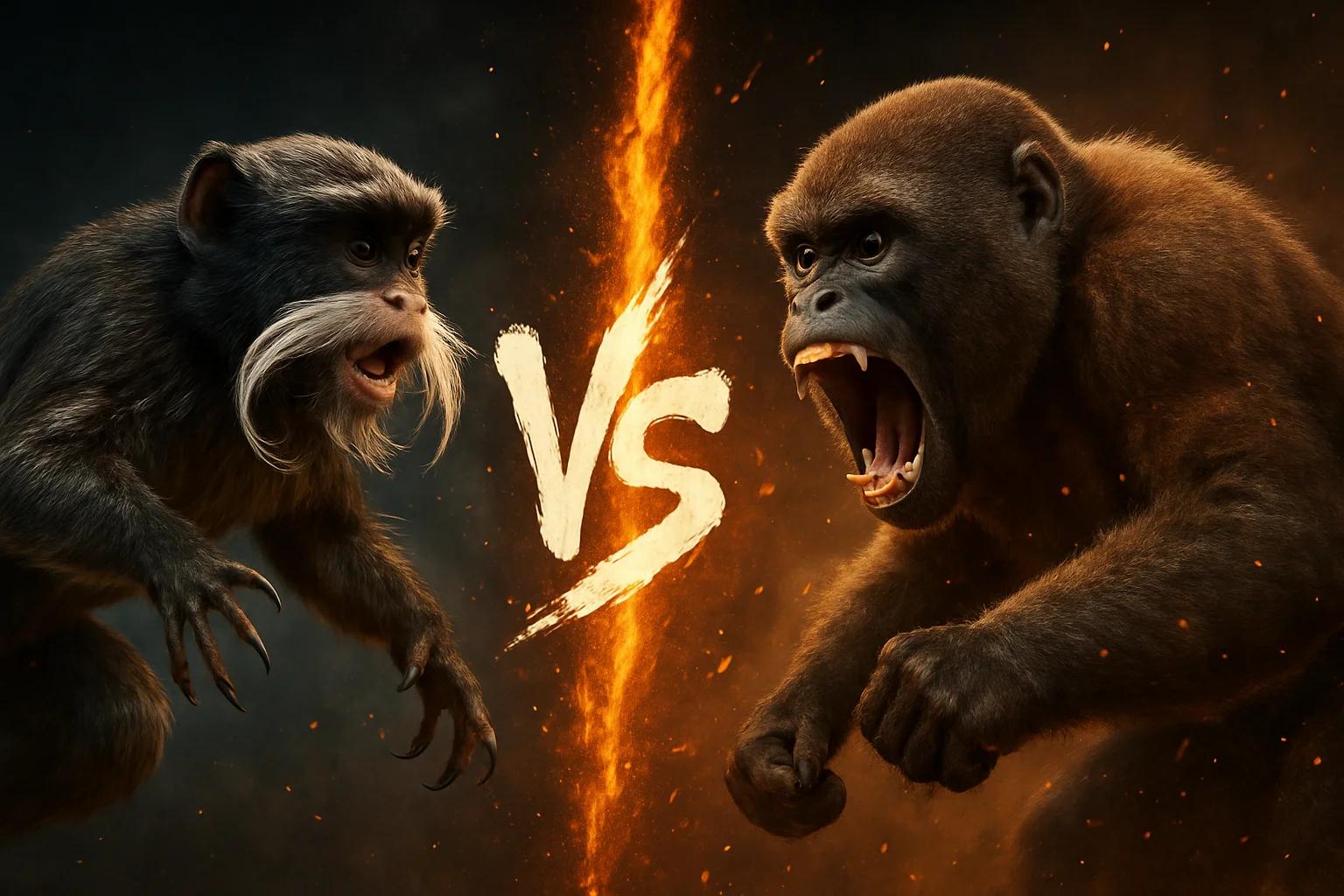
Emperor Tamarin vs Woolly Monkey: Who Actually Wins?
The woolly monkey wins, and it is not especially close. An adult woolly monkey weighs roughly 5–10 kg against the emperor tamarin's 400–500 g, which makes it about fifteen to twenty times heavier. It also has a powerful prehensile tail that works as a fifth limb, a dense muscular build, and the social confidence of a large-bodied primate that displaces smaller species at fruiting trees. The tamarin's speed, clawlike nails and twig-level agility make it nearly impossible to pin down in fine branches, so it rarely loses its life in a standoff. It simply loses the contest. In any real dispute over space or food, the woolly monkey dictates terms.
Read comparison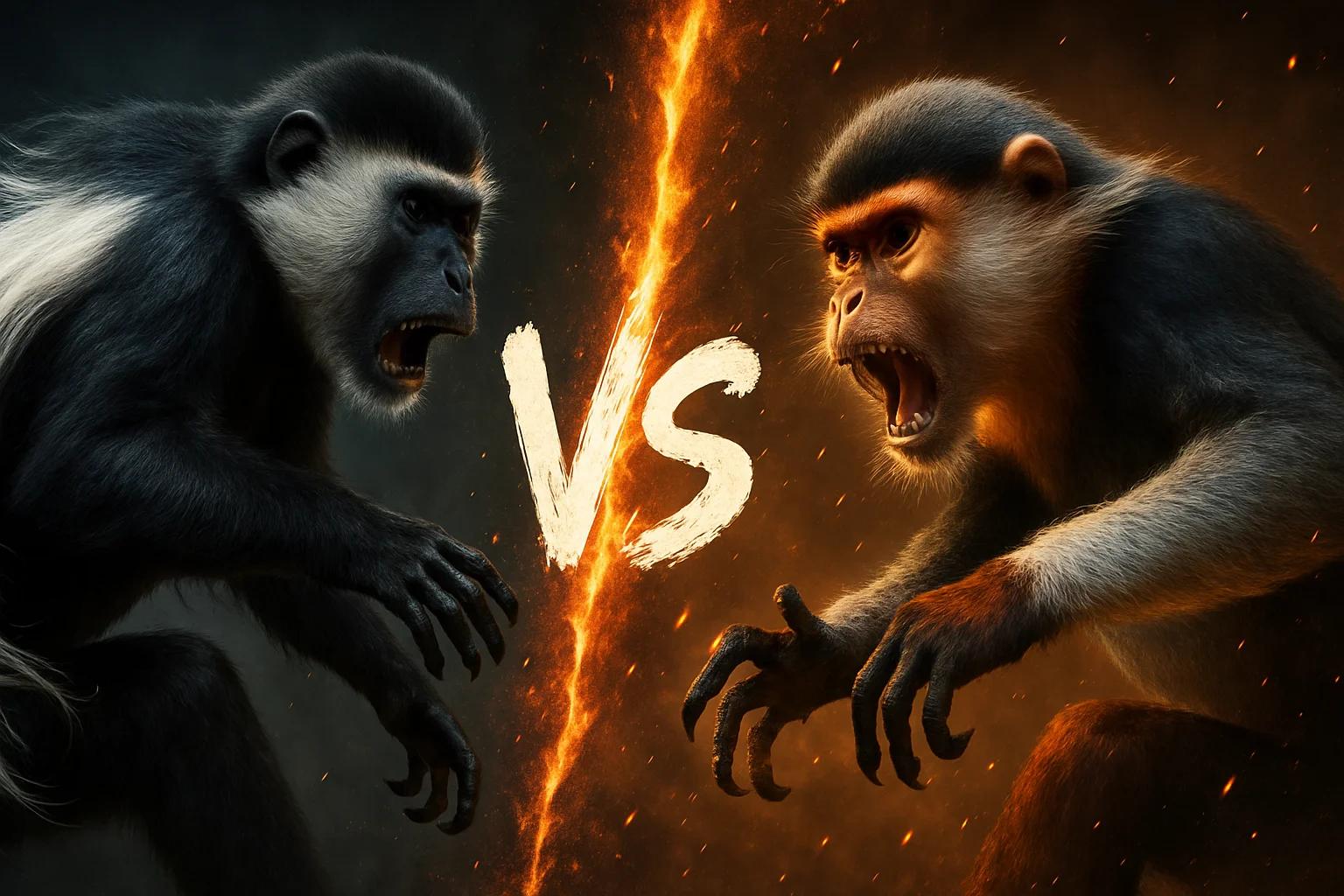
Mantled Guereza vs Red-shanked Douc: Who Actually Wins?
The mantled guereza wins this colobine clash, though it is a close fight between leaf-eating cousins. Both monkeys are similar in size, with adult males around 9–14 kg for the guereza and roughly 10–11 kg for the douc, and both run on a slow-burning folivore engine built around a multi-chambered stomach. The guereza gets the edge for three reasons. Its males are seasoned territorial defenders whose roaring choruses and branch-shaking displays are built for confronting rivals. It has a slightly heavier, denser frame. And it is famous for bold, controlled leaps through the canopy, using its long cape and tail as stabilizers. The red-shanked douc is a slightly quicker, very agile arm-and-leg climber that lives in cohesive, low-aggression groups. That makes it superb at moving through the forest, but it is less practiced at forcing a confrontation. In a rare real dispute, the guereza's habit of defending space should carry it.
Read comparison
Discussion
What do you think?
Share your reasoning with other readers. Be civil and stick to the animals.
Sign in to join the discussion.
Sign inNo comments yet. Start the conversation.