


Black-headed Ibis vs Bronze-winged Jacana: Who Actually Wins?
Black-headed Ibis vs Bronze-winged Jacana: a biology-first breakdown of size, beak power, agility and wetland tactics to answer who would win.
Black-headed Ibis vs Bronze-winged Jacana
Matchup winner
Black-headed Ibis
Quick verdict
Start with the direct answer, then use the structured comparison below to see what changes the outcome.
The Black-headed Ibis wins this wetland matchup. It is a stork-sized wader, roughly 65–76 cm long and around 1.2–1.5 kg, with a long, heavy, down-curved bill built for probing mud. The Bronze-winged Jacana is a lily-trotter of about 28–31 cm. Females, the larger sex, weigh only around 230–350 g. That makes the ibis several times heavier, with far more reach and a bill that can strike and pin. The jacana has excellent footing on floating vegetation, sharp carpal wing spurs and a famously aggressive territorial temper, especially in females. Those tools make it bold and hard to pin down, but they cannot close a size gap this large. In most realistic confrontations the ibis simply displaces the jacana, and the jacana's best result is a nimble retreat across the lily pads.
Read the full explanation
The Black-headed Ibis wins: it is several times heavier, with much longer reach and a stronger bill.
The jacana's edge is footing. On floating vegetation it moves where the ibis can't follow.
Jacana wing spurs and territorial aggression make it a pest, not a winner, against a bird this size.
Most real encounters end in displacement, not a fight.
Reader vote
Who do you think wins?
Pick a side — no account needed. Results update live.
No votes yet — be the first to call it.
Editorial note
Why people disagree
Jacanas are famously feisty. Females defend territories hard and males guard chicks fiercely, so people overrate their fighting odds against much larger birds.
Body mass and frame
Bird squabbles are mostly decided by shoving and intimidation, and weight dominates those.
Reach and weaponry
The ibis can strike from outside the jacana's range. The jacana's spurs need close contact to work.
Footing on floating vegetation
The jacana can shift the contest to ground where the ibis can't press its advantage.
Read the full explanation +
The ibis looks gentle because it spends its day probing mud, but a long curved bill on a heavy body is real leverage in a squabble.
Habitat changes everything. On dense floating mats the jacana is at home and the ibis is clumsy, which fuels 'home-field' arguments.
Comparison FAQ
Short, direct answers to the next questions readers usually ask after the headline verdict.
Would a Black-headed Ibis beat a Bronze-winged Jacana in a fight?+
Yes. The ibis's size, reach and bill make it the strong favorite. Most encounters end with the jacana retreating.
Which bird is stronger?+
The Black-headed Ibis, by a wide margin. It weighs several times as much as a jacana and has a far bigger frame.
Why is the jacana still dangerous?+
It carries sharp carpal spurs on its wings, it defends territory and chicks aggressively, and it can fight from floating vegetation where the ibis loses its footing.
Where could the jacana win?+
On dense lily mats. There it can harass and escape the ibis indefinitely, which counts as a practical win.
Do these birds actually fight in the wild?+
They share South and Southeast Asian wetlands. Squabbles are usually brief displacement disputes rather than sustained fights.
Head-to-head species stats
These are the same core AnimalDex stat dimensions used on the dedicated animal pages, pulled side by side so the matchup is faster to scan.
Black-headed Ibis
Tier CBronze-winged Jacana
Tier CTrait-by-trait comparison
Only the categories that matter to this matchup are included. The goal is not filler stats, but the real design differences that change the result.
About 1.2–1.5 kg, tall wader
Body mass and frame
Black-headed Ibis
About 230–350 g (females larger)
Body mass and frame
Black-headed Ibis
Long, heavy, down-curved bill
Reach and weaponry
Black-headed Ibis
Short bill plus sharp carpal wing spurs
Reach and weaponry
Black-headed Ibis
Steady in shallows, awkward on lily mats
Footing on floating vegetation
Bronze-winged Jacana
Elite: huge toes spread its weight across lily pads
Footing on floating vegetation
Bronze-winged Jacana
Colonial and tolerant, defends mainly at the nest
Territorial aggression
Bronze-winged Jacana
Highly territorial, especially females
Territorial aggression
Bronze-winged Jacana
Strong, sustained flier
Speed and flight
Black-headed Ibis
Short, low flights with dangling legs
Speed and flight
Black-headed Ibis
Adaptable generalist, at home in farmland and wetlands
Foraging intelligence
Black-headed Ibis
Specialist forager on vegetation mats
Foraging intelligence
Black-headed Ibis
How the verdict forms
Verdict timeline
01 · Body mass and frame
Black-headed Ibis
02 · Reach and weaponry
Black-headed Ibis
03 · Footing on floating vegetation
Bronze-winged Jacana
04 · Territorial aggression
Bronze-winged Jacana
05 · Speed and flight
Black-headed Ibis
06 · Foraging intelligence
Black-headed Ibis
Change the conditions
Scenario breakdown
This is where shallow battle content usually fails. Terrain, spacing, timing, and engagement style can change the answer.
Scenario lean
Bronze-winged Jacana
Verdict confidence
82%
The jacana survives and frustrates. Home turf favors it.
On thick floating vegetation, the jacana's long toes let it run where the ibis would sink or stumble. It can harass with wing spurs and keep slipping out of bill range. This is the one setting where the smaller bird holds its ground, mostly by being impossible to corner.
AnimalDex field profiles
Explore these animals
Black-headed Ibis
Threskiornis melanocephalus
marsh, rice plain, and shallow wetland
Bronze-winged Jacana
Metopidius indicus
marsh, lotus pond, and slow wetland
Systems Intelligence & Hidden Purpose
See the animals behind this comparison as engineered biological systems: what each one is built to do, where it gains leverage, and why the matchup changes by scenario.
Specialized Hardware
bare black head, clean white body, and wetland probing feeding give the Black-headed Ibis a body plan tuned for its niche.
Systems Script
Black-headed Ibiss operate through marsh, rice plain, and shallow wetland. Their design links movement, feeding, shelter, and timing into one workable survival system.
Strategic Insight
Where water controls movement, position and timing often matter more than speed.
Specialized Hardware
metallic bronze wing sheen, extremely long toes, and floating-plant walking give the Bronze-winged Jacana a body plan tuned for its niche.
Systems Script
Bronze-winged Jacanas operate through marsh, lotus pond, and slow wetland. Their design links movement, feeding, shelter, and timing into one workable survival system.
Strategic Insight
Where water controls movement, position and timing often matter more than speed.
Final take
The Black-headed Ibis is the clear winner. Several times the weight, a long striking bill and strong flight give it control in almost every realistic setting, from open shallows to contested feeding patches.
Read the full explanation
The Bronze-winged Jacana is no pushover. Its spurs, temper and mastery of floating vegetation mean it wins the 'don't get caught' game on its own turf. In a straight contest of force, though, the size gap is too large, and the jacana's smartest move is to leave.
Collect both animals in AnimalDex
Track the species behind this matchup, compare their real traits, and build the rivalry into your AnimalDex collection.
Related comparisons
Continue with nearby matchups to compare more real-world animal traits without dropping into junky who-wins filler.

Bronze-winged Jacana vs Common Kingfisher: Who Actually Wins?
The Bronze-winged Jacana wins this wetland matchup. It is the heavier, longer-legged bird, often weighing roughly two to five times as much as a Common Kingfisher, with females the larger sex. It also comes from a lineage built for confrontation: jacanas defend floating territories with wing-flaps, lunges and pecks, and many species carry sharp wrist spurs. The Kingfisher is faster, has elite eyesight and a dagger bill built for precision strikes. But that bill evolved to seize small fish, not to grapple with a long-toed rival standing firmly on lily pads. In any sustained contact at close range, the jacana's mass, reach and territorial temperament take over. The Kingfisher's real victory condition is speed, and that usually means leaving the fight rather than winning it.
Read comparison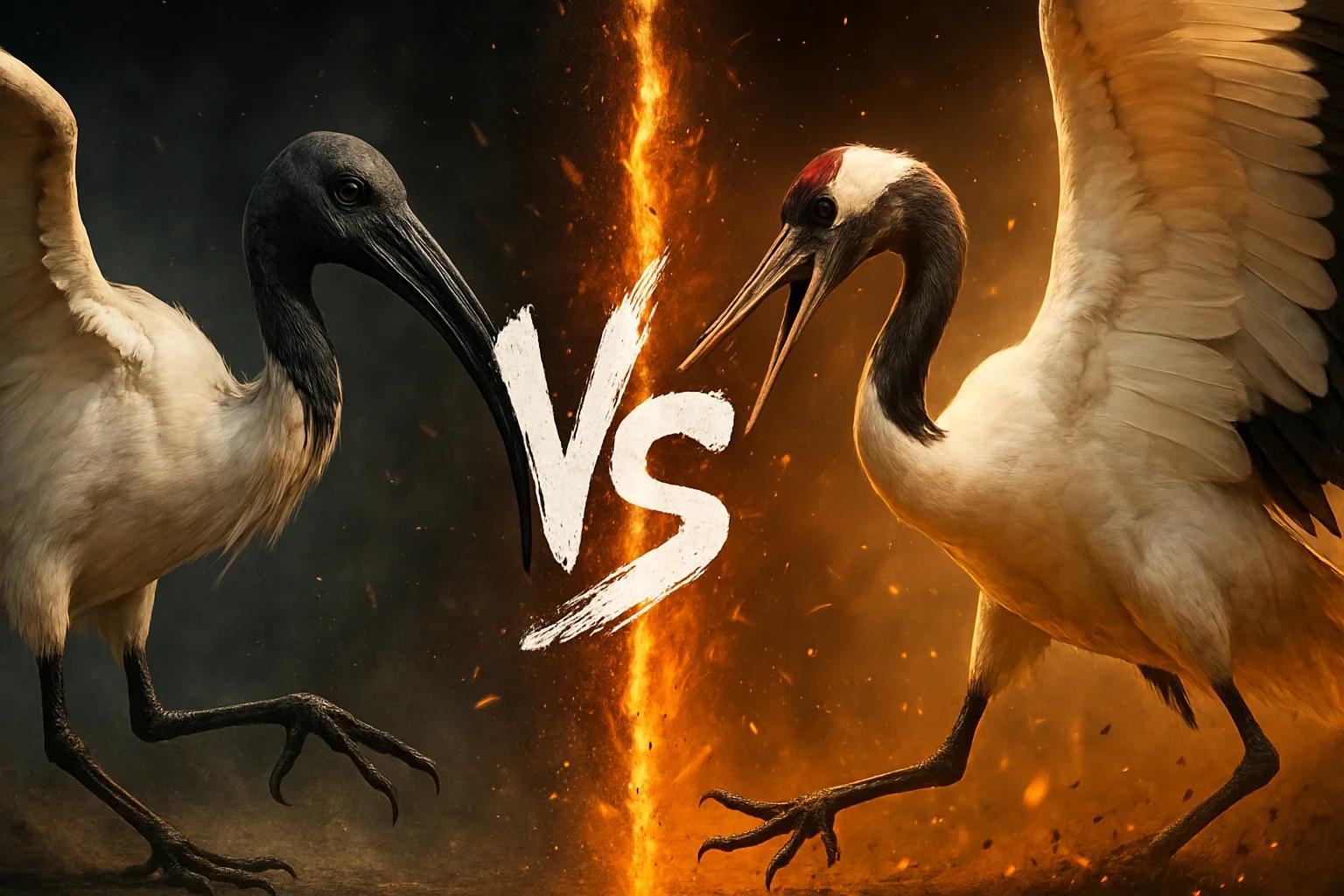
Black-headed Ibis vs Red-crowned Crane: Who Actually Wins?
The Red-crowned Crane wins this clearly. At roughly 150 cm tall, with a wingspan near 2.4 m and a body mass of 7–10 kg, it outweighs the Black-headed Ibis (about 65–75 cm long and roughly 1.5–2 kg) by around four to six times. It also carries a straight, dagger-like bill built for jabbing, long legs that can deliver kicks, and a breeding-season temperament forged by defending territories against foxes, raccoon dogs and rival cranes. The ibis is agile, social and armed with a long decurved bill, but that bill is a soft-mud probe, not a weapon. In almost any realistic wetland standoff, the crane's height, reach and willingness to escalate force the ibis to give way.
Read comparison
Bronze-winged Jacana vs Painted Stork: Who Actually Wins?
The Painted Stork wins, and it isn't especially close. A Painted Stork stands roughly 93–102 cm tall, weighs around 2–3.5 kg, and carries a long, heavy, slightly decurved bill. A Bronze-winged Jacana is a lightweight lily-trotter of roughly 28–31 cm, weighing in the low hundreds of grams. The stork has the reach, the mass, and the jabbing tool, so it controls any open confrontation. The jacana's real edge is not combat. Its long toes spread its weight across floating vegetation, letting it go where heavier wading birds can't follow. Males also defend territories with aggressive displays and sharp carpal (wrist) spurs on the wing. That makes the jacana hard to pin down on lily pads, but escaping is not the same as winning. On a straight head-to-head, the stork's size advantage of roughly ten times or more decides it.
Read comparison
Discussion
What do you think?
Share your reasoning with other readers. Be civil and stick to the animals.
Sign in to join the discussion.
Sign inNo comments yet. Start the conversation.