

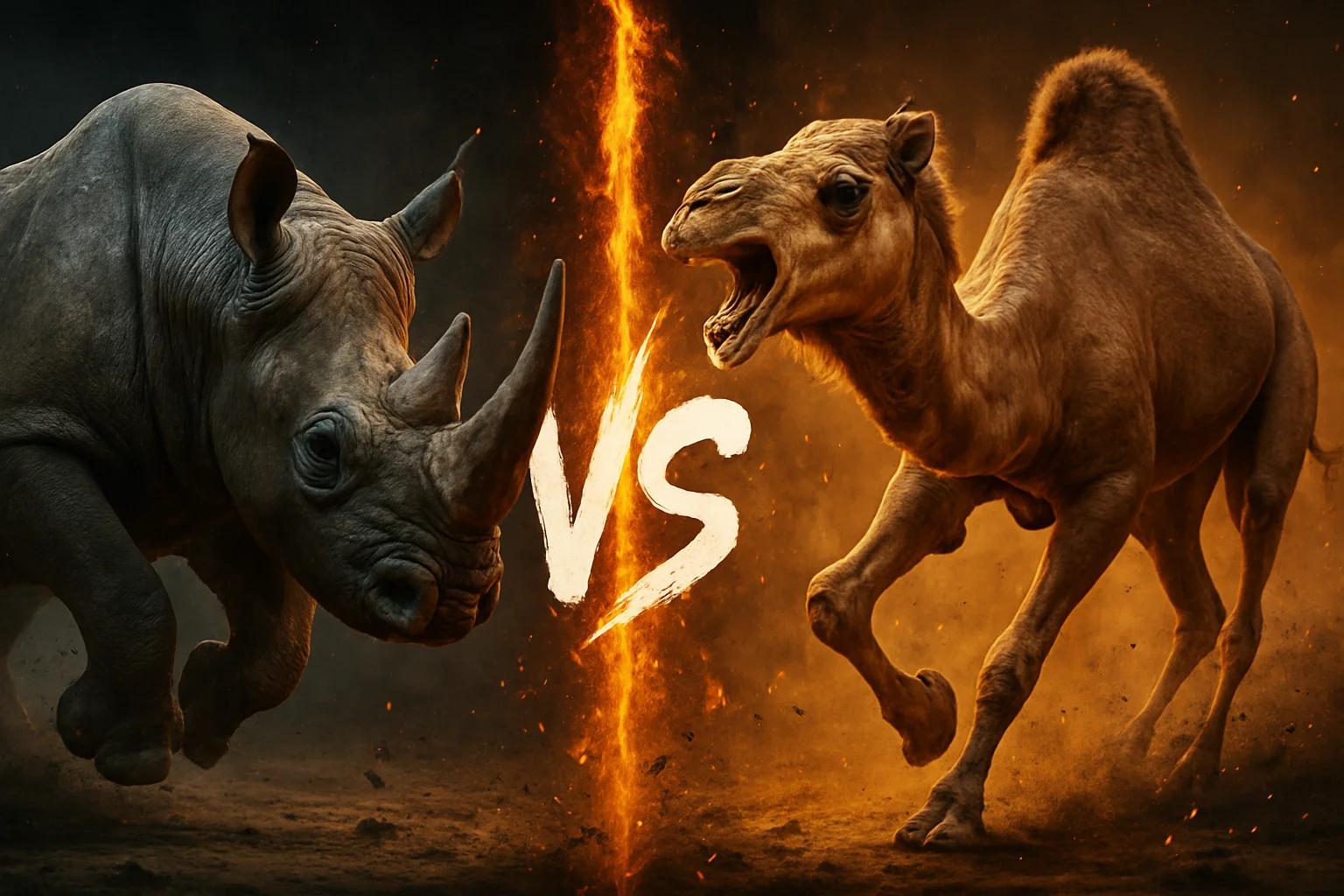
Black Rhinoceros vs Dromedary Camel: Who Actually Wins?
Black rhino vs dromedary camel: who would win? A biology-first breakdown of horns, armor, kicks, endurance and temperament, with a clear verdict.
Black Rhinoceros vs Dromedary Camel
Matchup winner
Black Rhinoceros
Quick verdict
Start with the direct answer, then use the structured comparison below to see what changes the outcome.
The black rhinoceros wins, and it is not especially close. An adult black rhino weighs roughly 800–1,400 kg against a dromedary's 400–600 kg. It carries a front horn that can exceed 50 cm and skin up to about 2 cm thick across the flanks and shoulders, and it is one of Africa's most notoriously quick-tempered large mammals, prone to charging first and investigating later. A dromedary's real weapons are a bite from large canine-like teeth, a powerful kick, and the ability to lean its full weight onto an opponent. Those tools are dangerous to people and to other camels. Against a low-slung, horn-led tank that charges at up to about 50 km/h, they lack the penetration and the mass to matter. The camel's genuine edges are heat and water endurance and long-distance walking, and those decide survival contests, not a head-on clash.
Read the full explanation
The black rhino wins a direct confrontation through mass, horn and armor.
It is roughly twice the camel's weight and far more willing to charge.
The camel's bite and kick can't meaningfully injure thick rhino hide.
The camel 'wins' only when the contest is about outlasting heat and drought, not fighting.
Reader vote
Who do you think wins?
Pick a side — no account needed. Results update live.
No votes yet — be the first to call it.
Editorial note
Why people disagree
Camels are famously aggressive and can seriously injure handlers, so people overrate how they'd fare against armored megafauna.
Explosive power
A charging rhino delivers concentrated force through a horn point. The camel's force spreads out over a push or bite.
Close-range durability
The rhino can absorb camel strikes. The camel's exposed legs and neck are vulnerable to a single goring.
Weapon quality
Horns are built for combat against other armored rhinos. Camel teeth evolved for rival-camel scuffles.
Read the full explanation +
Both stand tall and look big, but camel height is mostly leg and neck. The rhino's bulk sits low, dense and behind a horn.
Desert-survival framing tempts people to count endurance as combat. A camel can outlast a rhino in a drought but cannot outfight one.
Comparison FAQ
Short, direct answers to the next questions readers usually ask after the headline verdict.
Would a black rhino beat a camel in a fight?+
Yes. In a direct fight, the black rhino's weight, horn and thick skin give it a decisive advantage over a dromedary camel.
Which is stronger, a rhino or a camel?+
The black rhino is far stronger in raw pushing and striking power. It is heavier and much more muscular through the neck and shoulders. Camels are strong load-carriers, but their strength is built for endurance rather than impact.
Why is a camel still dangerous even though it would lose?+
Camels bite hard with sharp teeth, kick in multiple directions, and can crush a person by leaning or kneeling on them. Rutting males are especially aggressive. Against humans and smaller animals they can be genuinely deadly.
Could a camel outrun a rhino?+
Over a short burst they are fairly comparable. Over longer distances the camel's efficient gait and endurance let it escape a rhino reliably.
Do rhinos and camels ever meet in the wild?+
Rarely. Black rhinos live in eastern and southern African savanna and bush, while dromedaries are mostly domestic animals of North Africa, the Middle East and the Horn of Africa. Their ranges overlap only marginally, in parts of East Africa.
Head-to-head species stats
These are the same core AnimalDex stat dimensions used on the dedicated animal pages, pulled side by side so the matchup is faster to scan.
Black Rhinoceros
Tier BDromedary Camel
Tier CTrait-by-trait comparison
Only the categories that matter to this matchup are included. The goal is not filler stats, but the real design differences that change the result.
Horn-led charge, ~1+ tonne
Explosive power
Black Rhinoceros
Body shove and lunging bite
Explosive power
Black Rhinoceros
Thick dermal armor, heavy skull
Close-range durability
Black Rhinoceros
Thin-skinned limbs and long neck
Close-range durability
Black Rhinoceros
Two keratin horns, front often 50 cm+
Weapon quality
Black Rhinoceros
Sharp canines, strong kick
Weapon quality
Black Rhinoceros
Charge-first, highly reactive
Threat response
Black Rhinoceros
Grumpy but often displays first
Threat response
Black Rhinoceros
Needs regular water and wallows
Heat and drought endurance
Dromedary Camel
Can go days without drinking in extreme heat
Heat and drought endurance
Dromedary Camel
Short explosive bursts
Sustained travel
Dromedary Camel
Efficient long-distance gait
Sustained travel
Dromedary Camel
How the verdict forms
Verdict timeline
01 · Explosive power
Black Rhinoceros
02 · Close-range durability
Black Rhinoceros
03 · Weapon quality
Black Rhinoceros
04 · Threat response
Black Rhinoceros
05 · Heat and drought endurance
Dromedary Camel
06 · Sustained travel
Dromedary Camel
Change the conditions
Scenario breakdown
This is where shallow battle content usually fails. Terrain, spacing, timing, and engagement style can change the answer.
Scenario lean
Black Rhinoceros
Verdict confidence
82%
Rhino, decisively.
Black rhinos are browsers of dense thornbush and operate comfortably at short sight lines, relying on smell and hearing. In close cover, the camel's height and long legs become liabilities. It can't build speed or turn quickly, and a surprise charge from a few meters away gives it no time to escape.
AnimalDex field profiles
Explore these animals
Black Rhinoceros
Diceros bicornis
Dry savannah, scrubland, thornbush, and semi-desert browse country.
Dromedary Camel
Camelus dromedarius
Desert, semi-desert, dry scrubland, and human-managed arid travel routes.
Systems Intelligence & Hidden Purpose
See the animals behind this comparison as engineered biological systems: what each one is built to do, where it gains leverage, and why the matchup changes by scenario.
Specialized Hardware
Two horns on the nose, hooked upper lip for grasping shrubs, and heavy body with thick gray skin give the Black Rhinoceros a body plan tuned for its niche.
Systems Script
Black Rhinoceross operate in dry savannah, scrubland, thornbush, and semi-desert browse country. Their design helps them match food access, shelter, and timing inside that environment.
Strategic Insight
A strong frame matters most when the path ahead is thick, sharp, and resistant.
Specialized Hardware
Single large hump on the back, long legs and broad padded feet, and long neck and narrow head give the Dromedary Camel a body plan tuned for its niche.
Systems Script
Dromedary Camels operate in desert, semi-desert, dry scrubland, and human-managed arid travel routes. Their design helps them match food access, shelter, and timing inside that environment.
Strategic Insight
Good design makes harsh places feel less impossible.
Final take
The black rhinoceros is the clear winner of a black rhino vs camel fight. It brings roughly double the mass, a purpose-built horn, armored hide and a hair-trigger temperament. The camel brings a bad attitude and a strong kick. Those are formidable against humans but outmatched here.
Read the full explanation
The camel deserves respect on its own terms. It is one of the most heat- and drought-adapted large mammals on Earth, and in any contest measured in days without water it leaves the rhino behind. That's why it would rather walk away than stand its ground, and walking away is usually the smart play.
Collect both animals in AnimalDex
Track the species behind this matchup, compare their real traits, and build the rivalry into your AnimalDex collection.
Related comparisons
Continue with nearby matchups to compare more real-world animal traits without dropping into junky who-wins filler.
Dromedary Camel vs Red Kangaroo: Who Actually Wins?
The dromedary camel wins this matchup overall. A bull camel weighs roughly 400–600 kg against a big male red kangaroo's 55–90 kg, a mass gap of five to eight times. The kangaroo brings the more refined weapon: a tail-braced double kick with clawed hind feet that can open skin and break ribs on animals its own size. But those kicks were shaped by ritualized boxing between kangaroos and by defense against dingoes, not by contests with a half-tonne ungulate. A camel's thick hide, dense neck and chest, crushing bite and stamping forefeet let it absorb punishment and dish it out at a scale the kangaroo cannot match. The kangaroo's real edge is speed and evasion, so it wins any scenario where it can simply leave. In a committed, close-range confrontation, the camel's size settles it.
Read comparison
Discussion
What do you think?
Share your reasoning with other readers. Be civil and stick to the animals.
Sign in to join the discussion.
Sign inNo comments yet. Start the conversation.