

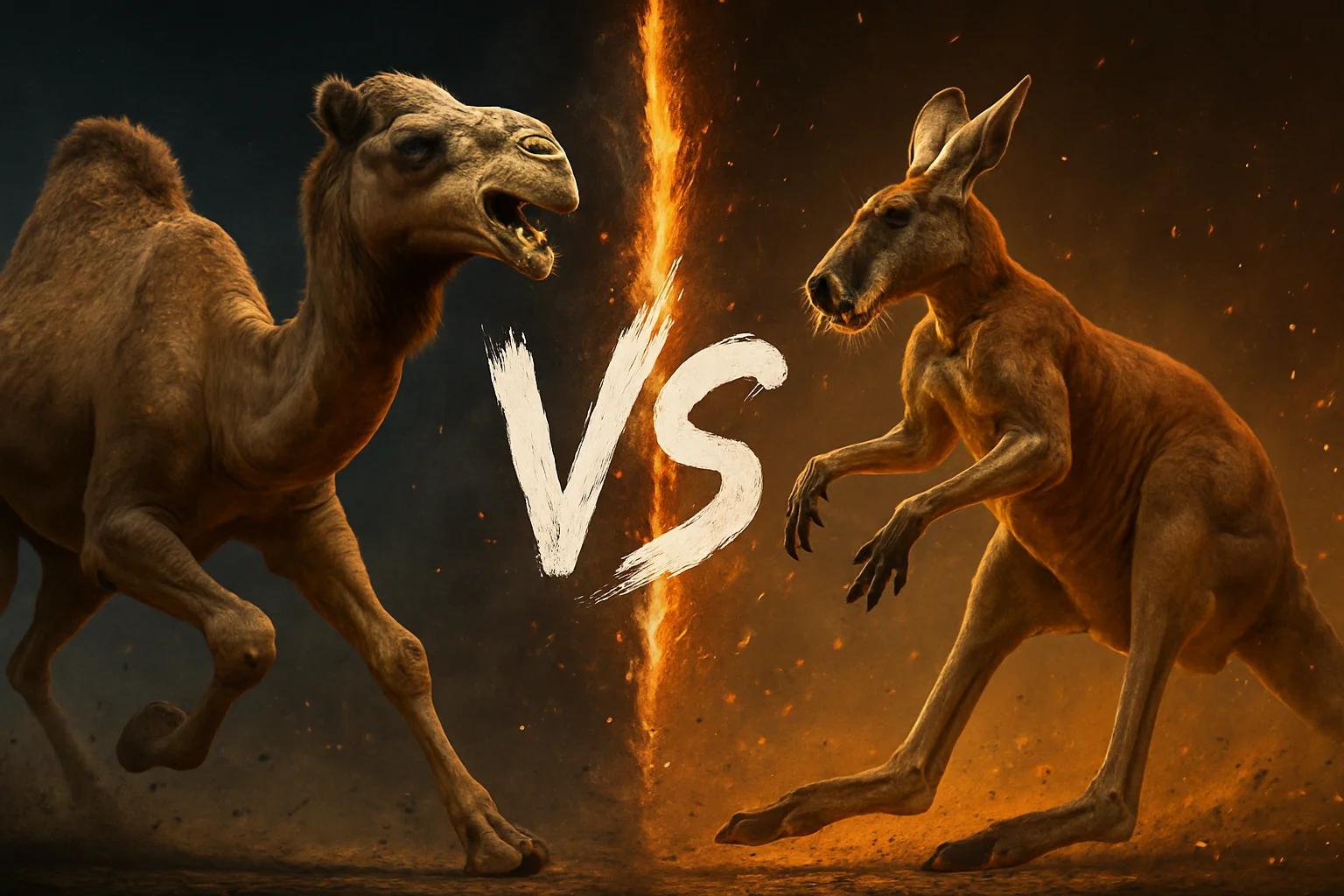
Dromedary Camel vs Red Kangaroo: Who Actually Wins?
Dromedary camel vs red kangaroo: a biology-first breakdown of size, kicks, bites, endurance and who would win a real confrontation.
Dromedary Camel vs Red Kangaroo
Matchup winner
Dromedary Camel
Quick verdict
Start with the direct answer, then use the structured comparison below to see what changes the outcome.
The dromedary camel wins this matchup overall. A bull camel weighs roughly 400–600 kg against a big male red kangaroo's 55–90 kg, a mass gap of five to eight times. The kangaroo brings the more refined weapon: a tail-braced double kick with clawed hind feet that can open skin and break ribs on animals its own size. But those kicks were shaped by ritualized boxing between kangaroos and by defense against dingoes, not by contests with a half-tonne ungulate. A camel's thick hide, dense neck and chest, crushing bite and stamping forefeet let it absorb punishment and dish it out at a scale the kangaroo cannot match. The kangaroo's real edge is speed and evasion, so it wins any scenario where it can simply leave. In a committed, close-range confrontation, the camel's size settles it.
Read the full explanation
Overall winner: Dromedary Camel, mainly because it outweighs a big red kangaroo about five to eight times.
Red kangaroos have the more specialized strike: a tail-supported double kick with sharp hind claws.
Camels counter with mass, tough hide, a powerful bite and heavy stamps, and rutting bulls are genuinely aggressive.
The kangaroo wins on escape speed and agility, but escaping is not the same as winning a fight.
Reader vote
Who do you think wins?
Pick a side — no account needed. Results update live.
No votes yet — be the first to call it.
Editorial note
Why people disagree
Viral kangaroo boxing clips make roos look like elite fighters, but most of those bouts are ritual sparring between near-equal males.
Raw mass
Mass determines who can absorb impact and who gets shoved, knocked down or pinned. It is the single biggest factor here.
Strike weaponry
The kangaroo's kick is the most refined weapon in this matchup. It is a precise, slashing strike built for close fights.
Close-range durability
The camel can take several kicks to the chest. One heavy stamp or body slam can end the kangaroo's ability to keep fighting.
Read the full explanation +
Camels have a docile reputation from tourism, yet rutting bulls bite, ram and kneel on rivals hard enough to kill people.
The kangaroo's kick is impressive per kilogram, and fans overlook how badly per-kilogram power scales against a 500 kg target.
Comparison FAQ
Short, direct answers to the next questions readers usually ask after the headline verdict.
Would a camel beat a kangaroo in a fight?+
Yes. In a committed fight, the dromedary camel's huge size advantage and crushing bite would overpower a red kangaroo, even though the kangaroo has the better kick.
Which is stronger, a camel or a kangaroo?+
The camel is far stronger in absolute terms. It can carry over 200 kg and outweighs a big kangaroo several times. The kangaroo is stronger for its size in explosive leg power.
Why is a red kangaroo still dangerous even though it loses?+
Its tail-braced double kick with sharp hind claws can cause serious cuts and blunt injuries, and it has injured dogs and people. A camel would likely take real wounds before winning.
Can a kangaroo outrun a camel?+
In short bursts the two have comparable top speeds, but the kangaroo is far more agile and accelerates faster. Over very long distances, especially in heat, the camel's endurance is stronger.
Do camels and kangaroos meet in the wild?+
Yes. Australia has one of the world's largest feral dromedary populations, and they share arid habitat with red kangaroos. Encounters typically end with the kangaroo moving away.
Head-to-head species stats
These are the same core AnimalDex stat dimensions used on the dedicated animal pages, pulled side by side so the matchup is faster to scan.
Dromedary Camel
Tier CRed Kangaroo
Tier CTrait-by-trait comparison
Only the categories that matter to this matchup are included. The goal is not filler stats, but the real design differences that change the result.
400–600 kg bull
Raw mass
Dromedary Camel
55–90 kg large male
Raw mass
Dromedary Camel
Crushing bite, stamping forefeet
Strike weaponry
Red Kangaroo
Tail-braced double kick, clawed hind feet
Strike weaponry
Red Kangaroo
Thick hide, dense neck and chest, padded knees
Close-range durability
Dromedary Camel
Lean, light frame with an exposed belly
Close-range durability
Dromedary Camel
About 65 km/h in a sprint, but lumbering in turns
Burst speed and agility
Red Kangaroo
About 56–70 km/h in bounds, with sharp lateral hops
Burst speed and agility
Red Kangaroo
Bull camels bite, ram and kneel on rivals
Rut-driven aggression
Dromedary Camel
Boomers box and kick, mostly in ritual contests
Rut-driven aggression
Dromedary Camel
Elite desert endurance
Heat and endurance
Dromedary Camel
Efficient hopping, but sheds heat by panting and licking
Heat and endurance
Dromedary Camel
How the verdict forms
Verdict timeline
01 · Raw mass
Dromedary Camel
02 · Strike weaponry
Red Kangaroo
03 · Close-range durability
Dromedary Camel
04 · Burst speed and agility
Red Kangaroo
05 · Rut-driven aggression
Dromedary Camel
06 · Heat and endurance
Dromedary Camel
Change the conditions
Scenario breakdown
This is where shallow battle content usually fails. Terrain, spacing, timing, and engagement style can change the answer.
Scenario lean
Dromedary Camel
Verdict confidence
82%
The camel overwhelms the kangaroo at grappling distance.
Once the gap closes, the kangaroo has to plant its tail to deliver kicks, which pins it in place. The camel can bite the neck or shoulder, shove with its chest, or drop its weight. Kangaroo claws can cut the camel, but they cannot drive through its mass. Here, size dominates technique.
AnimalDex field profiles
Explore these animals
Dromedary Camel
Camelus dromedarius
Desert, semi-desert, dry scrubland, and human-managed arid travel routes.
Red Kangaroo
Osphranter rufus
Arid grassland, desert scrub, and open semi-arid plains with scattered cover.
Systems Intelligence & Hidden Purpose
See the animals behind this comparison as engineered biological systems: what each one is built to do, where it gains leverage, and why the matchup changes by scenario.
Specialized Hardware
Single large hump on the back, long legs and broad padded feet, and long neck and narrow head give the Dromedary Camel a body plan tuned for its niche.
Systems Script
Dromedary Camels operate in desert, semi-desert, dry scrubland, and human-managed arid travel routes. Their design helps them match food access, shelter, and timing inside that environment.
Strategic Insight
Good design makes harsh places feel less impossible.
Specialized Hardware
Massive hind limbs, spring-loaded tendons, and a balancing tail make the red kangaroo low-cost locomotion hardware for sparse arid landscapes.
Systems Script
Red kangaroos track rain-driven productivity across desert systems and turn brief green windows into usable population gain. They are built to exploit pulses, not pretend the desert is stable.
Strategic Insight
In volatile systems, efficiency beats bravado. Save energy until the good window opens.
Final take
The dromedary camel wins this matchup. The red kangaroo has the more elegant weapon and is the better athlete, but a five- to eight-fold weight advantage, a tough hide and genuine rut aggression give the camel too much of a margin once contact happens.
Read the full explanation
The kangaroo's real strength is choice. It decides when and whether to engage, and in open country it can avoid the camel entirely. That keeps the kangaroo safe, but avoiding a fight is not winning one.
These two species do meet in Australia's interior, where feral dromedaries roam kangaroo country. Real encounters end in avoidance, not combat.
Collect both animals in AnimalDex
Track the species behind this matchup, compare their real traits, and build the rivalry into your AnimalDex collection.
Related comparisons
Continue with nearby matchups to compare more real-world animal traits without dropping into junky who-wins filler.
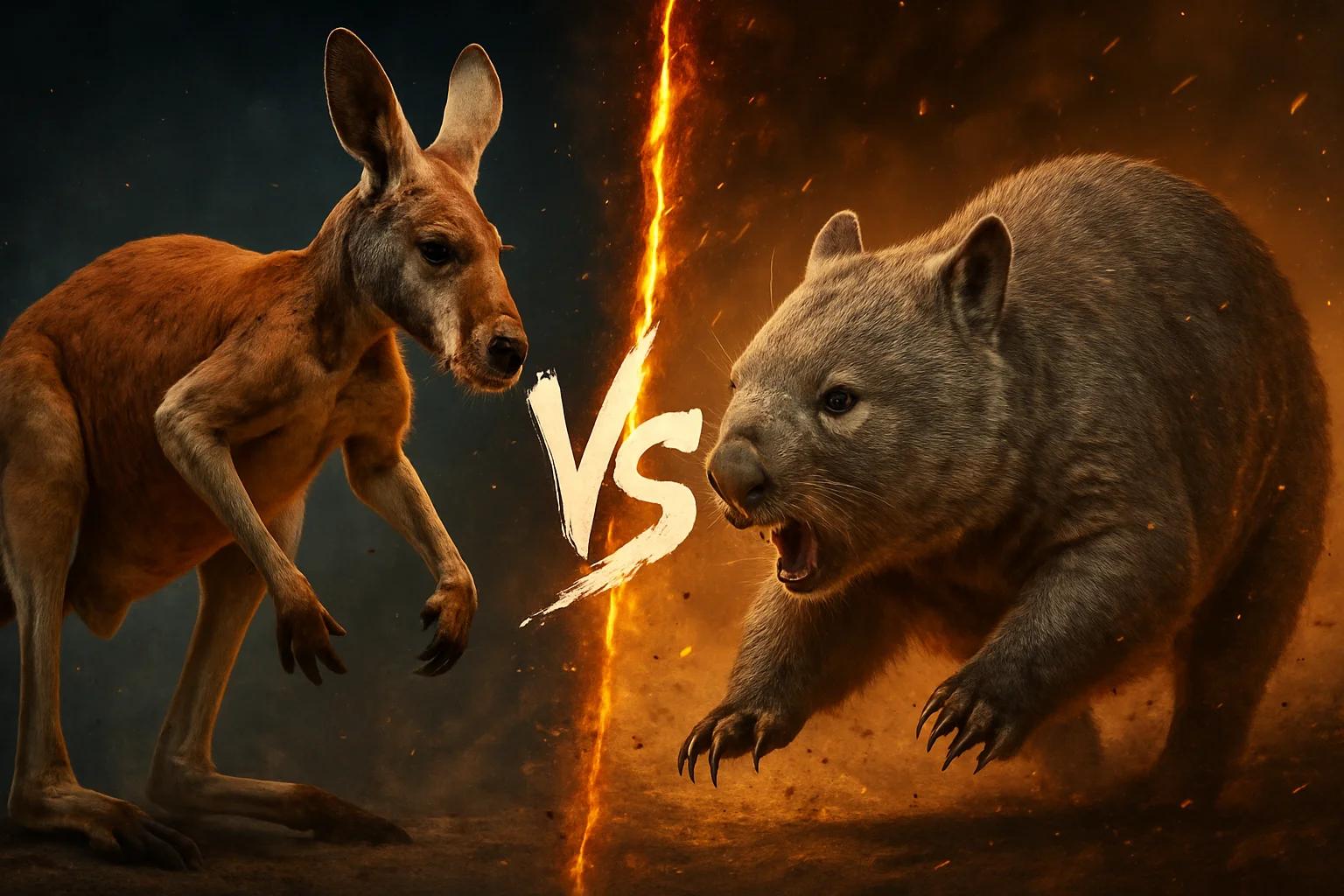
Red Kangaroo vs Southern Hairy-nosed Wombat: Who Actually Wins?
The red kangaroo wins this matchup overall. A large male red kangaroo can weigh around 85 kg and stand taller than most people, against a southern hairy-nosed wombat of roughly 19–32 kg. That size gap is decisive. The kangaroo also brings tail-braced double kicks with clawed hind feet, gripping forearms and serious speed. The wombat is no pushover. It is a dense, low-slung digging machine with a tough rump and powerful forelimbs. Next to its burrow it can make any intruder pay. But in open terrain it has no real way to stop a bigger, faster animal that can strike from range and leave whenever it wants. The kangaroo controls distance and timing. The wombat can only control its doorway.
Read comparison
Discussion
What do you think?
Share your reasoning with other readers. Be civil and stick to the animals.
Sign in to join the discussion.
Sign inNo comments yet. Start the conversation.