

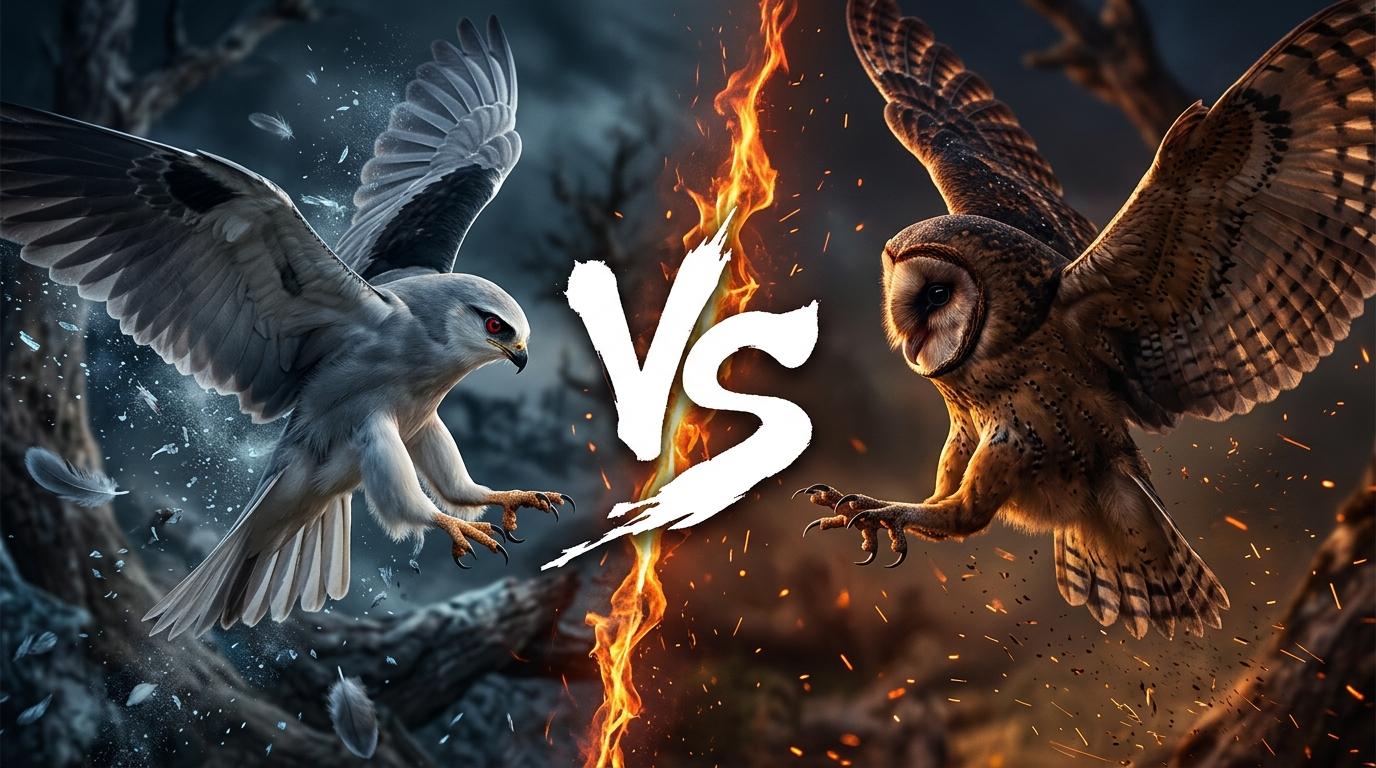
Black-shouldered Kite vs Masked Owl: Who Actually Wins?
Black-shouldered Kite vs Masked Owl: an Australian raptor showdown. See size, talons, speed and behaviour compared, and learn why the heavier Masked Owl usually wins.
Black-shouldered Kite vs Masked Owl
Matchup winner
Masked Owl
Quick verdict
Start with the direct answer, then use the structured comparison below to see what changes the outcome.
The Masked Owl wins this matchup. Tyto novaehollandiae is the heavier, more powerfully footed predator, and females are especially large: roughly 500–1,200 g against the kite's 250–350 g. The owl's long legs and big talons are built to grab and crush prey the size of rabbits, possums and rats. It also has a near-silent approach and dominates at night. The Black-shouldered Kite is a superb hoverer with sharp eyesight and real agility in daylight, but its feet are made for mice and grasshoppers, not for grappling a bird two to three times its mass. If the kite can't keep its distance, the owl's grip and body weight decide it.
Read the full explanation
Masked Owl wins most realistic confrontations thanks to a large mass and talon-strength advantage.
The kite's best tools are daylight agility and aerial mobbing, which let it harass rather than defeat.
At night or in timbered cover, the owl's silent approach makes it heavily favoured.
In open daylight sky, the kite can avoid the fight entirely, and in this matchup that counts as its 'win'.
Reader vote
Who do you think wins?
Pick a side — no account needed. Results update live.
No votes yet — be the first to call it.
Editorial note
Why people disagree
Both are mid-sized pale raptors, so people underestimate how much heavier and stronger-footed a female Masked Owl is.
Body mass
In raptor clashes, weight decides who can pin whom. The owl can carry and hold the kite; the reverse isn't possible.
Talon and grip power
Raptors kill with their feet. The owl's grip is a finishing tool; the kite's is a snatching tool.
Aerial agility
Agility lets the kite dictate distance in daylight and dodge commitment.
Read the full explanation +
Kites famously mob larger birds in daylight, which looks like dominance but is really harassment backed by an escape option.
The two species run on opposite clocks, so a 'real' fight is rare. The answer depends heavily on who is awake and where the encounter happens.
Comparison FAQ
Short, direct answers to the next questions readers usually ask after the headline verdict.
Would a Black-shouldered Kite beat a Masked Owl in a fight?+
Usually no. The Masked Owl is far heavier, with much stronger talons. In a committed close-range fight the owl wins. The kite's best outcome is escaping or mobbing in daylight.
Which is stronger, the Masked Owl or the Black-shouldered Kite?+
The Masked Owl. Its legs and feet handle prey like rabbits and possums, while the kite's grip is built for mice and insects.
Is the Masked Owl bigger than the Black-shouldered Kite?+
Yes. Masked Owls, especially females, can weigh two to three times as much as a kite, even though their wingspans are broadly comparable.
Why is the kite still dangerous to the owl?+
In daylight the kite is faster to turn, sees better and can dive repeatedly from above. Persistent mobbing can drive an owl off a perch or a kill, and a lucky strike could injure an eye.
Do these birds actually fight in the wild?+
Rarely. They hunt at opposite times of day. Daytime kites and other birds may mob a roosting owl, but true fights are uncommon.
Head-to-head species stats
These are the same core AnimalDex stat dimensions used on the dedicated animal pages, pulled side by side so the matchup is faster to scan.
Black-shouldered Kite
Tier CMasked Owl
Tier BTrait-by-trait comparison
Only the categories that matter to this matchup are included. The goal is not filler stats, but the real design differences that change the result.
~250–350 g, slender build
Body mass
Masked Owl
~500–1,200 g, females much larger
Body mass
Masked Owl
Small feet tuned for mice and insects
Talon and grip power
Masked Owl
Long, powerful legs that handle rabbit- and possum-sized prey
Talon and grip power
Masked Owl
Elite hoverer, quick turns, buoyant flight
Aerial agility
Black-shouldered Kite
Steady quartering flight, less nimble in open air
Aerial agility
Black-shouldered Kite
Conspicuous hunter that hovers in the open
Ambush control
Masked Owl
Silent-feathered, ear-guided night strikes
Ambush control
Masked Owl
Keen diurnal eyesight, scans open country
Daylight vision
Black-shouldered Kite
Eyes and ears optimised for darkness
Daylight vision
Black-shouldered Kite
Light frame, little reserve to absorb punishment
Close-range durability
Masked Owl
Robust body and dense plumage
Close-range durability
Masked Owl
How the verdict forms
Verdict timeline
01 · Body mass
Masked Owl
02 · Talon and grip power
Masked Owl
03 · Aerial agility
Black-shouldered Kite
04 · Ambush control
Masked Owl
05 · Daylight vision
Black-shouldered Kite
06 · Close-range durability
Masked Owl
Change the conditions
Scenario breakdown
This is where shallow battle content usually fails. Terrain, spacing, timing, and engagement style can change the answer.
Scenario lean
Masked Owl
Verdict confidence
82%
Masked Owl, decisively.
Among trees and hollows, the kite loses its open-air manoeuvring room. The owl is at home in forest edges and roost cavities, and it can close distance silently and engage at grappling range. In that range its mass and leg strength overwhelm the kite.
AnimalDex field profiles
Explore these animals
Black-shouldered Kite
Elanus axillaris
open grassland, farmland, and woodland edge
Masked Owl
Tyto novaehollandiae
forest edge, farmland, woodland, and open night-hunting ground
Systems Intelligence & Hidden Purpose
See the animals behind this comparison as engineered biological systems: what each one is built to do, where it gains leverage, and why the matchup changes by scenario.
Specialized Hardware
pale body with black shoulders, hovering rodent-hunt posture, and red eye glow give the Black-shouldered Kite a body plan tuned for its niche.
Systems Script
Black-shouldered Kites operate through open grassland, farmland, and woodland edge. Their design links movement, feeding, shelter, and timing into one workable survival system.
Strategic Insight
Dense environments reward precision, patience, and the ability to read layered cover.
Final take
The Masked Owl is the clear overall winner. It is simply the more heavily armed predator, with roughly double the kite's mass or more, much stronger feet, and the ability to strike unseen. Most of the plausible ways these two meet favour the owl.
Read the full explanation
The Black-shouldered Kite isn't outclassed in skill, only in hardware. In bright open country its eyesight and hovering agility let it avoid the owl indefinitely. That edge keeps the kite alive, but it doesn't win fights.
Collect both animals in AnimalDex
Track the species behind this matchup, compare their real traits, and build the rivalry into your AnimalDex collection.
Related comparisons
Continue with nearby matchups to compare more real-world animal traits without dropping into junky who-wins filler.
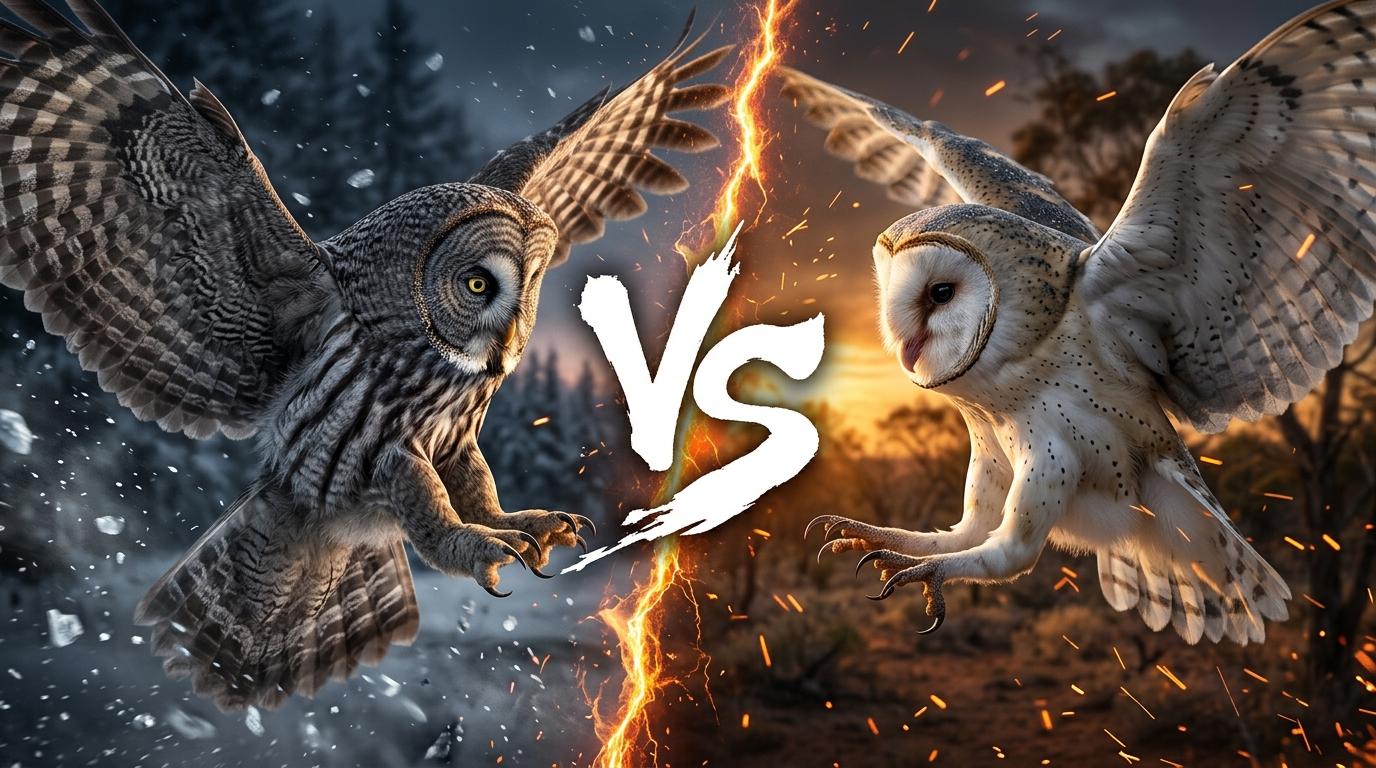
Great Gray Owl vs Masked Owl: Who Actually Wins?
The Masked Owl wins a straight fight. The Great Gray Owl looks like a giant, with a body up to 84 cm long and a wingspan around 1.5 m. Much of that bulk, though, is insulating feather over a lean body, and its feet are built for snatching voles through snow. The Masked Owl, Australia's largest barn owl relative, is more compact, with long legs, thick toes, and heavy talons. It routinely kills possums, bandicoots, rabbits, and large rats. Large females can match an average Great Gray in body mass (up to about 1.2 kg) while carrying far more grip force per gram. In a close-range grapple decided by talons, the bird built to subdue struggling mammals beats the bird built to pinch rodents. The Great Gray's size and fierce nest defense keep it dangerous, but power density decides this one.
Read comparison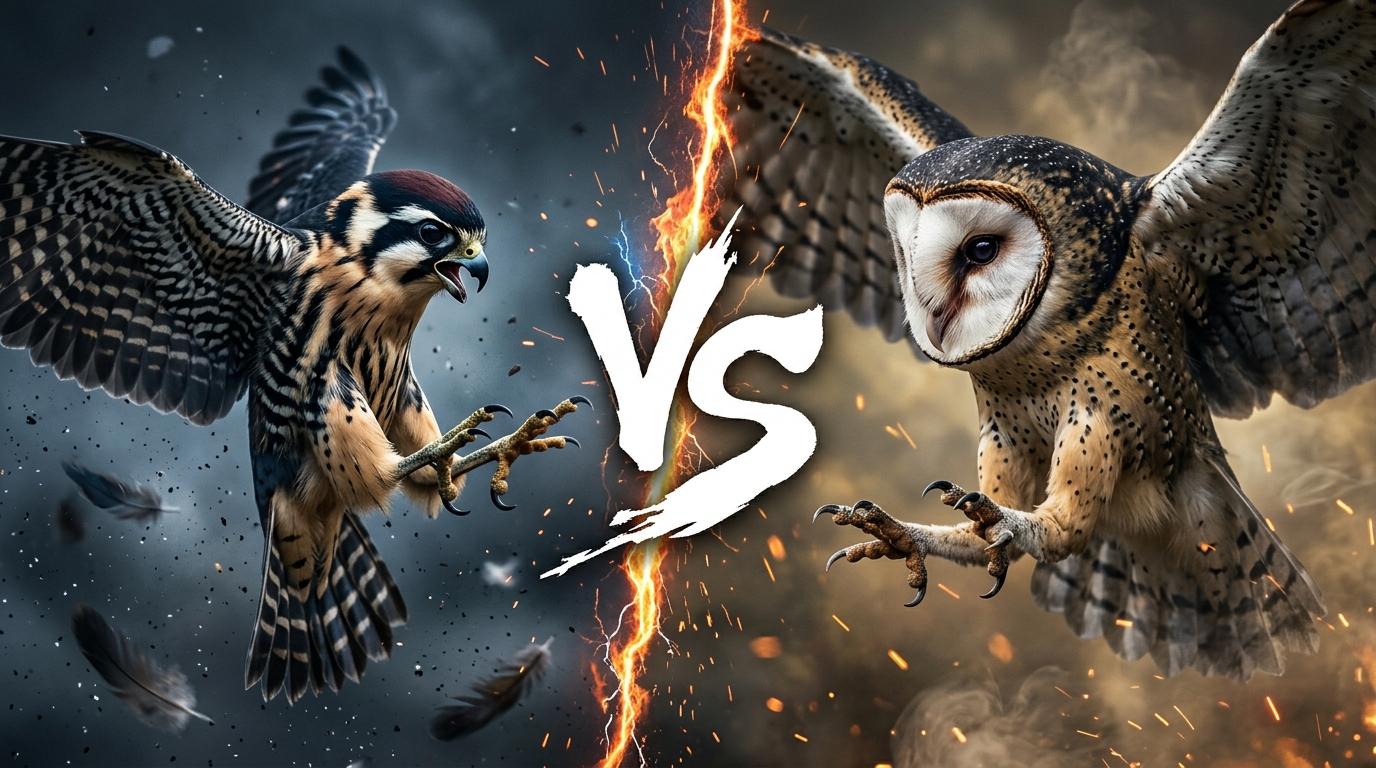
Collared Falconet vs Masked Owl: Who Actually Wins?
The Masked Owl wins, and it is not close on raw physics. A Masked Owl weighs roughly 400–1,200 g, with females at the top end, and carries some of the most powerful feet among barn owls, built to crush rats and possums. The Collared Falconet weighs around 30–50 g, about the mass of a sparrow, and its hardware is tuned to snatching insects and small birds in daylight. The falconet is faster to accelerate and far more agile in a sunlit canopy, so it can harass, dodge and escape. But it cannot meaningfully injure a bird twenty times its weight, while one closed owl foot ends the exchange. Any contact the falconet survives, it survives by leaving.
Read comparison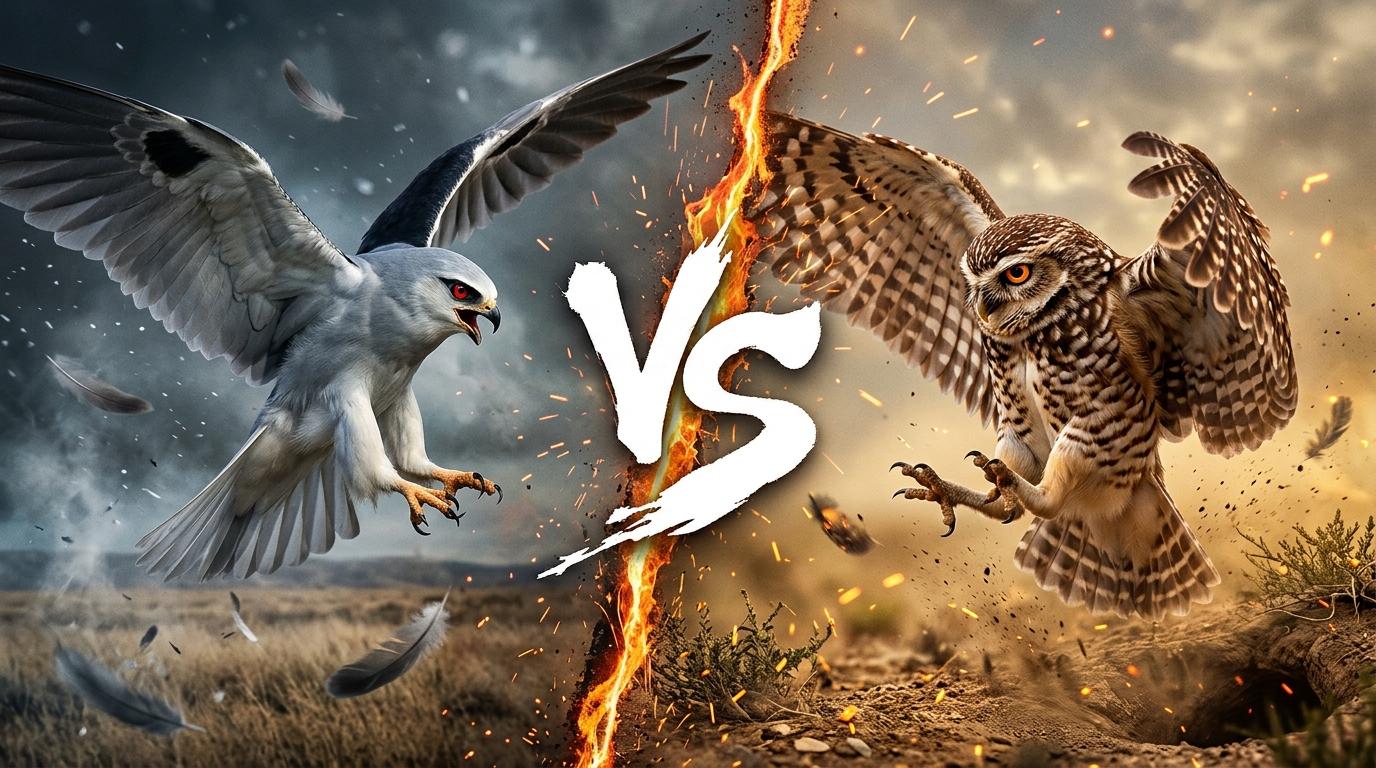
Black-shouldered Kite vs Burrowing Owl: Who Actually Wins?
The Black-shouldered Kite wins most realistic confrontations. It is heavier, at roughly 250–300 g against the owl's typical 150–200 g, and it carries a far bigger wingspan of about 80–95 cm. It is also a true aerial hunter, built to hover, stoop and strike from above. The Burrowing Owl is no pushover. It is quick on its feet, clever around its burrow, and famous for a rattlesnake-like hiss that bluffs off bigger threats. But it is a ground-centric, leggy bird that gives up the air. In any encounter that starts in the open or in flight, the kite controls the angle of attack. The owl's best result is a stalemate at its burrow mouth, where retreat beats victory. These species never meet in the wild: the kite is Australian and the owl lives in the Americas. This is a hypothetical comparison of body plans.
Read comparison
Discussion
What do you think?
Share your reasoning with other readers. Be civil and stick to the animals.
Sign in to join the discussion.
Sign inNo comments yet. Start the conversation.