

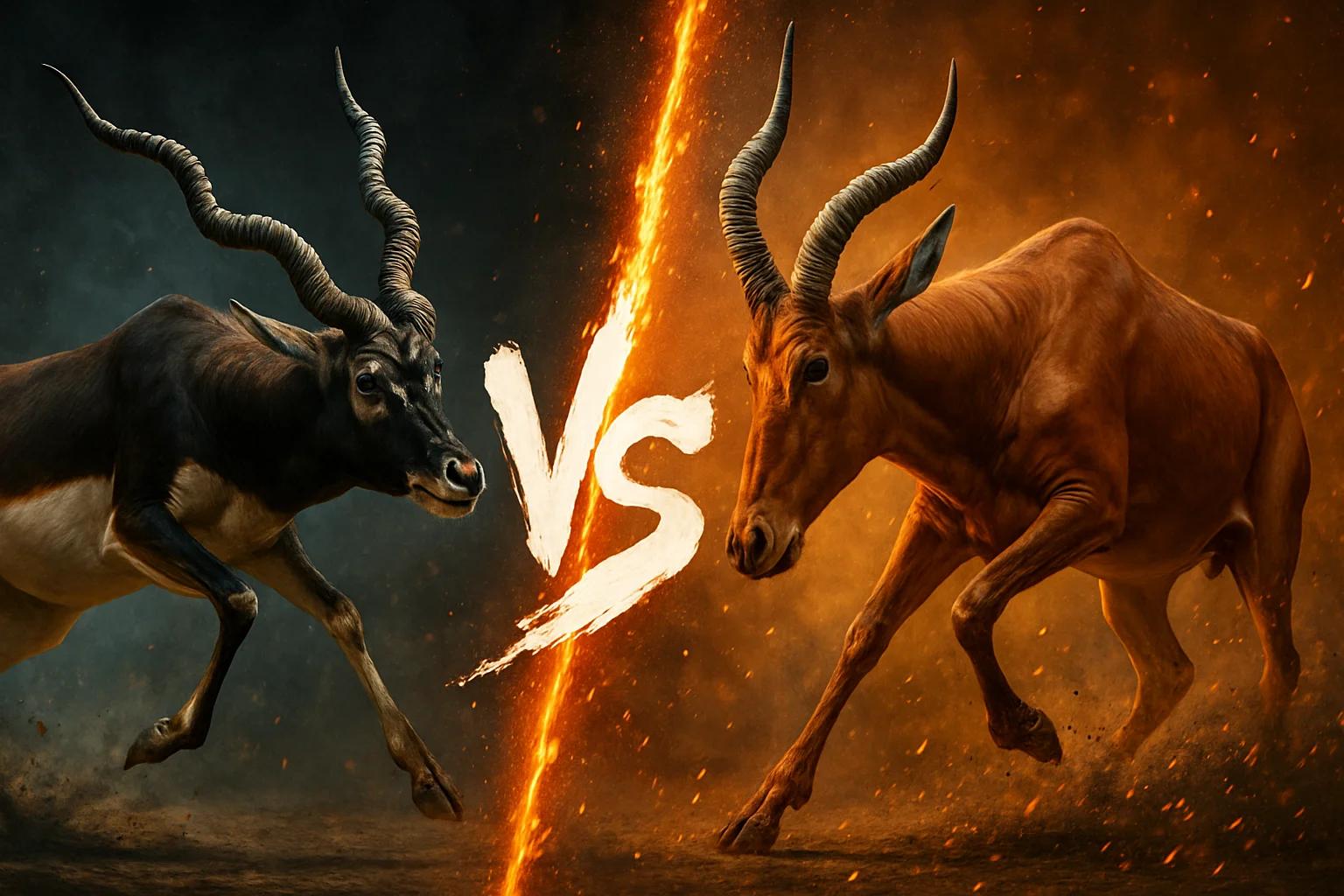
Blackbuck vs Hirola: Who Actually Wins?
Blackbuck vs hirola: India's spiral-horned sprinter meets Africa's rare 'four-eyed' antelope. We compare size, horns, speed and fighting style to find who wins a clash.
Blackbuck vs Hirola
Matchup winner
Hirola
Quick verdict
Start with the direct answer, then use the structured comparison below to see what changes the outcome.
The hirola wins. This is a clash between two horned antelopes from different continents. The blackbuck is faster and more agile. The hirola brings what a horn-to-horn contest rewards: more mass, a taller and heavier frame, and thick, ringed lyre-shaped horns built for shoving duels. Adult hirola commonly weigh around 80–118 kg against a blackbuck's roughly 25–45 kg, so in a committed head-on clash the hirola can drive the blackbuck backward and off balance. The blackbuck's long corkscrew horns are dangerous at the tips and its acceleration is elite, but its whole design favors escape over grinding contact. If the blackbuck can run, it survives. If it has to stand and push, the hirola's weight decides it.
Read the full explanation
Overall winner: hirola. Its heavier body and sturdier horns favor forehead-to-forehead combat.
The blackbuck is clearly faster, among the quickest antelopes, but speed wins escapes, not shoving matches.
In open ground with room to flee, the blackbuck 'wins' by not losing.
The hirola is critically endangered, numbering only in the hundreds, so this matchup exists purely as a thought experiment.
Reader vote
Who do you think wins?
Pick a side — no account needed. Results update live.
No votes yet — be the first to call it.
Editorial note
Why people disagree
Blackbuck horns look more lethal. Long spirals and sharp tips seem scarier than the hirola's lyre-shaped horns, but in a shoving fight, length matters less than mass behind the horns.
Body mass & frame
Horn fights are pushing contests, so roughly double the mass gives the hirola leverage the blackbuck can't counter.
Explosive speed
The blackbuck controls whether a fight happens at all. It can disengage almost at will.
Horn architecture
Ringed, robust horns lock and brace well in wrestling. Spirals reach far but are less suited to absorbing heavy pushes.
Read the full explanation +
Speed stats mislead. The blackbuck's huge speed edge dominates every chase scenario, yet a fight only happens when someone stops running.
The two species never meet. One lives in South Asia and the other in East African bushland, so every answer rests on anatomy, not observed encounters.
Comparison FAQ
Short, direct answers to the next questions readers usually ask after the headline verdict.
Would a hirola beat a blackbuck in a fight?+
Yes, in most committed fights. The hirola's heavier body and sturdier horns give it the edge in head-to-head pushing.
Which is stronger, blackbuck or hirola?+
The hirola. It is substantially heavier and more solidly built, which translates into more pushing power.
Is the blackbuck faster than the hirola?+
Yes, by a wide margin. The blackbuck is one of the fastest antelopes and can outrun the hirola easily.
Why is the blackbuck still dangerous if it loses?+
Its long, sharp spiral horns and quick sidesteps can deliver injuring strikes, and its speed means it rarely gets trapped at all.
Do blackbuck and hirola ever meet in the wild?+
No. Blackbuck live in South Asia and hirola in a small area of eastern Kenya and southern Somalia.
Head-to-head species stats
These are the same core AnimalDex stat dimensions used on the dedicated animal pages, pulled side by side so the matchup is faster to scan.
Blackbuck
Tier BHirola
Tier BTrait-by-trait comparison
Only the categories that matter to this matchup are included. The goal is not filler stats, but the real design differences that change the result.
Slender, ~25–45 kg males
Body mass & frame
Hirola
Stockier, ~80–118 kg adults
Body mass & frame
Hirola
Elite sprinter, bursts near 80 km/h
Explosive speed
Blackbuck
Capable runner, but heavier and slower
Explosive speed
Blackbuck
Long corkscrew spirals, sharp tips
Horn architecture
Hirola
Thick, ringed, lyre-shaped horns
Horn architecture
Hirola
Light build, built to flee
Close-range durability
Hirola
Heavier neck and shoulders
Close-range durability
Hirola
High leaps, rapid direction changes
Agility & evasion
Blackbuck
Steadier, less nimble
Agility & evasion
Blackbuck
Rutting males spar and display hard
Territorial combat drive
Hirola
Males defend territories with horn clashes
Territorial combat drive
Hirola
How the verdict forms
Verdict timeline
01 · Body mass & frame
Hirola
02 · Explosive speed
Blackbuck
03 · Horn architecture
Hirola
04 · Close-range durability
Hirola
05 · Agility & evasion
Blackbuck
06 · Territorial combat drive
Hirola
Change the conditions
Scenario breakdown
This is where shallow battle content usually fails. Terrain, spacing, timing, and engagement style can change the answer.
Scenario lean
Hirola
Verdict confidence
82%
Hirola dominates when escape lanes close.
In dense bush the blackbuck loses its main weapon, open-space speed. Forced into horn contact, it faces an opponent roughly twice its weight with sturdier horns, and the hirola can pin and push it out of position.
AnimalDex field profiles
Explore these animals
Blackbuck
Antilope cervicapra
open grassland, dry plain, and lightly wooded savannah
Hirola
Beatragus hunteri
dry grassland, open bushland, and lightly wooded savannah
Systems Intelligence & Hidden Purpose
See the animals behind this comparison as engineered biological systems: what each one is built to do, where it gains leverage, and why the matchup changes by scenario.
Specialized Hardware
spiraled horns on males, fast bounding movement, and lightweight grassland body give the Blackbuck a body plan tuned for its niche.
Systems Script
Blackbucks operate through open grassland, dry plain, and lightly wooded savannah Their design links movement, shelter, and feeding into one workable survival system.
Strategic Insight
A light system can survive by turning speed into space.
Specialized Hardware
long alert face, lyre-shaped horns, and dry grassland herd vigilance give the Hirola a body plan tuned for its niche.
Systems Script
Hirolas operate through dry grassland, open bushland, and lightly wooded savannah. Their design links movement, feeding, shelter, and timing into one workable survival system.
Strategic Insight
Harsh places reward efficiency, timing, and bodies that waste very little.
Final take
The hirola takes this matchup. Antelope fights are won by mass, bracing and leverage, and the hirola carries more of all three. The blackbuck is the better athlete, but athleticism mostly buys it an exit.
Read the full explanation
That is also why the blackbuck stays dangerous. Its sharp spiral horns and explosive agility mean any careless charge could end with a painful jab. Still, in the decisive frame of a committed fight, the heavier animal wins.
Collect both animals in AnimalDex
Track the species behind this matchup, compare their real traits, and build the rivalry into your AnimalDex collection.
Related comparisons
Continue with nearby matchups to compare more real-world animal traits without dropping into junky who-wins filler.
Blackbuck vs Giant Eland: Who Actually Wins?
The giant eland wins, and it isn't close in a physical confrontation. Africa's largest antelope can stand around 1.5–1.8 m at the shoulder and weigh roughly 400–900 kg, with thick spiral horns up to about a metre long and a heavy, muscular neck built for shoving contests between bulls. The blackbuck is a lightweight specialist of about 25–45 kg with ringed corkscrew horns. It was built to outrun threats across open plains at speeds reported near 80 km/h, not to absorb force. If the two ever squared off, the eland's mass, reach and pushing power would decide things within seconds. The blackbuck's real winning move is to leave, and in a pure race it wins easily.
Read comparison
Discussion
What do you think?
Share your reasoning with other readers. Be civil and stick to the animals.
Sign in to join the discussion.
Sign inNo comments yet. Start the conversation.