

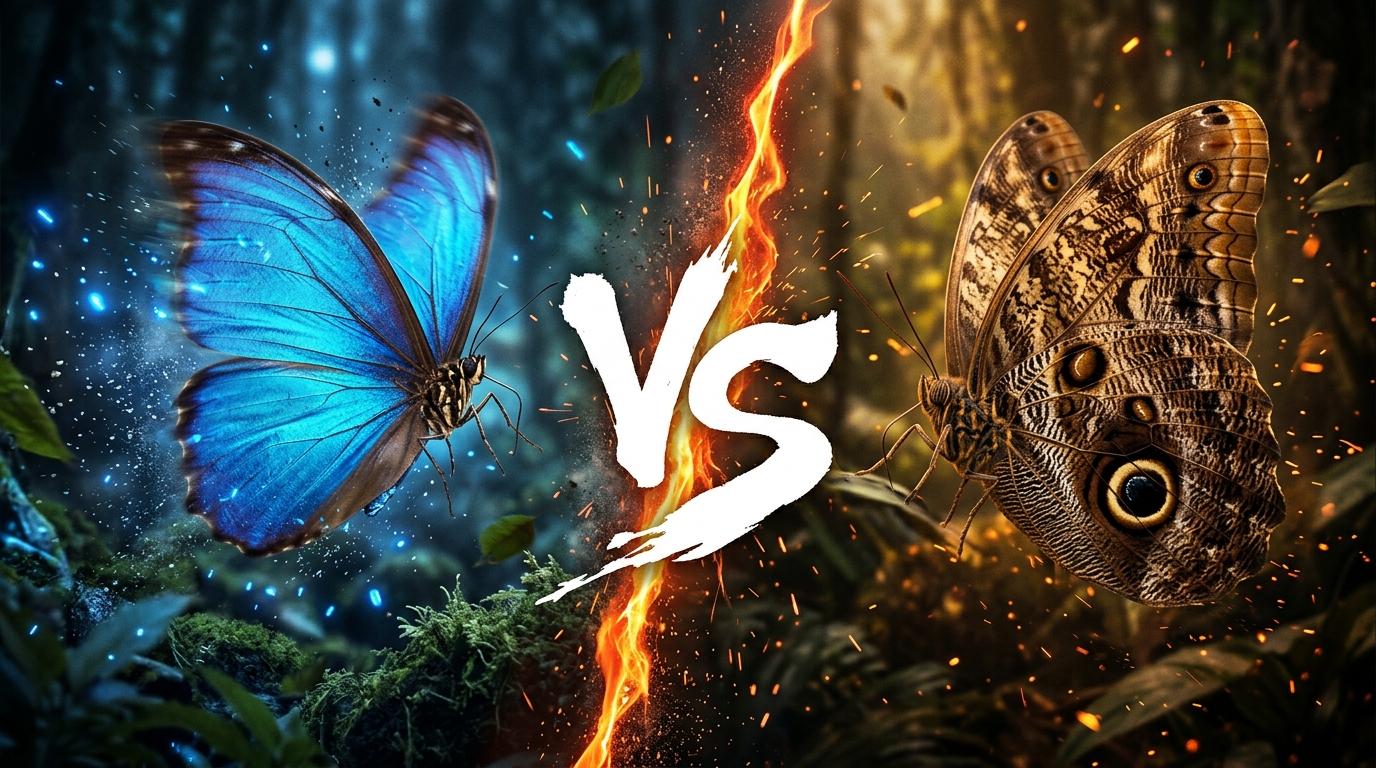
Blue Morpho vs Owl Butterfly: Who Actually Wins?
Blue Morpho vs Owl Butterfly: who would win? A biology-first breakdown of speed, flash defense, eyespot bluffing, territorial behavior, and which giant Neotropical butterfly comes out on top.
Blue Morpho vs Owl Butterfly
Matchup winner
Blue Morpho
Quick verdict
Start with the direct answer, then use the structured comparison below to see what changes the outcome.
The Blue Morpho wins. Neither butterfly can hurt the other because both are nectar- and fruit-feeding insects with coiled sipping mouthparts and no weapons. So a 'battle' between them comes down to who controls airspace, food, and position. The Blue Morpho has the better tools for that. Its males patrol forest flyways by day and chase off rival butterflies in fast, erratic aerial bouts. Its flashing structural-blue wings make it hard to track and hard to catch. It is also faster and more aggressive in flight. The Owl Butterfly is a dusk-active, energy-saving specialist built around one brilliant trick: giant eyespots that bluff predators. That trick does nothing against another butterfly. In any daytime contest over a sunlit gap or a pile of fermenting fruit, the Morpho holds the space and the Owl Butterfly gives way.
Read the full explanation
Blue Morpho wins most realistic contests on airspeed, flight agility, and territorial patrol behavior.
Neither species can physically injure the other. 'Winning' means displacing the rival from airspace or food.
The Owl Butterfly's eyespot bluff is built to scare vertebrate predators, not to intimidate other butterflies.
The Owl Butterfly holds its own at dusk and in deep shade, where it does most of its flying.
Reader vote
Who do you think wins?
Pick a side — no account needed. Results update live.
No votes yet — be the first to call it.
Editorial note
Why people disagree
The Owl Butterfly looks scarier: its owl-eye pattern makes people assume it would intimidate a rival, but insects don't read eyespots the way birds and lizards do.
Aerial speed & burst
Butterfly contests are chases. The faster flier dictates who leaves the patch.
Territorial drive
Willingness to engage is the closest thing butterflies have to dominance.
Flash-and-vanish defense
The Morpho's flicker confuses pursuers' tracking. That makes it hard to pin down in any chase.
Read the full explanation +
Both have similar wingspans, so some readers call it a size draw. Behavior and flight style, not size, decide the matchup.
They are active at different times. The Morpho flies in bright daytime and the Owl Butterfly at twilight, so a 'fair' arena is genuinely debatable.
Comparison FAQ
Short, direct answers to the next questions readers usually ask after the headline verdict.
Would a Blue Morpho beat an Owl Butterfly in a fight?+
Yes. Neither can injure the other, but the Blue Morpho's faster, more aggressive flight lets it chase the Owl Butterfly away from sunlit patches and food in daylight.
Which butterfly is stronger, the Blue Morpho or the Owl Butterfly?+
They are similar in size and both are large tropical butterflies. The Blue Morpho has more active flight power and territorial drive. The Owl Butterfly is built to save energy and fly in short bursts rather than to compete.
Why is the Owl Butterfly still dangerous even though it loses?+
It is dangerous to its predators' expectations, not to other butterflies. Its huge eyespots can startle birds and lizards into backing off, buying escape time. Its dusk activity also lets it exploit food while daytime rivals rest.
Do Blue Morphos really fight other butterflies?+
Males patrol flyways and chase off intruding butterflies in fast aerial pursuits. These are displacement chases, not damaging fights.
Can butterflies hurt each other?+
Practically, no. Adults have a coiled, straw-like proboscis for sipping and no biting jaws. Contests are settled by flight and persistence.
Head-to-head species stats
These are the same core AnimalDex stat dimensions used on the dedicated animal pages, pulled side by side so the matchup is faster to scan.
Blue Morpho
Tier DOwl Butterfly
Tier BTrait-by-trait comparison
Only the categories that matter to this matchup are included. The goal is not filler stats, but the real design differences that change the result.
Fast, bounding, erratic flight
Aerial speed & burst
Blue Morpho
Slower, short twilight flights
Aerial speed & burst
Blue Morpho
Males patrol and chase rivals along flyways
Territorial drive
Blue Morpho
Low-key; often rests in groups
Territorial drive
Blue Morpho
Iridescent blue topside alternates with brown undersides
Flash-and-vanish defense
Blue Morpho
Muted upperside; relies on resting camouflage
Flash-and-vanish defense
Blue Morpho
Small underside eyespots
Bluff & intimidation display
Owl Butterfly
Huge owl-like eyespots that startle predators
Bluff & intimidation display
Owl Butterfly
Mostly daytime and sun-gap flier
Low-light operation
Owl Butterfly
Crepuscular; comfortable at dusk and in deep shade
Low-light operation
Owl Butterfly
High-output patrol flight
Energy economy
Owl Butterfly
Rests long hours, flies in short bursts
Energy economy
Owl Butterfly
How the verdict forms
Verdict timeline
01 · Aerial speed & burst
Blue Morpho
02 · Territorial drive
Blue Morpho
03 · Flash-and-vanish defense
Blue Morpho
04 · Bluff & intimidation display
Owl Butterfly
05 · Low-light operation
Owl Butterfly
06 · Energy economy
Owl Butterfly
Change the conditions
Scenario breakdown
This is where shallow battle content usually fails. Terrain, spacing, timing, and engagement style can change the answer.
Scenario lean
Blue Morpho
Verdict confidence
82%
Clear Morpho win.
This is Blue Morpho home turf. Males patrol light gaps and stream corridors and chase intruding butterflies. The Morpho's speed and flashing wings let it close on and harass a rival repeatedly. The Owl Butterfly, built for short dusk flights, simply leaves.
AnimalDex field profiles
Explore these animals
Blue Morpho
Morpho menelaus
rainforest edge, river trail, and humid understory
Owl Butterfly
Caligo memnon
rainforest edge, orchard, and humid woodland
Systems Intelligence & Hidden Purpose
See the animals behind this comparison as engineered biological systems: what each one is built to do, where it gains leverage, and why the matchup changes by scenario.
Specialized Hardware
iridescent blue wings, broad slow gliding flight, and eyespot brown undersides give the Blue Morpho a body plan tuned for its niche.
Systems Script
Blue Morphos operate through rainforest edge, river trail, and humid understory. Their design links movement, feeding, shelter, and timing into one workable survival system.
Strategic Insight
Dense environments reward precision, patience, and the ability to read layered cover.
Specialized Hardware
giant eye-spot wings, dusky twilight flight, and broad leaf-like brown wings give the Owl Butterfly a body plan tuned for its niche.
Systems Script
Owl Butterflys operate through rainforest edge, orchard, and humid woodland. Their design links movement, feeding, shelter, and timing into one workable survival system.
Strategic Insight
Dense environments reward precision, patience, and the ability to read layered cover.
Final take
The Blue Morpho is the overall winner. Butterfly 'battles' are contests of airspace and persistence, not damage. The Morpho is faster, more territorial, and harder to track in flight. In daylight it reliably displaces the Owl Butterfly.
Read the full explanation
The Owl Butterfly is not a loser in evolutionary terms. Its eyespot bluff and twilight timing are elite survival strategies. It wins by avoiding the fight entirely: it feeds when the Morpho can't and saves energy the Morpho burns on patrols.
Collect both animals in AnimalDex
Track the species behind this matchup, compare their real traits, and build the rivalry into your AnimalDex collection.
Related comparisons
Continue with nearby matchups to compare more real-world animal traits without dropping into junky who-wins filler.

Blue Morpho vs Glasswing Butterfly: Who Actually Wins?
The Blue Morpho wins. With a wingspan of roughly 12–15 cm against the Glasswing's 5.5–6 cm, Morpho menelaus brings more than double the reach, much more wing area, and a stronger, faster flap-and-glide flight. In any physical contest, such as jostling over a fermenting fruit, a territorial chase along a forest stream, or a midair bump, the larger, more muscular morpho displaces the smaller butterfly. Male morphos are also known to patrol and chase intruders along flight paths. The Glasswing is no pushover in the bigger survival game. Its transparent wings make it nearly invisible against foliage, and the alkaloids it collects as an adult make it distasteful to many predators. Those are defenses against being eaten, though, not tools for winning a confrontation. Head to head, size and flight power decide it, and the morpho holds both.
Read comparison
Blue Morpho vs Hercules Beetle: Who Actually Wins?
The Hercules Beetle wins, and it is not especially close once the two actually touch. Dynastes hercules is one of the largest beetles on Earth. Males can reach about 17 cm including the horn. It carries hardened elytra, a pincer-like horn built for prying and lifting rivals, and leg strength that lets it carry loads many times its own weight. The Blue Morpho is a spectacular flier with a wingspan around 15 cm, but its body is light and soft, and its wings are fragile, scale-covered membranes. It has no weapon of any kind. The morpho's whole survival strategy is not being there: erratic, flashing flight and a dull brown underside that hides it when resting. That strategy wins escapes, not contests. In any frame where the butterfly is pinned, cornered, or competing for the same rotting fruit, the beetle's armor-and-leverage design decides it.
Read comparison
Discussion
What do you think?
Share your reasoning with other readers. Be civil and stick to the animals.
Sign in to join the discussion.
Sign inNo comments yet. Start the conversation.