


Blue-ringed Octopus vs Dugong: Who Actually Wins?
Blue-ringed octopus vs dugong: a pocket-sized carrier of a deadly toxin meets a 400 kg seagrass grazer. See who wins, why the venom isn't enough, and when the octopus still holds the edge.
Blue-ringed Octopus vs Dugong
Matchup winner
Dugong
Quick verdict
Start with the direct answer, then use the structured comparison below to see what changes the outcome.
The Dugong wins this matchup, though the margin is narrower than the size gap suggests. A Blue-ringed Octopus carries tetrodotoxin (TTX), a nerve toxin with no antidote. In theory, one octopus holds enough to kill an animal far heavier than a dugong. In practice, the octopus has to deliver it. That means biting through thick, tough sirenian hide with a beak only a few millimeters across, then holding on long enough for the toxin to spread through a large, slow-metabolism body. Dugongs do not hunt octopuses. They plow seagrass, push through sediment and shrug off contact. The octopus's whole strategy is to avoid fights: it flashes warning rings and retreats into rubble. Most realistic encounters therefore end with the dugong unharmed and the octopus hidden, and on a battle page that counts as a win for the larger animal. The real exception is if a dugong accidentally swallows an octopus while grazing. That scenario is genuinely dangerous for the dugong and is why the octopus never stops being a threat.
Read the full explanation
Overall winner: Dugong. It is about 100 times heavier, has a thick hide and cannot be meaningfully bitten in most contacts.
The Blue-ringed Octopus has the deadlier weapon. Tetrodotoxin can kill large mammals if it gets into the bloodstream.
The octopus's venom is built for defense and for subduing crabs and shrimp, not for offense against giants.
The octopus wins in rubble cover and in accidental-ingestion scenarios. The dugong wins open ground, contested seagrass and attrition.
Reader vote
Who do you think wins?
Pick a side — no account needed. Results update live.
No votes yet — be the first to call it.
Editorial note
Why people disagree
Toxin math vs delivery math: one octopus carries enough TTX to kill many humans, but getting it through a dugong's hide is the real bottleneck.
Lethal payload
The octopus has the only weapon on the board capable of killing outright. Everything else in this matchup is about whether that weapon lands.
Mass and hide armor
The hide turns the octopus's tiny beak from a needle into a scratch. Body mass dilutes any toxin that does get through.
Ambush and cover control
In structure, the octopus decides whether contact happens at all.
Read the full explanation +
Some readers count 'the octopus escaped unharmed' as a draw. Battle framing rewards whoever controls the space, which is the dugong.
Accidental ingestion is a real risk: a grazing dugong that swallows an octopus could be poisoned from the inside, which flips the outcome entirely.
Comparison FAQ
Short, direct answers to the next questions readers usually ask after the headline verdict.
Would a Blue-ringed Octopus beat a Dugong in a fight?+
Usually no. The dugong's size and thick hide make an effective bite unlikely, so the dugong wins most realistic encounters. The octopus's best outcome is escaping into cover.
Which is stronger, a dugong or a blue-ringed octopus?+
The dugong, by a huge margin. It weighs around 400 kg against the octopus's roughly 25 g. The octopus's strength is its toxin, not its muscle.
Can blue-ringed octopus venom kill a dugong?+
Potentially, yes, if enough tetrodotoxin enters the bloodstream. The challenge is the delivery: a tiny beak, thick skin and a large body mass all work against the octopus.
Why is the blue-ringed octopus still dangerous even though it loses?+
Its tetrodotoxin has no antidote and acts fast on nerves. Accidental ingestion or a well-placed bite on thinner tissue could seriously harm a dugong, which is why the octopus's warning rings work.
Do dugongs eat octopuses?+
Not deliberately. Dugongs are seagrass specialists, but they may take in small invertebrates by accident while uprooting plants.
Head-to-head species stats
These are the same core AnimalDex stat dimensions used on the dedicated animal pages, pulled side by side so the matchup is faster to scan.
Blue-ringed Octopus
Tier CDugong
Tier BTrait-by-trait comparison
Only the categories that matter to this matchup are included. The goal is not filler stats, but the real design differences that change the result.
Tetrodotoxin, no antidote
Lethal payload
Blue-ringed Octopus
No venom or toxin
Lethal payload
Blue-ringed Octopus
About 25 g, soft-bodied
Mass and hide armor
Dugong
Up to about 400 kg, thick tough skin
Mass and hide armor
Dugong
Elite camouflage, fits into tiny crevices
Ambush and cover control
Blue-ringed Octopus
Cannot pursue into reef rubble
Ambush and cover control
Blue-ringed Octopus
Exposed and slow on bare sand
Open-ground presence
Dugong
Dominates seagrass flats
Open-ground presence
Dugong
Highly flexible cephalopod brain
Tactical problem-solving
Blue-ringed Octopus
Steady, habit-driven forager
Tactical problem-solving
Blue-ringed Octopus
Crushable, short-lived
Close-range durability
Dugong
Absorbs bumps, bites and pressure
Close-range durability
Dugong
How the verdict forms
Verdict timeline
01 · Lethal payload
Blue-ringed Octopus
02 · Mass and hide armor
Dugong
03 · Ambush and cover control
Blue-ringed Octopus
04 · Open-ground presence
Dugong
05 · Tactical problem-solving
Blue-ringed Octopus
06 · Close-range durability
Dugong
Change the conditions
Scenario breakdown
This is where shallow battle content usually fails. Terrain, spacing, timing, and engagement style can change the answer.
Scenario lean
Blue-ringed Octopus
Verdict confidence
82%
The octopus controls the ground.
Among coral rubble and crevices, the dugong cannot reach the octopus and has no reason to try. The octopus can flash its warning rings, retreat or bite a probing snout. Holding territory with zero risk is a win for the octopus.
AnimalDex field profiles
Explore these animals
Blue-ringed Octopus
Hapalochlaena lunulata
shallow reef, tide pool, and rocky coastal water
Dugong
Dugong dugon
Shallow tropical coastal waters, lagoons, bays, and seagrass meadows.
Systems Intelligence & Hidden Purpose
See the animals behind this comparison as engineered biological systems: what each one is built to do, where it gains leverage, and why the matchup changes by scenario.
Specialized Hardware
tiny body with flashing blue rings, strong venom, and reef-crevice camouflage give the Blue-ringed Octopus a body plan tuned for its niche.
Systems Script
Blue-ringed Octopuss operate through shallow reef, tide pool, and rocky coastal water Their design links movement, shelter, and feeding into one workable survival system.
Strategic Insight
A very small system can still command distance if the warning is unmistakable.
Specialized Hardware
Rounded marine body with tail flukes, downturned snout for grazing, and smooth gray skin give the Dugong a body plan tuned for its niche.
Systems Script
Dugongs operate in shallow tropical coastal waters, lagoons, bays, and seagrass meadows. Their design helps them match food access, shelter, and timing inside that environment.
Strategic Insight
When your food comes from one fragile platform, protecting that platform becomes everything.
Final take
The Dugong wins because battles are decided by delivery, not by potential. The Blue-ringed Octopus carries one of the ocean's most dangerous molecules, but it is a defensive tool. It evolved to deter attackers and to subdue crabs and shrimp, not to bring down 400 kg mammals through thick skin.
Read the full explanation
Respect the octopus anyway. In cover it is untouchable, and a dugong that swallows one while grazing faces real poisoning risk. The octopus loses the fight, but no sensible animal treats it as harmless.
Collect both animals in AnimalDex
Track the species behind this matchup, compare their real traits, and build the rivalry into your AnimalDex collection.
Related comparisons
Continue with nearby matchups to compare more real-world animal traits without dropping into junky who-wins filler.
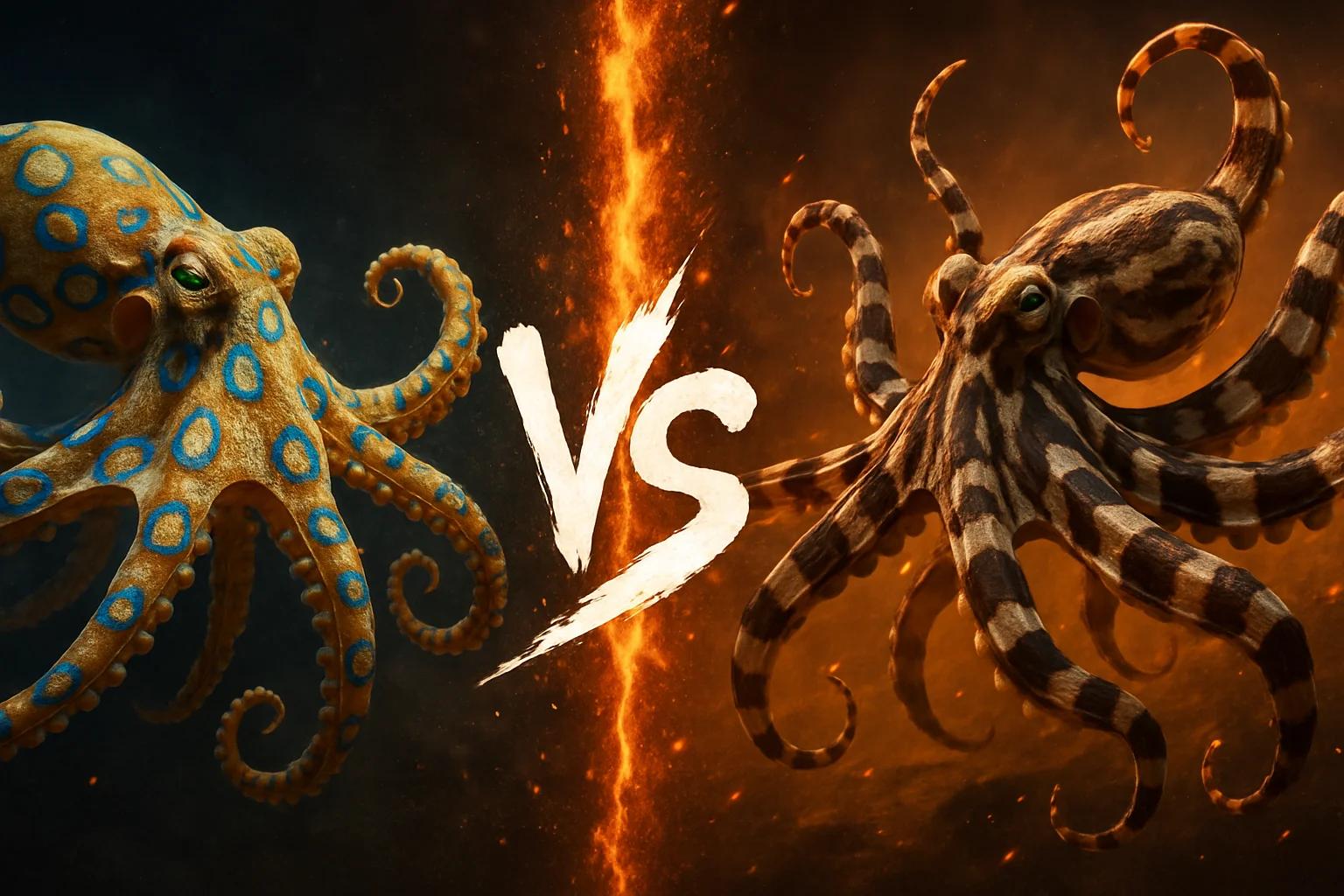
Blue-ringed Octopus vs Mimic Octopus: Who Actually Wins?
The blue-ringed octopus wins. The mimic octopus has every physical edge: a longer body, faster movement and one of the most sophisticated disguise repertoires in the ocean. Those edges matter for avoiding a fight, not for finishing one. Octopus-on-octopus combat is an arm-tangle that ends at the beak, and the blue-ringed octopus's bite delivers tetrodotoxin. That neurotoxin, produced by symbiotic bacteria in its salivary glands, blocks sodium channels and can paralyse animals far larger than a mimic. The mimic's tricks, such as impersonating lionfish, sea snakes and flatfish, are tuned to fool visual fish predators. They do little against a tiny, venom-armed cephalopod already in grappling range. If the mimic engages, a single bite likely decides it. The mimic's real win condition is refusing the fight on open sand.
Read comparison
Discussion
What do you think?
Share your reasoning with other readers. Be civil and stick to the animals.
Sign in to join the discussion.
Sign inNo comments yet. Start the conversation.