


Bombardier Beetle vs Devil's Flower Mantis: Who Actually Wins?
Bombardier beetle vs Devil's Flower Mantis: a biology-first look at how a boiling chemical cannon holds up against one of the largest, most specialized ambush mantises.
Bombardier Beetle vs Devil's Flower Mantis
Matchup winner
Bombardier Beetle
Quick verdict
Start with the direct answer, then use the structured comparison below to see what changes the outcome.
The Bombardier Beetle wins this matchup, though not by overpowering anything. The Devil's Flower Mantis is roughly three to four times longer, has spiked raptorial forelegs, and strikes with a visual ambush system built for catching flying insects. A win for the beetle therefore means it survives and the mantis lets go. Brachinus carries a two-chamber reactor in its abdomen. When it is grabbed, it mixes stored hydroquinones and hydrogen peroxide with enzymes and fires a pulsed spray of irritating benzoquinones at about 100°C. A rotating abdominal tip lets it aim that spray at whatever is holding it, including a mantis's forelegs and face. Raptorial capture only works if the predator can keep its grip and its focus, and a scalding chemical blast to the mouthparts at point-blank range breaks both. The mantis can win, but it needs a clean head-first grab that disables the beetle before the first pulse lands. The beetle's defense has more ways to work than the mantis's attack.
Read the full explanation
The Bombardier Beetle wins most realistic encounters by forcing the mantis to release it.
The Devil's Flower Mantis is much bigger, but its strike-and-hold method puts its face directly in the spray path.
The mantis's best chance is a precise head-first grab that disables the beetle instantly.
Neither animal hunts the other in the wild. This is a contest between a defensive system and an offensive one.
Reader vote
Who do you think wins?
Pick a side — no account needed. Results update live.
No votes yet — be the first to call it.
Editorial note
Why people disagree
Size bias: the mantis looks like a winged dragon beside a 1 cm beetle, so many readers assume a mismatch in the mantis's favor.
Explosive power
The beetle's burst is chemical and works even after it has been caught. The mantis's burst is mechanical and only matters if the grip holds.
Ambush control
The mantis decides when and whether contact happens, which is its main tactical edge.
Reach and frame
Reach lets the mantis strike first. Unfortunately for the mantis, striking first also puts it in the spray zone.
Read the full explanation +
Definition of winning: if winning means killing, the mantis comes out better. If it means walking away alive and making the attacker quit, the beetle usually wins.
Specialist diet: Idolomantis prefers flying insects such as flies and moths, so some argue it would simply ignore the beetle. The contest then hinges on whether the strike happens at all.
Comparison FAQ
Short, direct answers to the next questions readers usually ask after the headline verdict.
Would a Bombardier Beetle beat a Devil's Flower Mantis?+
Usually, yes, in the sense that matters for prey. The beetle's ~100°C benzoquinone spray typically forces a grabbing predator to let go. The mantis wins only with a precise, immediately disabling head-first grab.
Which is stronger, the Bombardier Beetle or the Devil's Flower Mantis?+
The mantis is far stronger and larger in raw physical terms. The beetle's strength is chemical: a reaction that releases enough heat to boil its spray, and it can fire that spray in rapid pulses.
Why does the Devil's Flower Mantis stay dangerous even though it loses?+
Its sit-and-wait ambush, long reach, and fast strike mean it chooses when contact happens. With clear sightlines and a perfect grab, it can disable the beetle before the beetle ever fires.
Does the Devil's Flower Mantis eat beetles in the wild?+
It mainly targets flying insects such as flies and moths. A chemically defended ground beetle is not typical prey, which is part of why the beetle holds the edge.
How hot is a bombardier beetle's spray?+
It reaches about 100°C, the boiling point of water. It is delivered in rapid pulses rather than as a single continuous stream.
Head-to-head species stats
These are the same core AnimalDex stat dimensions used on the dedicated animal pages, pulled side by side so the matchup is faster to scan.
Bombardier Beetle
Tier CDevil's Flower Mantis
Tier CTrait-by-trait comparison
Only the categories that matter to this matchup are included. The goal is not filler stats, but the real design differences that change the result.
Pulsed chemical spray at ~100°C
Explosive power
Bombardier Beetle
Fast raptorial foreleg strike
Explosive power
Bombardier Beetle
Ground forager with no ambush
Ambush control
Devil's Flower Mantis
Flower-mimic sit-and-wait specialist
Ambush control
Devil's Flower Mantis
About 1 cm, compact and armored
Reach and frame
Devil's Flower Mantis
About 10–13 cm, long spiked forelegs
Reach and frame
Devil's Flower Mantis
Hard elytra plus a reloadable chemical defense
Close-range durability
Bombardier Beetle
Delicate, elongated body built for display and mimicry
Close-range durability
Bombardier Beetle
Rotating abdominal tip aims the spray
Targeting precision
Devil's Flower Mantis
Binocular vision that judges strike distance
Targeting precision
Devil's Flower Mantis
Predators often release and learn to avoid it
Deterrence value
Bombardier Beetle
Threat display flashes warning colors
Deterrence value
Bombardier Beetle
How the verdict forms
Verdict timeline
01 · Explosive power
Bombardier Beetle
02 · Ambush control
Devil's Flower Mantis
03 · Reach and frame
Devil's Flower Mantis
04 · Close-range durability
Bombardier Beetle
05 · Targeting precision
Devil's Flower Mantis
06 · Deterrence value
Bombardier Beetle
Change the conditions
Scenario breakdown
This is where shallow battle content usually fails. Terrain, spacing, timing, and engagement style can change the answer.
Scenario lean
Bombardier Beetle
Verdict confidence
82%
The beetle stays low and sprays anything that grabs it.
In clutter, the mantis loses clean sightlines and has to strike at awkward angles. A partial grab is the worst outcome for the predator, because the beetle can swing its abdomen around and fire into the forelegs and mouthparts. Bombardier beetles can fire repeated pulses, so an imperfect hold almost always ends in a release.
AnimalDex field profiles
Explore these animals
Bombardier Beetle
Brachinus crepitans
Woodland edge, grassland, scrub, and moist ground cover.
Devil's Flower Mantis
Idolomantis diabolica
dry scrub, thorn bush, and flowering shrubland
Systems Intelligence & Hidden Purpose
See the animals behind this comparison as engineered biological systems: what each one is built to do, where it gains leverage, and why the matchup changes by scenario.
Specialized Hardware
Small dark body with contrasting colors, fast running beetle shape, and defensive tail-end chemical spray give the Bombardier Beetle a body plan tuned for its niche.
Systems Script
Bombardier Beetles operate in woodland edge, grassland, scrub, and moist ground cover. Their design helps them match food access, shelter, and timing inside that environment.
Strategic Insight
A fast smart response can protect a small system from a bigger threat.
Specialized Hardware
petal-like lobed body, pink-and-white camouflage, and sudden ambush grab give the Devil's Flower Mantis a body plan tuned for its niche.
Systems Script
Devil's Flower Mantiss operate through dry scrub, thorn bush, and flowering shrubland. Their design links movement, feeding, shelter, and timing into one workable survival system.
Strategic Insight
Harsh places reward efficiency, timing, and bodies that waste very little.
Final take
This matchup comes down to a beetle that turns its own body into a reactor against a mantis that turns its body into a flower. The Devil's Flower Mantis is the more impressive animal in nearly every visual way: it is bigger, longer, and more theatrical, and it is a specialist hunter. Its whole method, however, depends on holding prey close to its face.
Read the full explanation
The Bombardier Beetle is built for exactly that moment. It does not need to run, hide, or outsize anything. It only needs to be grabbed, and then it aims a hot chemical spray straight back at the attacker. That is why it takes the overall win: the mantis has to execute its strike perfectly, while the beetle has to land just one pulse.
Collect both animals in AnimalDex
Track the species behind this matchup, compare their real traits, and build the rivalry into your AnimalDex collection.
Related comparisons
Continue with nearby matchups to compare more real-world animal traits without dropping into junky who-wins filler.

Bombardier Beetle vs Grasshopper & Locust: Who Actually Wins?
The bombardier beetle wins a one-on-one encounter. It is a ground-hunting carabid predator with sharp mandibles and one of the most famous chemical defenses on Earth: a pulsed, boiling spray of benzoquinones near 100°C, aimed from a swiveling abdominal tip. A grasshopper or locust is larger and far more mobile, with a catapult jump and strong flight, but it has no weapons that can hurt a hard-shelled beetle. Its best options are kicking with spined hind legs, spitting brown regurgitant, and leaving. In a direct contest the beetle has the attack and the defense. The grasshopper's real edge is escape, and escaping is not the same as winning. Locust swarms are an ecological superpower, but that is an advantage at landscape scale, not in a duel.
Read comparison
Bombardier Beetle vs Tarantula Hawk Wasp: Who Actually Wins?
The Tarantula Hawk Wasp wins clearly. At up to roughly 5 cm long, Pepsis grossa outsizes the 7 to 10 mm Brachinus crepitans several times over. It also brings a tough exoskeleton, strong grasping legs, flight, and a paralytic sting built to subdue tarantulas many times its own mass. The bombardier beetle's famous defense is a pulsed, near-100°C jet of benzoquinone it can aim almost anywhere around its body. That spray stops ants, spiders, and frogs, and it can absolutely make the wasp flinch, retreat, or clean itself. But the spray is built to repel attackers, not to kill them. The wasp can take a hit, lift off, and choose whether to re-engage. The beetle cannot outrun, outfly, or out-armor something that big. In any exchange that lasts more than a second or two, size, mobility, and a weaponized sting decide it for the wasp.
Read comparison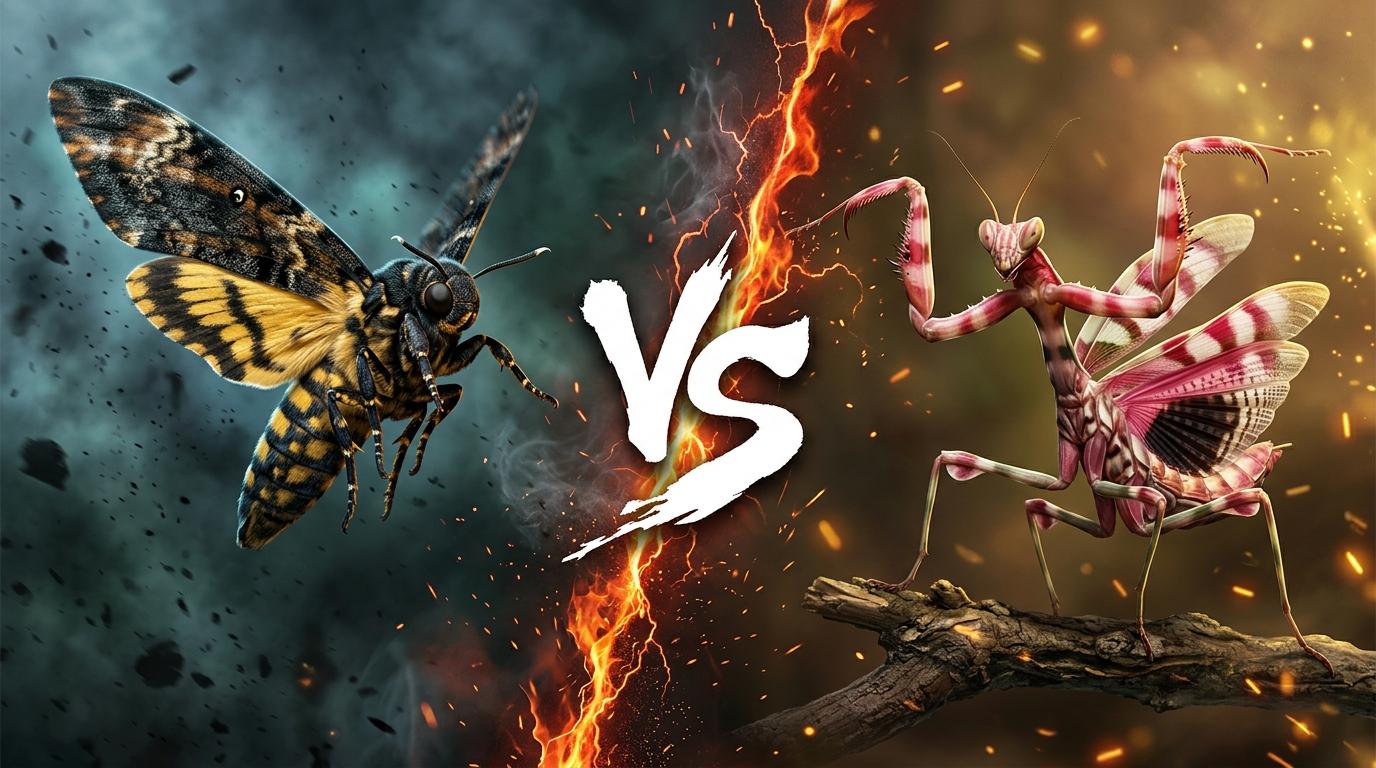
Death's-head Hawkmoth vs Devil's Flower Mantis: Who Actually Wins?
The Devil's Flower Mantis wins. It is a specialist predator built to catch flying insects. Its spined raptorial forelegs strike in a fraction of a second, its binocular vision judges distance precisely, and it hunts by sitting still until prey comes close. That is the exact setup in which a moth gets caught. The Death's-head Hawkmoth is one of the toughest moths alive. It has a heavy, scale-armored body, a thick cuticle that resists bee stings, a startling squeak, and fast, powerful flight. But it has no weapons at all. It feeds and fights by avoiding trouble, not by fighting back. If the moth stays airborne and keeps its distance, it simply leaves. Once it is within the mantis's strike range, its bulk and armor only slow the mantis down. They do not stop it. Mantids readily take large moths, and Idolomantis is big enough to handle one.
Read comparison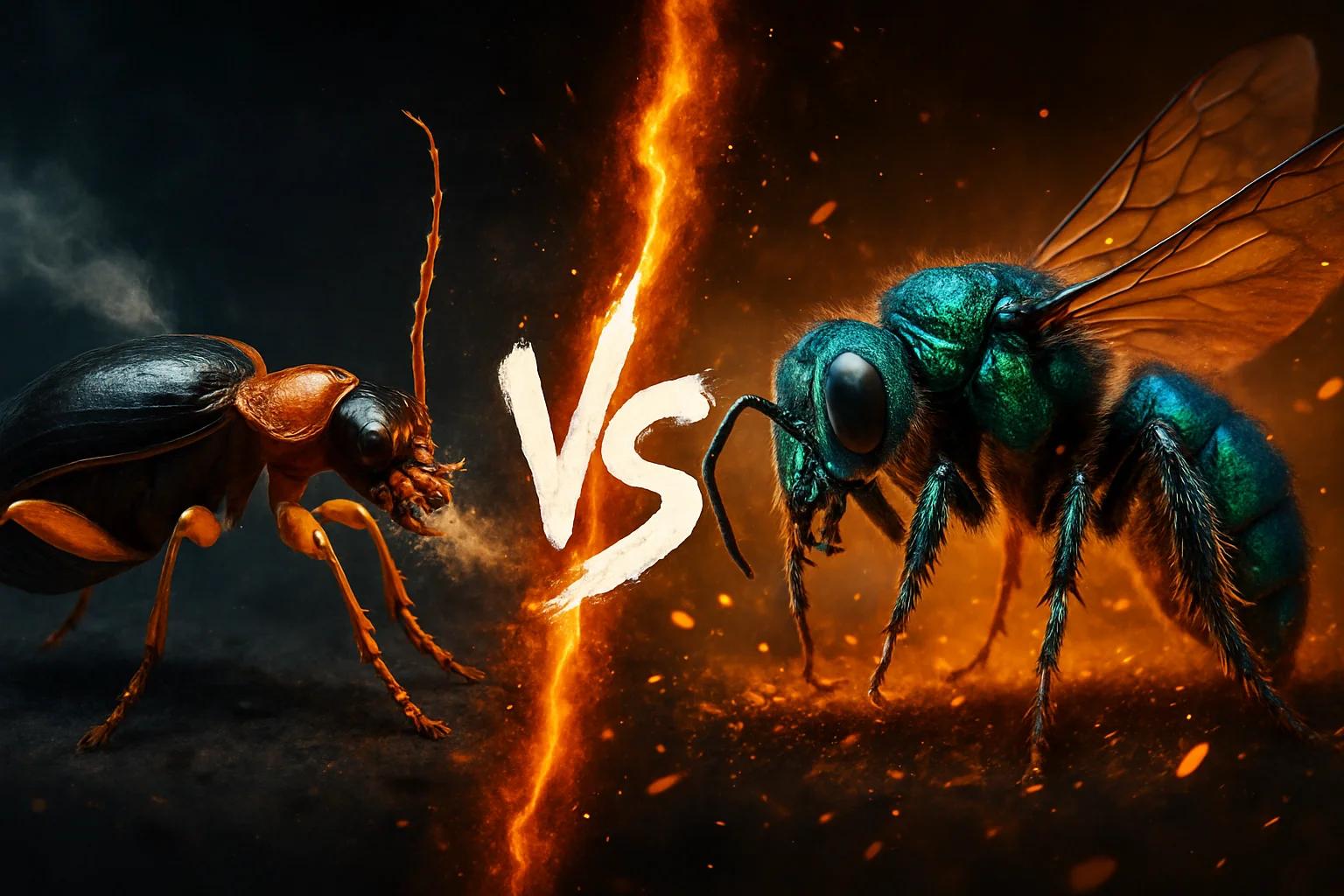
Bombardier Beetle vs Cuckoo Wasp: Who Actually Wins?
The Bombardier Beetle wins. Brachinus crepitans carries one of the most sophisticated defensive weapons in the insect world, a pulsed, aimable spray of benzoquinone-laced liquid that reaches about 100°C. The beetle can rotate its abdominal tip to hit an attacker almost anywhere around it. The Cuckoo Wasp (family Chrysididae) is a brilliant survivor, not a fighter. Its hard, deeply pitted metallic cuticle and its ability to curl into a tight armored ball are built to outlast angry host bees and wasps, not to kill. Most cuckoo wasps have a reduced, largely nonfunctional sting and no real way to hurt a beetle. In any forced encounter, the beetle controls the exchange and the wasp's best result is a fast exit. The wasp avoids defeat by fleeing, and that does not count as winning.
Read comparison
Discussion
What do you think?
Share your reasoning with other readers. Be civil and stick to the animals.
Sign in to join the discussion.
Sign inNo comments yet. Start the conversation.