

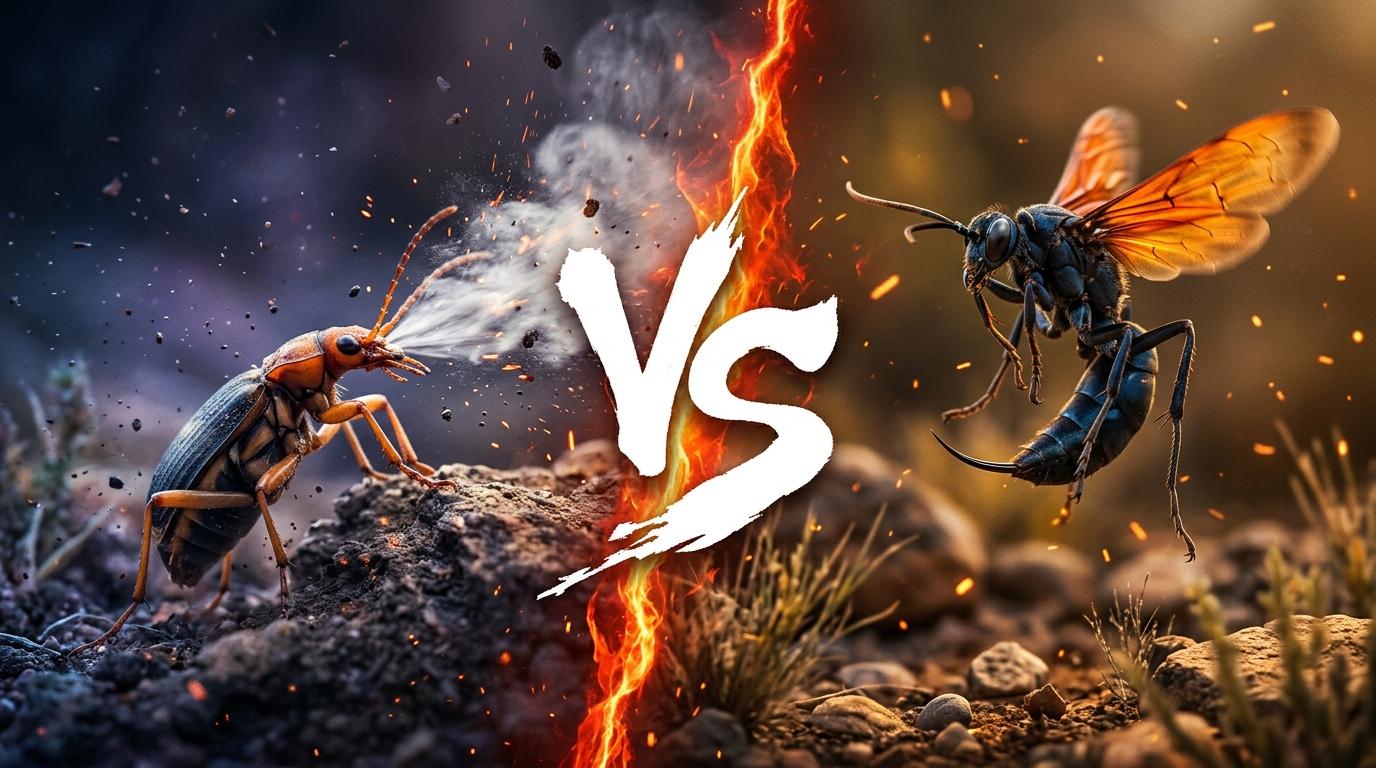
Bombardier Beetle vs Tarantula Hawk Wasp: Who Actually Wins?
Bombardier beetle vs tarantula hawk wasp: boiling chemical spray against one of the most painful stings known. See who wins, why, and how each insect's defenses really work.
Bombardier Beetle vs Tarantula Hawk Wasp
Matchup winner
Tarantula Hawk Wasp
Quick verdict
Start with the direct answer, then use the structured comparison below to see what changes the outcome.
The Tarantula Hawk Wasp wins clearly. At up to roughly 5 cm long, Pepsis grossa outsizes the 7 to 10 mm Brachinus crepitans several times over. It also brings a tough exoskeleton, strong grasping legs, flight, and a paralytic sting built to subdue tarantulas many times its own mass. The bombardier beetle's famous defense is a pulsed, near-100°C jet of benzoquinone it can aim almost anywhere around its body. That spray stops ants, spiders, and frogs, and it can absolutely make the wasp flinch, retreat, or clean itself. But the spray is built to repel attackers, not to kill them. The wasp can take a hit, lift off, and choose whether to re-engage. The beetle cannot outrun, outfly, or out-armor something that big. In any exchange that lasts more than a second or two, size, mobility, and a weaponized sting decide it for the wasp.
Read the full explanation
Winner: Tarantula Hawk Wasp. It is far bigger, better armored, airborne, and carries a paralytic sting.
The bombardier beetle's boiling chemical spray is a superb deterrent, but it repels attackers rather than disabling them.
The wasp can absorb a blast and fly away. The beetle has no follow-up once its defense is spent.
Ecology note: these species don't share a range (Europe vs the Americas) and don't naturally target each other, so this is a hypothetical matchup.
Reader vote
Who do you think wins?
Pick a side — no account needed. Results update live.
No votes yet — be the first to call it.
Editorial note
Why people disagree
The beetle's spray sounds unbeatable. 'Boiling chemical explosion' is dramatic, but against a large, armored, mobile opponent it buys time rather than victory.
Size and mass
Among insects, a several-fold size gap is decisive. The wasp can pin, grip, and overpower the beetle physically.
Chemical deterrence
This is the beetle's one elite tool. It reliably makes predators release or recoil, and it is the best case for an upset.
Offensive weapon
A weapon built to disable large prey beats a defense built to discourage it.
Read the full explanation +
The tarantula hawk doesn't hunt beetles. Its sting is aimed at spiders, and adults mostly drink nectar. Some argue it would simply leave, which is still a practical win.
Pain ratings get mistaken for killing power. The wasp's sting is legendarily painful to humans, but its real edge here is that it paralyzes, which works on insects as well as mammals.
Comparison FAQ
Short, direct answers to the next questions readers usually ask after the headline verdict.
Would a bombardier beetle beat a tarantula hawk wasp?+
No. The beetle might drive the wasp back briefly with its spray, but the much larger, armored, flying wasp with a paralytic sting would win any sustained encounter.
Which is stronger, the bombardier beetle or the tarantula hawk?+
The tarantula hawk, by a wide margin. It can drag a paralyzed tarantula many times its own weight. The beetle's strength lies in chemistry, not muscle.
How hot is the bombardier beetle's spray?+
It reaches close to 100°C. The beetle mixes stored chemicals with enzymes in a reinforced chamber, producing rapid pulses of hot, irritating benzoquinone.
Why is the bombardier beetle still dangerous even though it loses?+
Its spray is aimable and hot, and it can be fired several times in a row. It reliably makes ants, spiders, and frogs release it, and it can sting the wasp's sensitive face and mouthparts. Losing the fight doesn't mean it's an easy meal.
Does the tarantula hawk wasp eat beetles?+
No. Adults feed on nectar, and females hunt tarantulas to feed their larvae. A fight with a bombardier beetle would be defensive or accidental, not predatory.
Do these two insects live in the same place?+
No. Brachinus crepitans lives in Europe, and Pepsis grossa lives in the Americas. This is a hypothetical matchup.
Head-to-head species stats
These are the same core AnimalDex stat dimensions used on the dedicated animal pages, pulled side by side so the matchup is faster to scan.
Bombardier Beetle
Tier CTarantula Hawk Wasp
Tier DTrait-by-trait comparison
Only the categories that matter to this matchup are included. The goal is not filler stats, but the real design differences that change the result.
About 7 to 10 mm, a few dozen milligrams
Size and mass
Tarantula Hawk Wasp
Up to about 5 cm, large-bodied hunter
Size and mass
Tarantula Hawk Wasp
Pulsed, aimable jet of near-boiling benzoquinone
Chemical deterrence
Bombardier Beetle
No spray; relies on warning colors and its sting
Chemical deterrence
Bombardier Beetle
None designed for killing; jaws used for scavenging and small prey
Offensive weapon
Tarantula Hawk Wasp
Long stinger delivering paralytic venom
Offensive weapon
Tarantula Hawk Wasp
Quick runner; flight is limited or absent in many Brachinus
Mobility and escape
Tarantula Hawk Wasp
Strong flier and fast ground runner
Mobility and escape
Tarantula Hawk Wasp
Hard elytra, but small body mass
Close-range durability
Tarantula Hawk Wasp
Thick cuticle; few natural predators
Close-range durability
Tarantula Hawk Wasp
Single reflexive defense, repeated in bursts
Tactical flexibility
Tarantula Hawk Wasp
Search, grapple, sting, and drag behaviors
Tactical flexibility
Tarantula Hawk Wasp
How the verdict forms
Verdict timeline
01 · Size and mass
Tarantula Hawk Wasp
02 · Chemical deterrence
Bombardier Beetle
03 · Offensive weapon
Tarantula Hawk Wasp
04 · Mobility and escape
Tarantula Hawk Wasp
05 · Close-range durability
Tarantula Hawk Wasp
06 · Tactical flexibility
Tarantula Hawk Wasp
Change the conditions
Scenario breakdown
This is where shallow battle content usually fails. Terrain, spacing, timing, and engagement style can change the answer.
Scenario lean
Tarantula Hawk Wasp
Verdict confidence
82%
The wasp wins, though the beetle's best odds are here.
Clutter limits the wasp's flight and gives the beetle crevices to wedge into while it fires its spray. A cornered beetle could drive the wasp off once or twice. Still, tarantula hawks routinely search burrows and crevices for spiders. Their long legs and grip let them pull a small beetle into the open. Cover delays the outcome rather than flipping it.
AnimalDex field profiles
Explore these animals
Bombardier Beetle
Brachinus crepitans
Woodland edge, grassland, scrub, and moist ground cover.
Tarantula Hawk Wasp
Pepsis grossa
Desert scrub, dry woodland, and warm open country.
Systems Intelligence & Hidden Purpose
See the animals behind this comparison as engineered biological systems: what each one is built to do, where it gains leverage, and why the matchup changes by scenario.
Specialized Hardware
Small dark body with contrasting colors, fast running beetle shape, and defensive tail-end chemical spray give the Bombardier Beetle a body plan tuned for its niche.
Systems Script
Bombardier Beetles operate in woodland edge, grassland, scrub, and moist ground cover. Their design helps them match food access, shelter, and timing inside that environment.
Strategic Insight
A fast smart response can protect a small system from a bigger threat.
Specialized Hardware
Large dark body with bright wings, long dangling legs in flight, and wasp waist and curved antennae give the Tarantula Hawk Wasp a body plan tuned for its niche.
Systems Script
Tarantula Hawk Wasps operate in desert scrub, dry woodland, and warm open country. Their design helps them match food access, shelter, and timing inside that environment.
Strategic Insight
Extreme specialization can solve a problem that looks too dangerous for a generalist.
Final take
The Tarantula Hawk Wasp is the clear winner. It is one of the most formidable solitary insects in the Americas, built from head to stinger to defeat spiders far heavier than a bombardier beetle. Its size, armor, flight, and paralytic venom stack together, and the beetle has nothing that matches that combination.
Read the full explanation
The bombardier beetle loses with dignity. Its heated, pulsed chemical jet is among the most sophisticated defenses in the animal kingdom, and it wins the opening moment more often than you'd expect. But a defense that makes attackers let go only works if they can't simply shrug it off and try again. The wasp can.
Collect both animals in AnimalDex
Track the species behind this matchup, compare their real traits, and build the rivalry into your AnimalDex collection.
Related comparisons
Continue with nearby matchups to compare more real-world animal traits without dropping into junky who-wins filler.
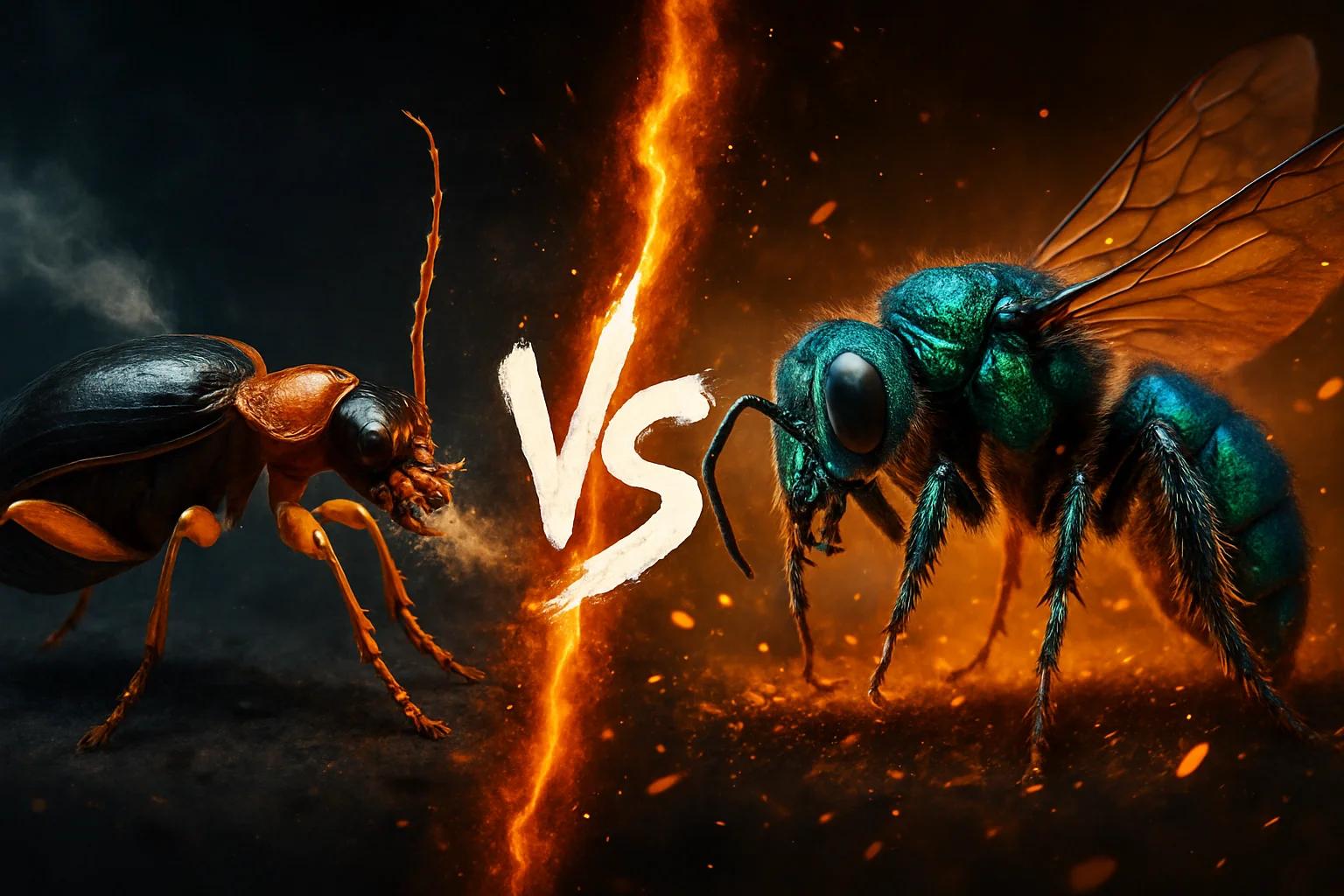
Bombardier Beetle vs Cuckoo Wasp: Who Actually Wins?
The Bombardier Beetle wins. Brachinus crepitans carries one of the most sophisticated defensive weapons in the insect world, a pulsed, aimable spray of benzoquinone-laced liquid that reaches about 100°C. The beetle can rotate its abdominal tip to hit an attacker almost anywhere around it. The Cuckoo Wasp (family Chrysididae) is a brilliant survivor, not a fighter. Its hard, deeply pitted metallic cuticle and its ability to curl into a tight armored ball are built to outlast angry host bees and wasps, not to kill. Most cuckoo wasps have a reduced, largely nonfunctional sting and no real way to hurt a beetle. In any forced encounter, the beetle controls the exchange and the wasp's best result is a fast exit. The wasp avoids defeat by fleeing, and that does not count as winning.
Read comparison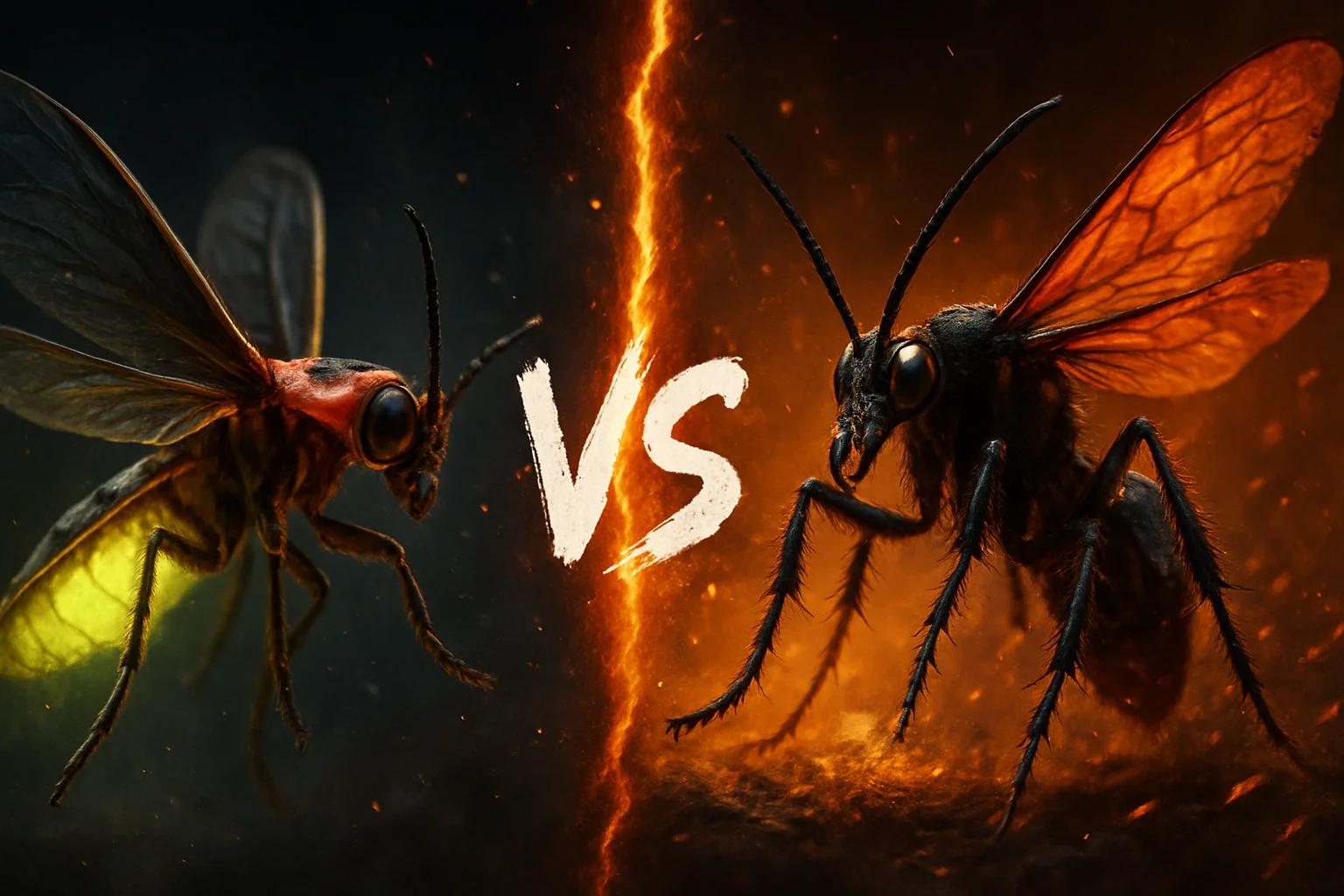
Firefly vs Tarantula Hawk Wasp: Who Actually Wins?
The tarantula hawk wasp wins, and it isn't close. Pepsis grossa can reach about 5 cm with a long, flexible stinger and some of the most painful venom known in insects. It flies fast and has spiny, grappling legs built to pin and paralyze tarantulas many times its own mass. A firefly is a soft-bodied beetle around 1–2 cm long with weak jaws as an adult, and many adults barely feed at all. Its real weapon is chemical. Many fireflies carry bitter, toxic lucibufagins, and their glow is partly a warning that they taste bad. That defense works against birds, lizards and spiders that bite and swallow. It does almost nothing against a wasp that has no reason to eat the firefly and can simply overpower it. The firefly's best outcome is to avoid the fight entirely, and that is not the same as winning it.
Read comparison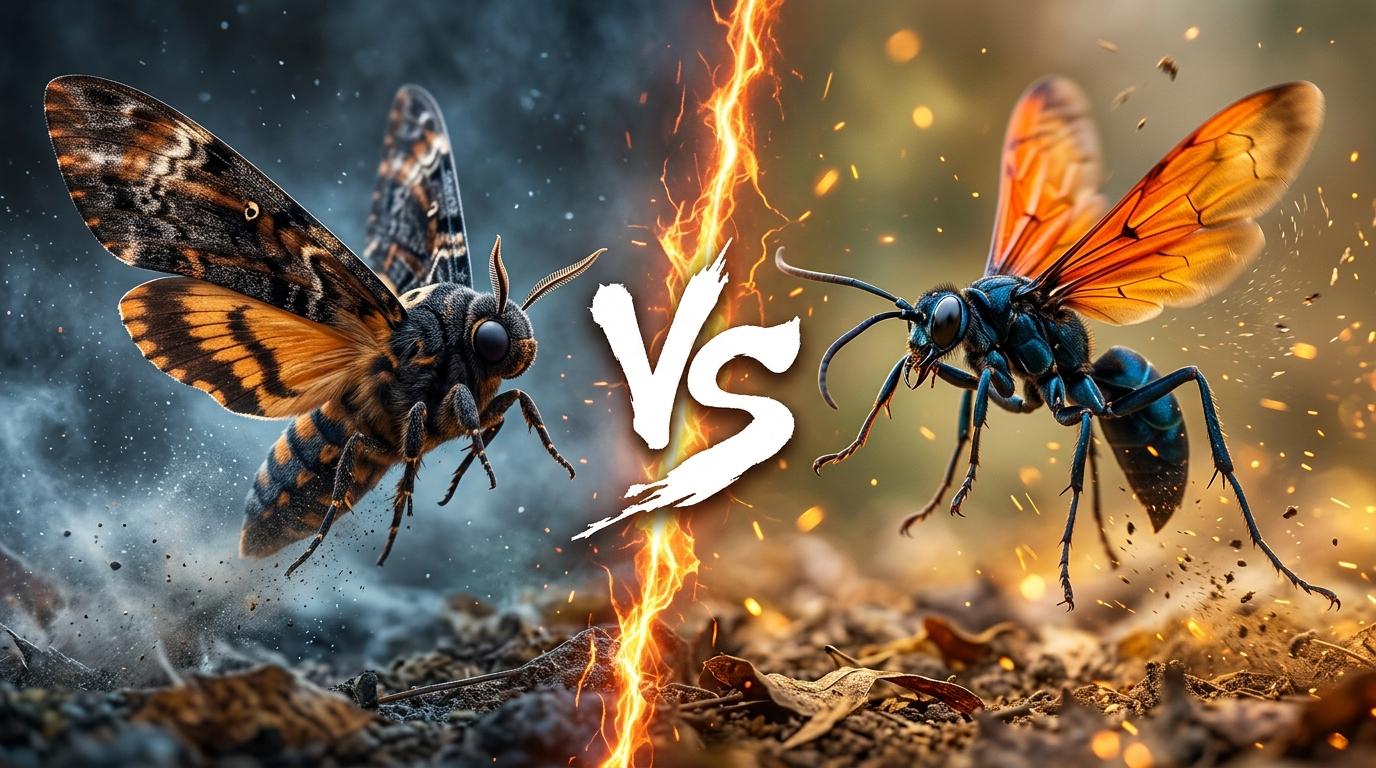
Death's-head Hawkmoth vs Tarantula Hawk Wasp: Who Actually Wins?
The Tarantula Hawk Wasp wins, and it isn't especially close in a forced fight. Pepsis grossa is a dedicated predator-grade insect. It carries a long sting, reportedly among the most painful insect stings known, along with strong mandibles, a hard warning-colored exoskeleton, and a hunting routine built around subduing tarantulas that outweigh it many times over. The Death's-head Hawkmoth is a remarkable animal, with a big body, powerful flight, a bee-scent disguise, and a squeak that startles attackers, but its entire kit is built for raiding, deceiving, and escaping rather than fighting. It has no sting and no real biting weapon, and its stout proboscis is a feeding tool. If the two lock up, the wasp's weapons decide it. The moth's best result is never letting the fight start.
Read comparison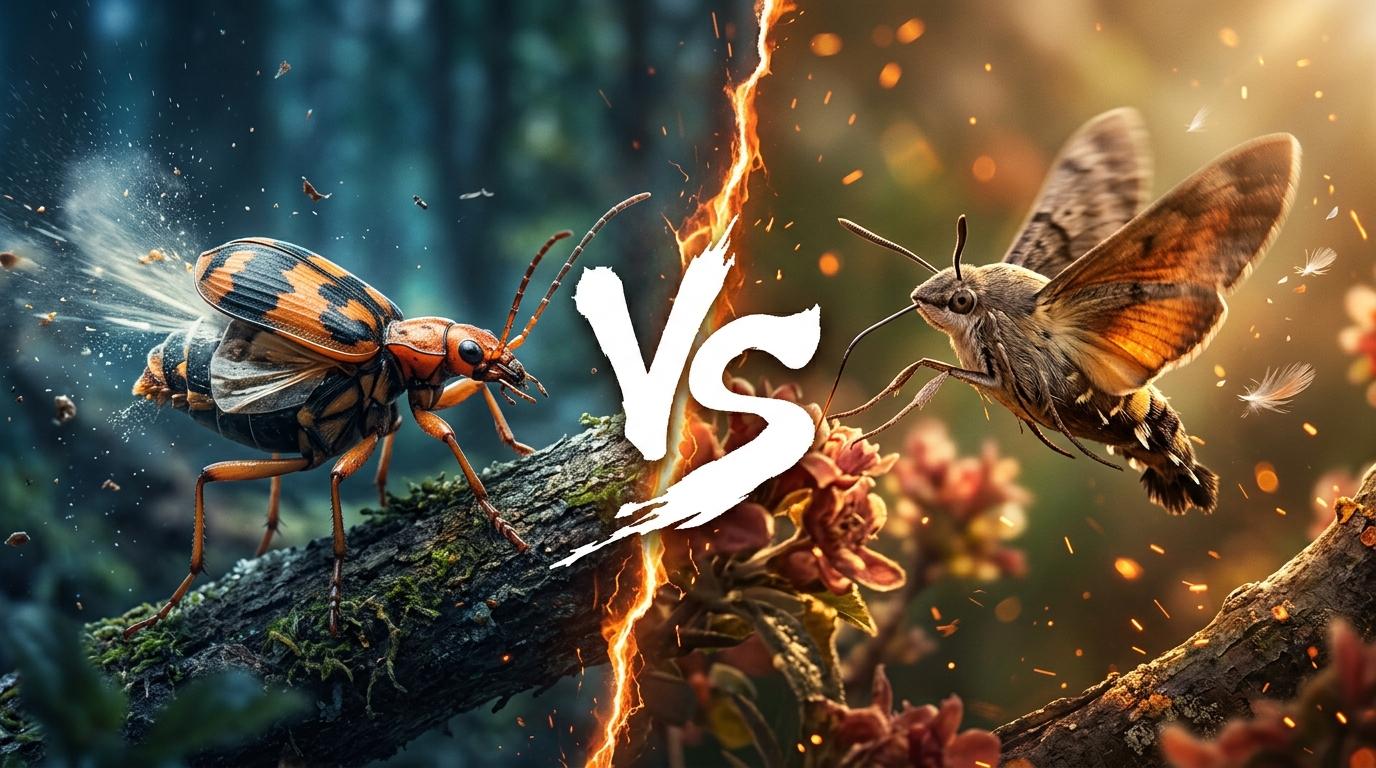
Bombardier Beetle vs Hummingbird Hawk-Moth: Who Actually Wins?
The Bombardier Beetle wins any encounter that turns into actual contact. It is a predatory ground beetle with biting mandibles, an armored body, and a built-in reaction chamber that mixes hydroquinones and hydrogen peroxide into a boiling, pulsed spray near 100°C that it can aim almost anywhere around its body. The Hummingbird Hawk-Moth is faster, more agile, and far better at staying out of trouble, but it is a soft-bodied nectar feeder with no weapons, built to sip, hover, and flee. The moth's only path to a result is never engaging, and that is escape, not victory. Once the two meet at close range, the beetle's armor, jaws, and chemical defense decide it. The moth rarely loses its life to this beetle in nature, because it simply leaves.
Read comparison
Discussion
What do you think?
Share your reasoning with other readers. Be civil and stick to the animals.
Sign in to join the discussion.
Sign inNo comments yet. Start the conversation.