


Boomslang vs Monkey-tailed Skink: Who Actually Wins?
Boomslang vs monkey-tailed skink: a biology-first look at venom, armor, bite force and tree-canopy tactics to decide who would win.
Boomslang vs Monkey-tailed Skink
Matchup winner
Boomslang
Quick verdict
Start with the direct answer, then use the structured comparison below to see what changes the outcome.
The boomslang wins. This is an encounter between a specialist arboreal predator and a heavy-bodied, plant-eating canopy lizard. The boomslang (Dispholidus typus) carries a potent hemotoxic venom that disrupts blood clotting. It has huge eyes tuned for spotting movement among branches and a fast, precise strike. The monkey-tailed skink (Corucia zebrata) is a slow, prehensile-tailed herbivore from the Solomon Islands. It defends itself with a strong bite, hissing and stubborn grip, not with speed. The skink's bulk and bite make it a risky target at very close range. But the snake decides when and where contact happens, and a single successful envenomation tilts the outcome decisively over the following hours. Note that a large adult skink, at roughly 70–80 cm, is too bulky for a boomslang to swallow, and these two species never meet in the wild. In a hypothetical clash, though, the venom-delivery system beats a defensive toolkit built for deterring birds and mammals.
Read the full explanation
Boomslang wins most scenarios thanks to hemotoxic venom and superior strike speed.
The skink's real weapon is a powerful, clamping bite. It is dangerous only if the snake gets careless at close range.
Venom acts slowly but surely, so the snake can strike and withdraw rather than wrestle.
They live on different continents (Africa vs Solomon Islands), so this is purely hypothetical.
Reader vote
Who do you think wins?
Pick a side — no account needed. Results update live.
No votes yet — be the first to call it.
Editorial note
Why people disagree
Size intuition: the skink is chunkier and heavier, so some readers assume bulk beats a slender snake. Venom makes mass far less relevant.
Lethal payload
One delivered bite can end the contest without prolonged grappling.
Strike speed
The snake controls range and can hit before the skink can respond.
Close-range durability
The skink can absorb pressure and punish grappling.
Read the full explanation +
Delayed venom: boomslang venom works slowly, so a skink could keep fighting for a while after the bite. That creates a short window where the 'loser' still looks like the winner.
Prey vs fight: a boomslang may not pursue an adult skink at all, since it can't swallow it. That has people arguing whether a real 'fight' would ever happen.
Comparison FAQ
Short, direct answers to the next questions readers usually ask after the headline verdict.
Would a boomslang beat a monkey-tailed skink?+
Yes, in most hypothetical encounters. Its hemotoxic venom and fast strike outclass the skink's slow, bite-based defense.
Which is stronger, the boomslang or monkey-tailed skink?+
The skink is physically stronger and bulkier, with a harder bite. The boomslang is far more dangerous because of its venom.
Can a boomslang eat a monkey-tailed skink?+
An adult skink is probably too large to swallow. A juvenile skink would be realistic prey.
Why is the monkey-tailed skink still dangerous in this fight?+
Its strong crushing bite and anchored grip can injure a snake that comes too close, especially in confined spaces.
Do they live in the same place?+
No. Boomslangs live in sub-Saharan Africa, while monkey-tailed skinks are endemic to the Solomon Islands.
Head-to-head species stats
These are the same core AnimalDex stat dimensions used on the dedicated animal pages, pulled side by side so the matchup is faster to scan.
Boomslang
Tier BMonkey-tailed Skink
Tier CTrait-by-trait comparison
Only the categories that matter to this matchup are included. The goal is not filler stats, but the real design differences that change the result.
Potent hemotoxic venom
Lethal payload
Boomslang
No venom
Lethal payload
Boomslang
Fast, accurate lunges
Strike speed
Boomslang
Slow, deliberate movement
Strike speed
Boomslang
Slender, lightly built
Close-range durability
Monkey-tailed Skink
Stocky body, tough scales
Close-range durability
Monkey-tailed Skink
Light grip, rear fangs
Bite clamp
Monkey-tailed Skink
Strong crushing bite
Bite clamp
Monkey-tailed Skink
Huge eyes, keen motion detection
Canopy vision
Boomslang
Adequate, mostly nocturnal forager
Canopy vision
Boomslang
Agile branch travel
Arboreal grip
Monkey-tailed Skink
Prehensile tail anchor
Arboreal grip
Monkey-tailed Skink
How the verdict forms
Verdict timeline
01 · Lethal payload
Boomslang
02 · Strike speed
Boomslang
03 · Close-range durability
Monkey-tailed Skink
04 · Bite clamp
Monkey-tailed Skink
05 · Canopy vision
Boomslang
06 · Arboreal grip
Monkey-tailed Skink
Change the conditions
Scenario breakdown
This is where shallow battle content usually fails. Terrain, spacing, timing, and engagement style can change the answer.
Scenario lean
Boomslang
Verdict confidence
82%
Boomslang strikes from concealment.
Among leaves, the boomslang's camouflage and motion-tuned eyes let it pick the moment of contact. It strikes and disengages, leaving the venom to work while the skink clings in place.
AnimalDex field profiles
Explore these animals
Boomslang
Dispholidus typus
savannah woodland, forest edge, and shrub canopy
Monkey-tailed Skink
Corucia zebrata
rainforest canopy, mangrove edge, and island woodland
Systems Intelligence & Hidden Purpose
See the animals behind this comparison as engineered biological systems: what each one is built to do, where it gains leverage, and why the matchup changes by scenario.
Specialized Hardware
enormous emerald eyes, slender branch body, and front-fanged arboreal strike give the Boomslang a body plan tuned for its niche.
Systems Script
Boomslangs operate through savannah woodland, forest edge, and shrub canopy. Their design links movement, feeding, shelter, and timing into one workable survival system.
Strategic Insight
Dense environments reward precision, patience, and the ability to read layered cover.
Specialized Hardware
prehensile tail grip, heavy olive scales, and slow canopy leaf browsing give the Monkey-tailed Skink a body plan tuned for its niche.
Systems Script
Monkey-tailed Skinks operate through rainforest canopy, mangrove edge, and island woodland. Their design links movement, feeding, shelter, and timing into one workable survival system.
Strategic Insight
Dense environments reward precision, patience, and the ability to read layered cover.
Final take
The boomslang takes this matchup because it fights on its own terms. It sees first, strikes first and lets venom do the work.
Read the full explanation
The monkey-tailed skink is no pushover. Its bulk, prehensile tail and strong bite make it costly to grapple, and it can win a defensive standoff in tight cover. In the open canopy, though, slow defense loses to precise chemical offense.
Collect both animals in AnimalDex
Track the species behind this matchup, compare their real traits, and build the rivalry into your AnimalDex collection.
Related comparisons
Continue with nearby matchups to compare more real-world animal traits without dropping into junky who-wins filler.
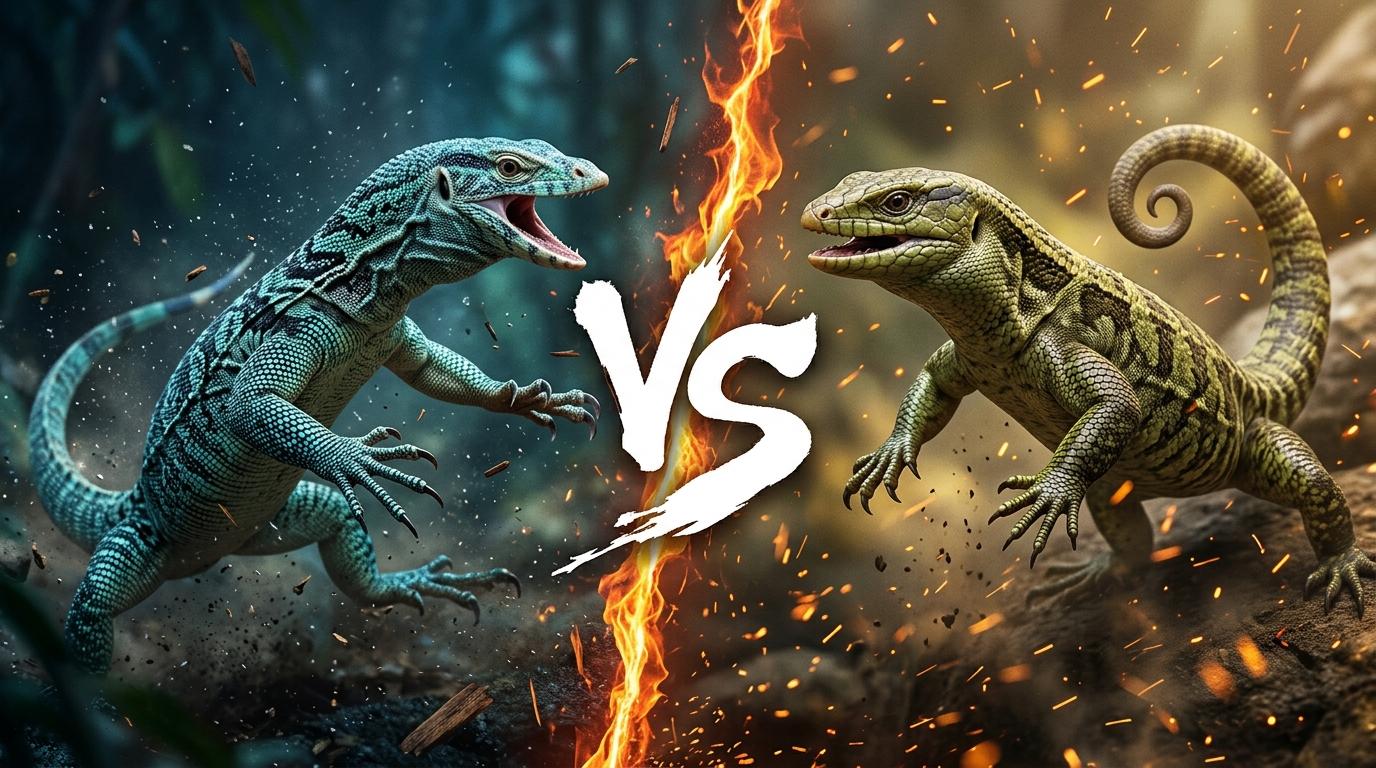
Blue Tree Monitor vs Monkey-tailed Skink: Who Actually Wins?
The Blue Tree Monitor wins this matchup. Varanus macraei is a slender, fast, actively foraging predator from Batanta Island. It has recurved serrated teeth, needle-sharp climbing claws, a prehensile tail and the high-energy metabolism typical of monitors. The Monkey-tailed Skink (Corucia zebrata) of the Solomon Islands is bulkier and can be similar in overall length. But it is a slow, almost entirely herbivorous leaf-eater, built for patience and grip rather than offense. The skink's real weapons are a hard, crushing bite, tough scales and an ability to clamp onto a branch and refuse to move. Those weapons make it costly to fight, but not hard to outmaneuver. In most realistic contexts, the monitor's speed, reach, tooth design and predatory decision-making give it control of the encounter, while the skink's best outcome is a stubborn stalemate that ends with the monitor walking away.
Read comparison
Gaboon Viper vs Monkey-tailed Skink: Who Actually Wins?
The Gaboon viper wins, and it is not especially close. The heaviest viper in Africa carries fangs up to about 5 cm long, the longest of any snake. It also has one of the largest venom yields of any snake and a strike that lands before most animals register movement. The monkey-tailed skink, or prehensile-tailed skink, is a large, slow, plant-eating lizard from the Solomon Islands. It is built for climbing and chewing leaves, not for fighting predators. It has a strong bite, tough scales and a fierce defensive temperament, but none of that answers a deep venom injection from an ambush specialist that sits still until the moment it strikes. In nearly every realistic setting, one well-placed viper bite decides the encounter.
Read comparison
Boomslang vs Gaboon Viper: Who Actually Wins?
The Gaboon viper wins this matchup, and it is not especially close. When two venomous snakes fight, the one that delivers venom fastest, deepest and in the greatest volume usually decides the outcome, and the Gaboon viper is built for exactly that. It is a heavy, thick-bodied ambush predator that can weigh several times as much as a boomslang. Its hinged front fangs, among the longest of any snake at roughly 5 cm, fold out and inject a very large dose of tissue-destroying, blood-disrupting venom in a single strike. The boomslang's venom is extremely potent drop for drop, but the snake is rear-fanged. It has to hold on and work its grooved back fangs into tissue, its venom yield is small, and its hemotoxin acts slowly, over hours rather than seconds. The boomslang is faster, sharper-eyed and far more agile, so its real winning move is to avoid the fight, especially in trees. If the two are forced into contact on the ground, the viper's mass, fang length and venom dose make it the clear favorite.
Read comparison
Discussion
What do you think?
Share your reasoning with other readers. Be civil and stick to the animals.
Sign in to join the discussion.
Sign inNo comments yet. Start the conversation.