

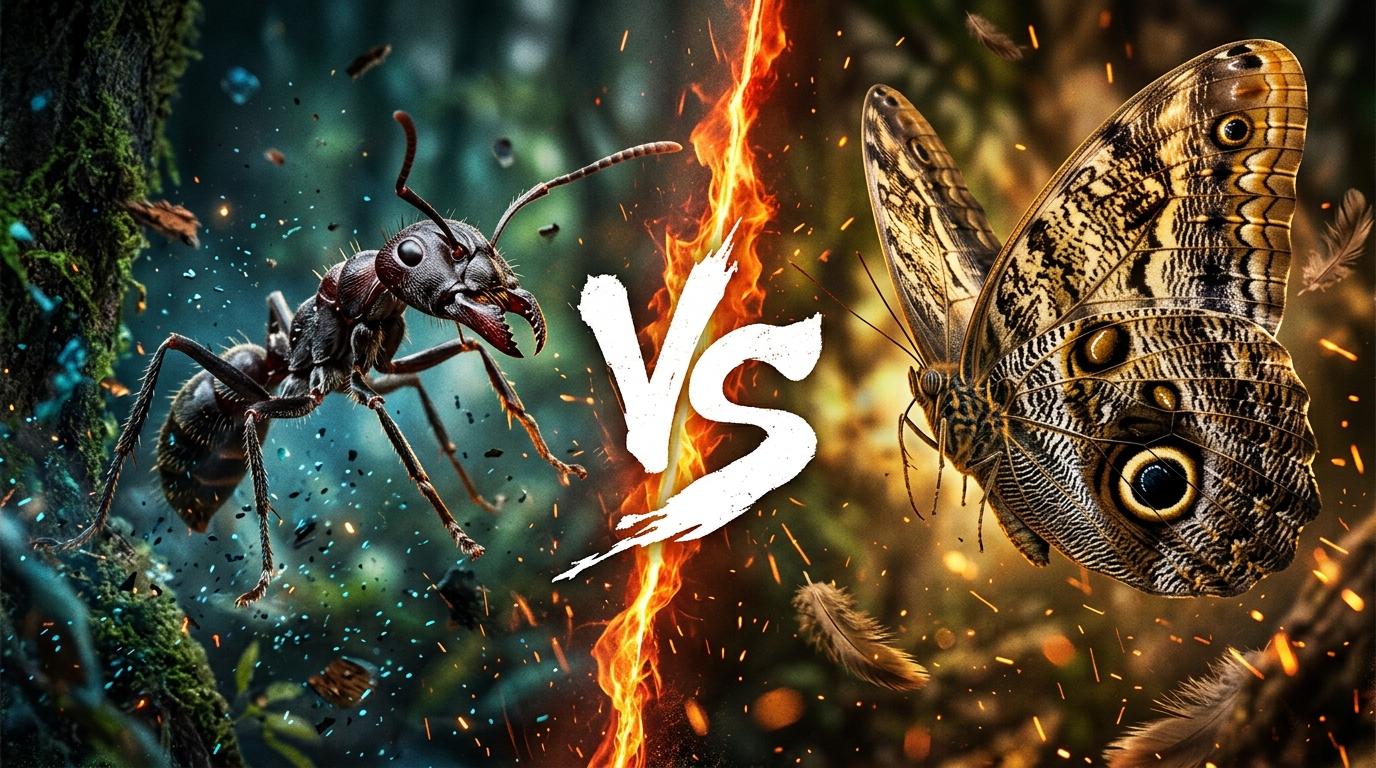
Bullet Ant vs Owl Butterfly: Who Actually Wins?
Bullet ant vs owl butterfly: who would win? A biology-first breakdown of venom, mandibles, eyespot bluffing, flight escape and why the ant takes this matchup.
Bullet Ant vs Owl Butterfly
Matchup winner
Bullet Ant
Quick verdict
Start with the direct answer, then use the structured comparison below to see what changes the outcome.
The bullet ant wins clearly. Paraponera clavata is a heavily armored, roughly 2.5 cm ground and canopy forager. It has gripping mandibles and a stinger that delivers poneratoxin, one of the most painful insect venoms known. The owl butterfly (Caligo memnon) is far larger in wingspan, but it has no weapons at all. Its survival kit is built for vertebrate predators: big owl-like eyespots, cryptic underwings, crepuscular habits and a fast, erratic escape flight. Eyespots mean nothing to an ant that hunts by touch and chemistry. If the two make contact, the ant can grip, bite and sting a soft-bodied butterfly or its caterpillar. The butterfly's only real 'win condition' is to avoid contact entirely by flying away. That makes it a survivor, not a victor.
Read the full explanation
Bullet ant wins: armor, mandibles and a powerful sting versus no weapons at all.
The owl butterfly's eyespots are a bluff aimed at birds and lizards, not ants.
The butterfly's best outcome is escape, which counts as survival rather than a win.
Owl butterfly caterpillars and resting adults on low vegetation are realistic ant targets.
Reader vote
Who do you think wins?
Pick a side — no account needed. Results update live.
No votes yet — be the first to call it.
Editorial note
Why people disagree
Size illusion: the butterfly's 13+ cm wingspan looks dominant, but wings are surface area, not muscle or armor.
Offensive weaponry
Only one side can actually injure the other, which decides almost every contact scenario.
Close-range durability
Torn wings ground a butterfly permanently, while the ant shrugs off flailing contact.
Escape mobility
Flight is the butterfly's one genuine edge. It can leave before the ant ever closes in.
Read the full explanation +
Escape vs victory: some argue flight 'beats' the ant. Avoiding a fight is survival, not winning one.
Pain vs lethality: the bullet ant's sting is legendary for pain in humans, but against insects its edge is grip plus venom, not fame.
Comparison FAQ
Short, direct answers to the next questions readers usually ask after the headline verdict.
Would a bullet ant beat an owl butterfly?+
Yes. In any contact scenario the bullet ant wins with its mandibles and venomous sting. The butterfly only 'wins' by flying away before contact.
Which is stronger, a bullet ant or an owl butterfly?+
The bullet ant. It is armored, muscular for its size and armed, while the owl butterfly's large wings are light structures built for flight and display, not force.
Can the owl butterfly's eyespots scare a bullet ant?+
Almost certainly not. Eyespots target vertebrate vision, and ants rely heavily on smell, touch and vibration.
Why is the owl butterfly still hard to catch?+
Its camouflage, dusk activity and fast, erratic flight make it hard to find and reach. Many predators simply never get the chance to make contact.
How painful is a bullet ant sting?+
It ranks at the top of the Schmidt sting pain index. People describe waves of burning pain lasting hours, caused by the neurotoxic peptide poneratoxin.
Head-to-head species stats
These are the same core AnimalDex stat dimensions used on the dedicated animal pages, pulled side by side so the matchup is faster to scan.
Bullet Ant
Tier COwl Butterfly
Tier BTrait-by-trait comparison
Only the categories that matter to this matchup are included. The goal is not filler stats, but the real design differences that change the result.
Mandibles plus poneratoxin sting
Offensive weaponry
Bullet Ant
None; proboscis for sipping fermenting fruit
Offensive weaponry
Bullet Ant
Thick chitinous exoskeleton
Close-range durability
Bullet Ant
Fragile scaled wings, soft abdomen
Close-range durability
Bullet Ant
Fast climber, flightless worker
Escape mobility
Owl Butterfly
Erratic, quick flight at dusk
Escape mobility
Owl Butterfly
Warning stridulation, chemical alarm
Deception and bluff
Owl Butterfly
Owl eyespots, bark-like camouflage
Deception and bluff
Owl Butterfly
Antennal chemoreception, vibration sense
Sensory targeting
Bullet Ant
Vision tuned for low light
Sensory targeting
Bullet Ant
Colony of hundreds, recruitment possible
Backup and numbers
Bullet Ant
Solitary or loose feeding groups
Backup and numbers
Bullet Ant
How the verdict forms
Verdict timeline
01 · Offensive weaponry
Bullet Ant
02 · Close-range durability
Bullet Ant
03 · Escape mobility
Owl Butterfly
04 · Deception and bluff
Owl Butterfly
05 · Sensory targeting
Bullet Ant
06 · Backup and numbers
Bullet Ant
Change the conditions
Scenario breakdown
This is where shallow battle content usually fails. Terrain, spacing, timing, and engagement style can change the answer.
Scenario lean
Bullet Ant
Verdict confidence
82%
Ant wins if the butterfly is resting within reach.
Owl butterflies rest on trunks and understory leaves by day, relying on camouflage. Bullet ants patrol exactly these surfaces. Camouflage defeats visual hunters, but an ant that bumps into a resting butterfly can seize a leg or wing base with its mandibles and sting. A grounded butterfly has no counterattack.
AnimalDex field profiles
Explore these animals
Bullet Ant
Paraponera clavata
rainforest floor, tree base, and humid woodland
Owl Butterfly
Caligo memnon
rainforest edge, orchard, and humid woodland
Systems Intelligence & Hidden Purpose
See the animals behind this comparison as engineered biological systems: what each one is built to do, where it gains leverage, and why the matchup changes by scenario.
Specialized Hardware
massive black ant body, tree-root colony life, and famously painful sting give the Bullet Ant a body plan tuned for its niche.
Systems Script
Bullet Ants operate through rainforest floor, tree base, and humid woodland. Their design links movement, feeding, shelter, and timing into one workable survival system.
Strategic Insight
Dense environments reward precision, patience, and the ability to read layered cover.
Specialized Hardware
giant eye-spot wings, dusky twilight flight, and broad leaf-like brown wings give the Owl Butterfly a body plan tuned for its niche.
Systems Script
Owl Butterflys operate through rainforest edge, orchard, and humid woodland. Their design links movement, feeding, shelter, and timing into one workable survival system.
Strategic Insight
Dense environments reward precision, patience, and the ability to read layered cover.
Final take
This is a mismatch of strategies. The bullet ant is built to grip, sting and dominate at contact. The owl butterfly is built never to be touched. Since a battle requires contact, the ant wins decisively.
Read the full explanation
The butterfly deserves credit as an elite bluffer. Its eyespots and flight are finely tuned against birds, lizards and frogs, its true predators. Against a chemically guided, armored stinger, though, that toolkit has nothing to offer once the butterfly is caught.
Collect both animals in AnimalDex
Track the species behind this matchup, compare their real traits, and build the rivalry into your AnimalDex collection.
Related comparisons
Continue with nearby matchups to compare more real-world animal traits without dropping into junky who-wins filler.
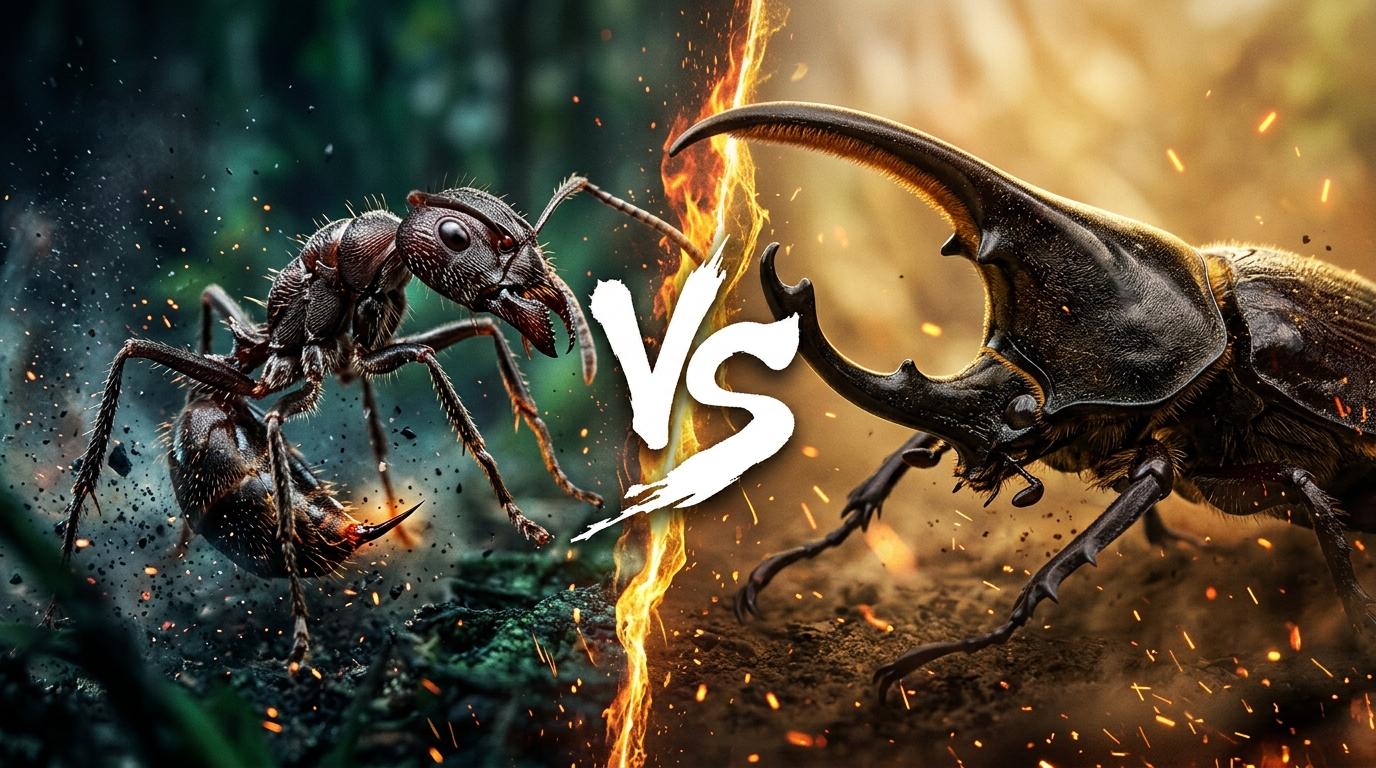
Bullet Ant vs Elephant Beetle: Who Actually Wins?
The elephant beetle wins a one-on-one encounter. A large male Megasoma elephas can reach about 12 cm and weighs many times more than a 2.5 cm bullet ant. Its body is a thick, domed exoskeleton, and its horn and legs are built for prying and shoving other heavy beetles off branches. The bullet ant carries poneratoxin, a sting that ranks at the top of the human pain scales and also paralyzes insect prey. That weapon was refined for small prey and for vertebrates with soft skin, not for punching through beetle armor. To land a sting, the ant has to find a narrow joint seam on a large animal that can simply walk forward, shove, or lift it off the bark. The ant's real power is its colony, and that is where the answer flips.
Read comparison
Bullet Ant vs Hercules Beetle: Who Actually Wins?
The Hercules beetle wins a one-on-one fight. A bullet ant ranks near the very top of the Schmidt sting pain index, and its poneratoxin works on insects as well as vertebrates. To matter, though, that venom has to get inside the target. A male Hercules beetle can reach roughly 15–17 cm including its horn, against the ant's roughly 2.5 cm, and it is wrapped in thick, overlapping armor with very few open seams. The beetle does not need to hunt or kill. It only needs to shove, pin, or flip the ant, then walk away, and it holds every structural advantage for doing that: mass, leg leverage, armor, and a horn built for prying rivals off branches. The ant's best chance is a precise sting into a leg joint or neck membrane. That is possible but unlikely against a body this armored and this much larger. Bring the ant's colony into the picture and the story changes, but in a solo matchup armor and mass beat chemistry.
Read comparison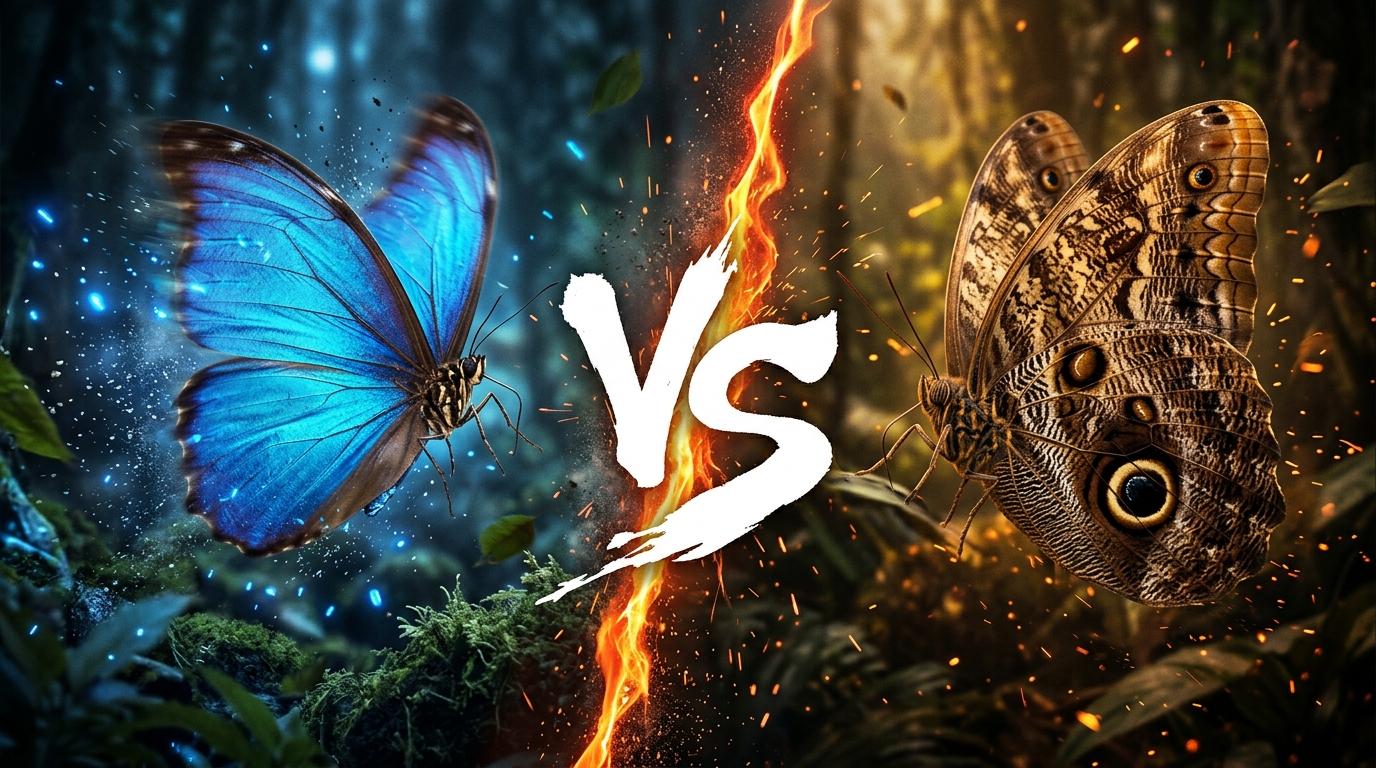
Blue Morpho vs Owl Butterfly: Who Actually Wins?
The Blue Morpho wins. Neither butterfly can hurt the other because both are nectar- and fruit-feeding insects with coiled sipping mouthparts and no weapons. So a 'battle' between them comes down to who controls airspace, food, and position. The Blue Morpho has the better tools for that. Its males patrol forest flyways by day and chase off rival butterflies in fast, erratic aerial bouts. Its flashing structural-blue wings make it hard to track and hard to catch. It is also faster and more aggressive in flight. The Owl Butterfly is a dusk-active, energy-saving specialist built around one brilliant trick: giant eyespots that bluff predators. That trick does nothing against another butterfly. In any daytime contest over a sunlit gap or a pile of fermenting fruit, the Morpho holds the space and the Owl Butterfly gives way.
Read comparison
Discussion
What do you think?
Share your reasoning with other readers. Be civil and stick to the animals.
Sign in to join the discussion.
Sign inNo comments yet. Start the conversation.