

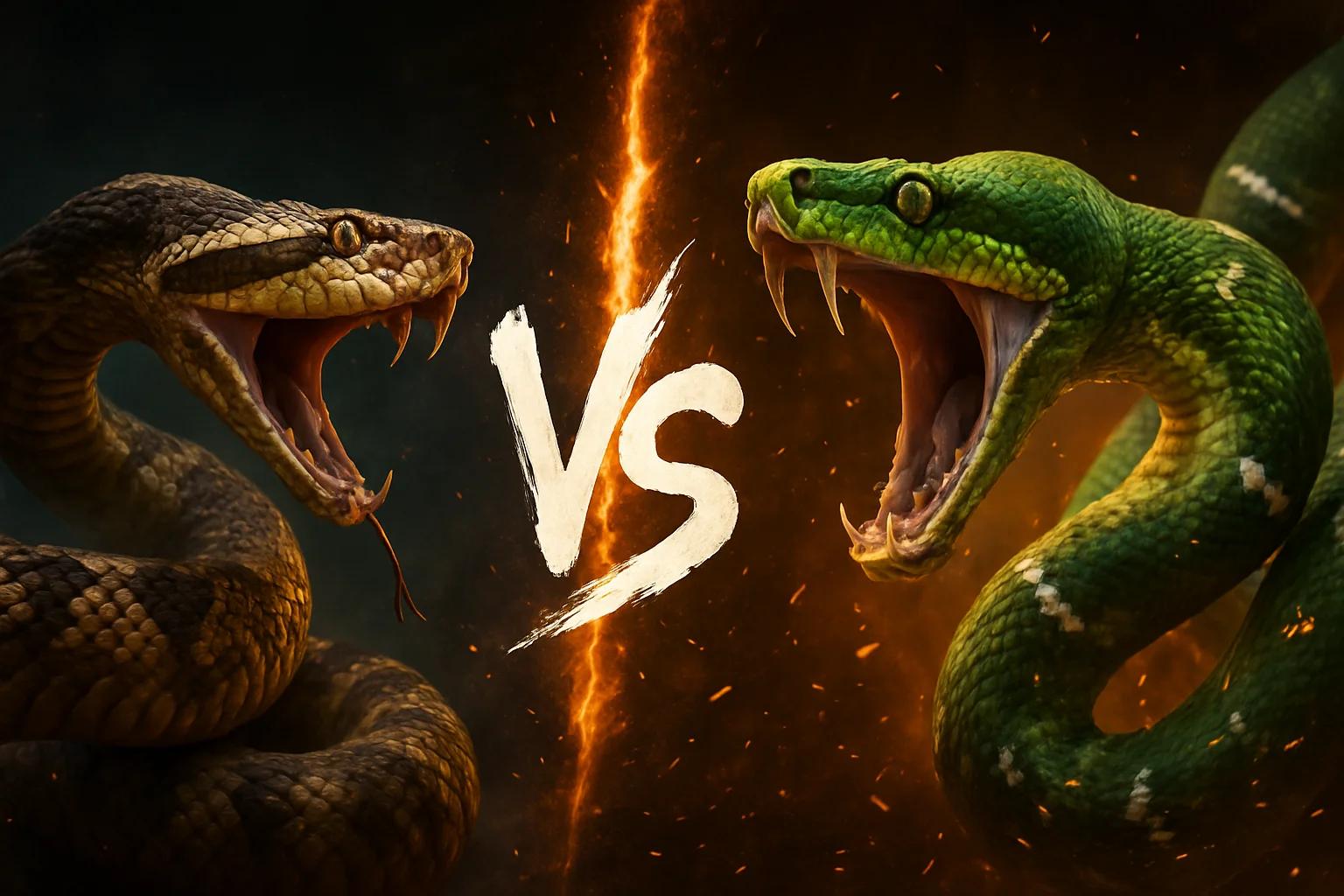
Bushmaster vs Emerald Tree Boa: Who Actually Wins?
Bushmaster vs emerald tree boa: venom, size, strike reach and constriction compared. See which Amazon snake wins, scenario by scenario, and why.
Bushmaster vs Emerald Tree Boa
Matchup winner
Bushmaster
Quick verdict
Start with the direct answer, then use the structured comparison below to see what changes the outcome.
The bushmaster wins clearly. As the longest viper in the Americas, Lachesis muta often reaches 2–2.5 m and carries a heavy body, long fangs and a large venom load. That venom causes rapid tissue damage and blood-clotting failure. The emerald tree boa is a medium-sized arboreal constrictor, usually 1.5–1.8 m. It has extremely long front teeth built to grip birds and small mammals in the canopy, but it has no venom and was never built to subdue a large, armed snake. On the forest floor, where the bushmaster lives, the boa would have to close to grappling range. That range is exactly where a single envenomating bite decides the encounter. The boa's best outcome is avoidance, not victory.
Read the full explanation
Bushmaster wins: it is larger, venomous, and holds a long-range strike advantage.
Emerald tree boa relies on grip and constriction, which only work after it gets into contact range.
In the canopy the boa can stay out of reach, but staying out of reach is not the same as winning.
Real encounters are rare because the two use different forest layers and both prefer to avoid conflict.
Reader vote
Who do you think wins?
Pick a side — no account needed. Results update live.
No votes yet — be the first to call it.
Editorial note
Why people disagree
Boa fans point to constriction strength and huge front teeth, but those tools are scaled for birds and rodents, not a 3+ kg viper.
Lethal payload
One effective bite can end a snake-on-snake contest before any wrestling starts.
Body mass and length
Constriction works when the constrictor outmatches its target, and here the boa does not.
Strike reach and timing
The bushmaster can deliver damage from farther away than the boa needs to be to start grappling.
Read the full explanation +
Some assume the arboreal snake 'controls the high ground'. In practice, height is mainly a way to avoid fights, not a way to attack from above.
People underrate the bushmaster because it is slow and sit-and-wait. That ignores how fast it strikes and how severe its venom is.
Comparison FAQ
Short, direct answers to the next questions readers usually ask after the headline verdict.
Would a bushmaster beat an emerald tree boa?+
Yes. It is longer, heavier and venomous, and its strike can disable the boa before constriction becomes a factor.
Which snake is stronger?+
The emerald tree boa has better gripping and constricting control for its size. The bushmaster has more overall mass and far greater lethal capability.
Could the emerald tree boa constrict the bushmaster?+
It is unlikely. The boa is sized for birds and small mammals, and it would have to survive bites while trying to coil around a larger snake.
Why is the emerald tree boa still dangerous?+
It strikes quickly and has some of the longest front teeth of any nonvenomous snake. Those teeth can cause deep, painful lacerations, especially to anything reaching into its perch.
Do these snakes meet in the wild?+
Both live in Amazonian rainforest, but bushmasters stay on the floor and emerald tree boas live in the trees, so confrontations are rare.
Head-to-head species stats
These are the same core AnimalDex stat dimensions used on the dedicated animal pages, pulled side by side so the matchup is faster to scan.
Bushmaster
Tier BEmerald Tree Boa
Tier CTrait-by-trait comparison
Only the categories that matter to this matchup are included. The goal is not filler stats, but the real design differences that change the result.
Large-yield hemotoxic venom, long fangs
Lethal payload
Bushmaster
No venom; long grasping teeth
Lethal payload
Bushmaster
Often 2–2.5 m, heavy-bodied
Body mass and length
Bushmaster
Typically 1.5–1.8 m, slender-to-moderate
Body mass and length
Bushmaster
Long, coiled ambush strike
Strike reach and timing
Bushmaster
Fast lunge from perch coils
Strike reach and timing
Bushmaster
Strike-and-release style
Grip and control
Emerald Tree Boa
Prehensile tail anchor, strong coils
Grip and control
Emerald Tree Boa
Ground specialist
Canopy mobility
Emerald Tree Boa
Elite branch-dweller
Canopy mobility
Emerald Tree Boa
Weeks-long patient trail ambushes
Ambush control
Bushmaster
Nocturnal perch ambush
Ambush control
Bushmaster
How the verdict forms
Verdict timeline
01 · Lethal payload
Bushmaster
02 · Body mass and length
Bushmaster
03 · Strike reach and timing
Bushmaster
04 · Grip and control
Emerald Tree Boa
05 · Canopy mobility
Emerald Tree Boa
06 · Ambush control
Bushmaster
Change the conditions
Scenario breakdown
This is where shallow battle content usually fails. Terrain, spacing, timing, and engagement style can change the answer.
Scenario lean
Bushmaster
Verdict confidence
82%
Bushmaster, decisively.
On leaf litter the boa loses its anchoring branches and its main mobility advantage. The bushmaster's coiled strike posture and longer reach mean the first meaningful contact is likely a venomous bite. Coagulopathy and tissue damage then cut off the boa's ability to keep up sustained constriction.
AnimalDex field profiles
Explore these animals
Bushmaster
Lachesis muta
humid tropical forest and dense rainforest floor
Emerald Tree Boa
Corallus caninus
Humid tropical rainforest canopy and understory branch systems.
Systems Intelligence & Hidden Purpose
See the animals behind this comparison as engineered biological systems: what each one is built to do, where it gains leverage, and why the matchup changes by scenario.
Specialized Hardware
large viper body, leaf-litter camouflage, and forest-floor ambush give the Bushmaster a body plan tuned for its niche.
Systems Script
Bushmasters operate through humid tropical forest and dense rainforest floor Their design links movement, shelter, and feeding into one workable survival system.
Strategic Insight
An unseen system can hold enormous force if position and camouflage are already doing the work.
Specialized Hardware
Bright green body with white markings, heavy body coiled on branches, and large head with facial pits give the Emerald Tree Boa a body plan tuned for its niche.
Systems Script
Emerald Tree Boas operate in humid tropical rainforest canopy and understory branch systems. Their design helps them match food access, shelter, and timing inside that environment.
Strategic Insight
A system gains efficiency when rest position and attack position are almost the same thing.
Final take
The bushmaster is the overall winner. It brings venom, size and reach to a matchup where the emerald tree boa brings grip and climbing. Snake-versus-snake outcomes hinge on who can inflict decisive damage first, and only one of these animals can do that from range.
Read the full explanation
The boa's real strengths are vertical escape and canopy control. They make it very hard to catch, but they are survival tools, not weapons against a larger venomous snake. In any frame where the two actually fight, the bushmaster's toolkit ends it.
Collect both animals in AnimalDex
Track the species behind this matchup, compare their real traits, and build the rivalry into your AnimalDex collection.
Related comparisons
Continue with nearby matchups to compare more real-world animal traits without dropping into junky who-wins filler.
Bushmaster vs Rhinoceros Viper: Who Actually Wins?
The bushmaster wins. Lachesis muta is the longest viper in the Americas and regularly exceeds 2 meters, sometimes approaching 3. The rhinoceros viper is a heavy-bodied African ambusher that usually stays around 1 to 1.2 meters. That length gap gives the bushmaster greater strike reach, a larger venom reserve per bite, and a body that is harder to pin or overwhelm. The rhinoceros viper has long fangs and a potent hemotoxic venom, so it can absolutely inflict a serious bite. But neither snake hunts other snakes, and in a forced clash, reach and mass decide who lands first and who absorbs the reply. Those advantages belong to the bushmaster.
Read comparison
Discussion
What do you think?
Share your reasoning with other readers. Be civil and stick to the animals.
Sign in to join the discussion.
Sign inNo comments yet. Start the conversation.