


Bushmaster vs Rhinoceros Viper: Who Actually Wins?
Bushmaster vs rhinoceros viper: which viper would win? We compare size, venom delivery, strike reach, and ambush style to name a clear winner.
Bushmaster vs Rhinoceros Viper
Matchup winner
Bushmaster
Quick verdict
Start with the direct answer, then use the structured comparison below to see what changes the outcome.
The bushmaster wins. Lachesis muta is the longest viper in the Americas and regularly exceeds 2 meters, sometimes approaching 3. The rhinoceros viper is a heavy-bodied African ambusher that usually stays around 1 to 1.2 meters. That length gap gives the bushmaster greater strike reach, a larger venom reserve per bite, and a body that is harder to pin or overwhelm. The rhinoceros viper has long fangs and a potent hemotoxic venom, so it can absolutely inflict a serious bite. But neither snake hunts other snakes, and in a forced clash, reach and mass decide who lands first and who absorbs the reply. Those advantages belong to the bushmaster.
Read the full explanation
The bushmaster wins most realistic encounters.
It is roughly twice the length of the rhinoceros viper, with more strike reach and a larger venom reserve.
The rhinoceros viper's long fangs and potent venom keep it dangerous, but it is outsized.
Neither species naturally hunts snakes, so a real confrontation would be brief and defensive.
Reader vote
Who do you think wins?
Pick a side — no account needed. Results update live.
No votes yet — be the first to call it.
Editorial note
Why people disagree
Rhinoceros viper fans point to its heavy build, long fangs, and potent venom. They argue that bulk per length offsets the bushmaster's size.
Strike reach
In a snake confrontation, the animal that can connect from farther away controls the exchange.
Venom payload
Bigger reserves mean more damage per bite and less risk of a 'dry' exchange.
Fang engineering
The rhinoceros viper punches above its size class in bite depth.
Read the full explanation +
Some readers assume snake fights are decided by venom alone. In practice, snakes have limited susceptibility data against each other, so reach and who strikes first often matter more.
Both are rare and sit-and-wait specialists, so there is little observed behavior to settle the debate. Size is the most defensible tiebreaker.
Comparison FAQ
Short, direct answers to the next questions readers usually ask after the headline verdict.
Would a bushmaster beat a rhinoceros viper?+
Yes, in most scenarios. Its greater reach, size, and venom volume give it the edge.
Which snake is stronger?+
The bushmaster. It is far longer and heavier overall, although the rhinoceros viper is very stout for its length.
Why is the rhinoceros viper still dangerous?+
It has long fangs and potent hemotoxic venom, plus superb camouflage. A surprise first bite could seriously harm even a larger snake.
Do these snakes ever meet in the wild?+
No. The bushmaster lives in South and Central American rainforests, while the rhinoceros viper lives in African rainforests.
Head-to-head species stats
These are the same core AnimalDex stat dimensions used on the dedicated animal pages, pulled side by side so the matchup is faster to scan.
Bushmaster
Tier BRhinoceros Viper
Tier BTrait-by-trait comparison
Only the categories that matter to this matchup are included. The goal is not filler stats, but the real design differences that change the result.
Long body, often 2 m or more, with wide coil leverage
Strike reach
Bushmaster
Compact 1 m frame, shorter strike radius
Strike reach
Bushmaster
Large glands that deliver high venom volume
Venom payload
Bushmaster
Potent hemotoxic blend, smaller total yield
Venom payload
Bushmaster
Long hinged fangs
Fang engineering
Rhinoceros Viper
Very long fangs relative to body size
Fang engineering
Rhinoceros Viper
Greater mass and length to absorb strikes
Close-range durability
Bushmaster
Stout body but far less overall mass
Close-range durability
Bushmaster
Elite leaf-litter ambusher, waits for weeks
Ambush control
Rhinoceros Viper
Superb camouflage on forest floor
Ambush control
Rhinoceros Viper
Tail vibration, raised S-coil, large gape
Defensive presence
Bushmaster
Loud hiss and horned snout display
Defensive presence
Bushmaster
How the verdict forms
Verdict timeline
01 · Strike reach
Bushmaster
02 · Venom payload
Bushmaster
03 · Fang engineering
Rhinoceros Viper
04 · Close-range durability
Bushmaster
05 · Ambush control
Rhinoceros Viper
06 · Defensive presence
Bushmaster
Change the conditions
Scenario breakdown
This is where shallow battle content usually fails. Terrain, spacing, timing, and engagement style can change the answer.
Scenario lean
Bushmaster
Verdict confidence
82%
The bushmaster's reach controls the leaf litter.
Both snakes are coiled and concealed. Camouflage cancels out, so whoever strikes effectively first wins. The bushmaster's longer coil lets it strike from outside the rhinoceros viper's range.
AnimalDex field profiles
Explore these animals
Bushmaster
Lachesis muta
humid tropical forest and dense rainforest floor
Rhinoceros Viper
Bitis nasicornis
rainforest floor, swamp forest, and dense humid cover
Systems Intelligence & Hidden Purpose
See the animals behind this comparison as engineered biological systems: what each one is built to do, where it gains leverage, and why the matchup changes by scenario.
Specialized Hardware
large viper body, leaf-litter camouflage, and forest-floor ambush give the Bushmaster a body plan tuned for its niche.
Systems Script
Bushmasters operate through humid tropical forest and dense rainforest floor Their design links movement, shelter, and feeding into one workable survival system.
Strategic Insight
An unseen system can hold enormous force if position and camouflage are already doing the work.
Specialized Hardware
horn-like nasal scales, bold mosaic camouflage, and still leaf-litter ambush give the Rhinoceros Viper a body plan tuned for its niche.
Systems Script
Rhinoceros Vipers operate through rainforest floor, swamp forest, and dense humid cover. Their design links movement, feeding, shelter, and timing into one workable survival system.
Strategic Insight
Dense environments reward precision, patience, and the ability to read layered cover.
Final take
The bushmaster takes this one. Its length, strike reach, and venom volume outclass a smaller viper, even one built as solidly as the rhinoceros viper.
Read the full explanation
The rhinoceros viper's best route to victory is concealment and a surprise first bite with its long fangs. That keeps it credible, but it remains the underdog when both snakes are aware of each other.
Collect both animals in AnimalDex
Track the species behind this matchup, compare their real traits, and build the rivalry into your AnimalDex collection.
Related comparisons
Continue with nearby matchups to compare more real-world animal traits without dropping into junky who-wins filler.
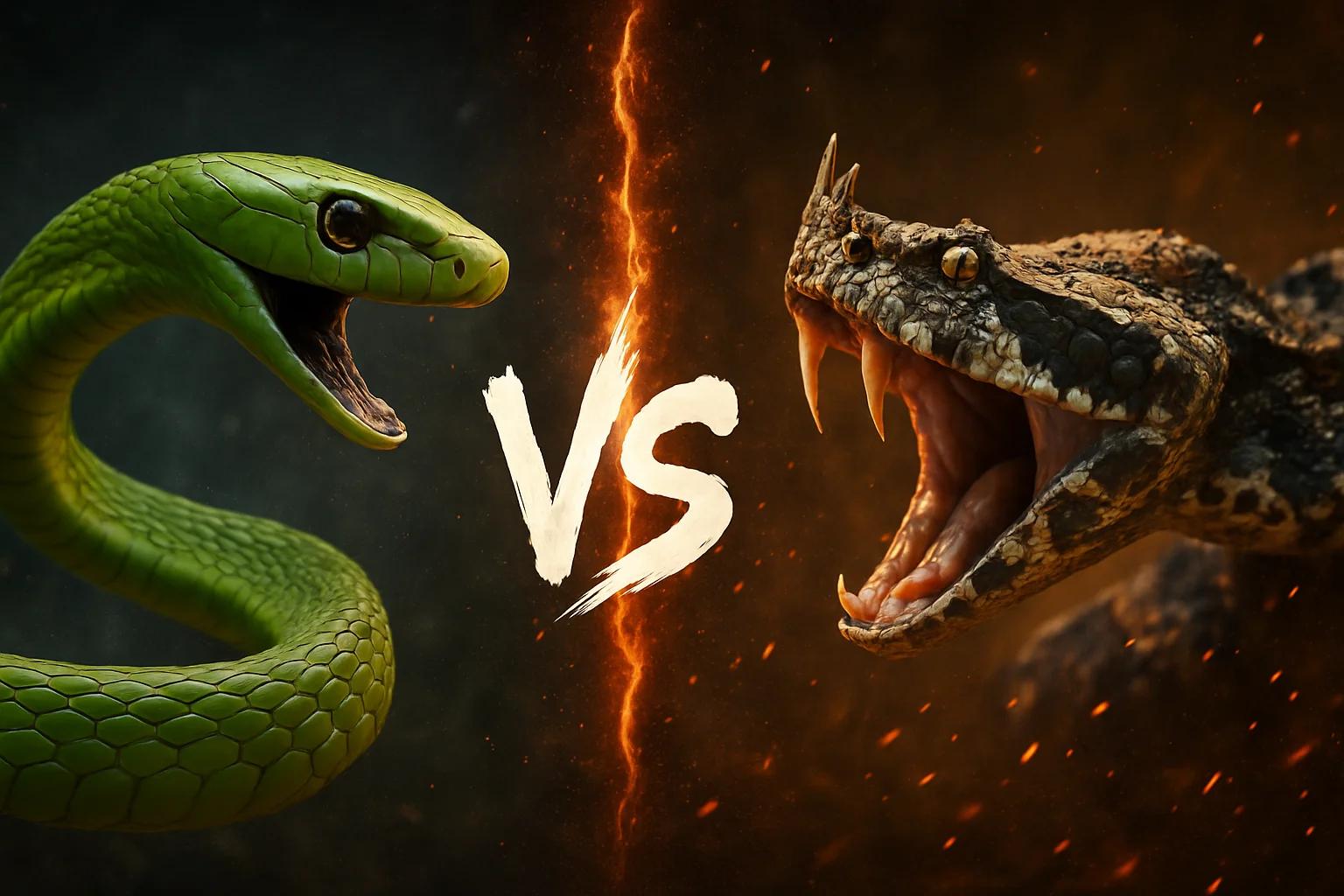
Eastern Green Mamba vs Rhinoceros Viper: Who Actually Wins?
The Eastern green mamba wins most realistic encounters. It is longer, faster, and far more mobile. It can see a threat, strike from range, and get out of reach before a slow, heavy-bodied viper can line up a counterstrike. The rhinoceros viper has huge fangs, a fast close-range strike, and a mostly tissue-destroying venom. But it is a sit-and-wait ambusher built to hit prey that walks into it, not to chase or duel a nimble, alert snake. The mamba carries fast-acting neurotoxic venom and fights on its own terms, usually by avoiding the fight entirely. That makes it the stronger overall bet. If the mamba blunders straight into the viper's strike zone on the forest floor, it can still lose badly.
Read comparison
Eyelash Viper vs Rhinoceros Viper: Who Actually Wins?
The rhinoceros viper wins this matchup clearly. Bitis nasicornis is a heavy-bodied West and Central African forest-floor viper that commonly reaches 90–120 cm. It has a massive head, long hinged fangs and a large venom yield. The eyelash viper is a slender Central and South American arboreal pit viper that usually measures 55–80 cm. It weighs a fraction of its rival and is built for precise ambush strikes on small birds and frogs. The eyelash viper has better climbing, heat-sensing pits and a quick strike from branch cover. The rhinoceros viper answers with body mass, deeper fang penetration and venom delivery scaled for mammals. In any ground-level encounter, that scale gap decides the outcome.
Read comparison
Discussion
What do you think?
Share your reasoning with other readers. Be civil and stick to the animals.
Sign in to join the discussion.
Sign inNo comments yet. Start the conversation.