


Caiman Lizard vs Emerald Tree Boa: Who Actually Wins?
Caiman lizard vs emerald tree boa: a biology-first breakdown of bite, body mass, constriction, and habitat to show which Amazonian reptile wins and why.
Caiman Lizard vs Emerald Tree Boa
Matchup winner
Caiman Lizard
Quick verdict
Start with the direct answer, then use the structured comparison below to see what changes the outcome.
The caiman lizard wins most realistic encounters. The emerald tree boa looks like the bigger threat because it is longer, has fearsome front teeth, and is a precise ambush constrictor. But it is a slender, light-bodied snake, usually around 1.5–1.8 m and under about 1.5 kg, built to snatch birds and small mammals from branches. The caiman lizard is a heavy-bodied tegu relative, roughly 0.9–1.2 m long and often 2 kg or more. It is covered in thick, keeled, armor-like scales and armed with broad molar-like teeth and jaw muscles made for crushing snail shells. That combination is the wrong size and the wrong build for a tree boa to subdue. On the ground, in flooded forest, or in the water, the lizard's mass, durability, and crushing bite decide things. The boa's real edge exists only high in the canopy, where its grip, camouflage, and strike geometry control the fight.
Read the full explanation
Winner: Caiman lizard, in most realistic settings.
The caiman lizard has more body mass, heavier armor, and a crushing bite that can injure a snake's spine and ribs.
The emerald tree boa is a light canopy specialist, and an adult caiman lizard is too bulky and armored to constrict well.
The boa wins only in high arboreal ambushes, where the lizard loses its footing advantage.
Reader vote
Who do you think wins?
Pick a side — no account needed. Results update live.
No votes yet — be the first to call it.
Editorial note
Why people disagree
Length fools people. The boa is longer, but the lizard is usually heavier and far more robust, and in reptile fights mass usually matters more.
Body mass and frame
A constrictor has to out-mass and out-anchor its prey. The lizard's bulk makes it a poor target for this boa.
Crushing bite
A shell-crushing bite can do real structural damage to a thin snake body. Needle teeth mainly hold on.
Close-range durability
The lizard can absorb strikes. The boa has nothing comparable to blunt a bite.
Read the full explanation +
The boa's long front teeth look decisive. They are built to hook feathers and fur, not to get through dense keeled scales.
Habitat flips the script. Fans who picture the canopy pick the boa, while anyone who pictures flooded forest floors and riverbanks picks the lizard.
Comparison FAQ
Short, direct answers to the next questions readers usually ask after the headline verdict.
Would a caiman lizard beat an emerald tree boa?+
Yes, in most realistic encounters, especially on the ground or near water. The lizard's mass, armor, and crushing bite outclass the slender boa.
Which is stronger, the caiman lizard or the emerald tree boa?+
The caiman lizard is generally heavier and has far greater bite force. The boa's strength is in grip and constriction, which works poorly on a bulky, armored lizard.
Can an emerald tree boa constrict a caiman lizard?+
A juvenile caiman lizard, possibly. An adult is usually too heavy and too thickly built for a typical emerald tree boa to subdue.
Why is the emerald tree boa still dangerous in this matchup?+
Its long front teeth deliver deep, painful bites. It is nearly invisible in foliage, and in the canopy it can strike first and knock the lizard off its perch.
Do caiman lizards and emerald tree boas meet in the wild?+
Their ranges overlap in Amazonian forests, but they use different habitats. The lizard stays in flooded forest and on the ground, while the boa lives in the canopy. Direct conflict is rare.
Head-to-head species stats
These are the same core AnimalDex stat dimensions used on the dedicated animal pages, pulled side by side so the matchup is faster to scan.
Caiman Lizard
Tier CEmerald Tree Boa
Tier CTrait-by-trait comparison
Only the categories that matter to this matchup are included. The goal is not filler stats, but the real design differences that change the result.
Thick, heavy-bodied, often 2+ kg
Body mass and frame
Caiman Lizard
Slender, typically under 1.5 kg
Body mass and frame
Caiman Lizard
Broad molariform teeth that crack snail shells
Crushing bite
Caiman Lizard
Long, needle-like front teeth for gripping
Crushing bite
Caiman Lizard
Raised, keeled, armor-like dorsal scales
Close-range durability
Caiman Lizard
Smooth scales, little protection
Close-range durability
Caiman Lizard
Forager that hunts by probing water and mud
Ambush control
Emerald Tree Boa
Elite heat-sensing, camouflaged sit-and-wait striker
Ambush control
Emerald Tree Boa
Can climb and bask on branches
Canopy grip
Emerald Tree Boa
Prehensile-tailed branch specialist
Canopy grip
Emerald Tree Boa
Laterally flattened tail, a strong swimmer
Water mobility
Caiman Lizard
Rarely enters water
Water mobility
Caiman Lizard
How the verdict forms
Verdict timeline
01 · Body mass and frame
Caiman Lizard
02 · Crushing bite
Caiman Lizard
03 · Close-range durability
Caiman Lizard
04 · Ambush control
Emerald Tree Boa
05 · Canopy grip
Emerald Tree Boa
06 · Water mobility
Caiman Lizard
Change the conditions
Scenario breakdown
This is where shallow battle content usually fails. Terrain, spacing, timing, and engagement style can change the answer.
Scenario lean
Caiman Lizard
Verdict confidence
82%
Caiman lizard, decisively.
On the ground the boa has no branch to anchor its coils and gets little help from camouflage. The heavier lizard can pin the snake and use its crushing jaws, while its armor absorbs the boa's defensive strikes.
AnimalDex field profiles
Explore these animals
Caiman Lizard
Dracaena guianensis
swamp forest, river edge, and tropical wetland
Emerald Tree Boa
Corallus caninus
Humid tropical rainforest canopy and understory branch systems.
Systems Intelligence & Hidden Purpose
See the animals behind this comparison as engineered biological systems: what each one is built to do, where it gains leverage, and why the matchup changes by scenario.
Specialized Hardware
armor-like scales, strong jaws for hard snails, and semi-aquatic riverbank life give the Caiman Lizard a body plan tuned for its niche.
Systems Script
Caiman Lizards operate through swamp forest, river edge, and tropical wetland Their design links movement, shelter, and feeding into one workable survival system.
Strategic Insight
A hard environment often rewards tools built for hard targets.
Specialized Hardware
Bright green body with white markings, heavy body coiled on branches, and large head with facial pits give the Emerald Tree Boa a body plan tuned for its niche.
Systems Script
Emerald Tree Boas operate in humid tropical rainforest canopy and understory branch systems. Their design helps them match food access, shelter, and timing inside that environment.
Strategic Insight
A system gains efficiency when rest position and attack position are almost the same thing.
Final take
The caiman lizard wins because the matchup comes down to physics. A constrictor needs a manageable, soft-bodied target, and an adult caiman lizard is heavy, armored, and armed with a bite built to break hard things.
Read the full explanation
The emerald tree boa is still a superb predator. It just specializes in a different problem: catching agile birds and mammals from ambush in the canopy. Pull it out of that niche and its advantages disappear. Leave it in the canopy and it can embarrass the lizard.
Collect both animals in AnimalDex
Track the species behind this matchup, compare their real traits, and build the rivalry into your AnimalDex collection.
Related comparisons
Continue with nearby matchups to compare more real-world animal traits without dropping into junky who-wins filler.
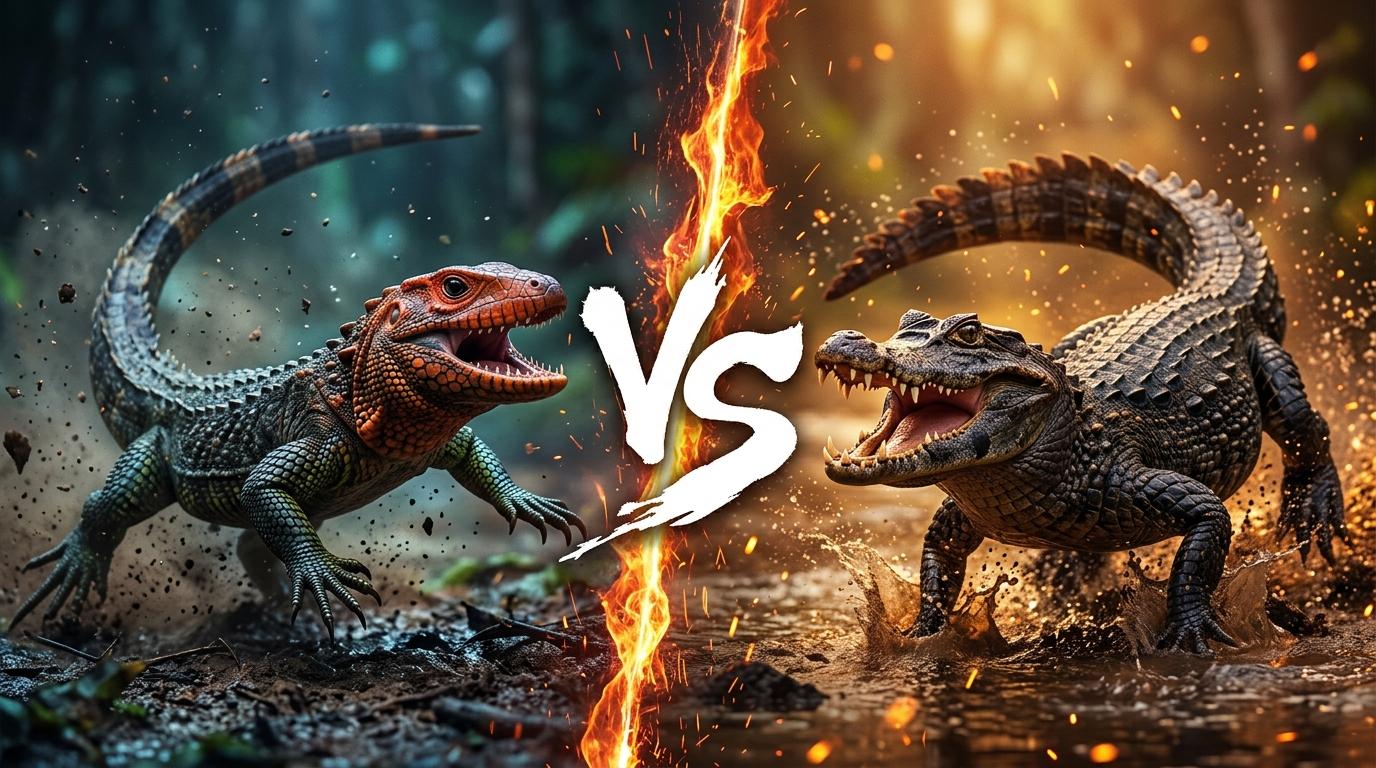
Caiman Lizard vs Dwarf Caiman: Who Actually Wins?
The dwarf caiman wins clearly. Cuvier's dwarf caiman is a true crocodilian. Adults reach about 1.2–1.6 m and 6–7 kg. It has heavy bony osteoderms, a conical-toothed bite built to seize and hold struggling prey, and the classic crocodilian death-grip instinct. The caiman lizard is impressive for a lizard: about 1.2 m long, mostly tail, and roughly 1.5–4 kg. But its broad crushing molars evolved to pop apple snails, not to grapple a living, armored predator. The lizard has respectable scutes and a strong bite. The caiman brings more mass, a more lethal tooth design, thicker armor and ambush instincts honed for exactly this kind of close-quarters water contact.
Read comparison
Caiman Lizard vs Mata Mata: Who Actually Wins?
The caiman lizard wins this matchup. Both are slow-water Amazon specialists of similar mass, with the mata mata turtle often heavier, but the caiman lizard brings the tools that matter in a confrontation. It is mobile on land and in water, and it climbs. Its jaws carry broad, molar-like crushing teeth built to split snail shells. Its armored, keeled scales and a strong tail add both protection and propulsion. The mata mata is a brilliant ambush machine, but almost all of its power sits in one instant: the suction gulp, a sudden throat expansion that vacuums small fish whole. Its jaws are soft-edged and weak, it moves sluggishly on land, and it has no real way to hurt an armored reptile that refuses to swim past its mouth. The mata mata's shell makes it extremely hard to kill, so the realistic 'win' is the lizard controlling the encounter and driving the turtle off, not a dramatic kill.
Read comparison
Bushmaster vs Emerald Tree Boa: Who Actually Wins?
The bushmaster wins clearly. As the longest viper in the Americas, Lachesis muta often reaches 2–2.5 m and carries a heavy body, long fangs and a large venom load. That venom causes rapid tissue damage and blood-clotting failure. The emerald tree boa is a medium-sized arboreal constrictor, usually 1.5–1.8 m. It has extremely long front teeth built to grip birds and small mammals in the canopy, but it has no venom and was never built to subdue a large, armed snake. On the forest floor, where the bushmaster lives, the boa would have to close to grappling range. That range is exactly where a single envenomating bite decides the encounter. The boa's best outcome is avoidance, not victory.
Read comparison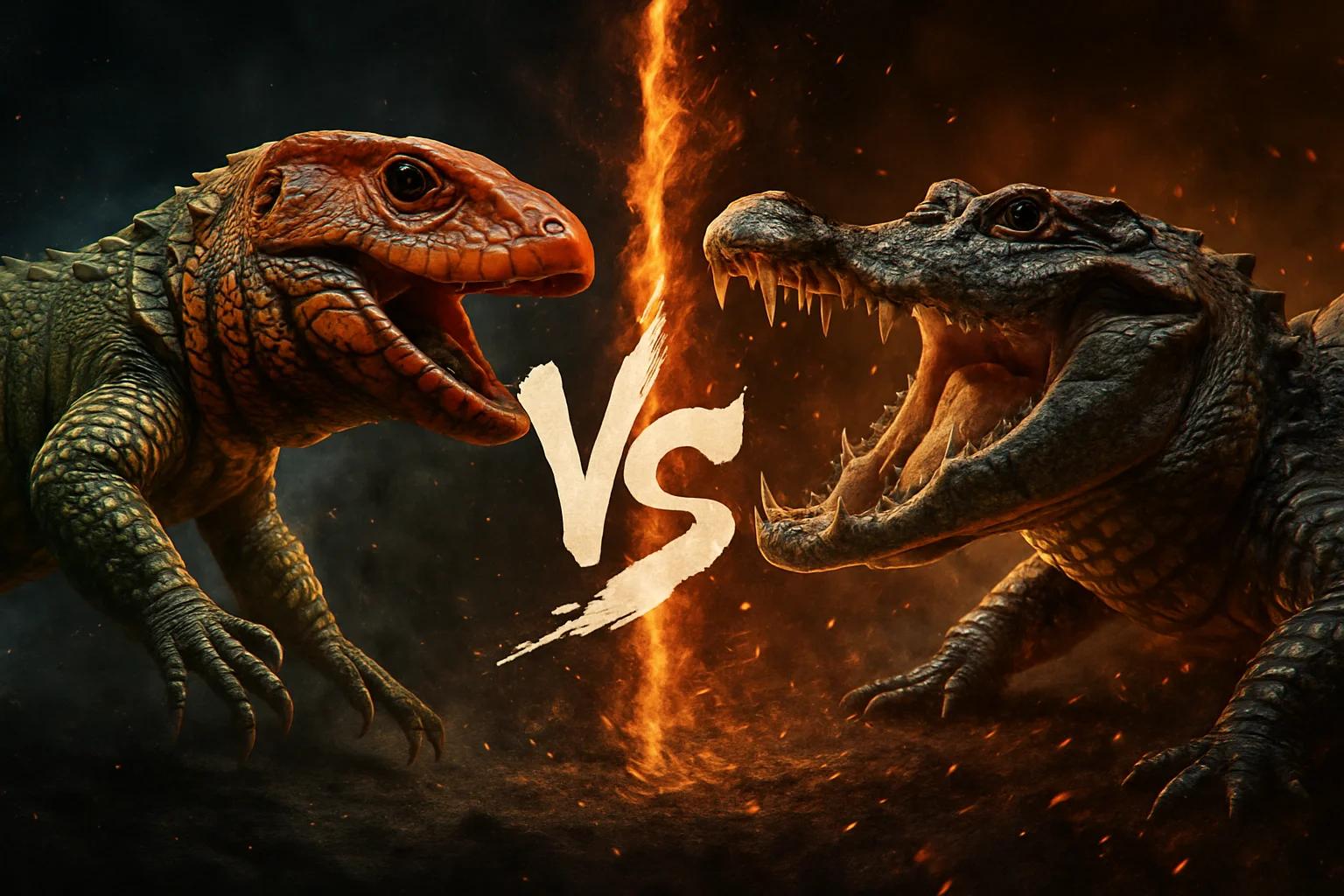
Caiman Lizard vs Yacare Caiman: Who Actually Wins?
The yacare caiman wins, and it isn't especially close. An adult yacare is a 2–2.5 m crocodilian weighing 20–60 kg, with bony osteoderm armor, a skull built for gripping and twisting, and the whole-body death-roll mechanics that crocodilians use to break down prey. The caiman lizard is a striking semi-aquatic tegu relative of about 1–1.2 m and a few kilograms. It is armored too, with heavy bead-like scales, and it has powerful jaws. Those jaws, though, carry broad, flat molar-like teeth evolved to crush snail shells, not to subdue large animals. In water, where both species live, the yacare holds every structural advantage: mass, bite architecture, armor and ambush instincts. The lizard's best outcome is to avoid the fight, and it often can, by climbing into overhanging branches where the caiman can't follow.
Read comparison
Discussion
What do you think?
Share your reasoning with other readers. Be civil and stick to the animals.
Sign in to join the discussion.
Sign inNo comments yet. Start the conversation.