


Caiman Lizard vs Red-footed Tortoise: Who Actually Wins?
Caiman lizard vs red-footed tortoise: crushing jaws meet a living fortress. We compare bite, armor, speed and habitat to settle who wins.
Caiman Lizard vs Red-footed Tortoise
Matchup winner
Caiman Lizard
Quick verdict
Start with the direct answer, then use the structured comparison below to see what changes the outcome.
The caiman lizard wins this matchup on initiative and weaponry. Dracaena guianensis is a heavy-bodied, semi-aquatic South American teiid that reaches about 1.2 m. It carries broad, molar-like crushing teeth built to crack snail shells, and it is quicker, more agile and more willing to press an encounter than the slow, herbivorous red-footed tortoise. But the tortoise's shell is the great equalizer. An adult Chelonoidis carbonarius can tuck its head and legs inside and become a problem the lizard cannot realistically solve. So 'winning' here means controlling the encounter, pushing the tortoise into a defensive shutdown, and walking away unharmed. It does not mean killing it. The lizard dictates every exchange. The tortoise only survives them.
Read the full explanation
Caiman lizard wins overall: it is faster, longer, and armed with a shell-crushing bite.
The red-footed tortoise's shell makes it nearly impossible to seriously injure as an adult.
The lizard controls the encounter. The tortoise simply outlasts it.
Near water, the lizard's advantage becomes overwhelming.
Reader vote
Who do you think wins?
Pick a side — no account needed. Results update live.
No votes yet — be the first to call it.
Editorial note
Why people disagree
Some readers count 'can't be hurt' as a win. The tortoise's armor really does neutralize most attacks.
Crushing bite
Only one of these animals has a jaw designed to apply serious force to hard objects.
Mobile initiative
The lizard decides when an encounter starts, how it unfolds, and when it ends.
Fortress defense
The tortoise's shell turns a losing exchange into a stalemate it can survive.
Read the full explanation +
The caiman lizard's snail-crushing teeth sound like a can-opener for shells, but a tortoise carapace is far thicker than a snail shell.
Neither animal hunts the other, so any 'fight' is really a territorial bump or a tussle over food, not predation.
Comparison FAQ
Short, direct answers to the next questions readers usually ask after the headline verdict.
Would a caiman lizard beat a red-footed tortoise in a fight?+
Yes, in the sense of controlling the encounter. The lizard is faster and more aggressive. However, it is unlikely to seriously injure an adult tortoise sealed inside its shell.
Which is stronger, the caiman lizard or the red-footed tortoise?+
The caiman lizard has far stronger offensive force thanks to its crushing jaws. The tortoise can be heavier and has much stronger passive defense.
Can a caiman lizard bite through a tortoise shell?+
Not an adult's. Its teeth are built for snail shells, and a tortoise carapace is far thicker bony armor. Very small hatchlings would be more vulnerable.
Why is the red-footed tortoise still dangerous to the lizard?+
Mostly through attrition and injury risk. Biting at a shell can damage the lizard's teeth or jaw, and the tortoise's clawed limbs and solid mass punish sloppy attacks. The tortoise also outlasts almost anything.
Do caiman lizards and red-footed tortoises meet in the wild?+
Their ranges overlap in parts of northern South America, but they occupy different niches and rarely have a reason to clash.
Head-to-head species stats
These are the same core AnimalDex stat dimensions used on the dedicated animal pages, pulled side by side so the matchup is faster to scan.
Caiman Lizard
Tier CRed-footed Tortoise
Tier DTrait-by-trait comparison
Only the categories that matter to this matchup are included. The goal is not filler stats, but the real design differences that change the result.
Broad molariform teeth, powerful jaws
Crushing bite
Caiman Lizard
Toothless beak, plant-shearing
Crushing bite
Caiman Lizard
Quick bursts, strong swimmer
Mobile initiative
Caiman Lizard
Slow, deliberate walker
Mobile initiative
Caiman Lizard
Keeled scales, tough hide
Fortress defense
Red-footed Tortoise
Domed bony carapace and plastron
Fortress defense
Red-footed Tortoise
Up to ~1.2 m, 1.5–2+ kg
Body mass and frame
Red-footed Tortoise
30–40 cm shell, up to ~9 kg
Body mass and frame
Red-footed Tortoise
Predatory, willing to press
Aggression and drive
Caiman Lizard
Docile, withdraws under threat
Aggression and drive
Caiman Lizard
Water, banks, low branches
Terrain versatility
Caiman Lizard
Forest floor and savanna edge
Terrain versatility
Caiman Lizard
How the verdict forms
Verdict timeline
01 · Crushing bite
Caiman Lizard
02 · Mobile initiative
Caiman Lizard
03 · Fortress defense
Red-footed Tortoise
04 · Body mass and frame
Red-footed Tortoise
05 · Aggression and drive
Caiman Lizard
06 · Terrain versatility
Caiman Lizard
Change the conditions
Scenario breakdown
This is where shallow battle content usually fails. Terrain, spacing, timing, and engagement style can change the answer.
Scenario lean
Caiman Lizard
Verdict confidence
82%
The lizard harasses, the tortoise turtles up, and the lizard holds the ground.
In dense cover, the caiman lizard's agility lets it probe the tortoise's limbs and head before they retract. The tortoise answers by withdrawing completely. Neither animal is seriously hurt, but the lizard keeps control of the space and the initiative. That is the definition of winning a non-lethal encounter.
AnimalDex field profiles
Explore these animals
Caiman Lizard
Dracaena guianensis
swamp forest, river edge, and tropical wetland
Red-footed Tortoise
Chelonoidis carbonarius
Forest edge, savannah, scrub, and humid to seasonally dry tropical habitats.
Systems Intelligence & Hidden Purpose
See the animals behind this comparison as engineered biological systems: what each one is built to do, where it gains leverage, and why the matchup changes by scenario.
Specialized Hardware
armor-like scales, strong jaws for hard snails, and semi-aquatic riverbank life give the Caiman Lizard a body plan tuned for its niche.
Systems Script
Caiman Lizards operate through swamp forest, river edge, and tropical wetland Their design links movement, shelter, and feeding into one workable survival system.
Strategic Insight
A hard environment often rewards tools built for hard targets.
Specialized Hardware
Dark domed shell, red or orange leg scales, and heavy slow walking gait give the Red-footed Tortoise a body plan tuned for its niche.
Systems Script
Red-footed Tortoises operate in forest edge, savannah, scrub, and humid to seasonally dry tropical habitats. Their design helps them match food access, shelter, and timing inside that environment.
Strategic Insight
Consistency can take a system farther than urgency.
Final take
The caiman lizard is the overall winner because it holds every active advantage: speed, a real crushing bite, predatory drive, and access to water. It can start, steer, and end any encounter.
Read the full explanation
The red-footed tortoise never truly loses its life in this matchup, and that is a remarkable evolutionary achievement in its own right. Its strategy is endurance, not dominance. Endurance wins resource standoffs, but it does not win head-to-head control.
Collect both animals in AnimalDex
Track the species behind this matchup, compare their real traits, and build the rivalry into your AnimalDex collection.
Related comparisons
Continue with nearby matchups to compare more real-world animal traits without dropping into junky who-wins filler.

Caiman Lizard vs Emerald Tree Boa: Who Actually Wins?
The caiman lizard wins most realistic encounters. The emerald tree boa looks like the bigger threat because it is longer, has fearsome front teeth, and is a precise ambush constrictor. But it is a slender, light-bodied snake, usually around 1.5–1.8 m and under about 1.5 kg, built to snatch birds and small mammals from branches. The caiman lizard is a heavy-bodied tegu relative, roughly 0.9–1.2 m long and often 2 kg or more. It is covered in thick, keeled, armor-like scales and armed with broad molar-like teeth and jaw muscles made for crushing snail shells. That combination is the wrong size and the wrong build for a tree boa to subdue. On the ground, in flooded forest, or in the water, the lizard's mass, durability, and crushing bite decide things. The boa's real edge exists only high in the canopy, where its grip, camouflage, and strike geometry control the fight.
Read comparison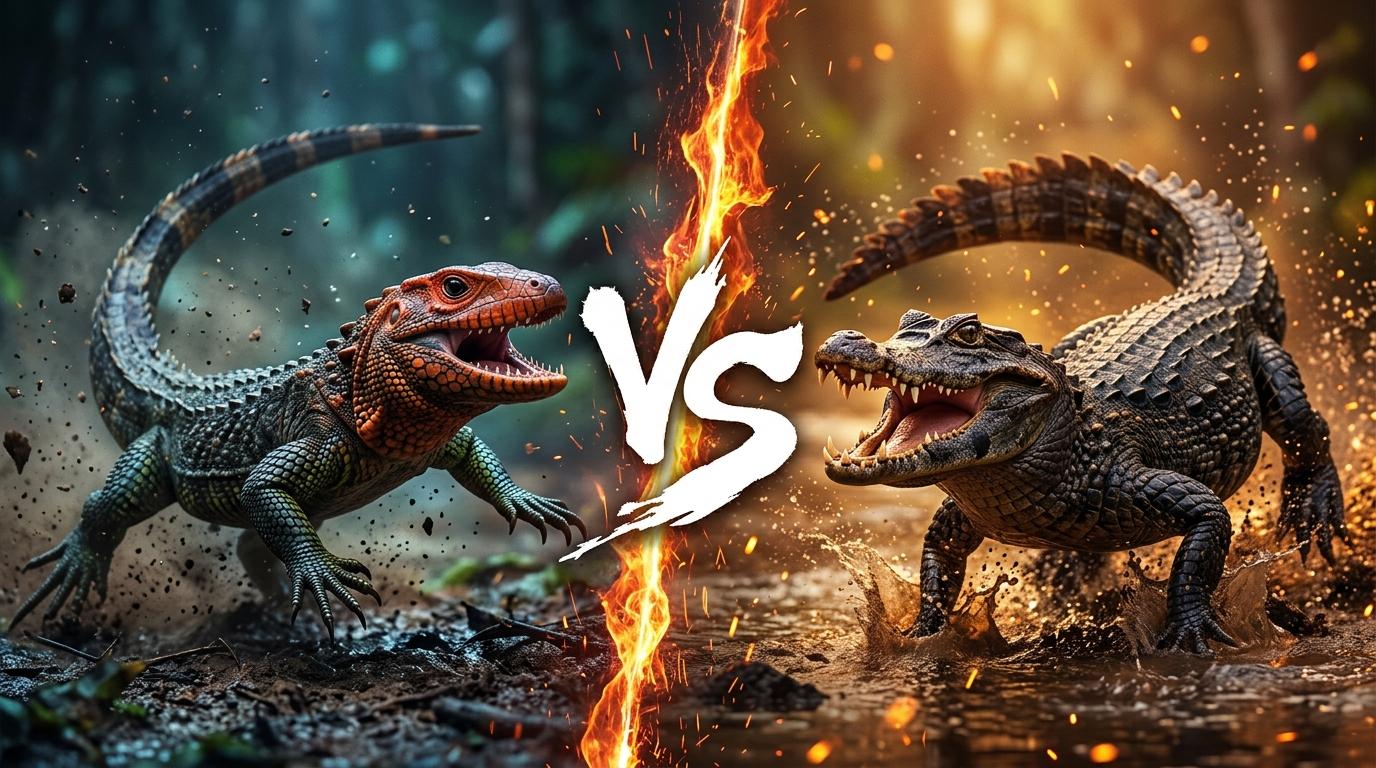
Caiman Lizard vs Dwarf Caiman: Who Actually Wins?
The dwarf caiman wins clearly. Cuvier's dwarf caiman is a true crocodilian. Adults reach about 1.2–1.6 m and 6–7 kg. It has heavy bony osteoderms, a conical-toothed bite built to seize and hold struggling prey, and the classic crocodilian death-grip instinct. The caiman lizard is impressive for a lizard: about 1.2 m long, mostly tail, and roughly 1.5–4 kg. But its broad crushing molars evolved to pop apple snails, not to grapple a living, armored predator. The lizard has respectable scutes and a strong bite. The caiman brings more mass, a more lethal tooth design, thicker armor and ambush instincts honed for exactly this kind of close-quarters water contact.
Read comparison
Dwarf Caiman vs Red-footed Tortoise: Who Actually Wins?
The Dwarf Caiman wins this matchup clearly. Cuvier's dwarf caiman is a fast-striking, heavily armored crocodilian with a bite built for gripping and crushing. It has far more speed, more aggression, and the only real offensive weapon in the pairing. The red-footed tortoise is a slow, plant-heavy forest grazer whose whole strategy is to retract and outlast. That shell is a serious obstacle: a full-grown adult tortoise can be too wide and too hard for a dwarf caiman to crack or swallow, so many encounters would end with no kill at all. But 'winning' here means controlling the encounter. The caiman sets the terms, can injure exposed limbs and heads, and easily overwhelms juveniles. The tortoise survives by refusing to fight, not by beating anything.
Read comparison
Caiman Lizard vs Mata Mata: Who Actually Wins?
The caiman lizard wins this matchup. Both are slow-water Amazon specialists of similar mass, with the mata mata turtle often heavier, but the caiman lizard brings the tools that matter in a confrontation. It is mobile on land and in water, and it climbs. Its jaws carry broad, molar-like crushing teeth built to split snail shells. Its armored, keeled scales and a strong tail add both protection and propulsion. The mata mata is a brilliant ambush machine, but almost all of its power sits in one instant: the suction gulp, a sudden throat expansion that vacuums small fish whole. Its jaws are soft-edged and weak, it moves sluggishly on land, and it has no real way to hurt an armored reptile that refuses to swim past its mouth. The mata mata's shell makes it extremely hard to kill, so the realistic 'win' is the lizard controlling the encounter and driving the turtle off, not a dramatic kill.
Read comparison
Discussion
What do you think?
Share your reasoning with other readers. Be civil and stick to the animals.
Sign in to join the discussion.
Sign inNo comments yet. Start the conversation.