

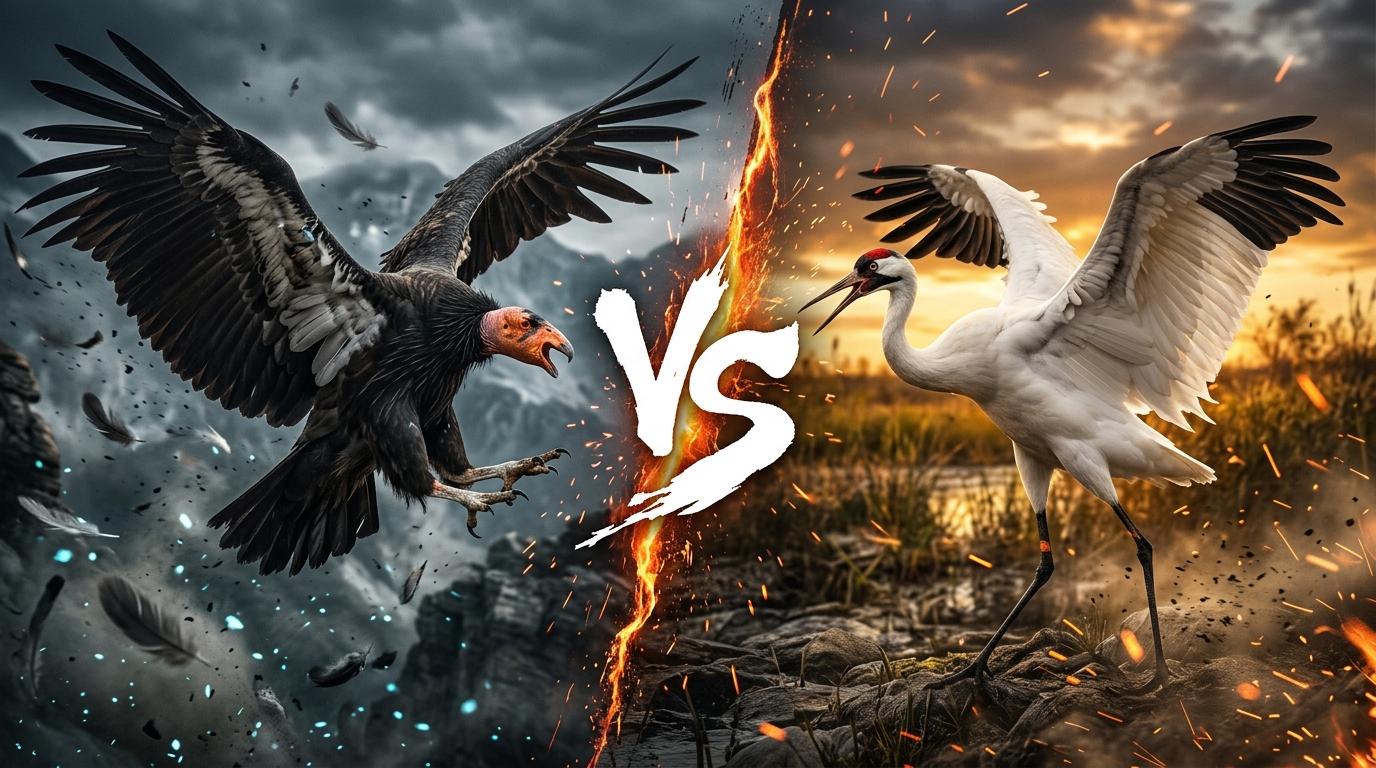
California Condor vs Whooping Crane: Who Actually Wins?
California Condor vs Whooping Crane: who would win? A biology-first breakdown of size, beaks, wings, temperament and the scenarios where each giant bird holds the edge.
California Condor vs Whooping Crane
Matchup winner
California Condor
Quick verdict
Start with the direct answer, then use the structured comparison below to see what changes the outcome.
The California Condor wins this clash of North American giants, but narrowly and mainly on mass. A condor weighs roughly 8–12 kg and can reach about 14 kg, with a wingspan near 2.9 m (9.5 ft). A whooping crane stands about 1.5 m tall, the tallest bird in North America, but usually weighs only 6–7.5 kg. The condor also carries a thick, hooked beak built to tear through cattle and elk hide, and it has years of practice shoving through crowded carcass scrums. The crane is the more willing fighter. Its dagger bill strikes fast at eye level, and its long legs deliver real kicks, so on its own nesting marsh it can drive the condor off. In a general confrontation, though, especially over food on open ground, the condor's bulk, its wing-mantling threat displays and its comfort with physical jostling make it the likelier bird to hold its position.
Read the full explanation
Overall winner: California Condor, with a modest edge built on weight and a hide-tearing beak.
The whooping crane is more aggressive and has the more dangerous weapon, a fast stabbing bill aimed at the face.
At a carcass or contested food on open ground, the condor's scramble experience and bulk usually decide it.
On the crane's breeding territory, the crane's defensive aggression can flip the result.
Reader vote
Who do you think wins?
Pick a side — no account needed. Results update live.
No votes yet — be the first to call it.
Editorial note
Why people disagree
Height fools people. The crane looks bigger standing up, but the condor is clearly heavier and has a far wider wingspan.
Raw mass
In bird confrontations, the heavier animal usually wins the shove and keeps the ground.
Reach and frame
The crane's height lets it strike downward at the condor's head from outside the condor's reach.
Primary weapon
A stabbing bill aimed at the eyes is the more dangerous offensive tool in a short exchange.
Read the full explanation +
Condors are scavengers with weak, flat feet and no killing talons, so some readers assume they can't fight. In practice they win plenty of shoving matches at carcasses.
Cranes are famously combative, and captive cranes have injured handlers. That leads some to rank the crane's bill above the condor's mass.
Comparison FAQ
Short, direct answers to the next questions readers usually ask after the headline verdict.
Would a California Condor beat a Whooping Crane in a fight?+
Usually, yes. The condor is heavier and more used to physical shoving contests, so it would likely win a general confrontation. The crane could win when defending its nest.
Which bird is stronger, the condor or the whooping crane?+
The condor. It can weigh nearly twice as much as a crane and has a powerful beak built for tearing thick hide.
Which is bigger, a California Condor or a Whooping Crane?+
The crane is taller at about 1.5 m. The condor is heavier and has the larger wingspan, around 2.9 m against the crane's 2.3 m.
Why is the whooping crane still dangerous to a condor?+
Its long, dagger-like bill strikes fast at head height and can target the eyes, and its kicks are strong. Cranes are known to injure much larger animals, including people.
Do condors and whooping cranes ever meet in the wild?+
Almost never. Condors live mainly in the mountains and canyons of California, Arizona, Utah and Baja California. Whooping cranes breed in Canada and winter on the Texas coast.
Head-to-head species stats
These are the same core AnimalDex stat dimensions used on the dedicated animal pages, pulled side by side so the matchup is faster to scan.
California Condor
Tier BWhooping Crane
Tier CTrait-by-trait comparison
Only the categories that matter to this matchup are included. The goal is not filler stats, but the real design differences that change the result.
8–14 kg, broad and heavy-bodied
Raw mass
California Condor
6–7.5 kg, lean and long-limbed
Raw mass
California Condor
~2.9 m wingspan, low stance
Reach and frame
Whooping Crane
~1.5 m tall, ~2.3 m wingspan
Reach and frame
Whooping Crane
Thick hooked beak for tearing hide
Primary weapon
Whooping Crane
Long dagger bill for fast jabs
Primary weapon
Whooping Crane
Dense body, heavy wings to buffet
Close-range durability
California Condor
Thin legs and neck, lighter build
Close-range durability
California Condor
Displays and jostles, rarely presses an attack
Combat temperament
Whooping Crane
Territorial, quick to charge and kick
Combat temperament
Whooping Crane
Constant dominance fights at carcasses
Scramble experience
California Condor
Ritual displays and territorial chases
Scramble experience
California Condor
How the verdict forms
Verdict timeline
01 · Raw mass
California Condor
02 · Reach and frame
Whooping Crane
03 · Primary weapon
Whooping Crane
04 · Close-range durability
California Condor
05 · Combat temperament
Whooping Crane
06 · Scramble experience
California Condor
Change the conditions
Scenario breakdown
This is where shallow battle content usually fails. Terrain, spacing, timing, and engagement style can change the answer.
Scenario lean
California Condor
Verdict confidence
82%
The condor keeps the food.
This is condor home turf. Condors settle disputes at carcasses with spread-wing mantling, lunges and body shoves, and they routinely push ravens and turkey vultures aside. The crane has little interest in carrion and gains nothing by escalating over it. The condor's mass and its willingness to crowd its rival should hold the prize.
AnimalDex field profiles
Explore these animals
California Condor
Gymnogyps californianus
Mountainous open country, canyon systems, coastal ranges, and wide dry landscapes.
Whooping Crane
Grus americana
Marshes, wetlands, shallow coastal flats, and prairie pothole systems.
Systems Intelligence & Hidden Purpose
See the animals behind this comparison as engineered biological systems: what each one is built to do, where it gains leverage, and why the matchup changes by scenario.
Specialized Hardware
Huge black wings with white patches, bare pink-orange head, and very broad soaring silhouette give the California Condor a body plan tuned for its niche.
Systems Script
California Condors operate in mountainous open country, canyon systems, coastal ranges, and wide dry landscapes. Their design helps them match food access, shelter, and timing inside that environment.
Strategic Insight
Big systems sometimes survive only when many smaller systems decide they are worth saving.
Specialized Hardware
Tall white body with red crown, long black legs and neck, and deep bugling voice give the Whooping Crane a body plan tuned for its niche.
Systems Script
Whooping Cranes operate in marshes, wetlands, shallow coastal flats, and prairie pothole systems. Their design helps them match food access, shelter, and timing inside that environment.
Strategic Insight
Long journeys only work when safe stopping places still exist along the way.
Final take
The California Condor wins this matchup on the fundamentals that usually decide bird confrontations: weight, a sturdy frame, and practice at physical dominance contests. It is no raptor, and its feet can't grip or kill, but it doesn't need to. It wins by refusing to be moved.
Read the full explanation
The whooping crane is the more dangerous bird in a single sharp exchange. A well-aimed bill strike to the eye can end any contest, and on its own marsh the crane defends with real ferocity. That is why our confidence stays moderate rather than overwhelming.
Neither bird should ever be tested this way. Both are among North America's rarest birds and were each reduced to only a couple of dozen individuals in the 20th century before conservation programs pulled them back. Real encounters between them are essentially nonexistent.
Collect both animals in AnimalDex
Track the species behind this matchup, compare their real traits, and build the rivalry into your AnimalDex collection.
Related comparisons
Continue with nearby matchups to compare more real-world animal traits without dropping into junky who-wins filler.
California Condor vs Greater Roadrunner: Who Actually Wins?
The California Condor wins this matchup clearly. A condor weighs roughly 8–11 kg with a wingspan near 3 meters, while a roadrunner tips the scales at about 300 grams. That gap is more than twenty-fold, and it decides almost everything. The condor is not a hunter. Its feet are weak and built for walking, and its hooked bill is designed to tear carrion, not to kill. Even so, sheer mass, a powerful bill and a dominance-driven social style let it displace nearly any small bird at a carcass. The roadrunner is a fast, pugnacious ground predator that kills rattlesnakes and lizards with rapid bill strikes. It would win any race on foot and could peck painfully, but it has no tool that can seriously hurt a bird thirty times its weight. In a realistic confrontation, the condor holds its ground or shoulders the roadrunner away, and the roadrunner wisely leaves.
Read comparison
Black Vulture vs California Condor: Who Actually Wins?
The California Condor wins. It weighs roughly 8–11 kg and has a wingspan near 2.9 m, about four times the mass of a 1.6–2.8 kg Black Vulture. At a carcass, that size gap decides almost everything. Condors sit at or near the top of the North American scavenger pecking order and routinely push smaller vultures off a kill through body mass, wing-spread displays, and lunging bites from a heavy, hooked bill. The Black Vulture is bold, quick on the ground, and famously pushy, but one-on-one it is a mid-weight bird trying to bully a heavyweight. Its real strength is numbers. A dense, cooperative mob of Black Vultures can crowd, harass, and strip a carcass faster than a lone condor can defend it. That keeps the matchup interesting, but it does not overturn the solo verdict.
Read comparison
Discussion
What do you think?
Share your reasoning with other readers. Be civil and stick to the animals.
Sign in to join the discussion.
Sign inNo comments yet. Start the conversation.