

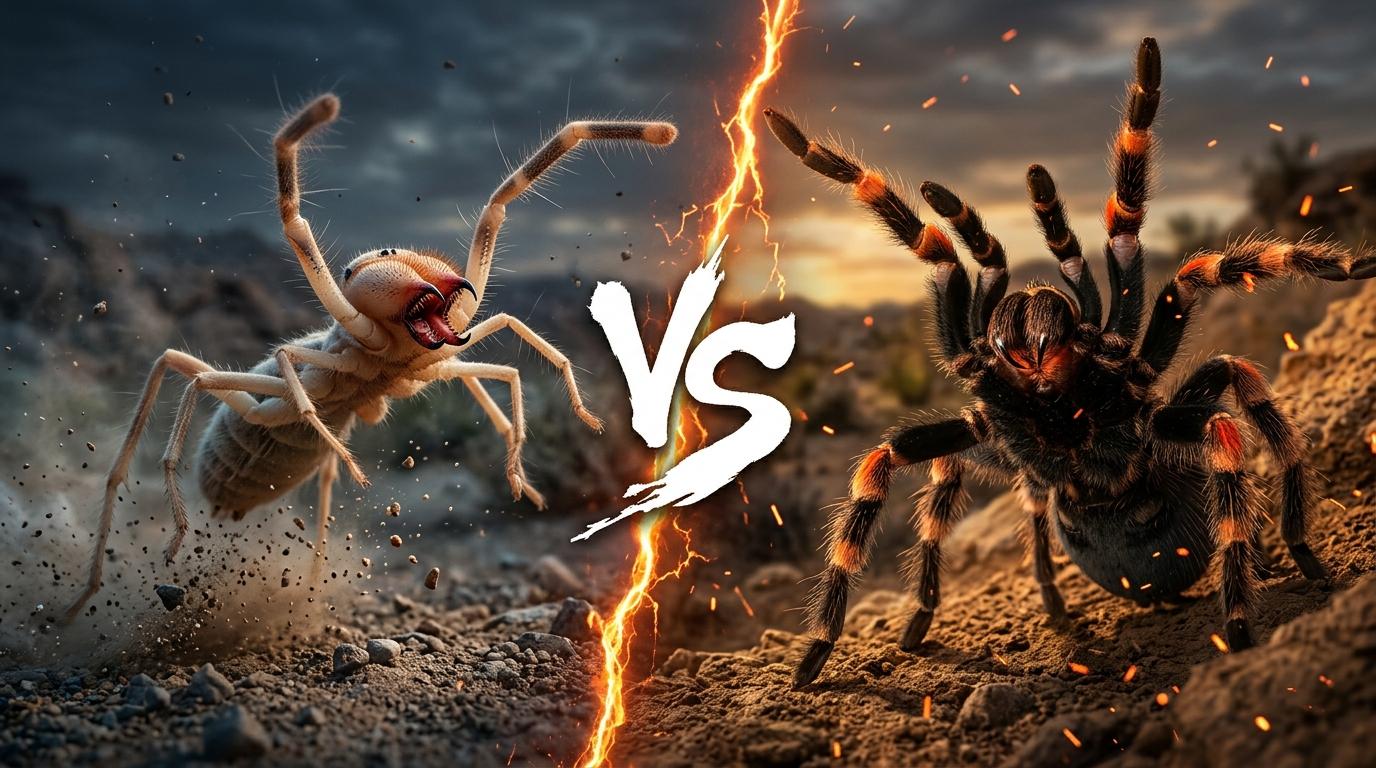
Camel Spider vs Red-kneed Tarantula: Who Actually Wins?
Camel spider vs red-kneed tarantula: speed and crushing jaws against bulk, fangs, venom, and irritating hairs. See who wins, why, and how the setting changes the result.
Camel Spider vs Red-kneed Tarantula
Matchup winner
Red-kneed Tarantula
Quick verdict
Start with the direct answer, then use the structured comparison below to see what changes the outcome.
The red-kneed tarantula wins more often than not. A mature Brachypelma hamorii brings a heavier, sturdier body, downward-striking fangs with venom, and a coat of barbed urticating hairs it can kick into an attacker's face. Galeodes arabs, the Arabian camel spider, is the faster and more aggressive animal. Its huge crushing chelicerae can do brutal damage if it lands a clean grip on the tarantula's abdomen. That is the camel spider's whole path to victory, though: strike first and fast, or lose. Once the tarantula braces in a threat posture, its size, fangs, and hair defense turn the fight into a war of attrition. The camel spider has no venom and depends on raw tearing, so it is badly suited to that kind of fight. Against an adult, burrow-anchored tarantula, bet on the tarantula.
Read the full explanation
Overall winner: red-kneed tarantula, mostly through size, venom, and urticating hairs.
The camel spider's best chance is a lightning ambush on open ground before the tarantula sets its defense.
Camel spiders have no venom. Their weapon is mechanical crushing with oversized jaws.
The longer the fight runs, the more it favors the tarantula.
Reader vote
Who do you think wins?
Pick a side — no account needed. Results update live.
No votes yet — be the first to call it.
Editorial note
Why people disagree
Viral clips usually show camel spiders shredding smaller or juvenile tarantulas, which badly misrepresents a fight against a full-grown Brachypelma.
Explosive power
The camel spider decides the opening seconds, which is its only reliable window.
Body mass and frame
Extra mass helps the tarantula absorb grips and pin a smaller attacker.
Primary weaponry
Venom keeps working after the bite. Crushing only works while the grip lasts.
Read the full explanation +
Camel spider speed and ferocity look decisive on camera. Tarantula defenses like hair-flicking and fang posture are quieter and easier to miss.
These animals come from different continents and never meet in the wild, so every claimed outcome is a hypothetical or a captive staging.
Comparison FAQ
Short, direct answers to the next questions readers usually ask after the headline verdict.
Would a camel spider beat a red-kneed tarantula?+
Usually not against a full-grown tarantula. It can win with a fast ambush, but most fights favor the tarantula.
Which is stronger?+
The tarantula is heavier and sturdier. The camel spider has proportionally huge jaws and more explosive speed.
Is the camel spider venomous?+
No. Solifugids have no venom glands and kill by crushing and tearing with their chelicerae.
Why is the camel spider still dangerous in a loss?+
Its jaws can tear open a tarantula's abdomen in seconds. One clean grip can be fatal even if the tarantula controlled the rest of the fight.
Are either dangerous to humans?+
Neither is medically significant. A camel spider bite can be painful, and tarantula hairs can irritate skin and eyes.
Head-to-head species stats
These are the same core AnimalDex stat dimensions used on the dedicated animal pages, pulled side by side so the matchup is faster to scan.
Camel Spider
Tier CRed-kneed Tarantula
Tier DTrait-by-trait comparison
Only the categories that matter to this matchup are included. The goal is not filler stats, but the real design differences that change the result.
Sprinting lunges, rapid jaw strikes
Explosive power
Camel Spider
Short, deliberate rearing strikes
Explosive power
Camel Spider
Lean, long-legged desert runner
Body mass and frame
Red-kneed Tarantula
Stocky, heavy-bodied adult
Body mass and frame
Red-kneed Tarantula
Massive crushing chelicerae, no venom
Primary weaponry
Red-kneed Tarantula
Paired fangs with venom
Primary weaponry
Red-kneed Tarantula
None notable
Passive defense
Red-kneed Tarantula
Kicked barbed urticating hairs
Passive defense
Red-kneed Tarantula
Fast forager, hits whatever it finds
Ambush control
Camel Spider
Burrow sit-and-wait predator
Ambush control
Camel Spider
Fast but burns energy quickly
Close-range durability
Red-kneed Tarantula
Patient, sturdy, long-lived
Close-range durability
Red-kneed Tarantula
How the verdict forms
Verdict timeline
01 · Explosive power
Camel Spider
02 · Body mass and frame
Red-kneed Tarantula
03 · Primary weaponry
Red-kneed Tarantula
04 · Passive defense
Red-kneed Tarantula
05 · Ambush control
Camel Spider
06 · Close-range durability
Red-kneed Tarantula
Change the conditions
Scenario breakdown
This is where shallow battle content usually fails. Terrain, spacing, timing, and engagement style can change the answer.
Scenario lean
Red-kneed Tarantula
Verdict confidence
82%
Tarantula, clearly.
At its burrow mouth, the tarantula faces outward with its fangs ready and its flanks protected. The camel spider can't flank it or reach the soft abdomen, so it would have to attack straight into the fangs and the hair cloud.
AnimalDex field profiles
Explore these animals
Camel Spider
Galeodes arabs
desert, rocky plain, and arid scrub
Red-kneed Tarantula
Brachypelma hamorii
dry forest, thorn scrub, and semi-arid grassland
Systems Intelligence & Hidden Purpose
See the animals behind this comparison as engineered biological systems: what each one is built to do, where it gains leverage, and why the matchup changes by scenario.
Specialized Hardware
huge forward chelicerae, fast desert sprinting legs, and night-active open-ground hunting give the Camel Spider a body plan tuned for its niche.
Systems Script
Camel Spiders operate through desert, rocky plain, and arid scrub. Their design links movement, feeding, shelter, and timing into one workable survival system.
Strategic Insight
Harsh places reward efficiency, timing, and bodies that waste very little.
Specialized Hardware
black velvet body, orange-red knee bands, and burrow-front threat display give the Red-kneed Tarantula a body plan tuned for its niche.
Systems Script
Red-kneed Tarantulas operate through dry forest, thorn scrub, and semi-arid grassland. Their design links movement, feeding, shelter, and timing into one workable survival system.
Strategic Insight
Harsh places reward efficiency, timing, and bodies that waste very little.
Final take
Speed versus staying power is the core of this matchup. The camel spider is a sprint-and-crush specialist built for desert foraging. The red-kneed tarantula is a fortress predator built to hold ground.
Read the full explanation
Give the camel spider surprise on open sand and it can win. In most realistic setups, though, the adult tarantula's mass, venom, and urticating hairs carry the fight. The red-kneed tarantula is our overall winner.
Collect both animals in AnimalDex
Track the species behind this matchup, compare their real traits, and build the rivalry into your AnimalDex collection.
Related comparisons
Continue with nearby matchups to compare more real-world animal traits without dropping into junky who-wins filler.

Camel Spider vs Trapdoor Spider: Who Actually Wins?
The camel spider (Galeodes arabs) wins this matchup in most realistic encounters. It is a larger, far faster, actively hunting solifuge armed with huge two-part chelicerae that crush and shear prey. Those jaws act like pincers on steroids, and the camel spider can sustain a running pursuit across open sand. The trapdoor spider (Cteniza sauvagesi) is a compact, slow-moving mygalomorph built for one thing: waiting inside a silk-lined, hinged burrow and striking whatever trips its signal lines. That design makes it formidable at its own doorway but poorly suited to a stand-up contest against a mobile predator that outsizes it, outpaces it and outbites it mechanically. Note that neither animal is dangerous to people. Camel spiders are not venomous, and this trapdoor species' venom is medically trivial to humans. Here the contest is about raw arachnid mechanics, and the camel spider has the stronger toolkit.
Read comparison
Giant Forest Scorpion vs Red-kneed Tarantula: Who Actually Wins?
The Giant Forest Scorpion (Heterometrus swammerdami) wins most realistic encounters. It is one of the largest scorpions alive, often 16–23 cm long, and its build is made for this kind of fight. Thick, heavily sclerotized armor blunts the tarantula's best weapon, a downward fang strike that needs a soft joint or seam to work. Massive crushing pincers can grip and pin the tarantula's long, comparatively fragile legs before it sets up a bite. The scorpion's venom is mild for its size, so it fights mostly with its claws. Those claws are the right tool for disabling a spider whose whole offense depends on getting close enough to bite. The Red-kneed Tarantula (Brachypelma hamorii) is no pushover. Its fangs are heavy and it has a defensive kit, but its main deterrent is a cloud of urticating hairs. Those hairs evolved to irritate the eyes and soft tissue of mammals and do little against an armored arthropod. If the tarantula lands a clean bite into a joint early, it can win. Over the course of a struggle, though, armor and grip favor the scorpion.
Read comparison
Camel Spider vs Desert Horned Viper: Who Actually Wins?
The Desert Horned Viper wins this one, and it isn't especially close. A camel spider (Galeodes arabs) is a fast, ferocious solifuge with huge crushing chelicerae, but it has no venom and averages around 10–15 cm across its legs. Cerastes cerastes is a 30–60 cm sand-buried ambush predator with a strike measured in milliseconds and a hemotoxic venom built to subdue prey many times heavier than any solifuge. The camel spider's whole strategy is to sprint in and seize. That puts it right into the strike envelope of a snake whose entire design is to wait for something warm and moving to come close. One envenomating bite ends the contest, while the spider has to land repeated, well-placed chelicerae bites through scales to do serious damage. The viper also has a big mass advantage and the patience edge, so it takes most realistic encounters.
Read comparison
Camel Spider vs Vinegaroon: Who Actually Wins?
The camel spider (Galeodes arabs) wins most encounters. It is a fast, aggressive solifuge built around huge paired chelicerae that work like crushing scissors, and it hunts by charging, seizing and shredding. The vinegaroon (order Uropygi, whip scorpions) is slower and more deliberate. It relies on stout pedipalp claws, a hardened body and a spray of concentrated acetic acid from a gland at the base of its whip-like tail. That acid spray is a real deterrent that can stall or repel an attacker. Still, the camel spider's speed and bite force let it control the opening seconds and target the vinegaroon's body before the chemical defense decides things. In a sustained clash, the solifuge's offensive hardware usually outweighs the whip scorpion's defensive kit.
Read comparison
Discussion
What do you think?
Share your reasoning with other readers. Be civil and stick to the animals.
Sign in to join the discussion.
Sign inNo comments yet. Start the conversation.