

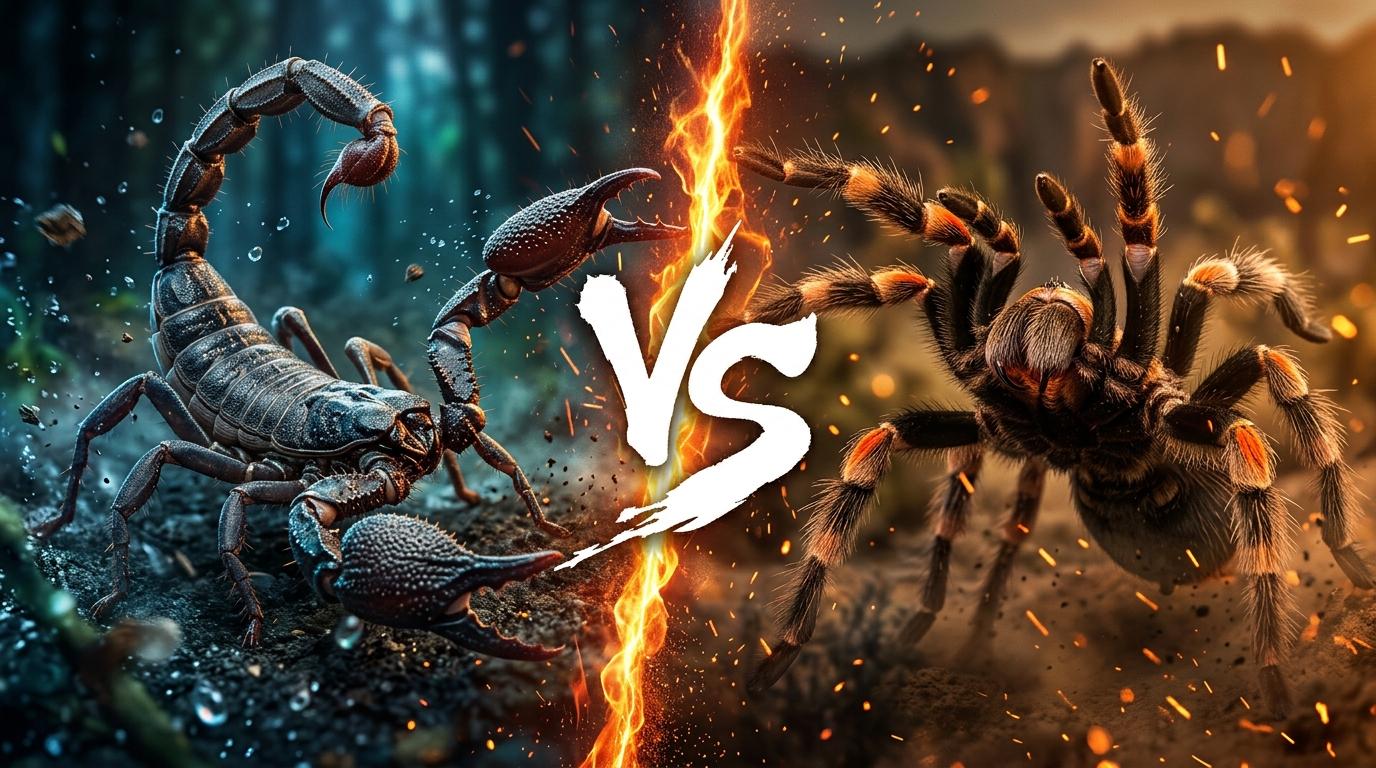
Giant Forest Scorpion vs Red-kneed Tarantula: Who Actually Wins?
Giant Forest Scorpion vs Red-kneed Tarantula: armor, pincers, fangs and urticating hairs compared, with a clear verdict on who wins a fight between two heavyweight arachnids.
Giant Forest Scorpion vs Red-kneed Tarantula
Matchup winner
Giant Forest Scorpion
Quick verdict
Start with the direct answer, then use the structured comparison below to see what changes the outcome.
The Giant Forest Scorpion (Heterometrus swammerdami) wins most realistic encounters. It is one of the largest scorpions alive, often 16–23 cm long, and its build is made for this kind of fight. Thick, heavily sclerotized armor blunts the tarantula's best weapon, a downward fang strike that needs a soft joint or seam to work. Massive crushing pincers can grip and pin the tarantula's long, comparatively fragile legs before it sets up a bite. The scorpion's venom is mild for its size, so it fights mostly with its claws. Those claws are the right tool for disabling a spider whose whole offense depends on getting close enough to bite. The Red-kneed Tarantula (Brachypelma hamorii) is no pushover. Its fangs are heavy and it has a defensive kit, but its main deterrent is a cloud of urticating hairs. Those hairs evolved to irritate the eyes and soft tissue of mammals and do little against an armored arthropod. If the tarantula lands a clean bite into a joint early, it can win. Over the course of a struggle, though, armor and grip favor the scorpion.
Read the full explanation
Winner: Giant Forest Scorpion, in roughly 7 of 10 realistic encounters.
Armor plus crushing pincers beats a bite-first attacker that needs soft openings.
The tarantula's urticating hairs are built for mammals, not armored arachnids.
The tarantula's upset path is an early, precise fang strike into a leg joint or the scorpion's softer underside.
Reader vote
Who do you think wins?
Pick a side — no account needed. Results update live.
No votes yet — be the first to call it.
Editorial note
Why people disagree
App stats rate the tarantula slightly higher on dominance and intelligence, but those numbers miss the matchup-specific value of armor and pincers.
Close-range durability
Fang-based predators need a soft entry point, and the scorpion offers very few of them.
Grip and pin control
Whoever controls the opponent's limbs controls the fight, and pincers are purpose-built for that job.
Single-strike damage
One well-placed tarantula bite is the most dangerous single event in this matchup.
Read the full explanation +
Tarantula fangs look terrifying. Fang size matters less than whether the fangs can find a weak point, and the scorpion offers few.
People assume a giant scorpion wins with venom. Heterometrus venom is fairly weak, so the claws do the real work.
Comparison FAQ
Short, direct answers to the next questions readers usually ask after the headline verdict.
Would a Giant Forest Scorpion beat a Red-kneed Tarantula?+
Usually, yes. Its armor resists fang strikes and its pincers can pin the tarantula's legs. We estimate it wins about 70% of realistic encounters.
Which is stronger, the scorpion or the tarantula?+
The Giant Forest Scorpion is stronger in grip and crushing force thanks to its massive pincers. The tarantula hits harder with a single bite but has no comparable grappling power.
Is the Giant Forest Scorpion's venom deadly?+
No. Heterometrus venom is relatively mild. In a fight it relies mainly on its claws, not its sting.
Why is the Red-kneed Tarantula still dangerous in this fight?+
Its large fangs and prey venom can disable the scorpion if it lands an early bite into a joint or the softer underside. It is the fastest way either animal can end the fight.
Do tarantula hairs work against scorpions?+
Not well. Urticating hairs mainly irritate mammal eyes and skin, and an armored arachnid is largely unaffected.
Head-to-head species stats
These are the same core AnimalDex stat dimensions used on the dedicated animal pages, pulled side by side so the matchup is faster to scan.
Giant Forest Scorpion
Tier DRed-kneed Tarantula
Tier DTrait-by-trait comparison
Only the categories that matter to this matchup are included. The goal is not filler stats, but the real design differences that change the result.
Thick, heavily sclerotized plating
Close-range durability
Giant Forest Scorpion
Softer abdomen, thinner leg cuticle
Close-range durability
Giant Forest Scorpion
Massive crushing pedipalp pincers
Grip and pin control
Giant Forest Scorpion
Leg grip with hooked claws, no crushing tool
Grip and pin control
Giant Forest Scorpion
Mild venom, sting rarely decisive
Single-strike damage
Red-kneed Tarantula
Large downward fangs, prey-subduing venom
Single-strike damage
Red-kneed Tarantula
Stridulation warning and claw display
Deterrent kit
Giant Forest Scorpion
Urticating hairs and threat posture
Deterrent kit
Giant Forest Scorpion
Long, dense body, very heavy for a scorpion
Heft and leverage
Giant Forest Scorpion
Bulky body with long legspan
Heft and leverage
Giant Forest Scorpion
Pincers extend reach forward
Reach and burst
Red-kneed Tarantula
Quick lunge, slightly faster overall
Reach and burst
Red-kneed Tarantula
How the verdict forms
Verdict timeline
01 · Close-range durability
Giant Forest Scorpion
02 · Grip and pin control
Giant Forest Scorpion
03 · Single-strike damage
Red-kneed Tarantula
04 · Deterrent kit
Giant Forest Scorpion
05 · Heft and leverage
Giant Forest Scorpion
06 · Reach and burst
Red-kneed Tarantula
Change the conditions
Scenario breakdown
This is where shallow battle content usually fails. Terrain, spacing, timing, and engagement style can change the answer.
Scenario lean
Giant Forest Scorpion
Verdict confidence
82%
The scorpion's home ground.
Heterometrus are burrowing ambushers, and tight spaces cancel the tarantula's legspan and lunge. In close quarters the pincers seize legs immediately and the armor absorbs fang attempts. This is the scorpion's most lopsided win.
AnimalDex field profiles
Explore these animals
Giant Forest Scorpion
Heterometrus swammerdami
humid forest floor, plantation edge, and tropical scrub
Red-kneed Tarantula
Brachypelma hamorii
dry forest, thorn scrub, and semi-arid grassland
Systems Intelligence & Hidden Purpose
See the animals behind this comparison as engineered biological systems: what each one is built to do, where it gains leverage, and why the matchup changes by scenario.
Specialized Hardware
massive black clawed body, thick defensive pincers, and night burrow waiting give the Giant Forest Scorpion a body plan tuned for its niche.
Systems Script
Giant Forest Scorpions operate through humid forest floor, plantation edge, and tropical scrub. Their design links movement, feeding, shelter, and timing into one workable survival system.
Strategic Insight
Dense environments reward precision, patience, and the ability to read layered cover.
Specialized Hardware
black velvet body, orange-red knee bands, and burrow-front threat display give the Red-kneed Tarantula a body plan tuned for its niche.
Systems Script
Red-kneed Tarantulas operate through dry forest, thorn scrub, and semi-arid grassland. Their design links movement, feeding, shelter, and timing into one workable survival system.
Strategic Insight
Harsh places reward efficiency, timing, and bodies that waste very little.
Final take
The Giant Forest Scorpion wins this matchup because its defenses and weapons line up exactly against the tarantula's plan. The spider must get close and find soft tissue. The scorpion is covered in armor and carries two crushing clamps that punish anything that gets close.
Read the full explanation
The Red-kneed Tarantula stays genuinely dangerous. Its fangs are the most damaging single weapon in the fight, and a fast, well-aimed first strike is a real path to victory. Over most realistic encounters, though, the armored grappler outlasts the precision biter.
Collect both animals in AnimalDex
Track the species behind this matchup, compare their real traits, and build the rivalry into your AnimalDex collection.
Related comparisons
Continue with nearby matchups to compare more real-world animal traits without dropping into junky who-wins filler.
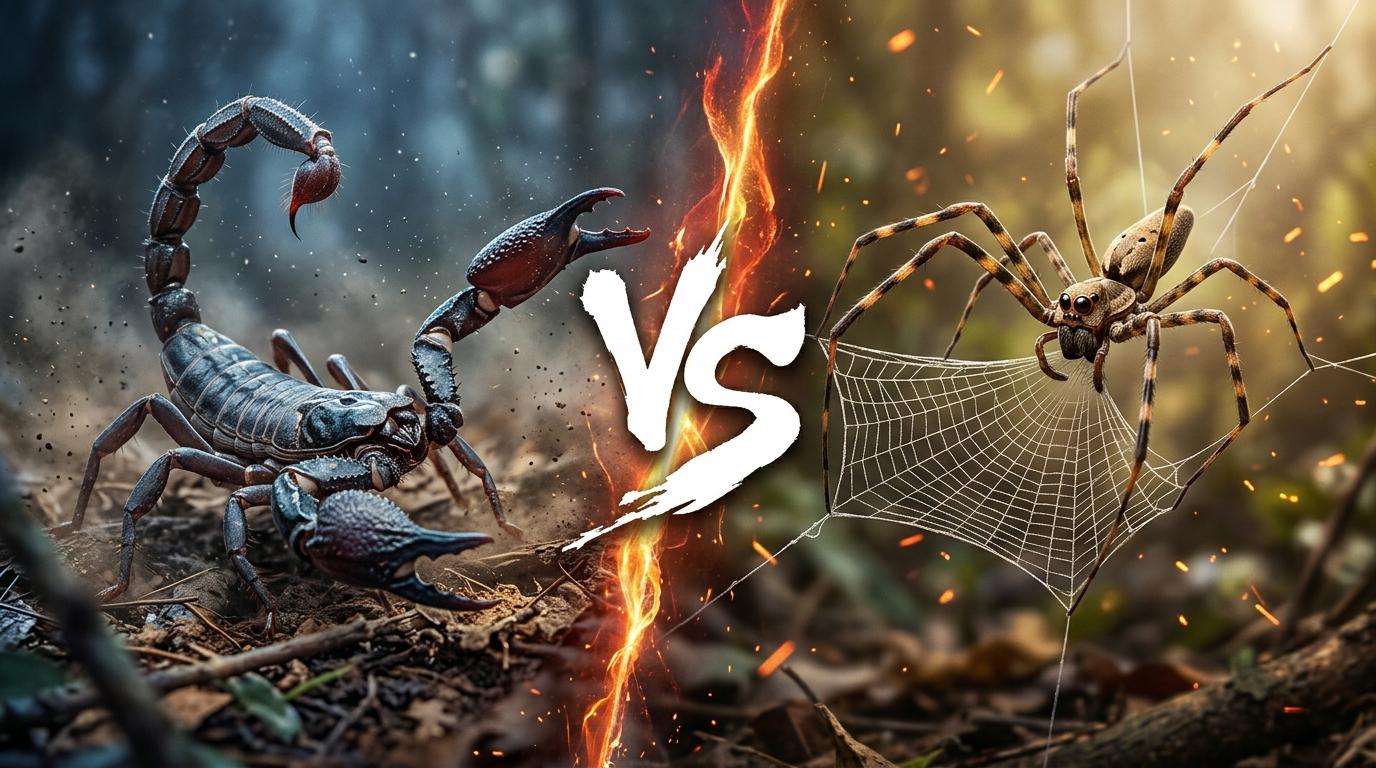
Giant Forest Scorpion vs Ogre-faced Spider: Who Actually Wins?
The Giant Forest Scorpion wins, and it is not close in a direct confrontation. Heterometrus swammerdami is one of the largest scorpions alive, with adults commonly reaching 15–20 cm and built around thick, crushing pedipalps and a hardened exoskeleton. Deinopis spinosa is a slender, stick-like spider roughly 2–2.5 cm long whose whole strategy depends on hanging motionless and casting a silk net over passing prey. The ogre-faced spider's huge posterior median eyes make it one of the best low-light hunters among invertebrates, but its net is sized for crickets, ants and moths, not a heavily armored animal many times its mass. Once the scorpion's pincers close, the spider has no armor, leverage or venom strong enough to change the outcome. The spider wins only by never being found.
Read comparison
Discussion
What do you think?
Share your reasoning with other readers. Be civil and stick to the animals.
Sign in to join the discussion.
Sign inNo comments yet. Start the conversation.