


Canada Lynx vs Grizzly Bear: Who Actually Wins?
Canada lynx vs grizzly bear: who would win? A biology-first breakdown of size, power, weapons and behavior shows why the grizzly wins decisively, and why the lynx still matters.
Canada Lynx vs Grizzly Bear
Matchup winner
Grizzly Bear
Quick verdict
Start with the direct answer, then use the structured comparison below to see what changes the outcome.
The grizzly bear wins, and it is not close. An adult grizzly typically weighs 180–360 kg against a Canada lynx's 8–14 kg, so the bear can outweigh the cat by twenty to forty times. The lynx is a precision snowshoe-hare specialist. It is built for silent stalking, deep-snow flotation and short pounces on prey smaller than itself. The grizzly is a shoulder-humped digging and crushing machine. It has 5–10 cm claws, a bite strong enough to crack bone, and a thick hide and fat layer that shrug off small-predator slashes. In any direct confrontation the lynx's best move is to avoid the bear entirely by climbing, slipping away or ceding a carcass. In nature that is exactly what lynx do.
Read the full explanation
Grizzly bear wins overwhelmingly. It is roughly 20–40x heavier than a Canada lynx.
Lynx weapons are tuned for hares, not for penetrating a bear's fur, fat and muscle.
The lynx's real advantage is escape: tree climbing, snow agility and stealth.
Grizzlies routinely displace smaller predators from carcasses. Lynx yield rather than fight.
Reader vote
Who do you think wins?
Pick a side — no account needed. Results update live.
No votes yet — be the first to call it.
Editorial note
Why people disagree
People see 'wild cat' and imagine big-cat ferocity. The Canada lynx is a medium-small cat closer in size to a large house cat or bobcat than to a cougar.
Mass and frame
A mass gap this large decides nearly every physical contest before tactics enter the picture.
Explosive power
The grizzly's hump is a muscle anchor for digging and striking, delivering force the lynx cannot absorb.
Natural weapons
Lynx weapons are built for gripping light prey. Bear weapons are built for tearing earth and large carcasses.
Read the full explanation +
Speed stats look similar on paper, but grizzlies sprint near 55 km/h in short bursts. The lynx wins on snow and climbing, not on flat-out pace.
Some argue agility beats size. That holds only when the smaller animal is fleeing. It does not hold when it tries to win a fight.
Comparison FAQ
Short, direct answers to the next questions readers usually ask after the headline verdict.
Would a Canada lynx beat a grizzly bear?+
No. A grizzly would win almost every confrontation because it is roughly 20–40 times heavier and far more heavily armed.
Which is stronger, a lynx or a grizzly?+
The grizzly is vastly stronger. Its shoulder musculature powers digging and strikes that dwarf anything a lynx can produce.
Why is the lynx still dangerous?+
Its sharp claws, quick reflexes and teeth can injure a bear's face or paws, and it is a lethal hunter of hares. Mostly, though, it stays safe by avoiding bears through stealth, climbing and snow mobility.
Do grizzlies and lynx meet in the wild?+
Their ranges overlap in Alaska and western Canada. Encounters are rare, and lynx typically avoid bears or give up food.
Could a lynx escape a grizzly?+
Often, yes. In deep snow or near trees, the lynx's agility gives it a strong chance to get away.
Head-to-head species stats
These are the same core AnimalDex stat dimensions used on the dedicated animal pages, pulled side by side so the matchup is faster to scan.
Canada Lynx
Tier BGrizzly Bear
Tier BTrait-by-trait comparison
Only the categories that matter to this matchup are included. The goal is not filler stats, but the real design differences that change the result.
8–14 kg, lightly built
Mass and frame
Grizzly Bear
180–360 kg, heavy-boned
Mass and frame
Grizzly Bear
Quick hare-catching pounce
Explosive power
Grizzly Bear
Shoulder-driven swipes that break bone
Explosive power
Grizzly Bear
Short, sharp retractable claws, small canines
Natural weapons
Grizzly Bear
Long fixed claws, crushing bite
Natural weapons
Grizzly Bear
Thin frame, dense winter fur
Close-range durability
Grizzly Bear
Thick hide, fat reserves, heavy musculature
Close-range durability
Grizzly Bear
Silent, patient snow stalker
Ambush control
Canada Lynx
Powerful but conspicuous forager
Ambush control
Canada Lynx
Snowshoe paws, strong climber
Snow and canopy escape
Canada Lynx
Adults climb poorly and sink in deep snow
Snow and canopy escape
Canada Lynx
How the verdict forms
Verdict timeline
01 · Mass and frame
Grizzly Bear
02 · Explosive power
Grizzly Bear
03 · Natural weapons
Grizzly Bear
04 · Close-range durability
Grizzly Bear
05 · Ambush control
Canada Lynx
06 · Snow and canopy escape
Canada Lynx
Change the conditions
Scenario breakdown
This is where shallow battle content usually fails. Terrain, spacing, timing, and engagement style can change the answer.
Scenario lean
Grizzly Bear
Verdict confidence
82%
Grizzly wins if contact happens.
Dense forest helps the lynx hide and approach. But a surprise attack gains nothing when the target outweighs you by hundreds of kilograms and is armored in fur and fat. Once the bear turns, the encounter ends quickly in its favor.
AnimalDex field profiles
Explore these animals
Canada Lynx
Lynx canadensis
Boreal forest, snowy woodland, and sub-Arctic forest systems.
Grizzly Bear
Ursus arctos horribilis
mountain forest, river valley, alpine meadow, and northern scrub
Systems Intelligence & Hidden Purpose
See the animals behind this comparison as engineered biological systems: what each one is built to do, where it gains leverage, and why the matchup changes by scenario.
Specialized Hardware
Ear tufts and short black-tipped tail, very large furry feet, and long legs and thick winter coat give the Canada Lynx a body plan tuned for its niche.
Systems Script
Canada Lynxs operate in boreal forest, snowy woodland, and sub-Arctic forest systems. Their design helps them match food access, shelter, and timing inside that environment.
Strategic Insight
Specialized footing can decide the whole contest when the ground is difficult.
Final take
The grizzly bear is the clear winner. Its mass, weapons, durability and dominance make a fight with a Canada lynx a mismatch.
Read the full explanation
The lynx is not a failure; it is a specialist. Its whole design targets snowshoe hares, and its winning strategy against a bear is invisibility and escape. In the boreal forest, both animals coexist precisely because the lynx never makes this a fight.
Collect both animals in AnimalDex
Track the species behind this matchup, compare their real traits, and build the rivalry into your AnimalDex collection.
Related comparisons
Continue with nearby matchups to compare more real-world animal traits without dropping into junky who-wins filler.

Canada Lynx vs Eurasian Lynx: Who Actually Wins?
The Eurasian lynx wins, and it isn't especially close in a straight confrontation. It is the largest lynx species. Adult males commonly weigh 18–30 kg, against roughly 8–14 kg for a Canada lynx, so it often brings double the body mass. Its build is made for killing roe deer and chamois, prey many times heavier than the snowshoe hares that dominate the Canada lynx's diet. That means heavier forelimbs, a stronger bite, and practiced experience controlling large, struggling animals. The Canada lynx has its own strengths. Its enormous snowshoe paws, low body weight and agility make it superbly efficient in deep, soft snow, which is the only setting where it can push the matchup. But in close contact, mass, bite force and large-prey grappling skill decide the outcome, and the Eurasian lynx owns all three.
Read comparison
Grizzly Bear vs Pika: Who Actually Wins?
The grizzly bear wins decisively. At roughly 180–360 kg against a pika's 120–180 g, the bear outweighs its opponent more than a thousand to one, and it carries forelimbs built to flip boulders and excavate burrows. In any direct confrontation the outcome is not close. The pika's real game is avoidance: talus-slope refuges, sharp alarm calls, and fast darts into rock gaps too narrow for a bear's paw. That buys survival, not victory. Grizzlies do dig out small mammals such as ground squirrels and marmots, and a pika caught in the open has no defense that matters against that much mass and reach.
Read comparison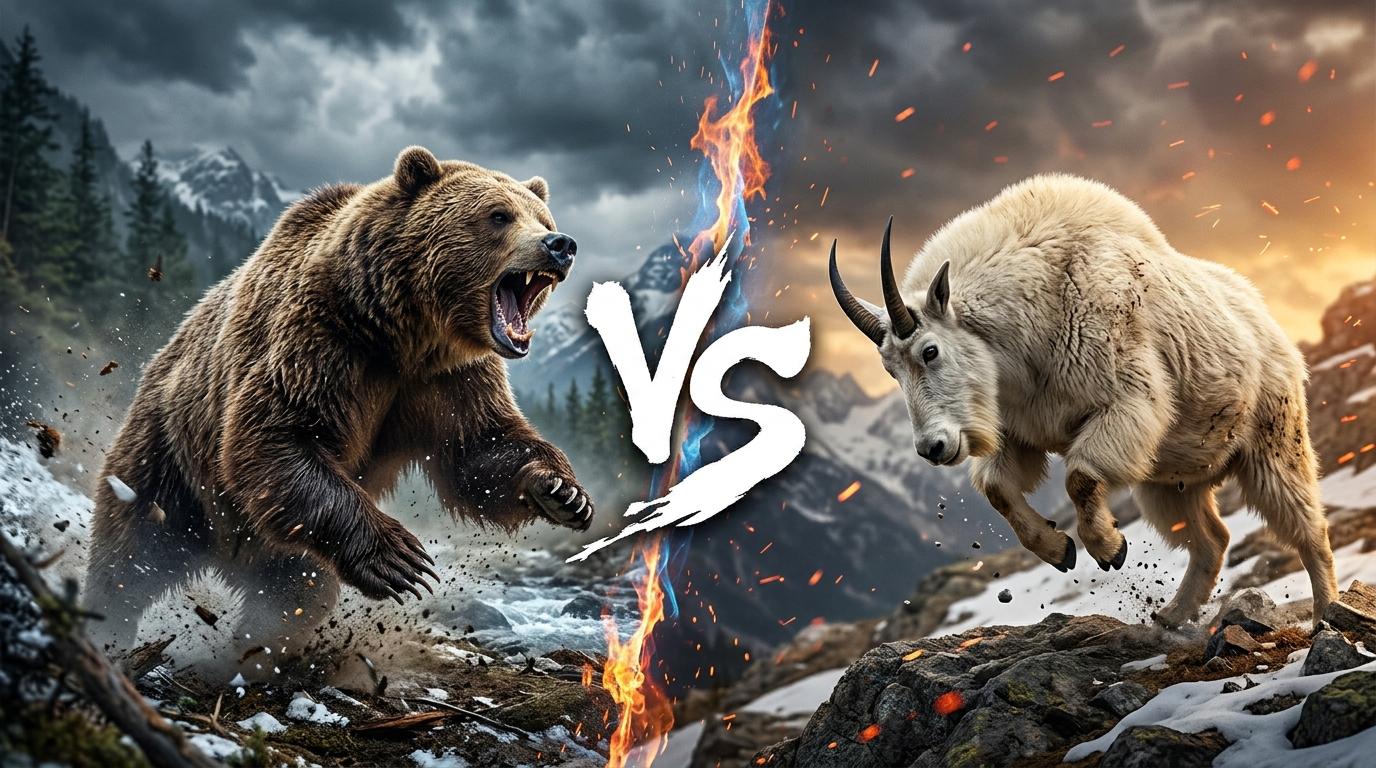
Grizzly Bear vs Mountain Goat: Who Actually Wins?
The grizzly bear wins clearly. An adult grizzly typically weighs 180–360 kg, against roughly 45–140 kg for a mountain goat. It also has the strongest forelimbs in North America, long digging claws, and a bite built for crushing bone. On level or moderately sloped ground, the goat's short, dagger-like horns can wound, but they cannot stop a bear that outweighs it three to five times. The goat's real defense is not fighting at all. It escapes onto cliffs and ledges where the bear cannot follow. Grizzlies do kill mountain goats, especially kids, injured animals, and goats caught on accessible slopes. But they win by reaching the goat, not by out-climbing it.
Read comparison
Discussion
What do you think?
Share your reasoning with other readers. Be civil and stick to the animals.
Sign in to join the discussion.
Sign inNo comments yet. Start the conversation.