


Cane Toad vs Red-eyed Tree Frog: Who Actually Wins?
Cane toad vs red-eyed tree frog: a biology-first look at size, toxins, speed and escape tactics, and why the cane toad wins most real confrontations.
Cane Toad vs Red-eyed Tree Frog
Matchup winner
Cane Toad
Quick verdict
Start with the direct answer, then use the structured comparison below to see what changes the outcome.
The cane toad wins, and it isn't close in a direct confrontation. An adult Rhinella marina typically weighs 200–1,000+ grams and can exceed 15 cm, while a red-eyed tree frog weighs roughly 6–15 grams and measures about 5–7 cm. Cane toads are indiscriminate gape-limited predators that will swallow smaller frogs whole, and their parotoid glands carry bufadienolide toxins strong enough to kill dogs, snakes and native predators. The red-eyed tree frog's real weapons are evasion: startle coloration, sticky toe pads, a vertical canopy refuge and quick leaps. That makes it the better survivor in its own trees, but it has nothing that can hurt or deter a toad. When the two meet on the ground, the toad's mass and appetite decide it.
Read the full explanation
Cane toad wins: it is roughly 20–60 times heavier and can eat a tree frog whole.
The toad's toxins defend it from predators. The tree frog has no offense that can threaten it.
The red-eyed tree frog's best move is to flee upward. In the canopy, it simply avoids the fight.
This is a predator-prey mismatch, not an even duel.
Reader vote
Who do you think wins?
Pick a side — no account needed. Results update live.
No votes yet — be the first to call it.
Editorial note
Why people disagree
Both are 'just frogs,' so people assume similar size. In reality, an adult cane toad dwarfs the tree frog.
Body mass and frame
In amphibians, gape size decides who eats whom, and the toad's mouth easily fits the tree frog.
Chemical arsenal
The toad's poison protects it from bigger animals. The tree frog's chemistry won't stop a toad that's eating it.
Escape agility
The tree frog's whole survival plan is getting out of reach quickly.
Read the full explanation +
The tree frog's vivid colors look like a toxic warning, but its skin peptides are mild compared with the toad's potent bufadienolides.
Tree frog fans point out that it would never stay on the ground. That's true, but escaping is not the same as winning.
Comparison FAQ
Short, direct answers to the next questions readers usually ask after the headline verdict.
Would a cane toad beat a red-eyed tree frog?+
Yes. A cane toad can overpower and swallow a red-eyed tree frog whole. The size gap makes this predator versus prey rather than a fair fight.
Which is stronger, a cane toad or a red-eyed tree frog?+
The cane toad by far. It can be dozens of times heavier, with a robust body and powerful jaws for gulping prey.
Is the red-eyed tree frog poisonous?+
Only mildly. Its bright colors mostly serve as a startle display. Its skin peptides are far weaker than the cane toad's bufadienolide toxins.
Why is the red-eyed tree frog still dangerous to predators?+
Its sudden flash of red eyes and vivid flanks can startle a predator into hesitating, giving it time to leap away. It is dangerous to catch rather than dangerous to fight.
Is the cane toad dangerous to other animals?+
Very. Its toxin can kill pets and native predators that bite it, which is one reason it is a damaging invasive species in Australia and elsewhere.
Head-to-head species stats
These are the same core AnimalDex stat dimensions used on the dedicated animal pages, pulled side by side so the matchup is faster to scan.
Cane Toad
Tier DRed-eyed Tree Frog
Tier BTrait-by-trait comparison
Only the categories that matter to this matchup are included. The goal is not filler stats, but the real design differences that change the result.
200–1,000+ g, heavy and broad
Body mass and frame
Cane Toad
6–15 g, slender and light
Body mass and frame
Cane Toad
Parotoid glands with bufadienolides, lethal to many predators
Chemical arsenal
Cane Toad
Mild skin peptides, mainly irritating
Chemical arsenal
Cane Toad
Short hops, walks more than it leaps
Escape agility
Red-eyed Tree Frog
Fast jumper with adhesive toe pads for climbing
Escape agility
Red-eyed Tree Frog
Puffs up and oozes toxin
Startle defense
Red-eyed Tree Frog
Flash of red eyes and blue-orange flanks
Startle defense
Red-eyed Tree Frog
Eats almost anything that fits, including frogs
Predatory appetite
Cane Toad
Insect specialist
Predatory appetite
Cane Toad
Ground-bound
Vertical habitat control
Red-eyed Tree Frog
Canopy and leaf-perch specialist
Vertical habitat control
Red-eyed Tree Frog
How the verdict forms
Verdict timeline
01 · Body mass and frame
Cane Toad
02 · Chemical arsenal
Cane Toad
03 · Escape agility
Red-eyed Tree Frog
04 · Startle defense
Red-eyed Tree Frog
05 · Predatory appetite
Cane Toad
06 · Vertical habitat control
Red-eyed Tree Frog
Change the conditions
Scenario breakdown
This is where shallow battle content usually fails. Terrain, spacing, timing, and engagement style can change the answer.
Scenario lean
Cane Toad
Verdict confidence
82%
The toad strikes and swallows.
On leaf litter or a lawn, the tree frog loses its adhesive advantage and its camouflage against green leaves. Cane toads are sit-and-wait feeders that lunge at anything moving within range. A single gulp ends it, because gape-limited predation favors the bigger mouth every time.
AnimalDex field profiles
Explore these animals
Cane Toad
Rhinella marina
grassland, farmland, woodland edge, and disturbed tropical habitat
Red-eyed Tree Frog
Agalychnis callidryas
Lowland rainforest, wet secondary growth, and forest-edge ponds with overhanging vegetation.
Systems Intelligence & Hidden Purpose
See the animals behind this comparison as engineered biological systems: what each one is built to do, where it gains leverage, and why the matchup changes by scenario.
Specialized Hardware
large warty body, poison glands behind the head, and tough adaptable ground movement give the Cane Toad a body plan tuned for its niche.
Systems Script
Cane Toads operate through grassland, farmland, woodland edge, and disturbed tropical habitat Their design links movement, shelter, and feeding into one workable survival system.
Strategic Insight
A durable system can spread quickly when many environments stop resisting it.
Specialized Hardware
Adhesive toe pads, bright concealed eye color, and leaf-resting camouflage make this frog arboreal hardware built for hiding until surprise becomes useful.
Systems Script
Red-eyed tree frogs operate in canopy-edge moisture systems where stillness is the main budget saver and sudden contrast buys escape time. They use visibility strategically, not constantly.
Strategic Insight
Not every capability belongs in your default state. Some advantages work best when revealed late.
Final take
The cane toad is the overall winner. In any meeting where contact happens, it holds every decisive advantage: mass, gape and a willingness to treat smaller frogs as prey. Its toxins also mean that whatever might threaten the pair usually leaves the toad alone.
Read the full explanation
The red-eyed tree frog stays impressive on its own terms. Its survival model is avoidance, not combat, built on startle colors, sticky feet and canopy living. Ask which animal survives in a rainforest tree, and the frog wins. Ask who wins a fight, and the answer is the toad.
Collect both animals in AnimalDex
Track the species behind this matchup, compare their real traits, and build the rivalry into your AnimalDex collection.
Related comparisons
Continue with nearby matchups to compare more real-world animal traits without dropping into junky who-wins filler.
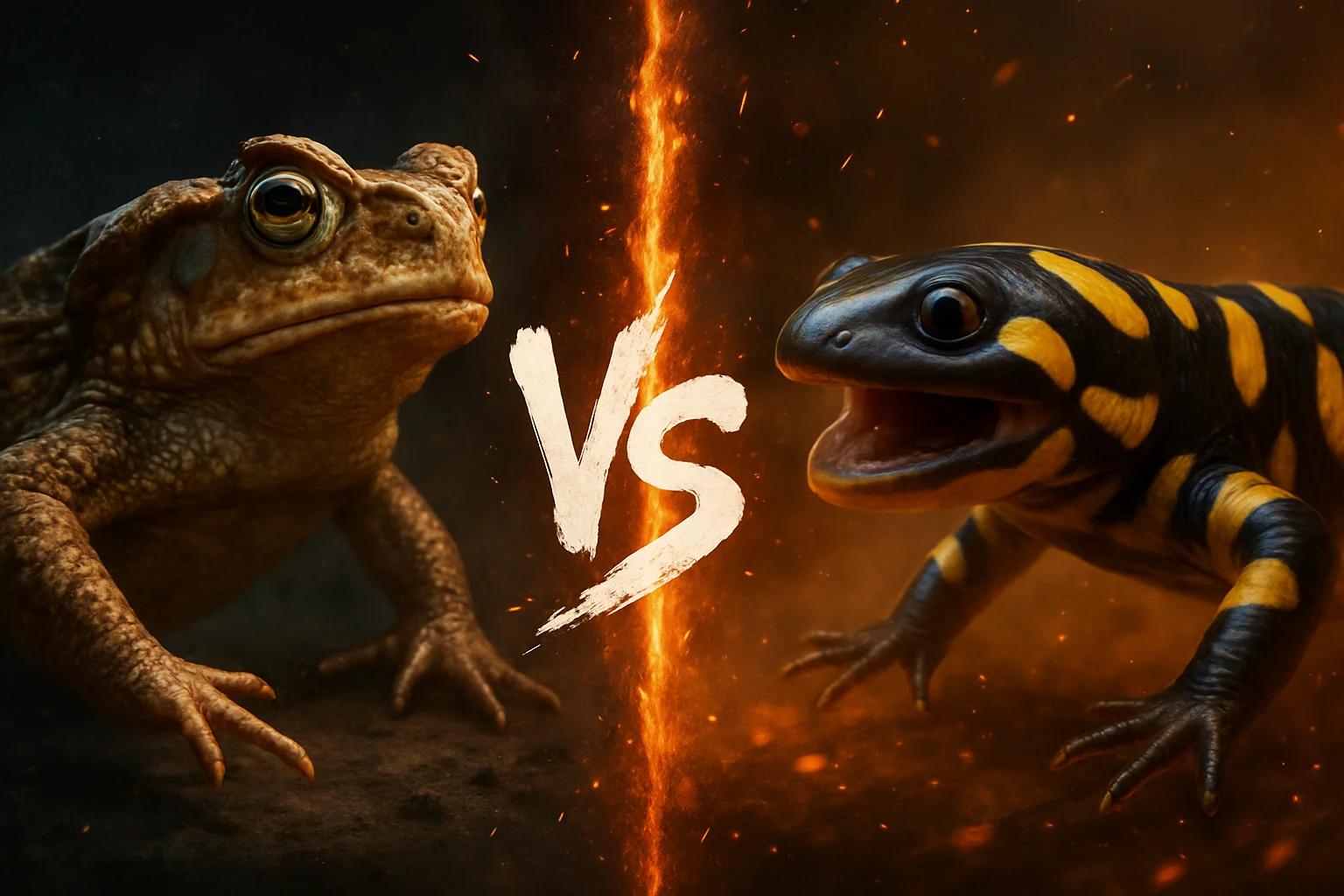
Cane Toad vs Tiger Salamander: Who Actually Wins?
The cane toad wins. In a straight confrontation, the tiger salamander is the more active predator: it has a wide mouth, a strong lunge, and a habit of swallowing whatever fits. The cane toad's advantage is that it doesn't need to win the fight at all. Its parotoid glands are loaded with bufadienolide toxins, which act on the heart. Any predator that bites or tries to swallow an adult toad takes in that poison, and many vertebrates that try die from it. A big adult cane toad is also bulkier and harder to swallow than anything a tiger salamander normally eats. The salamander is quicker to strike and better at ambushing small prey. The toad holds the outcome, though, because a bite costs the salamander more than it costs the toad.
Read comparison
Poison Dart Frog vs Red-eyed Tree Frog: Who Actually Wins?
The poison dart frog wins this matchup. The red-eyed tree frog is longer and leggier, but neither frog is built to fight, so the deciding factor is chemistry. Many dart frogs carry potent alkaloid skin toxins, and the most toxic, like Phyllobates terribilis, rank among the most poisonous animals known. The red-eyed tree frog's defense is mostly a startle trick: it flashes its red eyes and bright flanks to buy a split second for escape. Its skin peptides are mild by comparison. In any contact-based contest, the frog whose skin punishes touch holds the decisive edge. Dart frogs are also boldly active by day, defend territories, and will wrestle rivals of their own species, while the red-eyed tree frog is a nocturnal escape artist that avoids confrontation.
Read comparison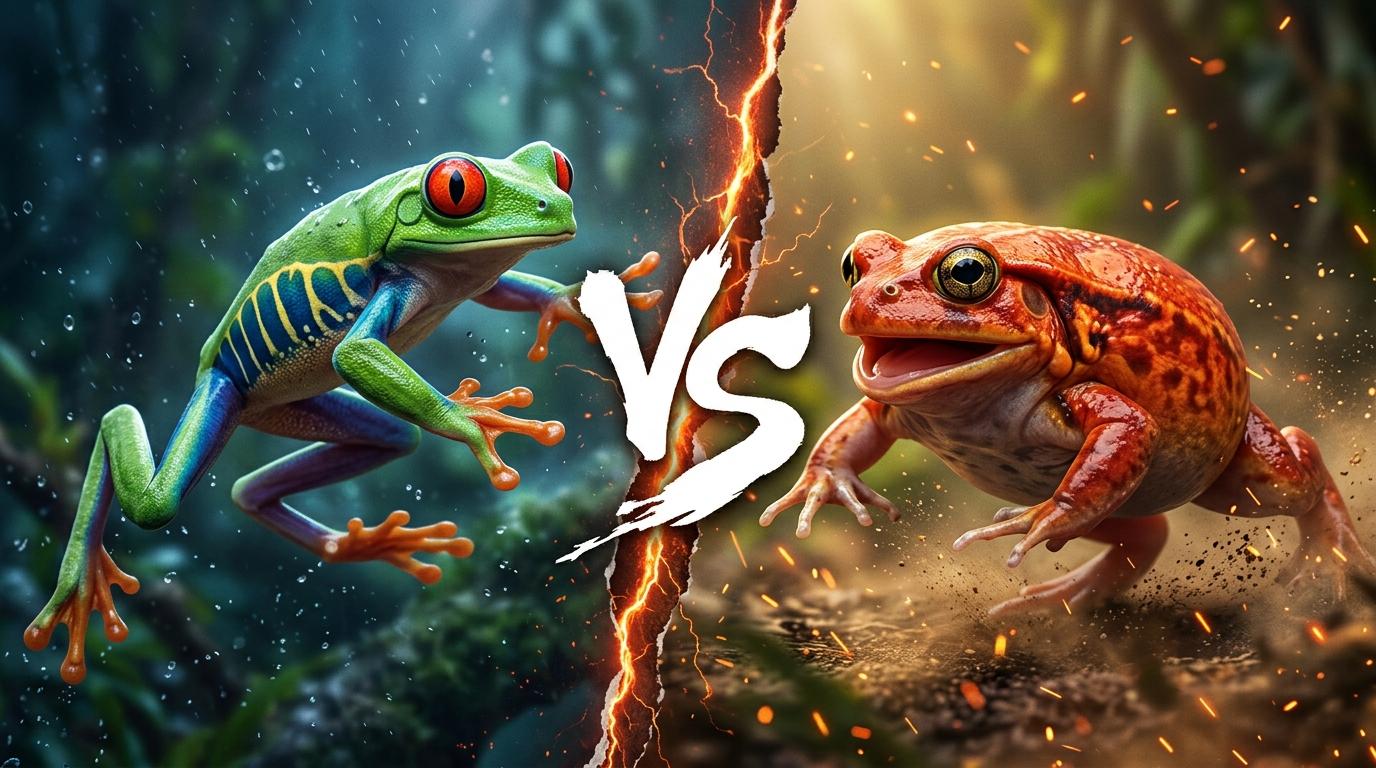
Red-eyed Tree Frog vs Tomato Frog: Who Actually Wins?
The Tomato Frog wins this matchup. At roughly 9–10 cm and often several times the body mass of a 5–7 cm Red-eyed Tree Frog, the Madagascan Tomato Frog brings a heavy, wide-mouthed frame. Its ground-level confidence and a sticky, gluey skin secretion can gum up an attacker's mouth and eyes. Frogs don't really 'fight' in the predator sense. What decides a contact standoff between them is who can displace, outlast, or deter the other, and mass plus chemical deterrence beats agility here. The Red-eyed Tree Frog's real gifts are startle coloration, sticky toe pads and explosive leaping. Those are superb tools for escaping, but they do little to win a contested patch of ground. If the tree frog gets a branch and a head start, it simply leaves. If it has to stand its ground, the Tomato Frog holds the space.
Read comparison
Discussion
What do you think?
Share your reasoning with other readers. Be civil and stick to the animals.
Sign in to join the discussion.
Sign inNo comments yet. Start the conversation.